
水泥

Search documents
水泥板块9月17日跌0.28%,海南瑞泽领跌,主力资金净流出1.74亿元
Zheng Xing Xing Ye Ri Bao· 2025-09-17 08:52
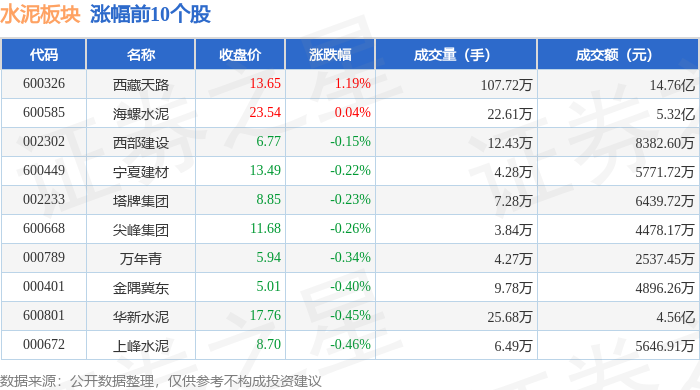
Market Overview - The cement sector experienced a decline of 0.28% on September 17, with Hainan Ruize leading the drop [1] - The Shanghai Composite Index closed at 3876.34, up 0.37%, while the Shenzhen Component Index closed at 13215.46, up 1.16% [1] Individual Stock Performance - Xizang Tianlu (600326) closed at 13.65, with an increase of 1.19% and a trading volume of 1.0772 million shares, amounting to 1.476 billion yuan [1] - Anhui Conch Cement (600585) closed at 23.54, with a slight increase of 0.04% and a trading volume of 226,100 shares, totaling 532 million yuan [1] - Other notable declines include West Construction (002302) down 0.15% to 6.77, and Ningxia Building Materials (600449) down 0.22% to 13.49 [1] Capital Flow Analysis - The cement sector saw a net outflow of 174 million yuan from institutional investors, while retail investors contributed a net inflow of 124 million yuan [2] - Speculative funds recorded a net inflow of 50.24 million yuan [2] Detailed Capital Flow for Selected Stocks - Xizang Tianlu (600326) had a net inflow of 76.34 million yuan from institutional investors, while retail investors saw a net outflow of 11.8 million yuan [3] - Tower Group (002233) experienced a net inflow of 6.90 million yuan from institutional investors but a net outflow of 476.25 million yuan from retail investors [3] - Sichuan Jinding (600678) had a net outflow of 285.87 million yuan from institutional investors, indicating a negative sentiment [3]


苏州国资入主港股上市企业首秀,与东吴水泥会擦出怎样的“火花”?
Zhi Tong Cai Jing· 2025-09-17 06:27
Core Viewpoint - The article highlights the significant breakthrough in domestic GPU development in China, led by Jiang Xueming and his investment in Lishan Technology, which has resulted in the first fully self-developed GPU surpassing NVIDIA's RTX series in certain benchmarks and gaming performance [1] Company Developments - Jiang Xueming's company, Dongxin Co., has transitioned from textiles and cement to storage chips and now to GPUs, embodying a philosophy of engaging in industries essential for national development [1] - Dongwu Cement has introduced Suzhou state-owned capital as its largest shareholder, marking a significant integration of local state-owned enterprises with overseas capital markets [1][2] - Following the acquisition, Hong Kong Port and Shipping Group became the largest shareholder with a 28% stake, while Jiang Xueming retains 16.89% [2] Strategic Transformation - The entry of Suzhou state-owned capital into Dongwu Cement is expected to lead to a strategic transformation or the injection of new resources, potentially moving away from traditional cement operations [2][3] - Dongwu Cement has already begun divesting from its biopharmaceutical and rare earth businesses, indicating preparations for a strategic shift [2] Industry Trends - Local state-owned enterprises typically aim for industrial optimization and upgrading, focusing on strategic emerging industries such as new energy, new materials, and high-end manufacturing [3] - There is speculation that Dongwu Cement may pivot towards emerging sectors like smart warehousing, modern logistics, and low-altitude economy, with a strong emphasis on low-altitude economy due to Jiangsu's proactive stance in this area [3][4] Market Expectations - The market has reacted positively to the involvement of Suzhou state-owned capital, with Dongwu Cement's stock price increasing by over 160% since August, reflecting optimism about its future development potential [5] - The innovative model of "local state-owned capital + overseas listed platform + industrial resources" is anticipated to set a new precedent for resource optimization and integration through mixed ownership reform [5]
东吴水泥再跌超15% 控股股东大幅减持股份 公司出售稀土业务精简运营
Zhi Tong Cai Jing· 2025-09-17 05:40
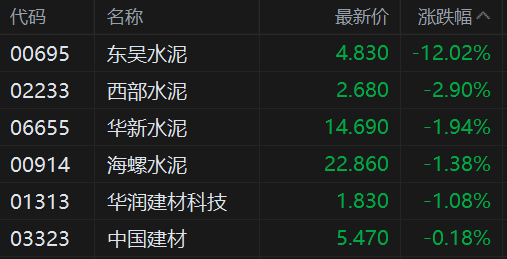
Group 1 - Dongwu Cement (00695) has seen a decline of over 15%, reaching a low of 4.63 HKD, which is nearly a 30% drop from the high of 6.52 HKD on Monday [1] - As of the latest update, the stock is down 12.57%, trading at 4.8 HKD with a transaction volume of 13.48 million HKD [1] Group 2 - The controlling shareholder Goldview is selling approximately 155 million shares to Suzhou State-owned Assets Supervision and Administration Commission's wholly-owned subsidiary, Hong Kong Port and Shipping, for about 286 million RMB [1] - Goldview is also selling 49.68 million shares to Fen Yuan Capital for 91.8 million RMB [1] - After these transactions, Hong Kong Port and Shipping will become the largest single shareholder of the company with a 28% stake, while Fen Yuan Capital will hold 9% [1] - Goldview's stake in the company will decrease from 53.89% to 16.89%, resulting in it no longer being the controlling shareholder [1] Group 3 - Dongwu Cement plans to sell all shares of Dongfang Chengzheng Rare Earth for 10 million HKD [1] - The company believes that selling the rare earth business will allow it to concentrate financial resources on its cement operations, improving cash flow and financial flexibility [1] - This strategic move aims to streamline operations and enhance overall financial performance [1]
港股异动 | 东吴水泥(00695)再跌超15% 控股股东大幅减持股份 公司出售稀土业务精简运营
智通财经网· 2025-09-17 05:39
Group 1 - Dongwu Cement (00695) has seen a decline of over 15%, reaching a low of 4.63 HKD, which is nearly a 30% drop from its high of 6.52 HKD on Monday [1] - As of the latest update, the stock is down 12.57%, trading at 4.8 HKD with a transaction volume of 13.48 million HKD [1] Group 2 - The controlling shareholder Goldview is selling approximately 155 million shares to Suzhou State-owned Assets Supervision and Administration Commission's wholly-owned Hong Kong subsidiary, Hong Kong Port, for about 286 million RMB, and 49.68 million shares to Fen Yuan Capital for 91.8 million RMB [1] - After these transactions, Hong Kong Port will become the largest single shareholder of the company, holding 28% of the shares, while Fen Yuan Capital will hold 9% [1] - Goldview's stake in the company will decrease from 53.89% to 16.89%, resulting in it no longer being the controlling shareholder [1] Group 3 - Dongwu Cement plans to sell all shares of Dongfang Chengzheng Rare Earth for 10 million HKD [1] - The company believes that selling the rare earth business will allow it to concentrate financial resources on its cement operations, improving cash flow liquidity and financial flexibility, thereby streamlining operations and enhancing overall financial performance [1]
港股午评:恒科指大涨3.49%再刷阶段新高,科技股强势,百度大涨15.9%
Ge Long Hui· 2025-09-17 04:12
Market Performance - The Hong Kong stock market showed a strong upward trend in the morning session, with major indices reaching new highs. The Hang Seng Tech Index surged by 3.49%, surpassing 6200 points, while the Hang Seng Index and the National Enterprises Index rose by 1.41% and 1.78%, respectively, with the Hang Seng Index approaching the 27000 points mark [1] Key Stocks - Major technology stocks led the market rally, with Baidu experiencing a significant increase of 15.9%. Other notable performers included JD.com, Meituan, and Alibaba, each rising over 5%, while Tencent and Xiaomi also showed strength [1] - Semiconductor stocks gained traction as SMIC reportedly tested China's first domestic DUV lithography machine, with SMIC's stock climbing 5.7% to reach a new historical high [1] Sector Performance - The aviation sector continued to rise, supported by a more than 25% increase in daily flight ticket bookings during the National Day and Mid-Autumn Festival period, which is expected to enhance airline profitability [1] - Other sectors that saw gains included Apple concept stocks, automotive stocks, robotics stocks, coal stocks, Chinese brokerage stocks, gaming stocks, and restaurant stocks [1] Declining Sectors - In contrast, spot gold prices fell below $3680, leading to declines in gold stocks and non-ferrous metal stocks. East Wu Cement experienced a nearly 11% drop following a 6.2% year-on-year decrease in national cement production in August [1] - The biopharmaceutical sector saw a majority of stocks retreat, while property management, steel, and sports goods sectors exhibited weak performance [1]






港股异动丨水泥股走低 东吴水泥大跌超12% 8月份全国水泥产量同比降6.2%
Ge Long Hui· 2025-09-17 03:06
Group 1 - The cement stocks in Hong Kong experienced a collective decline, with Dongwu Cement falling over 12%, the weakest performer [1] - According to the National Bureau of Statistics, the national cement production in August was 14.802 million tons, a year-on-year decrease of 6.2% [1] - From January to August, the national cement production totaled 110.457 million tons, reflecting a year-on-year decline of 4.8% [1] Group 2 - Data indicates that the total cement production for the first eight months of 2024 was 115.907 million tons, resulting in a reduction of 5.450 million tons compared to the same period last year, a decrease of 4.7% [1] - CICC's report states that the average cement shipment rate in August 2025 is projected to be 45.2%, down from 48.8% in the same month last year [1] - The single-month cement production in August saw a year-on-year decline of 6.2%, amounting to 14.8 million tons, indicating continued weak demand during the off-season [1]
季节性淡季需求走弱,新领域高景气持续 | 投研报告
Zhong Guo Neng Yuan Wang· 2025-09-17 03:05
Group 1: Cement Industry - In August, the cement market remained in a seasonal downturn, with high temperatures and rainy weather affecting downstream construction, leading to weak demand and a decrease in operating load of cement mills [1][2] - The average price of cement in August was 271.67 yuan/ton, showing a month-on-month decline [1][2] - A seasonal demand recovery is expected from September to November, combined with the "anti-involution" trend accelerating industry capacity reduction, which may help ease supply-demand imbalances and support price increases [1][2] Group 2: Construction Materials - Retail sales of construction and decoration materials saw a slight decline, with a year-on-year growth of 2.2% from January to July 2025, while July's retail sales decreased by 0.5% year-on-year and 14.45% month-on-month [2] - The ongoing urban renewal initiatives are expected to boost demand for renovation and repair materials, such as pipes, waterproofing, and coatings [2] Group 3: Fiberglass - In August, the pricing of fiberglass roving from small and medium enterprises showed slight weakening, while demand for high-end electronic yarn products remained strong [3] - The supply of traditional electronic yarn products faced pressure, leading to a slight price reduction, but high-end products are expected to see price increases due to demand recovery [3] Group 4: Float Glass - The float glass market continued to experience weak demand, with prices returning to levels seen before previous increases by the end of August [3] - Despite the potential for slight price recovery due to seasonal demand, supply-side pressures remain, limiting significant price increases [3] Group 5: Investment Recommendations - Companies with strong brand advantages and product quality in the construction materials sector, such as Beixin Building Materials, Weixing New Materials, and Dongfang Yuhong, are expected to benefit from urban development focusing on quality improvement [4] - In the cement sector, regional leaders like Shangfeng Cement are recommended, with attention to Huaxin Cement and Conch Cement due to expected profit recovery [5] - For fiberglass, companies like China Jushi are recommended, with a focus on Zhongcai Technology for potential performance recovery [5] - In the glass sector, attention is drawn to Qibin Group as the industry supply-demand dynamics improve [5]
券商晨会精华 | 建材行业将进一步深化产业改革 在四个方向进一步突破
智通财经网· 2025-09-17 00:54
Group 1: Market Overview - The market experienced fluctuations, with the ChiNext index initially dropping over 1% but recovering in the afternoon, leading to a positive close. The Shanghai Composite Index rose by 0.04%, the Shenzhen Component increased by 0.45%, and the ChiNext index gained 0.68% [1] - The total trading volume in the Shanghai and Shenzhen markets reached 2.34 trillion yuan, an increase of 64 billion yuan compared to the previous trading day [1] - Strong performances were noted in sectors such as robotics, internet e-commerce, and logistics, while sectors like pork, non-ferrous metals, and film and television saw declines [1] Group 2: Industry Insights - CITIC Securities indicated that the price of waterproof products in China is stabilizing under the "anti-involution" trend, with a positive outlook for the waterproof sector due to its correlation with construction activity and increased industry concentration [1] - China International Capital Corporation (CICC) projected that the ethylene industry may reach a turning point after 2027, driven by the exit of overseas capacities and potential domestic policy controls on new ethylene production [2] - Galaxy Securities highlighted that the building materials industry will deepen its reforms, focusing on structural optimization, green transformation, digital upgrades, and international expansion, with cement industry capacity reduction expected to accelerate [3] - The demand for high-end fiberglass products is anticipated to grow due to the rapid development of emerging industries, benefiting companies with R&D capabilities and production scale [3] - Leading consumer building materials companies are leveraging both domestic and international markets to enhance profitability and expand overseas production capacity, which is expected to contribute significantly to future performance growth [3]
联合深度专题:反内卷,细分行业如何选?
2025-09-17 00:50
Summary of Conference Call Records Industry Overview - **Steel Industry**: Profitability improvement relies on supply-demand optimization and capacity exit. Anti-dumping measures aim to suppress raw material positions and promote profit return to the industry chain, aligning with national strategic direction. Expected implementation of graded management starting in 2026, with non-compliant companies facing significant production cuts, thus driving market clearance [1][6][4]. - **Cement Industry**: Facing supply-side overproduction governance. Strict implementation and cooperation among companies could lead to price elasticity. Current actual capacity utilization is around 50%, with regional variations [13][14]. - **Photovoltaic Glass**: Low profitability but high capacity utilization, with long-term demand growth expected. Strong necessity for anti-involution measures due to low profitability [16][12]. - **Express Delivery Industry**: Rapid effects from anti-involution, with significant price increases and high profit elasticity. Each listed express company could add 500 to 1,000 million profits per quarter [20][23]. - **Aviation Industry**: Affected by weak business demand, but typically performs well in Q4. Structural oversupply is a challenge, with North American routes not recovering, leading to increased domestic capacity [22][29]. - **Chemical Industry**: Influenced by inventory cycles and new capacity launches, with most sub-industries in a wait-and-see state. Focus on opportunities for clearing outdated capacities in specific sectors [31][32]. Key Points and Arguments - **Steel Industry Profitability**: Post anti-involution policy, profitability surged from 40-50 RMB per ton to over 200 RMB, but has since declined due to rising raw material prices [2]. The industry needs supply-demand balance and capacity exit for sustained profitability [9]. - **Profit Distribution in Steel**: Iron ore accounts for 70-75% of the profit distribution, while steel and coking coal each account for 15%. The reliance on imported iron ore necessitates adjustments through anti-involution policies for reasonable profit distribution [5]. - **Future Management of Steel Capacity**: Starting in 2025, a limit of 50 million tons will be implemented, with graded management expected in 2026 to drive the exit of outdated capacities [6]. - **Cement Price Elasticity**: Price elasticity in the cement industry will depend on strict implementation of overproduction governance and cooperation among companies [17]. - **Photovoltaic Glass Supply Changes**: The industry has seen price increases due to production limits, with a current capacity utilization of about 70%. Long-term supply changes will depend on policy advancements [19]. - **Express Delivery Price Trends**: The express delivery industry has seen significant price increases, with regulatory measures supporting price hikes through warehouse locking and feedback mechanisms [26]. - **Aviation Industry Challenges**: The aviation sector is facing structural oversupply and weak business demand, with a projected low growth rate in supply over the next few years [28][30]. Additional Important Insights - **Investment Recommendations**: - For the steel sector, focus on leading companies like Hualing Steel and Baosteel, which could see profit elasticity of 40-80% if profitability rebounds [10]. - In the cement sector, Huaxin Cement is recommended due to its domestic and overseas business potential [18]. - In the express delivery sector, stocks of tail-end companies like Shentong, YTO, and Yunda are recommended for investment [27]. - **Chemical Industry Opportunities**: Potential for collaborative production cuts in sectors like organic silicon and polyester filament, which are currently underperforming [34]. - **Coal Industry Outlook**: The coal sector is expected to benefit from macroeconomic factors and supply restrictions, with specific recommendations for Yanzhou Coal and Electric Power [45]. This summary encapsulates the key insights and recommendations from the conference call, providing a comprehensive overview of the discussed industries and their future outlooks.
银河证券:“十五五”期间建材行业将在四个方向进一步突破
Zheng Quan Shi Bao Wang· 2025-09-17 00:21
Core Viewpoint - The construction materials industry in China is expected to undergo significant reforms and transformations, focusing on high-quality development, structural optimization, green transition, digital upgrades, and international expansion [1] Group 1: Industry Trends - The cement industry is likely to accelerate capacity reduction under the "anti-involution" backdrop, with the inclusion of cement in the carbon trading market leading to an improved supply-demand structure [1] - Market concentration is expected to increase towards leading enterprises, enhancing their competitive strength [1] Group 2: Emerging Opportunities - The rapid development of emerging industries such as electronic information and new energy will drive the demand for high-end fiberglass products, benefiting companies with technological R&D capabilities and large-scale production advantages [1] Group 3: Strategic Moves by Leading Companies - Leading consumer building material companies are leveraging a dual market strategy of "domestic + overseas" to navigate challenges, promoting "anti-involution" in the domestic market to restore healthy business practices and improve profitability [1] - These companies are also accelerating their overseas capacity layout, with international business expected to become a significant source of future revenue growth [1]