
造纸

Search documents
山鹰国际上半年毛利率回升 布局具身智能打造第二增长曲线
Zheng Quan Shi Bao Wang· 2025-08-25 12:31
Core Viewpoint - The paper industry is facing continuous pressure on performance due to supply-demand imbalances and policy adjustments, as evidenced by the financial results of leading domestic paper company Shanying International in the first half of 2025 [1][2]. Financial Performance - Shanying International reported a revenue of 13.842 billion yuan, a year-on-year decline of 2.89%, and a net profit of 41.8154 million yuan, down 63.17% year-on-year [1]. - The company's net profit after deducting non-recurring items was -65.7799 million yuan, indicating a significant narrowing of losses compared to the previous year [1]. - The raw paperboard segment saw production increase to 3.5664 million tons, up 4.3% year-on-year, while sales reached 3.4742 million tons, a slight increase of 0.29% [1]. Segment Performance - The raw paperboard segment's sales revenue was 9.215 billion yuan, down 3.56% year-on-year due to product price reductions [1]. - The packaging segment achieved a production volume of 977 million square meters, a decrease of 0.95%, but sales increased to 1.03 billion square meters, up 2.29% year-on-year, with a revenue of 3.358 billion yuan, an increase of 2% [1]. - New valuable clients in the packaging business included Nestlé, Unilever, and Pinduoduo [1]. Cost Management and Profitability - Despite weak market demand, Shanying International improved its gross profit margin to 9.51%, an increase of 0.72 percentage points year-on-year, with the core paperboard segment's gross margin rising to 8.05%, up 1.31 percentage points [2]. - The company implemented measures such as lean production and cost reduction to enhance profitability [2]. Industry Trends and Strategic Initiatives - The Guangdong Paper Association initiated an "anti-involution" campaign to resist low-price competition and optimize capacity structure [2]. - Shanying International adopted a strategy of "strategic contraction, value focus, and industry collaboration" to address overcapacity and price wars [2]. - The company has announced price increases and is focusing on high-end corrugated paper markets while enhancing collaboration with leading e-commerce platforms [2]. Future Outlook - With the implementation of "anti-involution" policies, the industry supply-demand balance is expected to improve, leading to stabilized prices and enhanced profitability for companies [3]. - Forecasts suggest that the cost of raw materials may decrease due to an expected 15% year-on-year increase in wood pulp imports, which will support profit levels [3]. - Shanying International is also diversifying its growth by establishing the "Zhiyuan Fund" to invest in industrial technology-related enterprises and is focusing on smart logistics solutions [3].

青山纸业:2025年半年度净利润约5608万元,同比增加1.74%
Mei Ri Jing Ji Xin Wen· 2025-08-25 10:01
Group 1 - The core viewpoint of the article highlights the financial performance of Qingshan Paper Industry for the first half of 2025, indicating a decline in revenue but a slight increase in net profit [1] - Qingshan Paper's operating revenue for the first half of 2025 is approximately 1.21 billion yuan, representing a year-on-year decrease of 15.27% [1] - The net profit attributable to shareholders of the listed company is around 56.08 million yuan, showing a year-on-year increase of 1.74% [1] - The basic earnings per share is 0.0252 yuan, which is an increase of 2.44% compared to the previous year [1] Group 2 - As of the report, Qingshan Paper's market capitalization stands at 5.3 billion yuan [2]

山鹰国际(600567.SH):上半年净利润4181.54万元 同比下降63.17%
Ge Long Hui A P P· 2025-08-25 09:43
Core Viewpoint - The company reported a significant decline in net profit despite an increase in production and sales volume, indicating challenges in pricing and revenue generation [1] Financial Performance - The company achieved operating revenue of 13.842 billion yuan, with a net profit attributable to shareholders of 41.8154 million yuan, a year-on-year decrease of 63.17% [1] - The production volume of the paperboard segment was 3.5664 million tons, an increase of 4.30% year-on-year, while sales volume reached 3.4742 million tons, up 0.29% year-on-year [1] - The sales revenue from the paperboard segment was 9.215 billion yuan, reflecting a decrease of 3.56% compared to the same period last year due to price reductions [1] Operational Efficiency - The company improved production costs through lean production and efficiency enhancement measures, leading to a recovery in the gross profit margin of the paper manufacturing segment [1] - The completion of the Suzhou facility marks the establishment of seven major paper manufacturing bases, positioning the company for future growth [1] Strategic Focus - The company plans to concentrate on technological innovation, process optimization, and smart manufacturing to create differentiated high-quality products [1] - There will be an increased emphasis on lean initiatives to further reduce costs and enhance profitability, thereby strengthening the company's competitive advantage [1]
胶版印刷纸期货上市系列报告(二):胶版印刷纸产业近况调研
Dong Zheng Qi Huo· 2025-08-25 09:17
1. Report Industry Investment Rating No information provided in the content. 2. Core View of the Report - The current supply - demand contradiction in the offset printing paper (double - offset paper) industry is prominent, and the industry's pessimistic sentiment is strong. The price of double - offset paper may have further room to decline [5][61]. 3. Summary by Relevant Catalogs 3.1. Research Purpose - On August 15, 2025, the China Securities Regulatory Commission approved the registration of offset printing paper futures and options on the Shanghai Futures Exchange, which will be launched on September 10, 2025. In the current market environment, the research aims to understand how different links in the industrial chain view the listing of double - offset paper futures, their participation willingness, and their expectations for the future market of double - offset paper, helping investors gain insights and investment ideas [13]. 3.2. Research Core Conclusions - **Cost difference**: The production cost of double - offset paper varies greatly among different manufacturers and product qualities. The main raw material is wood pulp, accounting for about 70%. Due to profit pressure, enterprises increase the proportion of chemimechanical pulp. The production cash cost of current natural white double - offset paper is about 3800 - 4200 yuan/ton, and most enterprises can maintain a certain gross profit [14]. - **Demand shift**: The demand for paper in publishing orders has shifted backward this year. Factors such as improved printing efficiency, high inventory levels, and pessimistic market expectations have led to a delay in the start of autumn publishing tenders to mid - late April, and concentrated printing of autumn textbooks from July to August [16]. - **Supply - demand and profit**: The industry generally recognizes the over - supply and profit pressure. In the long - term, factors like a decrease in school - age population, the "One Textbook, One Supplementary Material" policy, and the popularity of electronic reading will reduce demand, while new production capacity is being added. In the short - term, prices may rebound slightly during the spring publishing tender season from October to November [18]. - **Divergent attitudes**: Different industrial players have different attitudes towards the listing of offset printing paper futures. Some large - scale paper mills will actively respond, while small and medium - sized paper mills are more cautious. Downstream enterprises are relatively conservative, and the willingness of long - position holders to take delivery is expected to be weak [22][24]. 3.3. Detailed Research Situation - **Double - offset paper production enterprise A**: Located in Henan, with a total pulp and paper production capacity of 110 - 120 tons/year. The production line was fully loaded in the first half of the year. The pulp ratio is 1/3 each for broad - leaf, coniferous, and chemimechanical pulp, with a self - supply rate of about 40% - 50%. Downstream orders are mainly for social printing. The long - term view is that prices will decline, but the short - term price may rebound in October - November [25][27][30]. - **Double - offset paper trading enterprise B**: Based in Henan, with a trading volume of about 40,000 tons this year. It purchases through long - term supply agreements. It believes that the "One Textbook, One Supplementary Material" policy has reduced the demand for private books, and it generally does not stock up [31][32][34]. - **Double - offset paper production enterprise C**: A Henan pulp and paper enterprise with a cultural paper production capacity of 180,000 tons/year. The starting rate in the first half of the year was about 80%. It uses coniferous and chemimechanical pulp, with self - sufficient chemimechanical pulp. Downstream orders are mainly for publishing. In the long - term, prices may fall below the cost line [36][37][42]. - **Double - offset paper production enterprise D**: A Shandong pulp and paper enterprise with a cultural paper production capacity of 500,000 tons/year. The production line was fully operational in the first half of the year. The proportion of chemimechanical pulp varies by product. Downstream customers are mainly dealers. In the long - term, demand will decline, but textbook revisions may bring short - term demand growth [43][44][49]. - **Double - offset paper production enterprise E**: A Shandong paper mill with a cultural paper production capacity of 200,000 tons/year. The capacity utilization rate is about 90%, and it stopped production in August for equipment transformation. It mainly uses external high - quality wood pulp. Downstream orders are mainly for social printing. In the next two years, the market is expected to be difficult, and the current price may fall further [50][51][55]. - **Material printing and publishing enterprise F**: A Shandong group with a paper and pulp trading volume of about 200,000 tons each. It purchases through competitive negotiations. Orders are mainly for publishing, and the "One Textbook, One Supplementary Material" policy has increased publishing orders. It hopes for stable paper prices [56][57][60]. 3.4. Investment Suggestions - Due to the prominent supply - demand contradiction in the double - offset paper industry and the strong pessimistic sentiment, enterprises may adjust the pulp ratio to reduce costs, which may lead to a decline in product quality rather than capacity optimization. Therefore, the price of double - offset paper may further decline [61].
造纸板块8月25日涨0.94%,松炀资源领涨,主力资金净流出6037万元
Zheng Xing Xing Ye Ri Bao· 2025-08-25 08:47
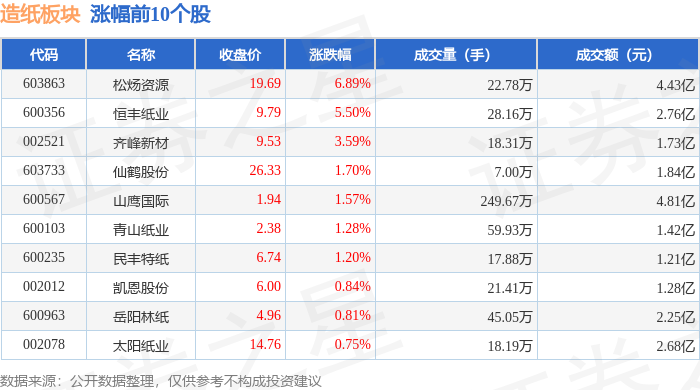
Group 1 - The paper sector experienced a rise of 0.94% on August 25, with Songyang Resources leading the gains [1] - The Shanghai Composite Index closed at 3883.56, up 1.51%, while the Shenzhen Component Index closed at 12441.07, up 2.26% [1] - Notable stock performances included Songyang Resources with a closing price of 19.69, up 6.89%, and Hengfeng Paper with a closing price of 9.79, up 5.50% [1] Group 2 - The paper sector saw a net outflow of 60.37 million yuan from institutional funds and 34.82 million yuan from speculative funds, while retail investors contributed a net inflow of 95.19 million yuan [3]


625股获融资买入超亿元,东方财富获买入40.02亿元居首
Mei Ri Jing Ji Xin Wen· 2025-08-25 01:47
Group 1 - On August 22, a total of 3,713 stocks in the A-share market received financing funds, with 625 stocks having a buying amount exceeding 100 million yuan [1] - The top three stocks by financing buying amount were Dongfang Caifu, SMIC, and ZTE, with amounts of 4.002 billion yuan, 3.517 billion yuan, and 3.11 billion yuan respectively [1] - Five stocks had financing buying amounts accounting for over 30% of the total transaction amount on that day, with Guangzhou Port, China Merchants Jinling, and Shanying International ranking highest at 38.22%, 36.22%, and 32.44% respectively [1] Group 2 - There were 48 stocks with a net financing buying amount exceeding 100 million yuan, with SMIC, ZTE, and Northern Rare Earth leading at 921 million yuan, 915 million yuan, and 790 million yuan respectively [1]




光大证券晨会速递-20250825
EBSCN· 2025-08-25 01:44
Market Overview - The A-share market has shown strong performance, breaking through last year's high, with expectations for continued upward movement supported by reasonable valuations and new positive factors such as a potential interest rate cut by the Federal Reserve and a recovery in public fund issuance [2][3] - The weighted REITs index has decreased by 1.52% during the week of August 18-22, 2025, indicating a downward trend in the secondary market prices of publicly listed REITs [2] Credit Bonds - A total of 375 credit bonds were issued from August 18 to August 22, 2025, with a total issuance scale of 376.74 billion, reflecting a week-on-week increase of 12.45% [3] - The total transaction volume of credit bonds reached 1,286.40 billion, up 16.04% week-on-week, with commercial bank bonds, corporate bonds, and medium-term notes being the top three in transaction volume [3] Convertible Bonds - The CSI Convertible Bond Index increased by 2.8% during the week, with a year-to-date increase of 17.9%, slightly below the equity market performance [4] - Current valuations of convertible bonds are close to or exceed historical highs, yet the equity market remains robust, suggesting continued strong performance in the convertible bond market [4] High-end Manufacturing - Exports of engineering machinery maintained double-digit growth, with excavators, tractors, and mining machinery showing year-on-year increases of 24%, 30%, and 25% respectively [6] - The report suggests focusing on companies like QuanFeng Holdings, JuXing Technology, and Xugong Machinery due to their strong export performance [6] TMT Sector - The company SUTENG has seen rapid growth in its robotics business, indicating a successful strategic transformation [6] - The report highlights the importance of SUTENG's self-research technology and its competitive advantages in the ADAS and robotics ecosystem [6] Agriculture, Forestry, Animal Husbandry, and Fishery - The report notes a slight decline in pig prices, with the average price of live pigs at 13.75 yuan/kg, down 0.07% week-on-week [6] - The government has initiated pork storage measures to boost market sentiment, suggesting a potential recovery in pig prices [6] Medical and Biological Sector - The report recommends increasing allocations to the medical device sector, highlighting undervalued companies in Hong Kong and those with strong growth potential [7] - Companies like Weikang Medical and Mindray Medical are noted for their robust growth and research capabilities [7] Petrochemical Sector - The report indicates a significant market opportunity for the renovation of old refineries, with companies like Sinopec Engineering and PetroChina Engineering expected to benefit [7] - The report emphasizes the trend of "de-involution" in the refining industry, which may lead to a substantial market for dismantling and renovation [7] Basic Chemicals - The second phase of phosphate fertilizer export quotas has been allocated, with leading companies expected to benefit from high overseas prices [7] - The report anticipates continued high demand for high-grade phosphate rock in the short to medium term [7] Non-Banking Financials - AIA Insurance has seen new business value reach new highs, with stable growth in operating profits [10] - The report adjusts profit forecasts for AIA for 2025-2027, maintaining a "buy" rating [10] Real Estate - The property management sector shows steady growth, with a stable dividend outlook from companies like Yuexiu Services [10] - The report notes a slight decline in net profit but maintains a positive outlook due to strong project delivery from related companies [10] Electric New Energy - The report highlights the growth potential in the energy storage battery sector, with companies like Yiwei Lithium Energy expected to benefit from increased demand [24] - The company has adjusted its profit forecasts for 2025, reflecting a strong competitive position in the market [24] Textile and Apparel - The report indicates a decline in profit margins for companies like Li Ning, despite revenue growth [34] - The company is expected to maintain a strong brand presence, with a "buy" rating maintained [34]





需求边际改善但持续性存疑 纸浆期货承压运行
Jin Tou Wang· 2025-08-24 23:40
Group 1 - The core viewpoint indicates that the pulp futures market is under pressure due to a seasonal demand slump, with processing profits for paper mills not showing significant improvement [3] - As of August 21, 2025, the inventory of pulp at major Chinese ports reached 2.132 million tons, reflecting a week-on-week increase of 33,000 tons, or 1.6% [2] - The main contract for pulp futures closed at 5,108 CNY/ton, with a weekly decline of 3.33% [1] Group 2 - Institutions suggest that the sentiment is dominated by expectations of supply contraction, as major international pulp producers like Suzano and Bracell have announced production cuts [3] - The external pricing for wood pulp has remained stable, with needle pulp priced at 720 USD/ton and bleached pulp at 590 USD/ton, indicating no significant changes since June [2] - Despite marginal improvements in demand, the sustainability of this trend is uncertain, as paper mills continue to face high inventory levels and low profit margins [3]
远期点价成为中小纸企锁利“护甲”
Qi Huo Ri Bao Wang· 2025-08-24 16:22
Core Viewpoint - The article discusses how a paper manufacturing company in Shandong, China, successfully utilized financial innovation solutions from Yong'an Futures to manage price risks associated with raw material procurement, specifically paper pulp, amidst a volatile market environment. Group 1: Market Conditions - In the first half of 2024, the global pulp and paper market faced significant disruptions due to supply chain issues, including limited wood supply, production equipment failures, and transportation obstacles, leading to a rising pulp price of 6400 yuan/ton [1] - Domestic demand for finished paper products, particularly cultural and packaging paper, has weakened, with order volumes significantly declining compared to the same period last year [1] Group 2: Challenges Faced by Companies - Many small and medium-sized paper companies in Shandong, including Company A, lack professional futures teams and comprehensive risk management systems, leaving them uncertain on how to hedge against price fluctuations [2] - Companies are often trapped in a passive procurement model, suffering from profit erosion due to pulp price volatility without the knowledge or experience to engage in futures trading [2] Group 3: Financial Solutions Provided - Yong'an Futures, through its risk management subsidiary Yong'an Capital, provided tailored financial solutions to help the company lock in pulp procurement costs and mitigate future market risks [2] - A customized forward pricing model was developed, allowing the company to secure a pulp price of 6250 yuan/ton, thus stabilizing procurement costs and ensuring profitability on existing orders [2][3] Group 4: Supply Chain Coordination - Yong'an Capital ensured stable supply of the specified brand of bleached softwood pulp by coordinating closely with upstream suppliers and managing logistics effectively [3] - The company utilized its own and partnered storage facilities to optimize warehousing and ensure timely delivery of raw materials [3] Group 5: Impact on Business Operations - The comprehensive service provided by Yong'an Capital improved the operational efficiency and risk resilience of the entire paper industry chain, facilitating collaborative development [3] - The successful implementation of the forward pricing model transformed the company's perception of the futures market from a high-risk tool to a manageable and effective means of addressing operational challenges [4] Group 6: Long-term Benefits - The new risk management approach allows companies to proactively establish operational safety margins, laying a foundation for sustainable growth [4] - The use of standardized pulp futures contracts through the forward pricing model enables companies to transfer price volatility risks to the futures market without directly engaging in complex derivative transactions [4][5]

光大证券-仙鹤股份-603733-2025年半年报点评:产销双增驱动营收大幅增长,部分产品降价影响上半年利润表现-250824
Xin Lang Cai Jing· 2025-08-24 12:09
Core Viewpoint - The company reported a significant revenue increase in 1H2025, driven by production and sales growth from new bases in Hubei and Guangxi, despite a decline in net profit due to pricing pressures on high-value products [1][2]. Financial Performance - In 1H2025, the company achieved revenue of 5.99 billion yuan, a year-on-year increase of 30.1%, while net profit attributable to shareholders was 470 million yuan, a decrease of 13.8% [1]. - For 1Q2025, revenue was 2.99 billion yuan, reflecting a year-on-year growth of 35.4%, with net profit at 240 million yuan [1]. - The production of specialty pulp paper reached 1.108 million tons in 1H2025, up 98.6% year-on-year, and sales volume was 833,000 tons, an increase of 62.3% [1]. Product Performance - In 1H2025, the food and medical consumer category achieved sales of 147,000 tons, a year-on-year increase of 35.7%, while the daily consumer series saw a sales increase of 24.9% [1]. - The average price of specialty pulp paper in 1Q2025 and 2Q2025 was approximately 7,480 yuan and 6,920 yuan per ton, respectively, with a quarter-on-quarter decrease of about 560 yuan in 2Q2025 [2]. Profitability and Cost Structure - The gross margin for 1H2025 was 13.7%, down 4.0 percentage points year-on-year, with 2Q2025 gross margin at 12.8%, a decline of 4.6 percentage points year-on-year and 1.8 percentage points quarter-on-quarter [1][2]. - The company’s expense ratio for 1H2025 was 6.2%, an increase of 0.4 percentage points year-on-year, with financial expenses slightly rising [2]. Future Outlook - The company anticipates a recovery in profitability in the second half of the year, as the Guangxi base has achieved stable profitability, while the Hubei base is still ramping up production [2]. - The company maintains a "buy" rating, expecting improved profitability despite competitive pressures and pricing declines in some products [2].
