
啤酒

Search documents
青岛啤酒股份(00168) - 海外监管公告
2025-08-26 14:17
香港交易及結算所有限公司及香港聯合交易所有限公司對本公告的內容概不負責,對其準確 性或完整性亦不發表任何聲明,並明確表示,概不對因本公告全部或任何部分內容而產生或 因依賴該等內容而引致的任何損失承擔任何責任。 執行董事: 姜宗祥先生(董事長)、劉富華先生及侯秋燕先生 青島啤酒股份有限公司 ( 於 中 華 人 民 共 和 國 註 冊 成 立 之 中 外 合 資 股 份 有 限 公 司 ) (股份編號:168) 海外監管公告 本公告乃根據香港聯合交易所有限公司證券上市規則第13.10B條而做出。 茲載列青島啤酒股份有限公司於中華人民共和國(「中國」)若干報章及上海證券交易所網站 (www.sse.com.cn)刊載之《青島啤酒股份有限公司2025年半年度報告摘要》,僅供參閱。 承董事會命 青島啤酒股份有限公司 侯秋燕 聯席公司秘書 中國 • 青島 2025年8月26日 青島啤酒股份有限公司於本公告日期的董事: 職工董事: 孫靜女士 獨立非執行董事: 肖耿先生、盛雷鳴先生、張然女士、趙昌文先生及趙紅女士 青岛啤酒股份有限公司2025 年半年度报告摘要 公司代码:600600 公司简称:青岛啤酒 青岛啤酒股份有限公司 ...
青岛啤酒(600600):25Q2点评:产品结构进一步提升,成本红利驱动净利率提升
Shenwan Hongyuan Securities· 2025-08-26 14:16
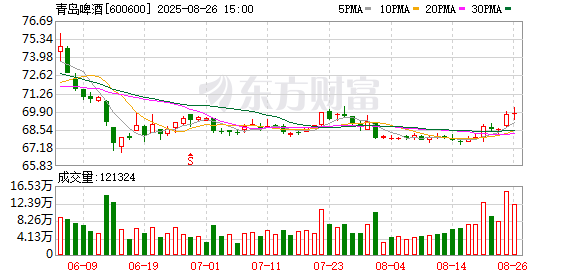
Investment Rating - The investment rating for Qingdao Beer (600600) is maintained as "Buy" [6] Core Views - The report highlights that Qingdao Beer has achieved a revenue of 20.49 billion yuan in H1 2025, with a year-on-year growth of 2.11%, and a net profit attributable to shareholders of 3.90 billion yuan, reflecting a growth of 7.21% [6] - The company is expected to continue optimizing its product structure, with a forecasted net profit of 4.79 billion yuan in 2025, representing a year-on-year growth of 10.3% [6] - The report emphasizes the potential for profit margin improvement due to cost reductions in raw materials and an increase in the proportion of high-end products [6] Financial Data and Profit Forecast - Total revenue forecast for 2025 is 33.50 billion yuan, with a year-on-year growth rate of 4.2% [2] - Net profit attributable to shareholders is projected to be 4.79 billion yuan in 2025, with a growth rate of 10.3% [2] - Earnings per share (EPS) is expected to be 3.51 yuan in 2025, with a projected PE ratio of 20 [2] Market Data - As of August 26, 2025, the closing price of Qingdao Beer is 69.78 yuan, with a market capitalization of 49.48 billion yuan [3] - The stock has a dividend yield of 3.15%, based on the most recent dividend announcement [3] - The price-to-book ratio is reported at 3.1 [3] Sales Performance - In Q2 2025, the company sold 2.471 million tons of beer, marking a 1% increase year-on-year, with a revenue per ton of 4,065.41 yuan, a slight increase of 0.3% [6] - The sales volume of the main brand and mid-to-high-end products increased by 3.8% and 4.81% respectively, with mid-to-high-end products accounting for 39.7% of total sales [6] Cost and Profitability - The cost per ton of beer in Q2 2025 was 2,201.88 yuan, a decrease of 5.1% year-on-year, contributing to a gross margin of 45.84%, an increase of 3.05 percentage points [6] - The net profit margin for Q2 2025 was 21.84%, reflecting a year-on-year increase of 1.23 percentage points [6]
青岛啤酒股份(00168) - 海外监管公告
2025-08-26 14:14
承董事會命 青島啤酒股份有限公司 侯秋燕 聯席公司秘書 中國 • 青島 香港交易及結算所有限公司及香港聯合交易所有限公司對本公告的內容概不負責,對其準確 性或完整性亦不發表任何聲明,並明確表示,概不對因本公告全部或任何部分內容而產生或 因依賴該等內容而引致的任何損失承擔任何責任。 青島啤酒股份有限公司 ( 於 中 華 人 民 共 和 國 註 冊 成 立 之 中 外 合 資 股 份 有 限 公 司 ) (股份編號:168) 海外監管公告 本公告乃根據香港聯合交易所有限公司證券上市規則第13.10B條而做出。 茲 載 列 青 島 啤 酒 股 份 有 限 公 司 於 中 華 人 民 共 和 國(「 中 國 」)上 海 證 券 交 易 所 網 站 (www.sse.com.cn)刊載之《青島啤酒股份有限公司2025年半年度報告》,僅供參閱。 青岛啤酒股份有限公司 2025 年半年度报告 公司代码:600600 公司简称:青岛啤酒 2025年8月26日 青島啤酒股份有限公司於本公告日期的董事: 青岛啤酒股份有限公司 2025 年半年度报告 1 / 157 青岛啤酒股份有限公司 2025 年半年度报告 執行董事: 姜宗祥 ...
霸榜电商平台,牛市啤酒上市即热销
Ge Long Hui· 2025-08-26 14:01
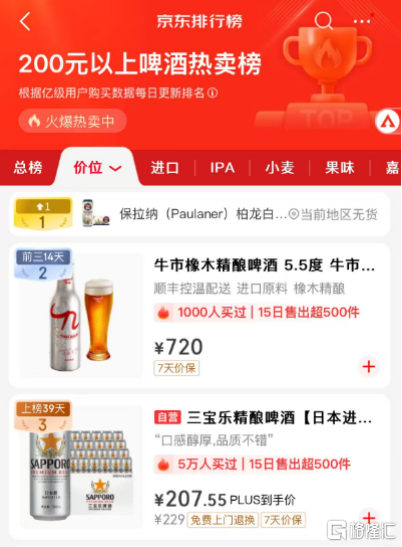
Group 1 - The core viewpoint of the article highlights the successful launch and rapid sales of the Bull Market Craft Beer, which has quickly become a popular brand in the beer market [1][5] - From August 1 to 13, Bull Market Beer topped the sales amount on JD.com, and on August 26, it ranked second in the "200 yuan and above beer hot sales list," maintaining a top-three position for 14 consecutive days [1][3] - On the day of its launch, August 8, Bull Market Beer achieved the highest sales in the beer category on Tmall [1][3] Group 2 - Bull Market Beer is the first high-end craft beer launched by the Zhenjiu Lidu Group, developed over three years using premium global ingredients, including hops from the Yakima Valley in the USA and malts from Canada and Australia [3] - The beer employs three top-tier brewing techniques, resulting in a unique and memorable taste [3] - The launch event, which included a live stream by the chairman of Zhenjiu Lidu Group, attracted over 1.9 million viewers and became the hottest live stream of the day, indicating strong consumer interest [5]

青岛啤酒上半年实现营收超200亿元 营收增速“跑输”净利润
Mei Ri Jing Ji Xin Wen· 2025-08-26 13:43
公告显示,由于公司A股限制性股票激励计划项下预留授予激励对象于第三个解除限售期内,有1名激励对象因个人原因辞职而不再具备激励资 格,公司董事会现决定对上述激励对象尚未解除限售的A股限制性股票合计1667股进行回购注销,回购资金来源为公司自有资金。 | 主要会计数据 | 本报告期 | 上年同期 | 本报告期比上年同 | | --- | --- | --- | --- | | | (1-6月) | | 期增减(%) | | 营业收入 | 20,491,167,745 | 20,068,307,930 | 2.11 | | 利润总额 | 5,263,157,400 | 4,909,634,563 | 7.20 | | 归属于上市公司股东的净利润 | 3,904,325,353 | 3,641,652,772 | 7.21 | | 归属于上市公司股东的扣除非经 常性损益的净利润 | 3.631.640.266 | 3,426,521,909 | 5.99 | | 经营活动产生的现金流量净额 | 4.799.544.157 | 5.713.872.510 | -16.00 | | | 本报告期末 | 上年度末 | 本报 ...
“啤强白弱” 华润偏科迎考白酒旺季
Bei Jing Shang Bao· 2025-08-26 13:41
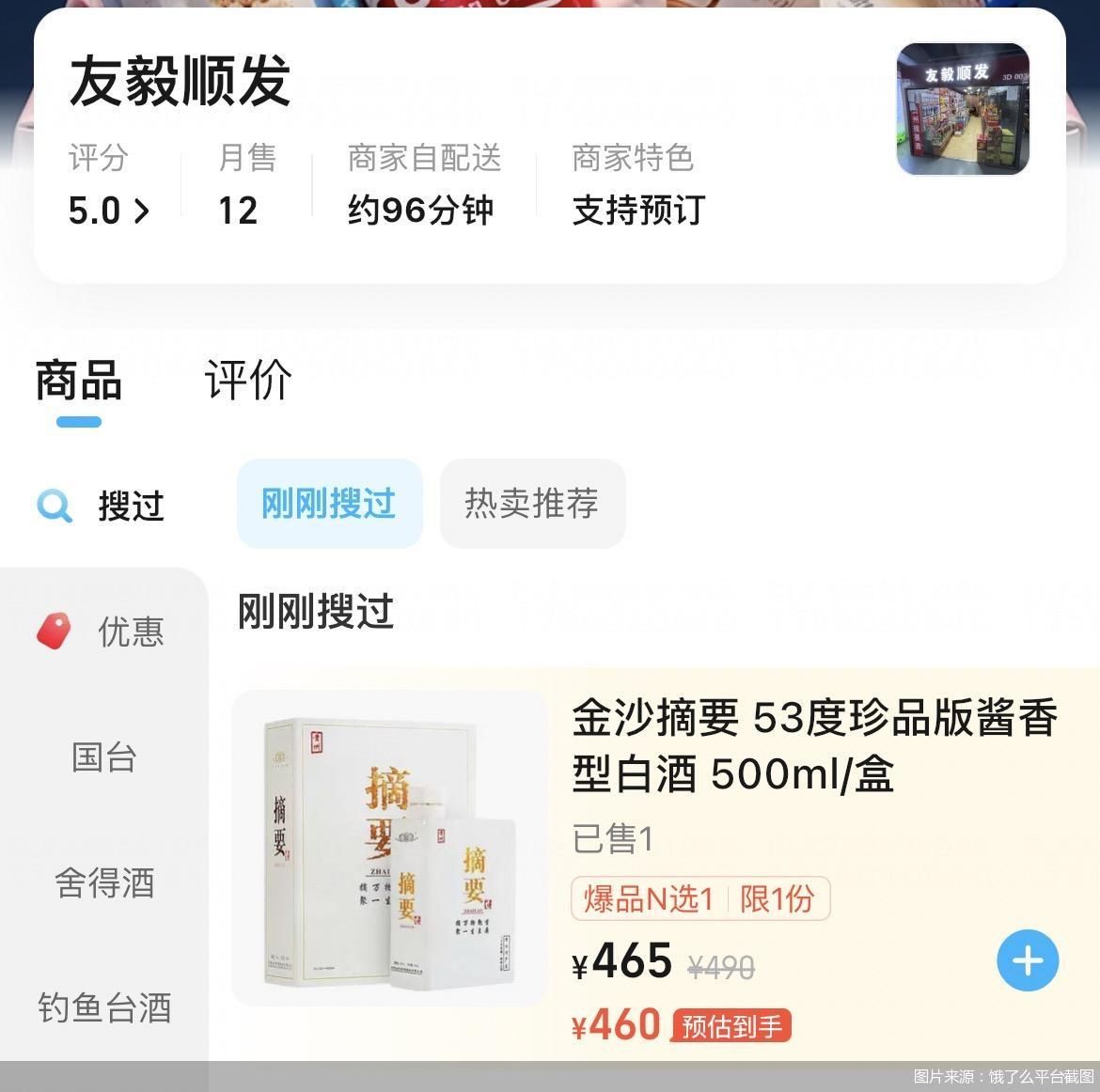
Core Viewpoint - The continuous price cuts by金沙酒业 have not alleviated the downward trend in terminal market prices, with significant declines in sales and revenue reported for华润啤酒's white liquor business [1][3][4] Group 1: Financial Performance -华润啤酒's white liquor business revenue for the first half of the year was 7.81 billion yuan, a decline of over 30% compared to the same period last year [3] - The core product "摘要" contributed nearly 80% of the white liquor business revenue, which saw a year-on-year decrease of 33.7% from 11.78 billion yuan [3][5] - Since the acquisition,金沙酒业's performance has decreased by approximately 60%, with revenue dropping from 57.66 billion yuan pre-acquisition to 21.49 billion yuan post-acquisition [5][6] Group 2: Market Challenges - The white liquor market is facing challenges due to weakened consumer demand and increased competition among brands, leading to a decline in investment expectations [4][6] - Price inversion issues are prevalent, with the core product "摘要" being sold at prices as low as 450 yuan on e-commerce platforms, indicating a significant price drop [7][10] - The management team at金沙酒业 is actively working to address high inventory and price inversion issues, including the establishment of a national price management committee [10][11] Group 3: Strategic Adjustments - To combat the current challenges,金沙酒业 is focusing on expanding product flow and cash flow, as well as targeting group purchases and banquet markets [12][13] - The company plans to implement five major initiatives to enhance market competitiveness, including deepening engagement in group purchase channels and improving customer experiences [12][13] - Industry experts suggest that华润啤酒 may need to restructure its approach to the white liquor market, emphasizing long-term strategies and professional management rather than relying on fast-moving consumer goods marketing [13]

青岛啤酒H1净利增7% 原料降成本“给力” 东南华南市场销量略降
Xin Lang Cai Jing· 2025-08-26 13:37
Core Viewpoint - Qingdao Beer achieved a dual growth in sales and profits in the first half of the year, with revenue increasing by approximately 2% and net profit rising by about 7% due to product structure upgrades and a decrease in raw material costs [1][2]. Financial Performance - In the first half of the year, Qingdao Beer reported revenue of 20.49 billion yuan, a year-on-year increase of 2.1%, and a net profit attributable to shareholders of 3.904 billion yuan, up 7.2% year-on-year [1]. - The company sold 4.732 million kiloliters of beer, representing a 2.3% increase compared to the same period last year, outperforming the overall beer industry [1]. - In Q2, revenue reached 10.046 billion yuan, a year-on-year growth of 1.28%, while net profit was 2.194 billion yuan, up 7.32% year-on-year [1]. Product and Market Analysis - The optimization of product structure was a significant highlight, with sales of mid-to-high-end products reaching 1.992 million kiloliters, a 5.1% increase, accounting for approximately 42% of total sales [2]. - The company launched several new mid-to-high-end products, including "Light Dry," "Sakura-flavored White Beer," and "Hazy IPA" [2]. - Raw material costs decreased, contributing to a 1.55% reduction in operating costs, which added approximately 182 million yuan to net profit, accounting for about 70% of the net profit increase [2]. Regional Performance - Qingdao Beer strengthened its market position in traditional base markets, achieving revenue of 13.109 billion yuan in Shandong, a year-on-year increase of 1.53% [2]. - Revenue in the North China region was 3.82 billion yuan, up 2.18%, while revenue in East China reached 1.458 billion yuan, growing by 7.44% [2]. - However, revenue in South China and Southeast regions saw slight declines of 0.42% and 0.5%, respectively, prompting the company to enhance resource allocation in these markets [2]. Strategic Initiatives - In response to the overall decline in beer industry sales and increased competition, Qingdao Beer is seeking to develop non-beer businesses, including a planned acquisition of 100% equity in Jimo Yellow Wine for 666.5 million yuan [3]. - The acquisition is expected to have limited short-term impact on overall performance, as Jimo Yellow Wine accounted for only 0.5% of Qingdao Beer's revenue last year [3].
青岛啤酒1—6月实现营收204.91亿元
Bei Jing Shang Bao· 2025-08-26 12:21
(文章来源:北京商报) 北京商报讯(记者刘一博冯若男)8月26日,青岛啤酒股份有限公司(以下简称"青岛啤酒")发布 《2025年半年度报告》显示,1—6月公司实现营业收入204.91亿元,同比提升2.11%;实现归属于上市 公司股东的净利润为39.04亿元,同比提升7.21%;实现经营活动产生的现金流量净额为48亿元,同比下 降16%;实现产品销量473.2万千升,同比增长 2.3%。报告期内,青岛啤酒主品牌共实现产品销量271.3 万千升,同比增长3.9%,其中中高端以上产品实现销量199.2万千升,同比增长5.1%。 ...
青岛啤酒上半年营收同比增长2.1%,高端化战略推动净利逆势增长7.21% | 财报见闻
Hua Er Jie Jian Wen· 2025-08-26 12:14
Core Viewpoint - Qingdao Beer achieved a revenue of over 20.49 billion yuan in the first half of 2025, with a net profit growth of 7.2% despite a 0.3% decline in the overall beer industry [1][4][6] Financial Performance - Revenue for the first half of 2025 reached 20.49 billion yuan, representing a year-on-year increase of 2.11% [6] - Net profit attributable to shareholders was 3.904 billion yuan, up 7.21% year-on-year [6] - Net profit excluding non-recurring items was 3.632 billion yuan, reflecting a growth of 5.99% [6] - Basic earnings per share were 2.862 yuan, an increase of 7.11% compared to the previous year [6] - Net cash flow from operating activities was 4.799 billion yuan, down 16.00% year-on-year [3][6] Market Position and Strategy - Qingdao Beer maintained its market share through channel advantages, achieving a product sales volume of 4.732 million kiloliters, a 2.3% increase year-on-year, while the overall industry faced a decline [1][4] - The growth in profit was driven by continuous optimization of product structure, with mid-to-high-end product sales increasing by 5.1%, surpassing the overall sales growth [4] - The company is advancing its strategy of "Qingdao Beer main brand + Laoshan Beer as a national second brand," focusing on upgrading the product mix of the main brand [4] - The main brand's sales volume reached 2.713 million kiloliters, a 3.9% increase, with high-value mid-to-high-end products accounting for 1.992 million kiloliters, up 5.1% [4] Innovation and New Channels - The company is focusing on new consumer groups and demands by launching innovative products such as "light dry beer," "sakura-flavored white beer," and "hazy IPA" to meet diverse market needs [4] - Qingdao Beer is solidifying its market position in mainstream channels while leading in emerging channels, with significant growth in its instant retail business through new operational models [5]
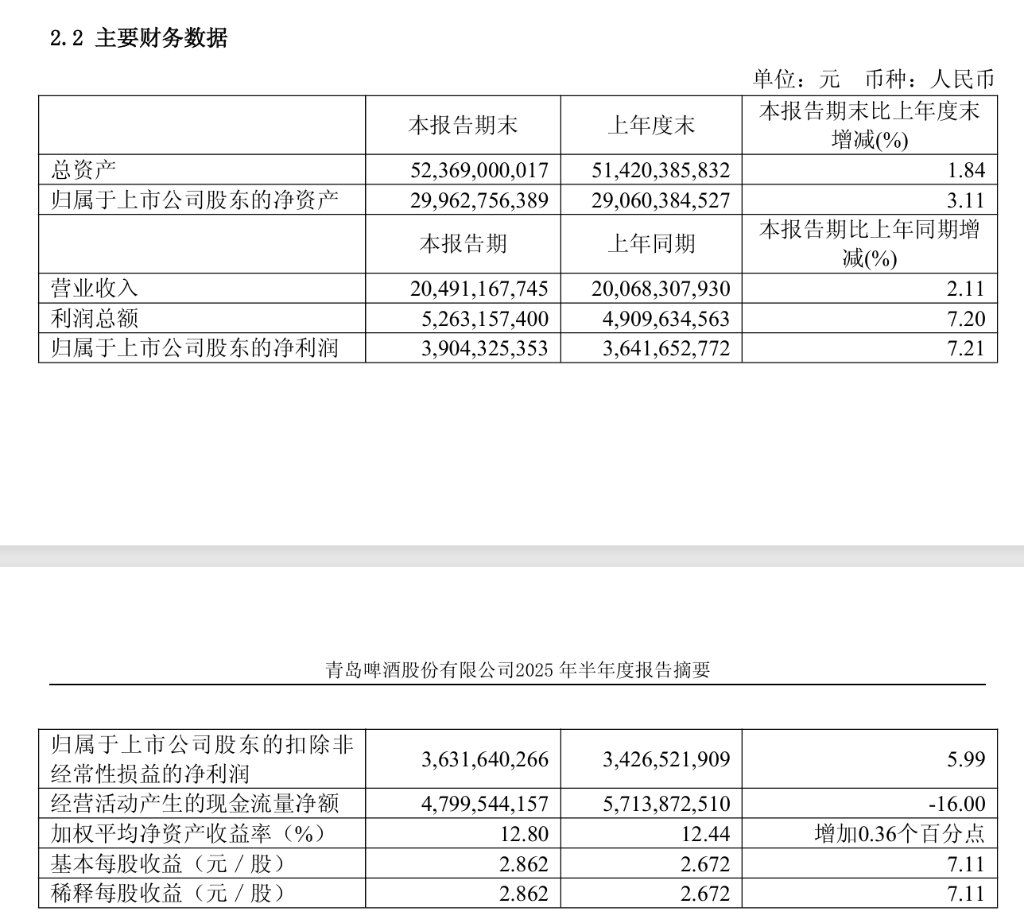
青岛啤酒上半年营收增长2.1%至204.9亿元,中高端以上产品销量提高5.1%
Cai Jing Wang· 2025-08-26 12:05
Core Insights - Qingdao Beer reported a 2.3% year-on-year increase in product sales, reaching 4.732 million kiloliters in the first half of 2025 [1] - The company achieved a revenue of RMB 20.49 billion, reflecting a 2.1% year-on-year growth [1] - Net profit attributable to shareholders was RMB 3.9 billion, showing an increase compared to the previous year [1] Group 1 - The company continues to deepen its focus on the domestic market, prioritizing growth, supported by structural advantages and driven by innovation [1] - Qingdao Beer is enhancing its product portfolio by accelerating the cultivation of major products and innovative categories, while optimizing its brand and product structure [1] - The main brand's product combination strategy, "1+1+1+2+N," is being developed, with steady sales in classic series, Qingdao White Beer, high-end fresh 1L aluminum bottles, and ultra-high-end products [1] Group 2 - The company is targeting new growth opportunities by focusing on "new demographics, new demands, new products, new channels, and new scenarios" [1] - Continuous product innovation and upgrades are being pursued, with several new products launched during the reporting period, including "light dry, cherry-flavored white beer, hazy IPA, and whole wheat national trend" [1]