科技

Search documents
10月券商策略披露科技成长方向仍是重点
Qi Lu Wan Bao· 2025-10-14 10:37
10月券商策略近日陆续披露。券商机构普遍认为,市场存向上动能,看好四季度和跨年行情,而科技成长主 线以及有色等顺周期方向仍是券商机构的关注重点。申万宏源认为,2026年春季前,科技产业催化显著多 于顺周期催化的格局不变,同时,科技成长可能会有中短期性价比问题,但距离长期性价比低位还有差距。 经济参考报 ...

不要恐慌!A股,周三行情没有问题了
Sou Hu Cai Jing· 2025-10-14 08:59
Group 1 - The overall sentiment in the A-share market is pessimistic, with the ChiNext index falling below yesterday's low, despite support from sectors like banking, liquor, insurance, and coal [1] - There is an expectation for a rebound in the technology index, with large funds still holding positions and potential bottom-fishing opportunities emerging [1][3] - The current market situation is seen as a healthy adjustment, with a likelihood of a broad market rally in the coming days [5] Group 2 - Concerns about the technology sector's performance are noted, with a belief that it will not experience a one-sided decline and will eventually build a top [3] - The securities sector is viewed as volatile, with large funds likely entering the market without a clear exit strategy, indicating a lack of profit for retail investors [5] - The market is characterized by emotional volatility, with large funds using negative sentiment to create price fluctuations for their own benefit [7]

港股收盘(10.14) | 恒指收跌1.73% 内银股逆市走高 科技、有色金属等显著下挫
智通财经网· 2025-10-14 08:50
Market Overview - The Hong Kong stock market experienced a decline, with the Hang Seng Index dropping 1.73% to close at 25,441.35 points, and a total trading volume of 398.91 billion HKD [1] - The recent escalation in US-China trade tensions has increased market uncertainty, leading to heightened volatility [1] Blue Chip Performance - China Merchants Bank (03968) led blue-chip gains, rising 4.7% to 48.16 HKD, contributing 13.25 points to the Hang Seng Index [2] - Other notable blue-chip movements included New Energy (02688) up 3.19%, and Construction Bank (00939) up 2.32%, while Semiconductor Manufacturing International Corporation (00981) fell 8.48% [2] Sector Performance Banking Sector - The banking sector is attracting defensive capital due to increased tariff uncertainties, with stable dividends and improved yield attractiveness post-correction [3] - The profit growth for listed banks in the first half of 2025 is projected at 0.8%, indicating a stable outlook [3] Shipping Sector - Shipping stocks showed strong performance, with China COSCO Shipping (01919) up 4.08% as the US port fee measures are set to take effect [4] - Analysts suggest that Chinese shipping companies may benefit more from the current trade dynamics compared to their US counterparts [4] Semiconductor Sector - Semiconductor stocks faced significant declines, with Hua Hong Semiconductor (01347) down 13.08% and SMIC (00981) down 8.48% [6] - Recent regulatory changes affecting a subsidiary of Wingtech Technology have raised concerns about market sentiment in the semiconductor industry [6] Gold Sector - Gold stocks fell sharply following a significant drop in gold prices, with notable declines in companies like Chifeng Jilong Gold Mining (06693) down 6.8% [5][7] Notable Stock Movements - Zhenjiu Lidu (06979) saw a rise of 5.42% following a leadership change, with the new CEO expected to enhance brand operations [8] - InnoCare Pharma (02577) increased by 4.91% due to advancements in GaN technology in collaboration with NVIDIA [9] - New China Life Insurance (01336) announced a profit increase forecast of 45% to 65% for the first three quarters of 2025, leading to a 3.52% rise in stock price [10]


资产的信号(20251013):TACO交易,并不容易
Western Securities· 2025-10-14 07:44
Group 1 - The current trade conflict between China and the US is expected to have a longer duration compared to April, as the US faces fewer constraints now, allowing for a more prolonged hardline stance from Trump [1][3][4] - China's economic resilience has been validated, with a significant reduction in reliance on the US market, decreasing from an average of 14.6% in 2024 to 10.5% since April 2025, providing China with more confidence to withstand US pressure [2][8] - The US has made significant progress in trade agreements with Europe and Japan, which enhances its bargaining power against China, making it less likely for Trump to back down easily [3][4] Group 2 - The report emphasizes the importance of the upcoming APEC summit at the end of the month, suggesting that the timing of Trump's tariff implementation on November 1 may be strategically aligned with this meeting [4][8] - The report highlights the need for caution in trading strategies, advising against reliance on past patterns of market behavior during trade negotiations, as the current situation may not follow the same trajectory as in April [4][20] - The report suggests focusing on sectors with high certainty, such as non-ferrous metals and high-end manufacturing, while also considering consumer goods that are currently undervalued [4][20] Group 3 - The report notes that the manufacturing PMI in China for September was recorded at 49.8, slightly below expectations, indicating a need for policy intervention to stimulate demand [11][12] - The report discusses the implications of the US government shutdown on economic data releases, which may affect future monetary policy decisions [15][17] - The report indicates that the global economic environment remains mixed, with varying performance in manufacturing and service sectors across different regions, impacting overall market sentiment [18][19] Group 4 - The report outlines the performance of various asset classes, noting a decline in oil prices due to oversupply expectations, while gold prices have risen significantly amid increased demand for safe-haven assets [27][28] - The report highlights the fluctuations in the foreign exchange market, with the US dollar strengthening slightly and the Chinese yuan experiencing a minor depreciation [28][30] - The report provides a comprehensive overview of the stock market performance, indicating a mixed response with some sectors outperforming others, particularly in the context of ongoing trade tensions [20][22]

体验户外“潮”运动 相关主题展常熟启幕
Su Zhou Ri Bao· 2025-10-14 00:33
Core Insights - The 2025 Suzhou Technology Fashion Week Outdoor, Fashion, and Technology themed exhibition opened on October 13 at the Changshu International Exhibition Center, showcasing a trend towards more technological and fashionable outdoor sports [1] - The exhibition features an area of nearly 5,000 square meters with over 70 participating companies, creating an experiential composite space [1] - The "TECHNOLOGY" theme area includes top industry players such as Feiliu, Alibaba, and Baidu, alongside numerous emerging companies displaying their latest products and technologies [1] - The "FASHION" theme area gathers well-known brands like Camel, OZARK, and Alpha, highlighting the fashion aspect of outdoor sports [1] - The exhibition also invites research institutions from universities such as Donghua University and Jiangnan University to showcase the practical application of laboratory results [1] - The exhibition will continue until October 16 [2]


美股财报季今揭幕:银行股有望开门红,人工智能成最大焦点
Di Yi Cai Jing Zi Xun· 2025-10-14 00:00
Core Viewpoint - The upcoming earnings season for major U.S. banks is expected to reveal insights into the financial sector's recovery and the broader economic landscape amid government shutdowns and tariff impacts [2][3]. Banking Sector Insights - Major banks including JPMorgan Chase, Wells Fargo, Citigroup, and Goldman Sachs are set to release their earnings reports, with expectations of strong performance driven by increased investment banking activity and capital market fees [3]. - Analysts predict double-digit year-over-year growth in bank earnings over the next few years, supported by improved trading activity and healthy credit conditions [3]. - The earnings reports will provide critical insights into the U.S. economy and consumer dynamics, especially in the context of the ongoing government shutdown [4]. Economic Data Delays - The government shutdown has delayed the release of key economic data, including the non-farm payroll report and the Consumer Price Index (CPI), adding uncertainty to market conditions [4]. - Analysts anticipate that the impact of the government shutdown will be reflected in the earnings calls, with more targeted questions from analysts regarding the macroeconomic environment [4]. Artificial Intelligence Focus - Analysts expect S&P 500 companies to see an 8.8% year-over-year earnings growth in Q3 2024, with technology sector leading the way at over 22% expected growth [5][6]. - The AI sector is gaining traction, with significant investments from companies like OpenAI, which plans to invest over $1 trillion in infrastructure, although the impact on quarterly earnings may not be fully realized until next year [7][8]. - Concerns are rising regarding the high valuations of tech stocks, with the S&P 500's expected P/E ratio at approximately 23, significantly above the 10-year average of 18.7 [8][9]. Market Sentiment - There is a cautious optimism in the market, with some strategists expressing concerns about high valuations and the potential for disappointment in earnings expectations [9]. - The current market conditions are reminiscent of the 1999 internet bubble, raising alarms about the sustainability of the ongoing bull market [9].



美股财报季今揭幕:银行股有望开门红,人工智能成最大焦点
第一财经· 2025-10-13 23:49
Core Viewpoint - The upcoming earnings reports from major U.S. banks are expected to provide insights into the financial sector's recovery and the broader economic landscape, amid concerns over inflation and the impact of tariffs on corporate profits [3][4][6]. Banking Sector Insights - Major banks including JPMorgan Chase, Wells Fargo, Citigroup, and Goldman Sachs are set to release their earnings reports, with expectations of strong performance driven by increased investment banking activity and a healthy credit environment [5][6]. - Analysts predict that bank earnings will achieve double-digit year-over-year growth in the coming years, supported by improved trading activity and loan growth [6][11]. - The financial sector is seen as well-positioned, with a focus on capital market fees and wealth management income benefiting from a strong stock market [6][8]. Economic Indicators and Market Sentiment - The delay in key economic data releases, such as the Consumer Price Index (CPI), due to the government shutdown adds uncertainty to market expectations [7][8]. - Analysts emphasize that the upcoming bank earnings will be crucial for understanding the current economic realities, especially in the absence of recent employment data [7][8]. AI and Technology Sector Outlook - The technology sector, particularly companies involved in artificial intelligence (AI), is expected to show significant earnings growth, with forecasts indicating over 22% growth in the third quarter [8][9]. - Major tech firms are anticipated to increase their capital expenditures in AI, with OpenAI's planned investment of over $1 trillion in infrastructure being a key focus for analysts [10]. - Despite the strong performance of AI-related companies, concerns about high valuations and potential market corrections persist, with the S&P 500's expected price-to-earnings ratio at approximately 23, significantly above the 10-year average of 18.7 [10][11]. Market Valuation Concerns - There are growing worries about the sustainability of the current market rally, with some analysts drawing parallels to the dot-com bubble of 1999, suggesting that a significant market correction may be necessary to realign valuations with fundamentals [11][12].

安徽皖通科技股份有限公司 关于2025年限制性股票激励计划预留授予部分 限制性股票授予登记完成的公告
Sou Hu Cai Jing· 2025-10-13 23:21
| 股份位置 | 本次世纪初 | | 本次要求数量 | ACCOME | | | --- | --- | --- | --- | --- | --- | | | 数量(股) | | PC .. | 胶型(段) | CLAND | | 天然而多年度分 | 29,586,454 | 6.95% | 3,000,000 | 32.586.454 | 7.61% | | 198655999 | 395,845,205 | 03.050 | | 395,845,295 | 92.399 | | | :425,431,749 | 100% | 3,000,000 | 428,431,749. | 100% | | 115-19 12.1 1972 | 25 查露用 禁止强制的 | 2025 4- | 20261 | 2027年 | | --- | --- | --- | --- | --- | | 酸量(万股) | | 一个历元 | (万元 | (万元 | | 300 | 1,410,00 | 302.27 | 855.99 | 251.74 | | | belocial of the procession in the ...


A股新开户数持续增加 透露了哪些利好信息
Zheng Quan Ri Bao· 2025-10-13 22:44
Core Insights - The continuous increase in new A-share accounts indicates growing investor confidence in China's economy and capital market reforms, highlighting the increasing attractiveness of Chinese assets [1][2][3] - The A-share market has shown resilience amid complex external conditions, with the Shanghai Composite Index rising 16.04% year-to-date as of October 13 [1][2] Group 1: Market Dynamics - In September, 2.9372 million new A-share accounts were opened, a year-on-year increase of 60.73% and a month-on-month increase of 10.83%, marking four consecutive months of growth [1] - The total number of new A-share accounts for the first three quarters of the year reached 20.1489 million, reflecting a year-on-year growth of 49.64% [1] - The resilience of the stock market is supported by a recovering economy and effective government measures to stabilize the market, which have led to a steady increase in market indices [2][3] Group 2: Investment Trends - The deepening reforms in the capital market are providing better investment opportunities, particularly in technology sectors, which have become the main focus of the current market rally [2][3] - The emergence of a "1+N" policy framework has led to significant structural changes in the market, fostering a culture of respecting and rewarding investors among listed companies [3] Group 3: Asset Allocation Shifts - There is a noticeable shift in residents' asset allocation towards financial assets, with A-shares expected to become a core vehicle for wealth preservation and appreciation [3][4] - Data from the central bank indicates a decrease of 1.1 trillion yuan in household deposits, while non-bank deposits increased by 2.14 trillion yuan, signaling a migration of funds towards financial assets [3] - High-net-worth clients and industrial capital are driving the growth of securities margin financing, indicating a preference for core assets in the A-share market among risk-tolerant investors [3]
美股三大指数齐涨,道指反弹近600点,博通涨超9%,中概指数涨3.21%
Ge Long Hui A P P· 2025-10-13 22:29
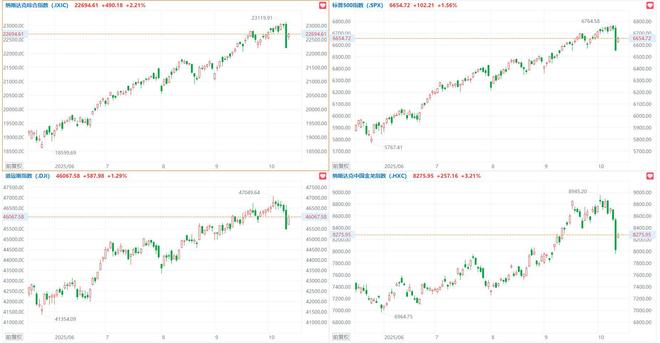
Core Points - The US stock market saw all three major indices rise, with the Dow Jones up 1.29%, the Nasdaq up 2.21%, and the S&P 500 up 1.56% [1] - Popular technology stocks experienced significant gains, with Broadcom rising over 9%, Tesla and Oracle up over 5%, Google up over 3%, and Nvidia up over 2% [1] - Cryptocurrency mining companies, precious metals, and semiconductors led the gains, with Bitfarms up over 28%, Nanometrics up over 21%, Arm up over 11%, Micron Technology and Pan American Silver up over 6%, and Qualcomm up over 5% [1] - The tobacco, food, and weight-loss sectors saw declines, with Beyond Meat dropping over 48%, General Mills down over 2%, and Eli Lilly down over 1% [1] - The Nasdaq Golden Dragon China Index rose by 3.21%, with popular Chinese concept stocks also seeing gains, including Century Internet up over 10%, NIO up nearly 7%, Miniso up over 5%, Alibaba and JD.com up over 4%, and Xpeng and Baidu up over 3% [1]