
半导体设备

Search documents
半导体设备板块ETF领涨;ETF年内发行创新高丨ETF晚报
2 1 Shi Ji Jing Ji Bao Dao· 2025-11-18 11:17
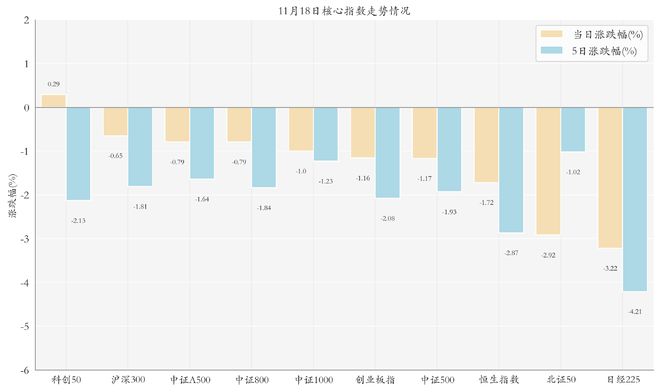
ETF Industry News Summary Group 1: Market Performance - Major indices experienced a decline today, with the Shanghai Composite Index down 0.81%, Shenzhen Component down 0.92%, and ChiNext down 1.16 [1][4] - Several semiconductor equipment ETFs saw gains, including Semiconductor Equipment ETF (561980.SH) up 2.32%, and others up 2.10% [1] Group 2: ETF Growth and Trends - The total scale of commodity ETFs has increased by over 200% this year, with 17 commodity ETFs attracting a net inflow of 1020.23 billion yuan, bringing the total scale to 2299.87 billion yuan [2] - The growth is primarily driven by gold ETFs, with the leading product, Huaan Gold ETF, reaching a scale of 873.83 billion yuan, up from 12 million yuan since its inception in 2013 [2] - A record 322 ETFs were issued this year, totaling 2446.44 billion units, marking an 80% increase in the number of ETFs compared to last year [3] Group 3: ETF Category Performance - Among different ETF categories, bond ETFs performed the best with an average change of 0.00%, while cross-border ETFs had the worst performance with an average change of -1.91% [9] - The top-performing ETFs today included Media ETFs and Semiconductor Equipment ETFs, with gains of 2.38%, 2.35%, and 2.32% respectively [11][12] Group 4: Trading Volume - The top three stock ETFs by trading volume were A500 ETF (512050.SH) with 5.184 billion yuan, followed by Zhongzheng A500 ETF (159338.SZ) with 4.809 billion yuan, and A500 ETF Huatai Baichuan (563360.SH) with 4.431 billion yuan [14][15]

KVB外汇:市场忧虑持续,但抛售最糟阶段是否已过?
Sou Hu Cai Jing· 2025-11-18 10:07
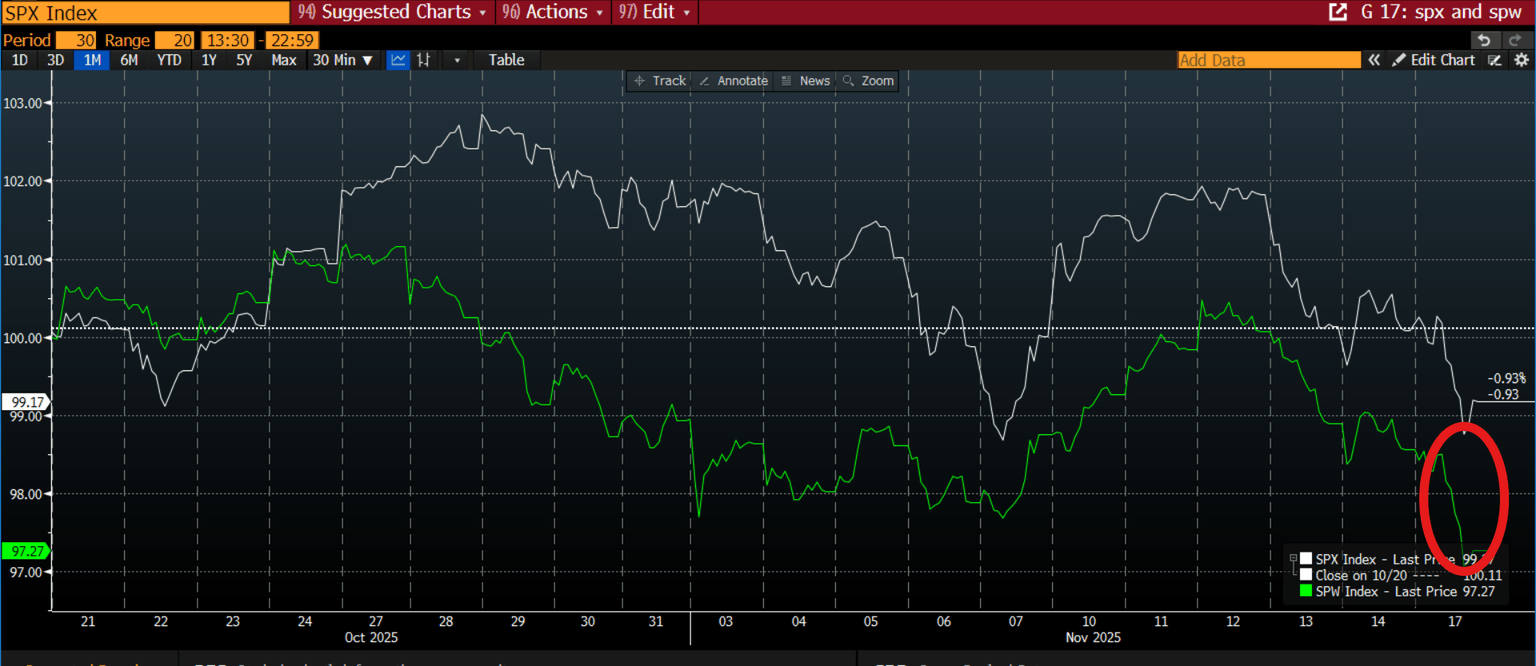
当前市场受多重因素驱动:对人工智能科技股估值的担忧、美国经济前景疲软的忧虑,以及美联储降息步伐可能不足的顾虑。就连传统避险资产今晨也显露 疲态,黄金每盎司下跌23美元,勉强守住4000美元关口。曾被视为"抗衰退"的奢侈品股正拖累欧洲股指下行。爱马仕和路威酩轩集团成为周二欧洲斯托克50 指数表现最差的个股,与荷兰巨头ASML等科技股同步下跌。外汇市场方面,日元和瑞郎正展现其避险货币属性,目前领涨十国集团货币。 周一跌幅超5%的美股涵盖航空、金融及科技股等广泛领域,表明抛售已超出科技板块。这正是推动标普500指数跌破50日均线的关键因素之一,该信号预示 短期动能呈下行趋势。 全面抛售表明科技股仍将主导市场 欧洲和亚洲股市跟随美股下行。 奢侈品和黄金等避险资产表现疲软。 全面抛售可能扼杀市场更广泛复苏的希望。 美国特定因素拖累市场情绪。 沃尔玛能拯救股市吗? 周二早盘股市一片红海,抛售潮持续加剧。欧洲股指目前重挫,泛欧斯托克50指数下跌逾1%,富时100指数跌幅超过0.8%,可选消费品、工业和金融等周期 性板块同样遭受重创。 避险资产随市场情绪动摇 周一的行情走势同样值得密切关注。全球股市在美股开盘前基本保持平稳, ...
半导体设备板块逆势走强,半导体设备ETF易方达(159558)、芯片ETF易方达(516350)助力布局产业龙头
Sou Hu Cai Jing· 2025-11-18 10:00
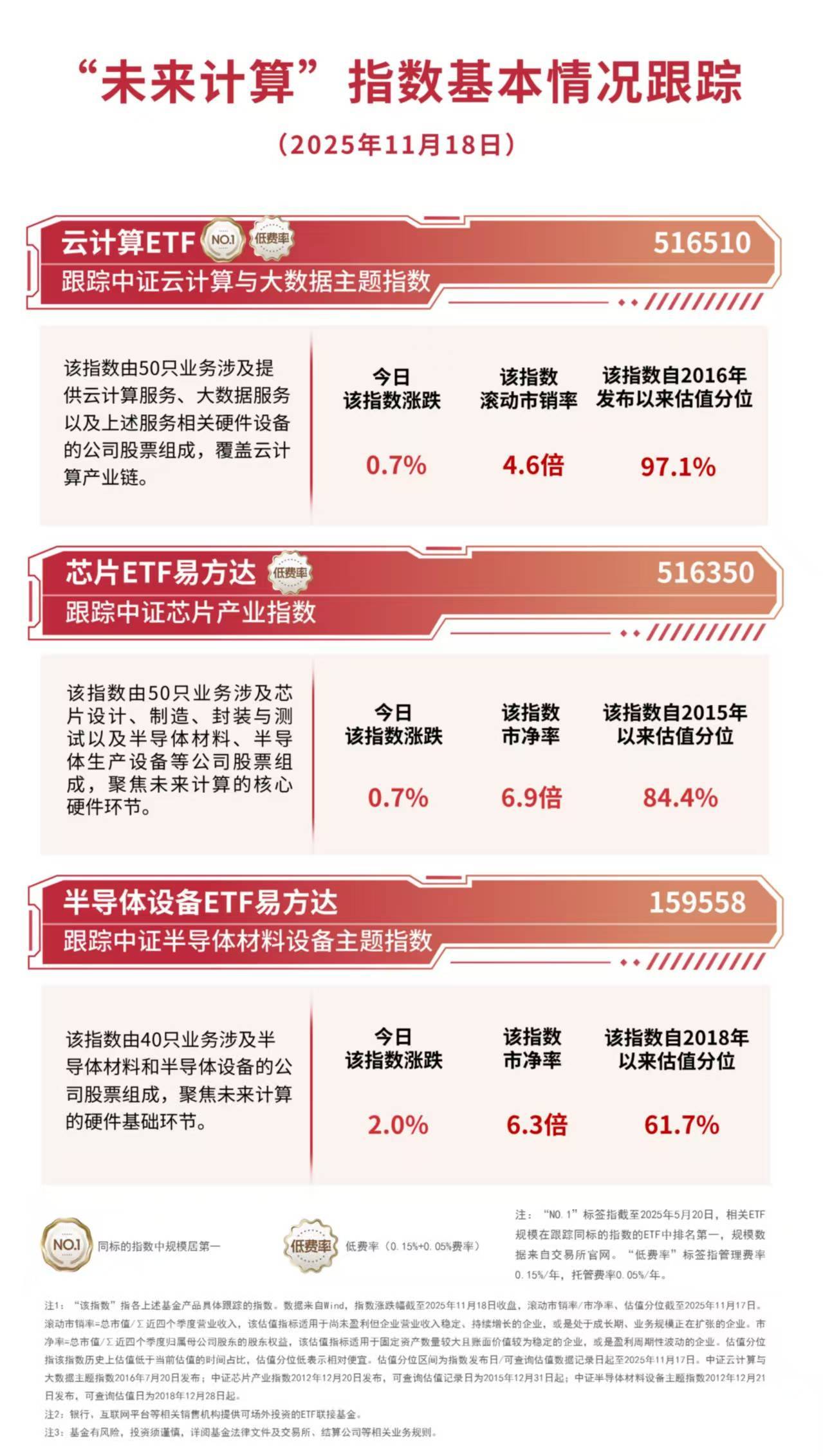
Group 1 - The core viewpoint of the article highlights the resilience of the semiconductor equipment sector amidst market fluctuations, with significant gains in related indices and ETFs [1] - The CSI Cloud Computing and Big Data Theme Index and the CSI Chip Industry Index both increased by 0.7%, while the CSI Semiconductor Materials and Equipment Theme Index rose by 2.0% [1] - The E Fund Semiconductor Equipment ETF (159558) saw a net subscription of over 10 million units throughout the day, indicating strong investor interest [1] Group 2 - Analysts suggest that the demand for advanced production lines in China will continue to grow due to the AI wave and domestic production needs, positioning semiconductor equipment as a crucial element for wafer foundry expansion [1] - Domestic semiconductor equipment companies are expected to benefit from these developments, as they play a vital role in achieving self-sufficiency in the industry chain [1]
北方华创(002371):联合研究|公司点评|北方华创(002371.SZ):北方华创(002371):北方华创:在手订单充裕,业绩稳健增长
Changjiang Securities· 2025-11-18 09:42
Investment Rating - The investment rating for the company is "Buy" and is maintained [8]. Core Views - The company reported a robust performance with significant revenue growth and a healthy order backlog, indicating stable growth prospects [6][12]. - The semiconductor equipment industry is expected to maintain its favorable conditions, with increasing demand for advanced process construction [12]. - The company is well-positioned to benefit from the domestic semiconductor equipment market's shift towards localization, enhancing its revenue and profitability in the long term [12]. Financial Performance Summary - In Q3 2025, the company achieved revenue of 11.16 billion yuan, a year-on-year increase of 38.31%, and a net profit attributable to shareholders of 1.92 billion yuan, up 14.60% year-on-year [2][6]. - For the first three quarters of 2025, the company reported total revenue of 27.30 billion yuan, a 32.97% increase year-on-year, with a net profit of 5.13 billion yuan, reflecting a 14.83% growth [2][6]. - The gross profit margin for Q3 2025 was 40.31%, a decrease of 1.95 percentage points year-on-year, while the gross margin for the first three quarters was 41.41%, down 2.81 percentage points year-on-year [2][6]. Research and Development - The company maintained high R&D intensity, with R&D expenses for the first three quarters of 2025 amounting to 3.285 billion yuan, a 48.4% increase year-on-year, representing a 12.0% R&D expense ratio [12]. - The company has achieved significant milestones in equipment delivery, with over 1,000 units of key products delivered, indicating strong operational capabilities [12]. Market Outlook - The semiconductor equipment market is projected to see continued growth, with a 7% increase in global spending on 300mm wafer fab equipment expected in 2025, reaching 107 billion USD [12]. - The domestic demand for semiconductor equipment remains strong, driven by ongoing construction of wafer fabs and the need for domestic equipment to replace foreign products [12].

光力科技:公司设备已经具有与国际竞争对手对标型号相媲美的稳定性、切割品质和切割效率
Zheng Quan Ri Bao Zhi Sheng· 2025-11-18 09:37
Core Insights - The company views Japanese semiconductor equipment as a benchmark for technology and application, indicating a long-standing accumulation of expertise in the field [1] - After years of effort, the company has successfully introduced domestic semiconductor slicing equipment to leading packaging enterprises, achieving bulk sales and comparable performance to international competitors [1] - The company aims to complete the layout of mechanical cutting, laser cutting, and grinding equipment in the semiconductor business by 2025, while continuing to enhance R&D and expand its product range to further promote domestic substitution of semiconductor equipment [1]

迈为股份(300751):半导体设备加速放量,钙钛矿先发优势明显
Soochow Securities· 2025-11-18 09:32
Investment Rating - The report maintains a "Buy" rating for the company [1] Core Views - The company is experiencing accelerated growth in semiconductor equipment, with a significant advantage in perovskite technology [1] - The forecast for net profit attributable to the parent company for 2025-2027 is 7.6 billion, 8.8 billion, and 11.0 billion RMB respectively, with corresponding P/E ratios of 39, 34, and 27 times [1] Financial Performance Summary - Total revenue for 2023 is projected at 8,089 million RMB, with a year-on-year growth of 94.99%. However, a decline of 23.09% is expected in 2025 [1][8] - Net profit attributable to the parent company for 2023 is estimated at 913.90 million RMB, with a growth of 6.03%. A decrease of 17.39% is anticipated in 2025 [1][8] - The latest diluted EPS for 2023 is 3.27 RMB, expected to drop to 2.74 RMB in 2025 before rising to 3.93 RMB by 2027 [1][8] Market Position and Product Development - The company has made significant advancements in semiconductor wafer etching and advanced packaging equipment, achieving key breakthroughs with differentiated technology [7] - The company has successfully launched several core devices in the semiconductor packaging sector and has a leading market share in laser grooving equipment [7] - The company is expanding its product matrix in 2024, introducing new equipment such as temporary bonding machines and laser debonding machines [7] - The company is also rapidly advancing in perovskite technology, adding a full suite of equipment necessary for perovskite tandem solar cells [7]

A股收评:日线三连跌!煤炭、电池股齐挫,AI应用概念逆市爆发
Ge Long Hui· 2025-11-18 07:36
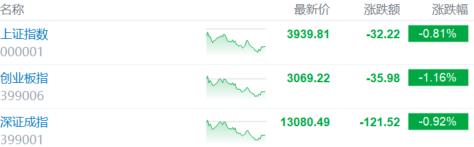
Market Overview - The A-share market experienced a collective decline, with all three major indices recording a three-day losing streak. The Shanghai Composite Index fell by 0.81% to 3939 points, the Shenzhen Component Index dropped by 0.92%, and the ChiNext Index decreased by 1.16% [1][2]. Trading Volume - The total market turnover reached 1.95 trillion yuan, an increase of 15.6 billion yuan compared to the previous trading day, with over 4100 stocks declining [2]. Sector Performance - The coal sector saw significant declines, with companies like Yunmei Energy and Baotailong hitting the daily limit down, and Antai Group falling over 9%. The report from Guotai Junan Securities indicated that coal prices have risen above 830 yuan/ton, but a short-term peak may be approaching [5][6]. - The battery sector also faced downturns, with Huasheng Lithium falling over 17% and several other stocks experiencing significant drops. Dongwu Securities noted that while short-term fluctuations are influenced by market sentiment and production data, the sector is not overvalued in the long term, with expected growth rates of 25%-30% [6][7]. - The steel sector experienced substantial losses, with Sansteel Mingguang dropping over 7%. CITIC Construction pointed out that steel prices are expected to decline significantly by 2025 due to supply-demand mismatches and weakening cost support [8]. - Precious metals and gold stocks also fell, with Hunan Silver dropping over 4%. The market's expectations for the Federal Reserve's interest rate decisions have led to fluctuations in gold prices, although long-term bullish trends are still anticipated [9]. Notable Stocks - In the AI application sector, stocks like Fushi Holdings and Xuan Ya International surged, with Fushi Holdings rising by 20.07% [10]. - Semiconductor equipment stocks saw gains, with companies like Yaxiang Integration and Shenghui Integration hitting the daily limit up, reflecting a trend towards supply chain security and domestic substitution [11][12]. Future Outlook - UBS predicts that the Chinese stock market will continue its upward trend into 2026, with the MSCI China Index target set at 100 points, indicating a potential 14% increase driven by earnings growth rather than valuation [12][13].
半导体设备板块领涨,半导体设备ETF易方达(159558)、芯片ETF易方达(516350)标的指数上扬
Sou Hu Cai Jing· 2025-11-18 05:27
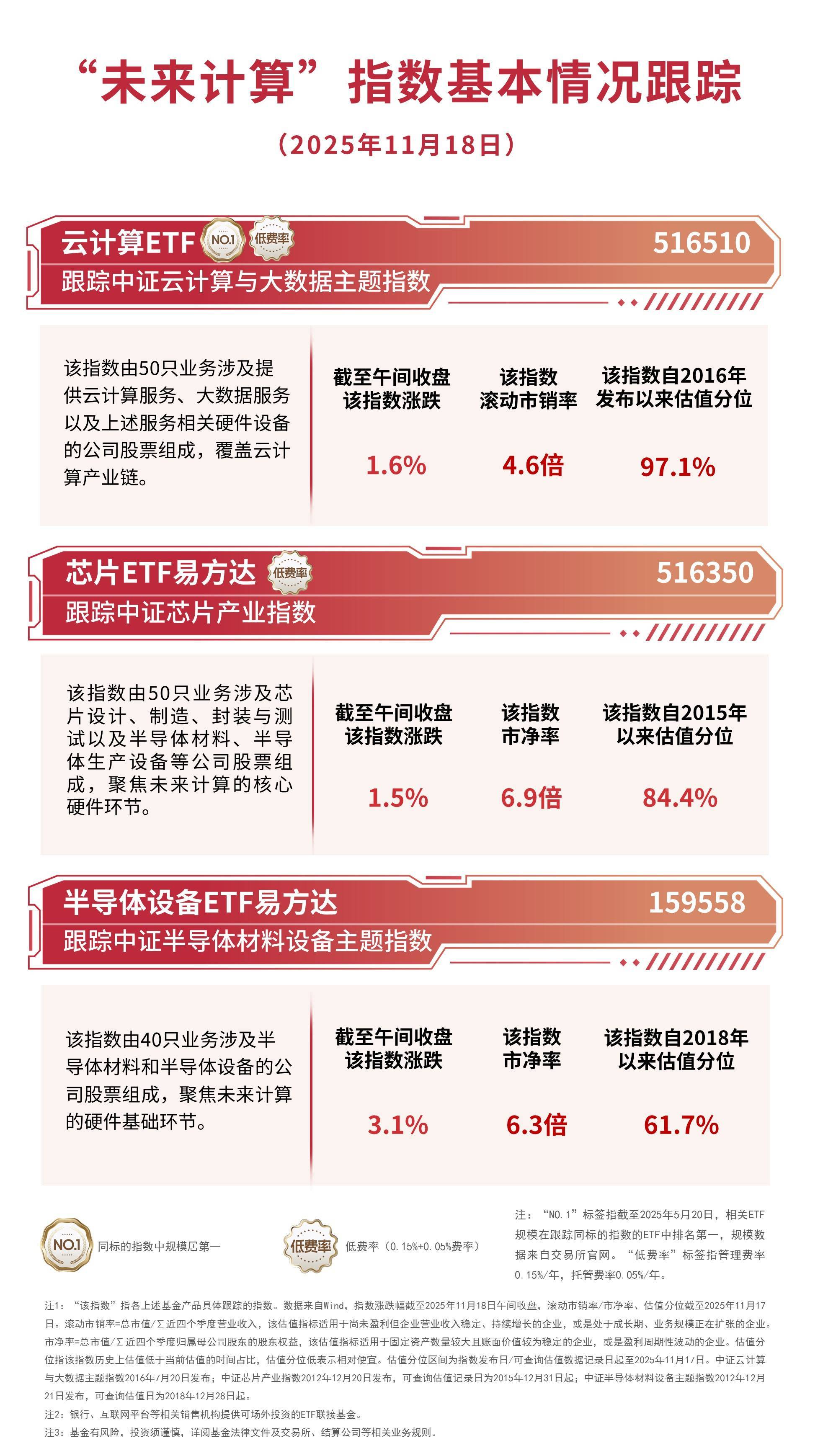
Group 1 - The semiconductor materials and equipment sector showed strong performance, with the CPO and computing industry chain themes rebounding, leading to a 3.1% increase in the CSI Semiconductor Materials and Equipment Theme Index and a 1.6% increase in the CSI Cloud Computing and Big Data Theme Index as of midday [1][4] - The CSI Semiconductor Industry Index rose by 1.5% as of midday, indicating positive market sentiment towards the semiconductor sector [1][4] - The E Fund Semiconductor Equipment ETF (159558) saw a net subscription of 4 million units in the first half of the trading day, reflecting increased investor interest in semiconductor-related investments [1] Group 2 - The CSI Semiconductor Materials and Equipment Theme Index is composed of 40 stocks related to semiconductor materials and equipment, focusing on the hardware foundation for future computing [3][4] - The index tracking the E Fund Semiconductor Equipment ETF is the largest in its category, with a low fee rate of 0.15% plus an additional 0.05% [4]
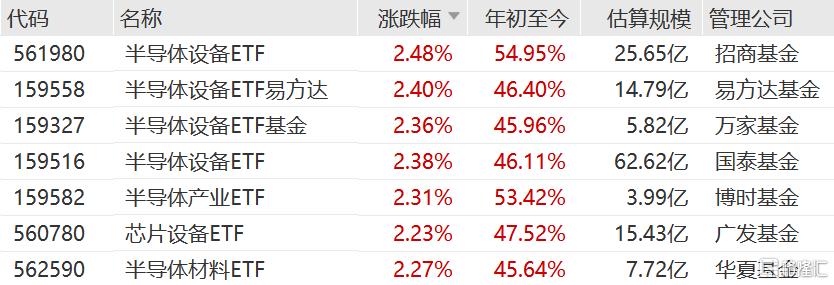
半导体设备走强,半导体设备ETF、半导体设备ETF易方达、半导体材料ETF涨超2%
Ge Long Hui A P P· 2025-11-18 05:23
Group 1: Semiconductor Equipment Market Performance - Semiconductor equipment stocks have shown strong performance, with North China Huachuang rising over 6% and Zhongwei Company increasing over 4%, leading to a rise of over 2% in various semiconductor equipment ETFs [1] - The Semiconductor Equipment ETF has a year-to-date increase of 54.95%, while other ETFs like the E Fund Semiconductor Equipment ETF and the Semiconductor Industry ETF have also shown significant gains [2] Group 2: Samsung's Strategic Moves - Samsung Electronics has reportedly increased the contract prices of certain server memory chips by up to 60% due to a supply shortage driven by the global AI data center construction boom [3] - Samsung Group plans to invest a total of 450 trillion KRW in South Korea over the next five years, including expanding semiconductor investments and establishing new production lines focused on AI data centers [4] Group 3: Semiconductor Industry Outlook - According to a report, the global semiconductor equipment market is expected to exceed 100 billion USD, with the etching equipment market projected to reach 25.61 billion USD by 2024, driven by advancements in AI, 5G, and 3D NAND technologies [5] - The semiconductor industry is experiencing structural opportunities characterized by capacity expansion and supply chain security, with a focus on high-value segments and domestic substitution [6]
A股光刻机概念股走强,同益股份、凯美特气涨停
Ge Long Hui· 2025-11-18 02:53
Core Viewpoint - The A-share market is experiencing a strong performance in the photolithography machine concept stocks, with notable gains in several companies [1] Company Performance - Tongyi Co., Ltd. reached a 20% limit up in stock price [1] - KMTQ Co., Ltd. saw a 10% increase in stock price [1] - Other companies such as Northern Huachuang, Chipsource Micro, New Lai Materials, and Jinsai Technology also experienced upward movement in their stock prices [1]

