发电

Search documents
消费回落,生产改善
Haitong Securities International· 2025-10-20 09:00
Consumption - Post-holiday consumption has shown a slight decline, with retail and wholesale automobile sales significantly dropping compared to the previous week, indicating a temporary "vacuum" in market demand after pre-holiday promotions[6] - The wholesale price index for agricultural products increased by 0.4% month-on-month, while the price of Moutai liquor has significantly decreased, reflecting a broader trend of price adjustments in consumer goods[6] - Service consumption has returned to normal levels, with a notable decline in movie attendance and tourism prices, indicating the end of the holiday "pulse" effect[7] Investment - Infrastructure investment has seen a cumulative issuance of special bonds amounting to CNY 3.81 trillion as of October 18, with an additional CNY 133.88 billion issued in October, suggesting a supportive funding environment for infrastructure projects[17] - Real estate transactions in 30 cities have shown a seasonal rebound, with first-tier and third-tier cities experiencing a narrowing of year-on-year declines, while second-tier cities have turned positive[17] Trade and Export - Domestic export prices have decreased by 4.1% month-on-month, while import prices fell by 2.2%, indicating weak demand in non-mainline shipping routes[23] - The Shanghai and Ningbo export container price indices increased by 12.9% and 16.8% respectively, reflecting a recovery in demand for mainline shipping routes post-holiday[23] Production - Most production sectors have shown improvement post-holiday, with coal consumption in coastal provinces increasing, although steel production has seen a mixed performance with some declines in output[26] - The operating rate for asphalt has slightly increased, indicating a gradual recovery in construction activities following the holiday[17] Inventory and Prices - Coal inventories at ports have significantly decreased, while cement inventory ratios have slightly increased, reflecting varying demand across sectors[36] - Consumer prices have shown a slight overall increase, while industrial prices have generally declined, with the PPI for industrial products decreasing by 1.1% month-on-month[38] Liquidity - The central bank has conducted a net withdrawal of CNY 231.9 billion to maintain liquidity stability, with the dollar index declining by 27 basis points, indicating a stable overall liquidity environment[42]
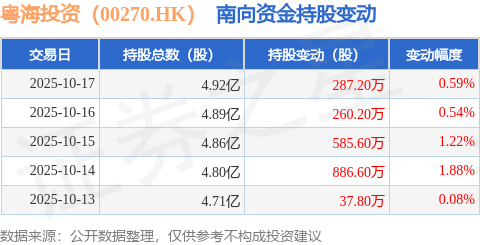
粤海投资(00270.HK):10月17日南向资金增持287.2万股
Sou Hu Cai Jing· 2025-10-17 19:24
Core Viewpoint - Southbound funds have increased their holdings in Yuehai Investment (00270.HK) by 2.872 million shares on October 17, indicating a positive trend in investor sentiment towards the company [1] Group 1: Shareholding Changes - In the last 5 trading days, southbound funds have increased their holdings for 5 days, with a total net increase of 20.574 million shares [1] - Over the past 20 trading days, southbound funds have reduced their holdings for 15 days, resulting in a total net reduction of 30.674 million shares [1] - As of now, southbound funds hold 492 million shares of Yuehai Investment, accounting for 7.51% of the company's total issued ordinary shares [1] Group 2: Daily Shareholding Data - On October 17, 2025, total shares held were 492 million, with a change of 2.872 million shares, reflecting a 0.59% increase [2] - On October 16, 2025, total shares held were 489 million, with a change of 2.602 million shares, reflecting a 0.54% increase [2] - On October 15, 2025, total shares held were 486 million, with a change of 5.856 million shares, reflecting a 1.22% increase [2] - On October 14, 2025, total shares held were 480 million, with a change of 8.866 million shares, reflecting a 1.88% increase [2] - On October 13, 2025, total shares held were 471 million, with a change of 0.378 million shares, reflecting a 0.08% increase [2] Group 3: Company Overview - Yuehai Investment Co., Ltd. primarily engages in water supply and wastewater treatment as an investment holding company [2] - The company operates through seven divisions, including water resources, property investment and development, department store operations, power generation, hotel management, toll roads and bridges, and treasury services [2]

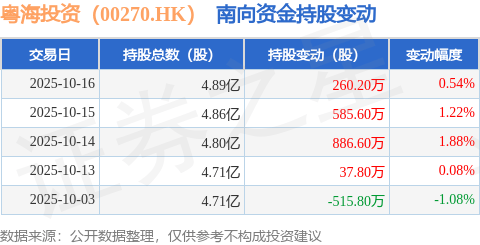
粤海投资(00270.HK):10月16日南向资金增持260.2万股
Sou Hu Cai Jing· 2025-10-16 19:27
Group 1 - The core point of the article is that southbound funds have increased their holdings in Yuehai Investment (00270.HK) by 2.602 million shares on October 16, 2025, marking a total net increase of 12.544 million shares over the last five trading days [1] - Over the past 20 trading days, southbound funds have reduced their holdings in Yuehai Investment for 16 days, resulting in a cumulative net reduction of 34.428 million shares [1] - As of now, southbound funds hold 488.9 million shares of Yuehai Investment, accounting for 7.47% of the company's total issued ordinary shares [1] Group 2 - The total number of shares held by southbound funds on October 16, 2025, is 488.9 million, with a change of 2.602 million shares, reflecting a change of 0.54% [2] - The previous trading days show a pattern of increasing holdings, with 5.856 million shares added on October 15, 2025, and 8.866 million shares on October 14, 2025, indicating a positive trend in recent days [2] - Yuehai Investment operates primarily in water supply and sewage treatment, with multiple business segments including water resources, property investment and development, department store operations, power generation, hotel management, and toll road operations [2]
【广发宏观贺骁束】10月经济初窥
郭磊宏观茶座· 2025-10-16 13:57
Group 1 - The travel market showed a rebound in demand during the holiday period, with a total of 8.88 billion domestic trips made during the National Day and Mid-Autumn Festival holiday, an increase of 1.23 billion trips compared to the previous year [1][7] - Consumer spending remained stable, with service consumption outperforming goods consumption. Retail and catering sales during the holiday increased by 2.7% year-on-year, while daily sales in consumption-related industries grew by 4.5% [1][8] - Power generation increased significantly in early October, with coal-fired power plants reporting a 9.1% year-on-year increase in output, contrasting with a 12.6% decline in September [1][10] Group 2 - Industrial operating rates showed mixed results, with PVC operating rates continuing to rise by 5.0 percentage points year-on-year [2][11] - Steel production experienced a slight negative growth of 0.83% year-on-year, with rebar production decreasing by 15.0% year-on-year [2][12] - The asphalt operating rate increased slightly, reaching 35.2% in mid-October, up 6.4 percentage points year-on-year, likely due to the acceleration of major projects [3][14] Group 3 - Real estate sales remained weak, with a 25.8% year-on-year decline in average daily transactions in major cities during the first half of October [3][15] - Passenger vehicle retail sales fell by 8% year-on-year in early October, influenced by a high base effect from the previous month [4][17] - Home appliance sales continued to decline, with offline sales of air conditioners, refrigerators, and washing machines dropping significantly [4][18] Group 4 - Port container throughput remained relatively strong, with a 7.6% year-on-year increase in container throughput from September 29 to October 12 [4][19] - Industrial product prices remained stable, while consumer product prices showed divergence, with energy prices declining and some consumer goods experiencing price drops [4][22] - The first half of October highlighted active holiday travel and service consumption, while real estate sales continued to be weak [4][26]

美科技巨头的AI能源突围战
Guo Ji Jin Rong Bao· 2025-10-16 12:11
Core Insights - A significant shift towards self-sufficient power generation is occurring in the tech industry, driven by the need for substantial energy to support AI and data center operations, as exemplified by projects like OpenAI and Oracle's $500 billion Stargate supercomputing center in Texas and Elon Musk's xAI data centers in Tennessee [1][2]. Group 1: Power Generation Demand - The U.S. requires an additional 80 gigawatts of power capacity annually to meet the demands of AI, cloud computing, and other sectors, but current construction is only at 65 gigawatts, creating a significant shortfall [2][3]. - By 2028, data centers are projected to consume 12% of the total U.S. electricity, up from just 2% in 2020, indicating a rapid increase in energy demand [2][3]. Group 2: Infrastructure Challenges - The construction of high-voltage transmission lines has drastically slowed, with only 888 miles added last year compared to an average of 2,000 miles a decade ago, complicating the energy supply for data centers [3][6]. - Equipment shortages and labor issues, exacerbated by tariffs on steel and aluminum, are hindering the progress of energy projects [3][6]. Group 3: Self-Sufficiency Initiatives - Tech companies are increasingly investing in their own power generation solutions, utilizing small gas turbines, reciprocating engines, and fuel cells to create energy systems comparable to large power plants [4][5]. - The Stargate project in Texas is expected to exceed 1 gigawatt of power capacity, equivalent to the energy consumption of San Francisco [4]. Group 4: Regulatory and Market Dynamics - Some states, like Oklahoma, are enacting laws to facilitate the construction of self-built power facilities to attract AI companies [5][6]. - Despite a focus on renewable energy, the current administration's policies may lead to a decline in investments in wind and solar projects, with over $22 billion in renewable energy projects canceled or scaled back this year [6][7]. Group 5: Future Energy Solutions - Companies like Equinix are exploring partnerships with small modular reactor developers to diversify their energy sources amid policy uncertainties [7]. - Caterpillar is investing $725 million to expand its Indiana facility to meet the growing demand for engines and turbines, indicating a shift towards more flexible energy solutions [7].


中国神华(601088) - 中国神华2025年9月份主要运营数据公告
2025-10-16 09:45
证券代码:601088 证券简称:中国神华 公告编号:临 2025-060 中国神华能源股份有限公司 2025 年 9 月份主要运营数据公告 中国神华能源股份有限公司("本公司")董事会及全体董事保证本公告内 容不存在任何虚假记载、误导性陈述或者重大遗漏,并对其内容的真实性、准确 性和完整性承担法律责任。 以上主要运营数据来自本公司内部统计。运营数据在月度之间可能存在较大 差异,其影响因素包括但不限于天气变化、设备检修、季节性因素和安全检查等。 1 运营数据可能与相关期间定期报告披露的数据有差异。投资者应注意不恰当信赖 或使用以上信息可能造成投资风险。 承中国神华能源股份有限公司董事会命 总会计师、董事会秘书 宋静刚 2025 年 10 月 17 日 2 | 运营指标 | 单位 | 2025 | 年 | 2024 | 年 | 同比变化 | | | --- | --- | --- | --- | --- | --- | --- | --- | | | | | | (重述后) | | (%) | | | | | 月 9 | 累计 | 月 9 | 累计 | 月 9 | 累计 | | (一)煤炭 | | | | | ...

中国大唐集团推动在蒙资产整合
Zhong Guo Dian Li Bao· 2025-10-16 01:55
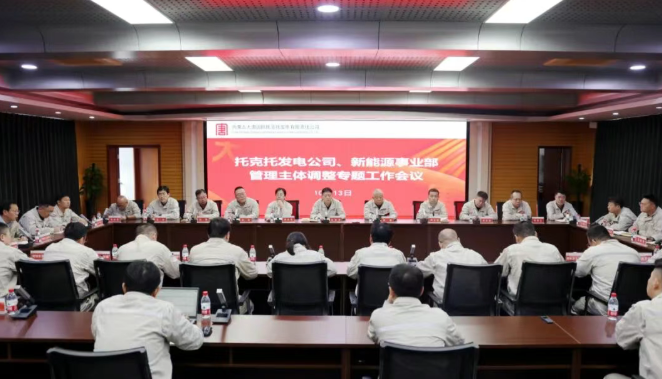
Core Viewpoint - China Datang is restructuring its power generation assets in Inner Mongolia, with the management of the world's largest operational thermal power plant, the Tuo Ke Tuo Power Plant, being transferred to Datang Inner Mongolia Company [1] Group 1: Strategic Development - Datang Inner Mongolia Company is identified as a key regional power generation company for Datang Group, emphasizing the need to seize strategic development opportunities and enhance major project construction such as "Mengdian into Su" [4] - The restructuring of power generation assets in Inner Mongolia is a strategic measure to create scale advantages and enhance Datang's core competitiveness in the region [4] Group 2: Management and Operational Transition - Specific requirements for a smooth transition of management responsibilities have been outlined, including the clear transfer of safety production responsibilities and seamless integration of management functions [5] - The Tuo Ke Tuo Power Company held a special meeting to discuss the management adjustment, emphasizing the importance of this strategic change and the role of Datang Inner Mongolia Company in supporting major energy projects [5]
17亿租10年!3GWh储能电站租赁协议签订
中关村储能产业技术联盟· 2025-10-13 09:41
Core Viewpoint - The announcement details a financing lease arrangement between China Development Bank Financial Leasing Co., Ltd. (国银金租), Baotou Tuyou BoSi New Energy Technology Co., Ltd. (承租人), and China Power Construction Group Hubei Engineering Co., Ltd. (卖方), involving the purchase and lease of energy storage equipment valued at approximately RMB 1.76 billion [2][3][13]. Financing Lease Arrangement - The financing lease arrangement includes a purchase agreement where the company will buy the energy storage equipment for RMB 1.7 billion and lease it back to the tenant for a period of 120 months [8][9]. - The total interest payable over the lease term is approximately RMB 380 million, with payments made semi-annually [3][18]. Company Profile - China Development Bank Financial Leasing Co., Ltd. is a non-bank financial institution with a registered capital of RMB 12.642 billion, making it the largest financial leasing company in China by registered capital and asset size [4][5]. - The company was established in 1984 and transformed into a joint-stock company in 2015, focusing on providing comprehensive leasing services across various sectors, including green energy [22]. Tenant and Seller Information - The tenant, Baotou Tuyou BoSi New Energy Technology Co., Ltd., is a wholly-owned subsidiary of Baotou Tuyou Bojun New Energy Technology Co., Ltd., primarily engaged in power generation [5][23]. - The seller, China Power Construction Group Hubei Engineering Co., Ltd., is a state-owned enterprise involved in construction engineering [24][27]. Transaction Disclosure - The transaction is classified as a discloseable transaction under the listing rules, as the applicable percentage ratio is above 5% but below 25%, requiring compliance with relevant disclosure regulations [25].

福能转债定价:首日转股溢价率27%-32%
NORTHEAST SECURITIES· 2025-10-13 03:16
1. Report Industry Investment Rating No relevant content provided. 2. Core View of the Report - The target price of Funeng Convertible Bonds on the first - day of listing is expected to be between 131 - 137 yuan, and investors are advised to actively subscribe. The estimated first - day new - bond subscription winning rate is around 0.0135% - 0.0163%. The bond has high issuance scale, good liquidity, good rating, and good bond floor protection, and there is no objection to primary participation [3][4][19][20] 3. Summary According to Related Catalogs 3.1. Funeng Convertible Bonds New - Bond Analysis and Investment Recommendations 3.1.1. Convertible Bond Basic Terms Analysis - The issuance methods of Funeng Convertible Bonds are priority placement and online issuance. The bond and the issuer's ratings are both AA+. The issuance scale is 3.802 billion yuan, the initial conversion price is 9.84 yuan. As of October 10, 2025, the convertible bond parity is 103.46 yuan, the calculated pure bond value is 94.95 yuan. The game terms (down - revision, redemption, and put - back clauses) are normal. Overall, the bond has high issuance scale, good liquidity, good rating, and good bond floor protection, and it is not difficult for institutions to include it in their portfolios [2][15] 3.1.2. New - Bond Initial Listing Price Analysis - The target price of Funeng Convertible Bonds on the first - day of listing is 131 - 137 yuan. Considering the current market environment and parity level, the conversion premium rate on the first - day of listing is expected to be in the range of [27%, 32%] [3][19] 3.1.3. Convertible Bond New - Bond Subscription Winning Rate Analysis - The estimated first - day new - bond subscription winning rate is around 0.0135% - 0.0163%. Assuming the old shareholders' placement ratio is 65% - 71%, the scale available for the market is 1.095 - 1.326 billion yuan. Assuming the number of effective online subscriptions is 8.13 million households, the winning rate is calculated based on full subscription [4][20] 3.2. Underlying Stock Fundamental Analysis 3.2.1. Company's Main Business and Up - and Down - Stream Industry Situations - The company is mainly engaged in the production and sales of electricity, heat, and industrial textiles, with electricity products as the mainstay. The power generation industry's upstream includes power design, power equipment manufacturing, and engineering construction. The downstream is mainly power grid companies. The raw materials for industrial textiles are market - oriented, and its downstream industries are diverse and expanding [21][22] 3.2.2. Company's Operating Conditions - From 2022 to H1 2025, the company's operating income was 14.318 billion yuan, 14.695 billion yuan, 14.563 billion yuan, and 6.369 billion yuan respectively, with year - on - year growth rates of 17.79%, 2.63%, - 0.90%, and - 4.44%. The comprehensive gross margin increased steadily from 23.93% in 2022 to 28.31% in H1 2025, and the net profit margin also showed an upward trend. The company's period expenses remained stable, and R & D expenses were relatively stable. The accounts receivable increased due to slow subsidy payments, and the accounts receivable turnover rate decreased. The net profit attributable to the parent company increased steadily [25][28][30] 3.2.3. Company's Equity Structure and Main Subsidiaries - As of June 30, 2025, Fujian Energy Group Co., Ltd. was the largest shareholder, holding 1.536 billion shares (55.25% of the total shares). The top two shareholders' combined shareholding ratio was 65.13%, and the top ten shareholders' combined shareholding ratio was 71.19%. The actual controller of the company is the State - owned Assets Supervision and Administration Commission of Fujian Provincial People's Government [43] 3.2.4. Company's Business Characteristics and Advantages - The company has market position and scale advantages, as it is a leading wind - power company in Fujian, with its power generation business installation scale ranking among the top in Fujian. It has unit quality advantages, with a diversified energy structure mainly composed of thermal power, wind power, and photovoltaic power. It also has project reserve advantages, with many under - construction and reserve projects [50] 3.2.5. Allocation of Current Fund - Raising - After deducting issuance fees, 2.5 billion yuan of the raised funds is planned to be used for the 2×660MW ultra - supercritical cogeneration project in Quanhuixin Petrochemical Industrial Zone (total investment: 6.986 billion yuan), and 1.302 billion yuan for the Fujian Xianyou Mulan Pumped - storage Power Station Project (total investment: 8.383 billion yuan) [13][49]

民用工业衰退严重!炼油厂不断被炸,俄罗斯石油出口已接近最大值
Sou Hu Cai Jing· 2025-10-12 09:22
Group 1 - The ongoing overheating of the military industry is exacerbating the decline of Russia's civilian industries, particularly in bank loans and labor attraction [1] - Major industrial companies in Russia are placing employees on leave or laying them off due to a slowdown in the war economy, stagnant domestic demand, and depleted exports, affecting sectors from railways and automobiles to metals, coal, diamonds, and cement [1] - The largest cement manufacturer in Russia, Cemros, has extended its four-day workweek policy until the end of the year to preserve all employees amid declining cement demand, which is expected to be less than 60 million tons this year, similar to the pandemic period [4] Group 2 - The Russian economy's non-military sectors have shrunk by 5.4% since the beginning of the year, with GDP growth forecasted to slow significantly to between 0.7% and 1.0% for the year [4] - Labor issues are emerging even in state-owned enterprises, with reports of over 60 workers at a power plant staging a strike due to months of unpaid wages, highlighting legal protections for workers in Russia [4] - The energy sector, a pillar of the Russian economy, is facing increased sanctions from the West and ongoing direct sanctions from Ukraine, impacting its operational capacity [5] Group 3 - Continuous attacks from Ukraine are causing a decline in Russian refining capacity, forcing the country to sell more oil at lower prices, with major oil export ports nearing historical maximum levels [7] - In August, profits from energy sales in Russia dropped to the lowest level since 2022, averaging €546 million per day [10] - Goldman Sachs predicts a 10% decline in Russian oil production by next year, from 9.3 million barrels per day to 8.4 million barrels per day, due to ongoing pressures on refining capacity and high benchmark interest rates [11]