
水泥

Search documents
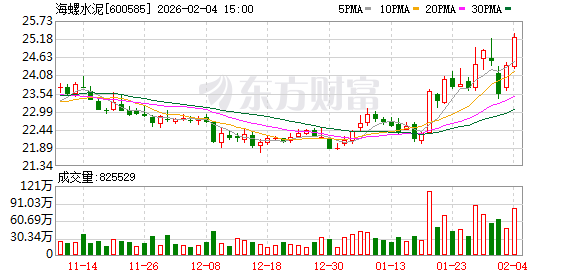
海螺水泥控股子公司4.34亿元项目环评获同意
Mei Ri Jing Ji Xin Wen· 2026-02-04 10:07
Group 1 - The core viewpoint of the article highlights that Conch Cement's subsidiary, Zhenjiang Conch Cement Co., Ltd., has received approval for an environmental impact assessment for its new projects, which include a 2 million-ton new environmentally friendly cement grinding station and a 1.2 million cubic meter high-end commercial concrete facility [2] - The total investment for the approved projects amounts to 434 million yuan [2] - The approval information was disclosed by relevant regulatory authorities on January 22, 2026 [2]

青松建化:约2.26亿股限售股2月11日解禁
Sou Hu Cai Jing· 2026-02-04 10:07
Group 1 - Company Qing Song Jian Hua announced that approximately 226 million restricted shares will be unlocked and listed for circulation on February 11, 2026, accounting for 14.08% of the company's total share capital [1]

水泥板块2月4日涨2.79%,韩建河山领涨,主力资金净流出9660.22万元
Zheng Xing Xing Ye Ri Bao· 2026-02-04 08:57
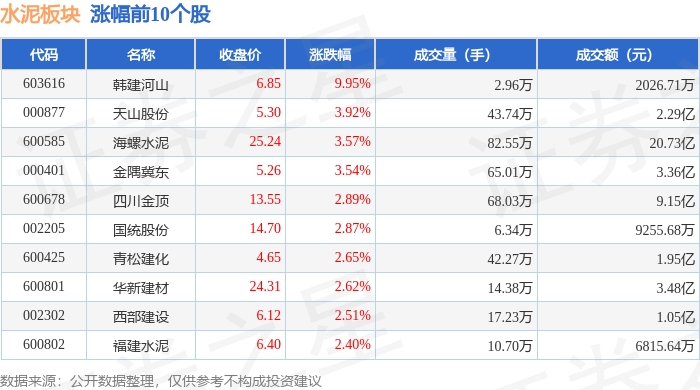
Market Performance - The cement sector increased by 2.79% compared to the previous trading day, with Hanjian Heshan leading the gains [1] - The Shanghai Composite Index closed at 4102.2, up 0.85%, while the Shenzhen Component Index closed at 14156.27, up 0.21% [1] Individual Stock Performance - Hanjian Heshan (603616) closed at 6.85, with a rise of 9.95% and a trading volume of 29,600 lots [1] - Tianshan Shares (000877) closed at 5.30, up 3.92%, with a trading volume of 437,400 lots [1] - Conch Cement (600585) closed at 25.24, increasing by 3.57%, with a trading volume of 825,500 lots [1] - Other notable stocks include Jinyu Modong (000401) at 5.26 (+3.54%), Sichuan Jinding (600678) at 13.55 (+2.89%), and Guotong Shares (002205) at 14.70 (+2.87%) [1] Capital Flow Analysis - The cement sector experienced a net outflow of 96.60 million yuan from institutional investors, while retail investors saw a net inflow of 79.28 million yuan [1] - The capital flow for individual stocks shows that Sichuan Jinding had a net inflow of 43.37 million yuan from institutional investors, but a net outflow of 27.60 million yuan from retail investors [2] - Hanjian Heshan had a significant institutional net inflow of 15.74 million yuan, but also faced a retail net outflow of 9.54 million yuan [2]



地方两会收官:GDP目标之外的信号
Guolian Minsheng Securities· 2026-02-04 06:57
其二,经济大省将"卯足劲"搞科技。随着中央经济工作会议将我国国际科技创 新中心布局从北京、上海、大湾区,拓围至京津冀、长三角、大湾区三大区域, 2026 年这些地区在政府工作报告中,几乎"清一色"将打造科技创新中心集群置 于全年工作的最领先位置,显示出区域协同创新已成为驱动高质量发展的核心战 略。 当然,"卯足劲"搞科技的同时,还要沉下心来"反内卷"。有趣的是,这些承担 国际科技创新中心建设任务的核心地区,在 2026 年几乎都专门部署了"反内卷" 工作,而许多其他省份则未将其列为重点。可见在创新高地,构建清朗、高效、 可持续的科研与产业生态的重要作用。 其三,地方的"促消费"虽然作为重点工作部署,但并非当务之急。尽管各地均对 国家层面提出的消费品以旧换新、清理消费领域不合理限制、丰富服务消费供给 等政策进一步落实安排,但对比 2025 年地方政府工作报告来看,今年各地对"扩 内需、促消费"相关任务的次序安排,多数保持稳定或有所后移(包括我们此前 报告《提升消费率:中国的四类画像》提到的"乐于消费型"的广东、浙江,其 2026 年工作报告均将内需的工作次序下调)。 在 2026 年开局工作中,地方政府仍将有限 ...
1月高频数据跟踪
LIANCHU SECURITIES· 2026-02-04 06:02
证券研究报告 宏观经济点评 2026 年 02 月 04 日 1 月高频数据跟踪 [Table_Author] 魏争 分析师 Email:weizheng@lczq.com 证书:S1320524100001 摘要: 生产端看,开工率边际回暖,工业品库存、产能利用率分化。开工率方 面,1 月,247 家高炉开工率 78.96%,略有抬升,但仍偏弱;电炉开工 率、螺纹钢开工率分别为 62.44%、38.77%,高于上月均值。水泥磨机开 工率为 27.92%,较上月回落;除沥青外,化工品开工率普遍回升:石油 沥青开工率均值为 26.23%,低于上月;纯碱、PVC、PTA 开工率均值分 别为 84.36%、79.12%、76.10%,均较上月明显提升。库存方面,冷 轧、热卷、浮法玻璃去库,环比增速分别为-3.58%、-7.91%、-7.63%, 螺纹钢、铁矿石、炼焦煤库存上升,环比增速分别为 4.57%、6.65%、 0.36;水泥库容比、水泥发运率环比回落,环比分别为-4.28%、 10.93%。产能利用率方面,焦化产能利用率略下降,录得 76.38%;电炉 产能利用率为 53.74%,较上期均值略提升;水泥熟料 ...
以“反内卷”促“企业合理利润率”
Guoxin Securities· 2026-02-04 03:14
以"反内卷"促"企业合理利润率" 证券研究报告 | 2026年02月03日 2026年02月04日 目录 01 本轮内卷式竞争的起源与表现 02 本轮内卷式竞争的宏微观影响 03 企业合理利润率—宏观增长的微观动因 请务必阅读正文之后的免责声明及其项下所有内容 导言 请务必阅读正文之后的免责声明及其项下所有内容 证券分析师:董德志 02160933158 dongdz@guosen.com.cn S0980513100001 请务必阅读正文之后的免责声明及其项下所有内容 Ø "内卷式"竞争的起源及表现 • 新范式下,需求偏弱与同质化扩张让存量市场竞争加速,企业内卷成为典型症候 Ø "内卷式"竞争的宏微观影响 • 一方面直接压低价格、挤压企业利润率,另一方面间接抑制消费与创新 Ø "内卷式"竞争如何破解? • 短期来看,仍需依靠行政协调破除地方保护与行业壁垒, "反内卷"还要继续 • 长期来看,更应抓住"宏观问题"背后的"微观动因" ,以企业合理利润率为政策锚,助推政府、企业、居民、 资本市场进入良性循环,搭建宏微观桥梁 Ø 为什么要以利润率为锚? • 合理利润率既防止"倾销"引发恶性内卷的底线,也约束"垄断" ...
华新建材获股东增持1546.87万股 2025年业绩预喜净利润最高29.5亿
Chang Jiang Shang Bao· 2026-02-04 00:04
Core Viewpoint - Huanxin Building Materials continues to signal its commitment to a global development strategy through significant share buybacks by major shareholders and management, reflecting confidence in the company's future prospects and long-term value [2][5]. Shareholder Actions - Huanxin Group, a major shareholder, increased its stake in Huanxin Building Materials by acquiring 15.4687 million shares, representing 0.74% of the total share capital, from January 12 to February 2, 2026 [3][4]. - Following this transaction, Huanxin Group's ownership rose from 16.26% to 17.00%, totaling 354 million shares [3]. - The total expenditure for this share acquisition was approximately 380 million yuan, based on an average transaction price of 24.7 yuan per share [4]. Management Confidence - Eleven executives of Huanxin Building Materials collectively purchased 2.578 million shares, demonstrating their confidence in the company's growth, with total expenditures around 22.9442 million yuan [4]. - The CEO, Li Yeqing, personally acquired 915,900 shares, investing approximately 8.1515 million yuan [4]. Financial Performance - Huanxin Building Materials forecasts a net profit of 2.7 billion to 2.95 billion yuan for 2025, an increase of 280 million to 530 million yuan compared to the previous year, reflecting a year-on-year growth of 11.6% to 21.9% [6][7]. - The company expects a non-net profit of 2.58 billion to 2.76 billion yuan, indicating a significant increase of 800 million to 980 million yuan, or 45% to 55% year-on-year [6]. Business Strategy and Growth - The company has successfully transitioned from a cement manufacturer to a comprehensive building materials service provider, enhancing its profitability through diversified operations [2][6]. - Huanxin Building Materials has seen a 15.37% year-on-year increase in revenue from its overseas cement business, contributing 4.128 billion yuan to the overall revenue [7].

上峰水泥(000672):新质生产力系列:水泥现金牛第二曲线拓展加速,有望迈向综合硅基材料企业
East Money Securities· 2026-02-03 13:12
Investment Rating - The report maintains a rating of "Buy" for the company [6] Core Insights - The company is positioned as a cash cow in the cement industry, with a strong focus on cost control and profitability, leading to a competitive edge in the market [4][48] - The company is expanding into the semiconductor sector, with financial investments expected to yield returns starting in 2026, enhancing overall profitability [59][60] - The company aims to develop a dual-driven business model combining construction materials and equity investments, targeting a new growth curve in silicon-based materials [32][59] Summary by Sections Company Overview - The company, established in 1978, has a mixed ownership structure that combines the flexibility of private enterprises with the resources of state-owned enterprises, enhancing its competitive position [14] - As of Q3 2025, the company has a market capitalization of approximately 14.49 billion yuan and a significant cash reserve of 3.1 billion yuan, supporting its investment strategies [4][25] Cement Industry Analysis - The cement industry is expected to see improvements in supply-demand dynamics due to capacity replacement policies and government support for infrastructure projects [33][41] - The company has successfully implemented a T-shaped strategy similar to that of Conch Cement, leading to industry-leading cost and profit margins [48][49] Financial Performance - Revenue projections for 2025-2027 are estimated at 5.43 billion, 5.57 billion, and 5.72 billion yuan, with net profits expected to grow significantly during this period [6][7] - The company has a high dividend payout ratio, with a projected dividend of 6 billion yuan for 2024, reflecting a strong commitment to shareholder returns [5][27] Investment Strategy - The company has invested in over 20 semiconductor firms since 2020, focusing on various sectors within the semiconductor industry, which is anticipated to contribute significantly to profits in the coming years [59][60] - The establishment of a partnership with Lanpu Venture Capital aims to further enhance the company's investment capabilities in the semiconductor space [32][59]

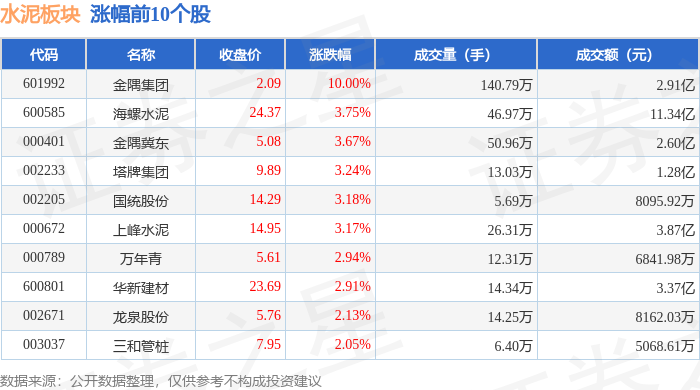
水泥板块2月3日涨2.9%,金隅集团领涨,主力资金净流入1.34亿元
Zheng Xing Xing Ye Ri Bao· 2026-02-03 09:03
Group 1 - The cement sector experienced a 2.9% increase on February 3, with Jinju Group leading the gains [1] - The Shanghai Composite Index closed at 4067.74, up 1.29%, while the Shenzhen Component Index closed at 14127.1, up 2.19% [1] - Key stocks in the cement sector showed significant price increases, with Jinju Group rising by 10.00% to a closing price of 2.09 [1] Group 2 - The cement sector saw a net inflow of 134 million yuan from main funds, while retail investors experienced a net outflow of 92.23 million yuan [1] - Main fund inflows varied across companies, with Jinju Group receiving 116 million yuan, representing 39.86% of its trading volume [2] - Other notable companies included Conch Cement with a main fund inflow of 80.85 million yuan, and Jinyu Modong with 28.98 million yuan [2]
国联民生证券:预计25Q4玻纤收入利润高增 传统建材业绩承压
智通财经网· 2026-02-03 07:25
Group 1: Cement Industry - The demand for cement in developing countries is steadily increasing, with a favorable competitive landscape, leading to significantly higher profit per ton compared to domestic markets. Companies actively expanding into overseas markets are expected to perform better [1] - The domestic cement market is expected to face pressure in Q4 2025, while overseas performance is anticipated to be stronger. Non-operating projects may impact profits [1] - Cement prices and profits are expected to stabilize in 2025, with a slight seasonal rebound in Q4 2025 due to a temporary increase in coal prices. However, year-on-year pressure on prices and profits is expected in Q4 2025 [1] Group 2: Glass Industry - The float glass industry is experiencing a bottoming out phase, with weak downstream demand leading to continued losses. Some small to medium enterprises are reducing production, resulting in a slight decrease in capacity [2] - The photovoltaic glass segment is expected to see a decrease in volume but an increase in price in Q4 2025, leading to significant pressure on revenue and profits. The demand for photovoltaic glass is expected to be impacted by earlier demand surges [2] Group 3: Glass Fiber Industry - The glass fiber sector is projected to experience high growth in revenue and profits in 2025, driven by strong demand in wind power and thermoplastics. Domestic net demand for glass fiber is expected to reach 5.48 million tons in 2025, a year-on-year increase of 19% [3] - High-end electronic fabric is expected to see a simultaneous increase in both price and volume, benefiting companies with a first-mover advantage. The price of 7628 electronic fabric is projected to be 4.1 yuan per meter in 2025, a year-on-year increase of 9% [3] Group 4: Renovation and Building Materials - The renovation and building materials sector is expected to face continued pressure in 2025, with significant declines in housing starts, completions, and sales. The year-on-year declines for these metrics are projected to be 21%, 18%, and 8%, respectively [4] - The competitive landscape in the renovation and building materials sector is intensifying, with many companies exploring new business avenues to maintain resilience in performance [4]
