
航运业

Search documents
中远海控11月28日斥资3978.25万港元回购300万股
Zhi Tong Cai Jing· 2025-11-28 09:51
Group 1 - The company, COSCO Shipping Holdings (中远海控), announced a share buyback plan on November 28, 2025, involving an expenditure of HKD 39.7825 million to repurchase 3 million shares at a price range of HKD 13.22 to HKD 13.37 per share [1]

交运行业2026年度投资策略要点汇报
2025-11-28 01:42
Summary of Key Points from Conference Call Records Industry Overview - **Transportation Industry**: The report focuses on the transportation sector, particularly the aviation and shipping industries, with a positive outlook for 2026 [1][2][3]. Core Insights and Arguments Aviation Industry - **Optimistic Outlook**: The aviation sector is expected to perform well in 2026, with passenger load factors reaching historical highs (e.g., 87% for major airlines like China Southern and China Eastern, and over 90% for Spring Airlines) [3][4]. - **Profit Potential**: A 10% increase in ticket prices for airlines with revenues around 100 billion can lead to a profit increase of approximately 10 billion [1][3]. - **Supply Chain Constraints**: The global aircraft supply chain is anticipated to remain tight due to limited participants in the manufacturing market and challenges in scaling production [4]. - **Demand Drivers**: Increased consumer policies and travel demand are expected to significantly boost service consumption, particularly in cultural and tourism sectors [4]. Shipping Industry - **Market Segments to Watch**: Focus on cruise, bulk cargo, and container shipping markets, with cruise rates exceeding $100,000 per day, driven by oil production cycles and sanctions [5][6]. - **Capacity Constraints**: The shipping industry faces limited capacity growth due to low order backlogs since 2022, leading to a strong growth outlook [5][6]. - **Oil Tanker Market**: High percentage of aging vessels (20 years or older) necessitates increased scrapping, with every $10,000 rise in rates potentially adding over 1 billion in profits for companies like COSCO Shipping Energy [8]. - **Dry Bulk Market**: The Simandou iron ore project is expected to significantly increase transportation demand, with production projected to reach 20 million tons by 2026 and 80 million tons by 2028 [8]. Dividend Assets - **Return Expectations**: Dividend assets are projected to revert to mean returns around 10% in 2026, driven by 5% earnings growth and a 4-5% dividend yield [9][10]. - **Highway Sector Stability**: The highway sector is expected to maintain stable operations, with dividend yields projected between 4.5-5% for companies like Sichuan Chengyu and Shandong Highway, and potentially over 6% for Hong Kong-listed firms [10]. Port Sector - **Strategic Importance**: Ports are highlighted as strategic global assets, with companies like China Merchants Port showing upward momentum due to their current undervaluation [11]. Express Delivery Industry - **Market Adjustments**: The express delivery sector, particularly the Tongda system, is positioned for growth following adjustments and the "anti-involution" policy, which is expected to enhance industry quality and profitability [12]. Additional Important Insights - **Investment Recommendations**: Key companies to watch include major airlines (Air China, China Eastern, China Southern), and shipping firms like COSCO Shipping and China Merchants Energy, as well as express delivery leaders like YTO Express and ZTO Express [6][12]. - **Overall Investment Focus**: The report emphasizes the importance of sectors with upward performance potential, such as aviation, shipping, and express delivery, alongside dividend assets that are expected to recover in the economic recovery context [13].
可持续方法论|以《国际绿色航运走廊合作倡议》为契机,加速航运脱碳
Xin Lang Cai Jing· 2025-11-27 06:19
Core Viewpoint - The global shipping industry, responsible for over 80% of goods transport, faces significant challenges in reducing greenhouse gas emissions, which currently account for about 2%-3% of global emissions. The International Maritime Organization warns that emissions could rise to 1.5-3.5 times the 2008 levels by 2050, necessitating a systemic transformation in fuel alternatives, energy efficiency, and infrastructure connectivity [1][3]. International Progress and Policy Landscape - The EU has introduced the FuelEU Maritime initiative under the "Fit for 55" framework, aiming to progressively tighten greenhouse gas intensity limits for marine fuels, targeting a 2% reduction by 2025 and an 80% reduction by 2050 compared to 2020 levels. This encourages investments in renewable fuels and low-carbon technologies [3]. - The EU Emissions Trading System (EU ETS) includes shipping, providing a carbon price signal to enhance marginal abatement costs, prompting companies to balance energy efficiency improvements, fuel alternatives, and operational optimizations [3]. - Over 60 green shipping corridor projects have been announced or planned globally, although only one-third have progressed to feasibility studies or pilot phases due to high initial investment costs and lack of standardization [3]. China's Policy and Engineering Practices - Since the 14th Five-Year Plan, China has been enhancing its top-level design for green and low-carbon transformation in transportation, with a focus on the shipping industry's green and digital development [4]. - Approximately 60 automated terminals have been established, with significant advancements in shore power usage, reaching nearly 200 million kilowatt-hours. Shanghai is a leader in LNG and methanol dual-fuel refueling [4]. - The "Green Development Action Plan for Shipbuilding Industry (2024-2030)" aims to integrate green and low-carbon improvements across the entire lifecycle of ships, promoting collaboration across the industry [4]. Insights from the International Green Shipping Corridor Cooperation Initiative - The initiative emphasizes voluntary and open collaboration among governments, ports, shipping companies, and fuel suppliers, proposing seven measures to enhance clean fuel application and infrastructure development [5][6]. - It aims to create a closed-loop mechanism linking policy, technology, infrastructure, and market dynamics to facilitate the transition from demonstration projects to large-scale implementation [6]. - The initiative advocates for a collaborative supply chain for clean fuels, addressing the current fragmentation and promoting long-term contracts and joint investments [6]. Technological and Standardization Collaboration - The initiative highlights the need for technological and standardization collaboration to reduce systemic costs and support large-scale replication of clean fuel technologies [7]. - It calls for the establishment of a mutual recognition certification system for sustainable shipping fuels, which would streamline regulatory processes and reduce compliance costs [7]. Fair Transition and Global Cooperation - The initiative stresses the importance of equitable transition principles, supporting developing countries in upgrading port infrastructure and localizing green fuel production [8]. - It suggests exploring demonstration projects in emerging shipping routes and enhancing multilateral financing and technical cooperation to ensure broader participation in the global corridor network [8]. - By operationalizing fairness through funding, technology, and institutional arrangements, the initiative aims to ensure that the benefits of green transformation are widely distributed, promoting sustainable and equitable progress in the global shipping industry [8].


永安期货集运早报-20251126
Yong An Qi Huo· 2025-11-26 03:06
1. Report Industry Investment Rating No relevant content provided. 2. Core Viewpoints of the Report - Due to the price cut in week49 and Maersk's low - opening expectation for week50, the near - month contract disk dropped significantly. The FC2512 contract is moving towards the delivery logic and follows the spot price, with P1 around 1600 points, and P2 and P3 corresponding to the second half of December. Observe the shipping companies' price increase announcements and implementation [2][13]. - The valuation of the EC2602 contract is moderately low. It's difficult to prove or disprove the off - peak season in the short term, especially when the price support in early December was not ideal. This year, the Chinese New Year is late, and pre - Spring Festival shipments have not fully started, so it's normal that the price has not significantly recovered. The overall cargo volume on the European route this year is good. Although the shipping capacity is high from December to January, if the peak season is gradually realized later, the EC2602 contract may have more upside potential, and an overly pessimistic outlook is not given. Subsequently, observe the cargo - booking situation [2][13]. - For the EC2604 contract, a short - selling approach on rallies is still recommended [2][13]. 3. Summary by Related Catalogs 3.1 Futures Contract Data - **Contract Prices and Changes**: The closing prices of FC2512, EC2602, EC2604, EC2606, EC2608, and EC2610 on the previous day were 1650.0, 1453.5, 1126.4, 1338.0, 1464.0, and 1108.0 respectively, with price changes of - 7.29%, - 7.34%, - 1.37%, - 1.49%, - 1.62%, and - 0.18% respectively [2][13]. - **Trading Volume and Open Interest**: The previous trading volumes of FC2512, EC2602, EC2604, EC2606, EC2608, and EC2610 were 6884, 51412, 5004, 272, 171, and 563 respectively, and the open interests were 6454, 48279, 17016, 1629, 1399, and 2556 respectively, with changes in open interest of - 403, 4946, 920, 95, 74, and 65 respectively [2][13]. - **Month - spread Data**: The month - spreads of EC2512 - 2504, EC2512 - 2602, and EC2502 - 2604 on the previous day were 523.6, 196.5, and 327.1 respectively, with daily changes of - 114.0, - 14.6, and - 99.4 respectively, and weekly changes of - 81.0, 130.2, and - 211.2 respectively [2][13]. 3.2 Spot Market Data - **Spot Indexes**: The SCHI (European route) index on November 24, 2025, was 1639.37 US dollars/TEU, with a period - on - period increase of 20.75% and a previous - period decrease of - 9.78%. The CCFI index on November 21, 2025, was 1432.96 points, with a period - on - period increase of 2.09% and a previous - period increase of 2.69%. The NCFI index on November 21, 2025, was 951.65 points, with a period - on - period decrease of - 2.83% and a previous - period increase of 7.42% [2][13]. - **Recent Spot Situation**: The overall average price of week48 was about 2200 US dollars (equivalent to about 1540 points on the disk). In week49, the offline quotes of the GEMINI and PA alliances were between 2300 - 2500 US dollars, and that of the OA alliance was between 2300 - 2600 US dollars, with an average of about 2400 US dollars (equivalent to about 1650 points on the disk). Subsequently, OOCL reduced the price to 2530 US dollars, CMA to 2645 US dollars, HPL to 2300 US dollars, and OOCL to 2300 US dollars. Maersk opened the cabin at 2200 US dollars for week50 [3][14]. 3.3 Related News - On November 25, local time, the Egyptian Intelligence Bureau Director and the Qatari Deputy Prime Minister and Foreign Minister held talks in Cairo on the Gaza cease - fire. They agreed to continue to strengthen cooperation and coordination with the US to maintain the cease - fire and implement the second phase of the cease - fire agreement [4][15]. - Maersk's CEO stated that due to the significant progress in Gaza and the Bab el - Mandeb Strait, Maersk will take measures to resume shipping through the Suez Canal. Maersk's spokesperson said that the previous statement by the Suez Canal Authority about resuming navigation in December was false [4][15].
华创证券:把握航运业供需缺口核心变量 看好油、散、集运支线市场机会
智通财经网· 2025-11-26 02:30
Group 1: Oil Shipping - The oil shipping sector is expected to benefit from three sustainable factors: global crude oil production increase, improved trade structure due to sanctions, and supply constraints, driving market conditions upward [1][2] - Since the second half of 2025, the oil shipping industry's market conditions have improved, with VLCC freight rates rebounding earlier in August, reaching $126,000/day on November 13, and an average of $104,000/day in November, surpassing the highest values since 2022 [1] Group 2: Dry Bulk Shipping - The dry bulk shipping market has been recovering since the second half of 2025, with the BDI average rising to 1997 points, slightly above the levels seen in 2022, driven by the consumption of iron ore port inventories and improvements in the steel industry [3] - The supply growth for dry bulk shipping is limited, with Capesize orders only accounting for 9.32%, and the effective supply is expected to be impacted by stricter environmental policies [3] Group 3: Container Shipping - The container shipping market in Asia remains tight, with supply constraints as new orders focus on larger vessels, while smaller vessels face aging issues, leading to a projected growth rate of only 0.5% for 3000TEU vessels in 2026 [4] - Despite a temporary easing of US-China tariff tensions, the demand for container shipping in Asia is expected to continue to grow above industry rates due to regional economic growth [4]
集运指数(欧线):弱势震荡,02观望,04空单
Guo Tai Jun An Qi Huo· 2025-11-26 01:31
集运指数(欧线):弱势震荡;02 观望,04 空单 持有 2025 年 11 月 26 日 郑玉洁 投资咨询从业资格号:Z0021502 zhengyujie@gtht.com 【基本面跟踪】 表 1:集运指数(欧线)基本面数据 | | | 昨日收盘价 | 日涨跌 | 昨日成交 | 昨日持仓 | 持仓变动 | 昨日成交/持仓 | 前日成交/持仓 | | --- | --- | --- | --- | --- | --- | --- | --- | --- | | 期 货 | EC2512 | 1,779.7 | 0.69% | 1,541 | 6,862 | -461 | 0.22 | 0.27 | | | EC2602 | 1,568.6 | -0.54% | 17,415 | 43,333 | -100 | 0.40 | 0.66 | | | EC2604 | 1,142.1 | -0.45% | 1,676 | 16,096 | 135 | 0.10 | 0.17 | | | EC2512 - EC2604 | 637.6 | | | EC2602-EC2604 | | | 426.5 | | | | ...
集运指数大跌近8%,如何看待未来的运力过剩?
对冲研投· 2025-11-25 07:15
Core Viewpoint - The shipping industry is expected to enter a downward cycle due to a significant delivery of new ships from 2026 to 2028 and a lack of growth in global trade demand, compounded by geopolitical factors that may affect shipping routes [6][7]. Group 1: Market Dynamics - The main driver of the shipping industry's cyclical nature is the balance between demand surges and supply contractions, leading to periods of prosperity followed by downturns as new ship orders flood the market [7]. - The outbreak of the Russia-Ukraine war and the Federal Reserve's aggressive interest rate hikes have contributed to a decline in global demand, marking the beginning of a downward cycle for the shipping industry after the highs of 2020-2021 [7][8]. - The anticipated delivery of new ships from 2023 to 2028 is projected to create a significant oversupply, with delivery volumes peaking at 3.88 million TEU in 2028, exacerbating the supply-demand imbalance [8][9]. Group 2: Supply and Demand Forecast - According to Linerlytica, the projected delivery capacities from 2023 to 2028 are 2.3 million TEU, 2.95 million TEU, 2.25 million TEU, 1.48 million TEU, 3.13 million TEU, and 3.88 million TEU, indicating a growing supply pressure in the latter years [8]. - The average age of ships being scrapped has increased to 29 years since 2021, which is significantly higher than the historical average of 20-25 years, indicating reluctance among shipowners to retire older vessels despite high profits [8][9]. - The expected growth rate of throughput volume is around 2% from 2026 to 2028, while fleet size is projected to grow by up to 10%, leading to a widening gap between supply and demand [8][9]. Group 3: Market Analysis and Projections - Sea Intelligence's analysis suggests that the peak of excess capacity will occur in 2027, with the overcapacity levels being higher than in 2023 but lower than in 2009 [9][14]. - The comparison of two methods for estimating supply-demand dynamics indicates that the excess capacity in 2027-2028 may be less severe than in 2023, but still significant enough to suggest a potential decline in global shipping rates by approximately 300 points [15]. - The concentration ratio (CR10) in the global shipping industry has increased from less than 60% before 2008 to 84% in 2024, indicating that shipping companies have gained more control over freight rates despite the impending downturn [16].

香港成为资金避险的安全港
Ren Min Ri Bao· 2025-11-24 20:53
Group 1 - The Hong Kong government is seeing an increase in bank deposits, which rose over 10% this year to exceed 19 trillion HKD, following a 7% increase last year, indicating a trend of investors seeking safe havens amid geopolitical tensions [1] - Hong Kong's new stock fundraising activities are leading globally, and the wealth management sector is thriving, reflecting international capital's interest in the Hong Kong market [1] - The shipping and trade sector in Hong Kong is experiencing growth, with commodity exports showing a significant year-on-year increase of 11.3% in the first three quarters of this year, despite global trade tensions [1] Group 2 - Hong Kong maintains strong international connections with over 1,100 flights daily to more than 200 destinations, making it an attractive strategic hub for the exhibition industry and international events [2] - The AsiaWorld-Expo and Hong Kong Convention and Exhibition Centre hosted over 350 events last year, attracting more than 9 million participants, with expectations for increased attendance this year due to rising domestic and international travel [2] - The Hong Kong government and industry stakeholders are actively planning large-scale events to create greater synergy and economic benefits [2]
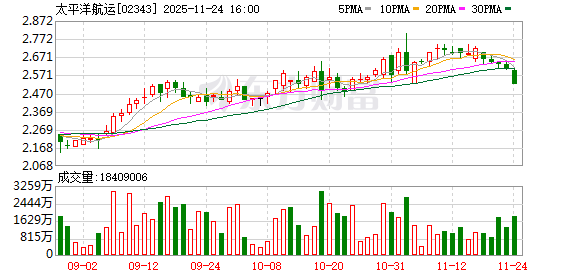
太平洋航运(02343.HK)连续5日回购,累计回购2156.80万股
Zheng Quan Shi Bao Wang· 2025-11-24 13:53
自11月18日以来公司已连续5日进行回购,合计回购2156.80万股,累计回购金额5618.66万港元。 其间 该股累计下跌7.35%。 今年以来该股累计进行40次回购,合计回购1.48亿股,累计回购金额3.04亿港元。(数据宝) 太平洋航运回购明细 证券时报·数据宝统计,太平洋航运在港交所公告显示,11月24日以每股2.540港元至2.600港元的价格回 购500.00万股,回购金额达1275.70万港元。该股当日收盘价2.520港元,下跌3.45%,全天成交额 4680.68万港元。 | 日期 | 回购股数(万股) | 回购最高价(港元) | 回购最低价(港元) | 回购金额(万港元) | | --- | --- | --- | --- | --- | | 2025.11.24 | 500.00 | 2.600 | 2.540 | 1275.70 | | 2025.11.21 | 800.00 | 2.630 | 2.600 | 2093.92 | | 2025.11.20 | 800.00 | 2.630 | 2.610 | 2099.66 | | 2025.11.19 | 45.80 | 2.630 ...


日度策略参考-20251124
Guo Mao Qi Huo· 2025-11-24 06:24
Report Industry Investment Ratings No specific industry investment ratings are provided in the report. Core Views - The current macro - level is in a relatively vacuum period, and A - shares lack a clear upward mainline. The market trading volume remains low, and short - term market differences are expected to be gradually digested during the index's shock adjustment. New driving mainlines are awaited for further index upward movement [1]. - Asset shortage and weak economy are beneficial to bond futures, but the central bank has recently warned of interest - rate risks, suppressing the upward space [1]. - There are various trends and influencing factors for different commodities, such as metals, energy, and agricultural products, with most prices expected to maintain a volatile trend, and some having specific supply - demand and macro - factor - related outlooks [1]. Summary by Related Catalogs Stock Index - The current macro - level is in a vacuum, A - shares lack an upward mainline, trading volume is low, and short - term market differences will be digested in index shock adjustment. New driving mainlines are needed for further upward movement [1]. Treasury Bonds - Asset shortage and weak economy are good for bond futures, but short - term central - bank interest - rate risk warnings suppress the upward space [1]. Non - ferrous Metals - **Copper**: The expectation of a December Fed rate cut has cooled, causing copper price to回调. However, the Fed is still in a rate - cut cycle, and there are still disturbances at the mine end, so the callback range is expected to be limited [1]. - **Aluminum**: Recently, industrial - side driving forces are limited, and macro - sentiment is volatile, so the aluminum price is running in a high - level shock [1]. - **Alumina**: With domestic alumina production capacity continuously releasing, production and inventory are both increasing, the fundamental situation is weak, and the price is oscillating around the cost line [1]. - **Zinc**: There are signs of short - term domestic improvement in the fundamentals, but the surplus pattern remains unchanged. With the Fed's internal differences on the December rate cut, the zinc price is expected to maintain a shock trend [1]. - **Nickel**: The Fed has large internal differences on the December rate cut, and the macro - sentiment is volatile. Indonesia has restricted nickel - related smelting project approvals again. Recently, the planned production cut of Indonesian intermediate products may affect about 6000 metal tons in July. If the macro - sentiment improves, the nickel price has a repair expectation. In the long - term, the primary nickel market will continue to be in a surplus pattern [1]. - **Stainless Steel**: The Fed's internal differences on the December rate cut are large, and the macro - sentiment is volatile. The price of raw - material nickel - iron has weakened again, and the social inventory of stainless steel has increased. The November production cut of steel mills is limited. The stainless - steel futures are searching for the bottom in shock [1]. - **Tin**: The Fed's internal differences are increasing, and the macro - sentiment is expected to be volatile. The long - term view on tin is bullish due to the significant decline in Indonesian tin export scale, unrepaired tin - ore supply, and expected terminal - downstream demand [1]. Precious Metals and New Energy - **Precious Metals**: Fed officials have soothed the market, and the probability of a December rate cut has rebounded. Precious - metal prices may fluctuate [1]. - **Industrial Silicon**: There is an expectation of medium - long - term capacity reduction. In the fourth quarter, terminal installation has a marginal increase. Northwest production capacity is continuously resuming, and the southwest's start - up is weaker than in previous years, with the impact of the dry season weakening [1]. - **Polysilicon**: The production schedule in November has decreased [1]. - **Organic Silicon**: There has been a joint production cut [1]. - **Lithium Carbonate**: The traditional peak season for new energy vehicles is approaching, energy - storage demand is strong, and there is supply - side resumption and production increase. But there are concerns about potential weakening of industrial demand in the off - season [1]. Building Materials and Energy - **Rebar**: The industry off - season effect is not obvious, but the industrial structure is still loose. In the short - term macro - vacuum period, the basis is acceptable, and it is advisable to participate in spot - futures positive arbitrage or use option strategies to optimize costs or sales profits [1]. - **Hot - Rolled Coil**: The near - month is restricted by production cuts, but the commodity sentiment is good, and the far - month still has upward opportunities [1]. - **Iron Ore**: The direct demand is okay, and there is cost support, but the supply is high, inventory is accumulating, and the sector is under pressure. The price rebound space is limited [1]. - **Coke and Coking Coal**: From a valuation perspective, this round of decline is close to the end. The coke price at 1630 reflects the expectation of 2 - 3 rounds of price cuts, and coking - coal contracts are also close to key support levels. Further decline requires continuous increase in coking - coal supply. Downstream is expected to start a new round of replenishment around mid - December [1]. - **Glass**: It follows the glass trend, but the supply - demand situation is average, and there is significant upward resistance [1]. - **Soda Ash**: The valuation indicates that this round of decline is close to the end, and the driving force may need more time. Downstream is expected to start replenishment around mid - December [1]. Agricultural Products - **Palm Oil**: High - frequency data shows increased production and reduced exports in the origin, and the near - month pressure is still high. Domestic ship - buying is active, and the basis is expected to be weak. The risk lies in a significant production cut in the origin [1]. - **Soybean and Soybean Oil**: The rumor of "US delaying the implementation of preferential cuts for imported bio - fuel raw materials" has been refuted, which has a positive expected difference for US soybeans and US soybean oil. Under high domestic crushing, the basis may be stable or slightly weak [1]. - **Rapeseed Oil**: The industry is optimistic about the replenishment of Australian rapeseed and imported crude rapeseed oil, and the trend remains unchanged, so it is advisable to wait and see [1]. - **Cotton**: There is a strong expectation of a domestic new - crop harvest, and the purchase price of seed cotton supports the cost of lint cotton. The downstream start - up remains low, but the yarn - mill inventory is not high, with rigid replenishment demand [1]. - **Sugar**: The global sugar supply has shifted from shortage to surplus, and the domestic new - crop supply pressure has increased year - on - year. Zhengzhou sugar futures are expected to be under pressure and follow the raw - sugar price [1]. - **Corn**: Short - term factors such as farmers' reluctance to sell, tight logistics in the Northeast, and low downstream inventory have led to a temporary supply shortage. The selling pressure is postponed, and the market's acceptance of high - price corn is limited before the supply pressure is fully released [1]. - **Soybean Meal**: Short - term attention should be paid to China's purchase of US soybeans. From December to January, the market is expected to gradually shift to trading the pressure of a bumper South American new crop. MO5 is recommended to be shorted on rallies [1]. Pulp and Wood - **Paper Pulp**: The pulp - futures price has risen above the registration - warehouse - receipt cost of most coniferous - pulp delivery products, and the upward space is limited. After new warehouse - receipts are registered, 1 - 3 reverse arbitrage can be considered [1]. - **Log**: The fundamental situation of logs has weakened, but it has been priced in the market. After a sharp decline in the futures price, the profit - loss ratio of short - selling is low, so it is advisable to wait and see [1]. Livestock - **Pig**: Recently, the spot price has gradually stabilized. With demand support and the un - cleared slaughter weight, the production capacity still needs to be further released [1]. Energy and Chemicals - **Crude Oil**: OPEC + plans to continue a small - scale production increase in December, the Russia - Ukraine peace agreement is being promoted, and the US has increased a new round of sanctions against Russia [1]. - **Fuel Oil**: It follows the crude - oil trend in the short - term, the demand for the 14th Five - Year Plan construction rush is likely to be falsified, and the supply of Ma Rui crude oil is sufficient. The asphalt profit is high [1]. - **BR Rubber**: The cost - end support of butadiene is insufficient, the supply of synthetic rubber is loose, and high - start - up and high - inventory have not been the main factors suppressing the price. The short - term price shows signs of stopping the decline [1]. - **PTA**: Gasoline profit and low benzene price support PX. Overseas and some domestic device malfunctions have led to a decline in the load of reforming devices. Domestic large - scale PTA devices are undergoing rotational inspections, and domestic PTA production has decreased [1]. - **Ethylene Glycol**: The crude - oil price decline has led to a fall in the ethylene - glycol price. The increase in coal price has slightly strengthened the cost support of domestic ethylene glycol. The strong expectation of domestic device commissioning suppresses the increase in ethylene - glycol price [1]. - **Short - Fiber**: Gasoline profit and low benzene price support PX. The PTA price has rebounded, and the short - fiber basis has strengthened. The short - fiber price continues to closely follow the cost [1]. - **Styrene**: The Asian benzene price is still weak, and the start - up rates of STDP devices and reforming devices have decreased. The US pure - benzene price has increased by 30 US dollars, and some US devices have reduced their loads [1]. - **Urea**: There is support from anti - involution and the cost end, but the export sentiment has eased, and domestic demand is insufficient [1]. - **PF**: The number of overhauls has decreased, the start - up load is high, the supply pressure is large, and the downstream improvement is limited [1]. - **PP**: The propylene monomer price is high, providing strong cost support. The supply pressure is increasing due to fewer future overhauls and new - capacity release [1]. - **PVC**: The delivery of Guangxi alumina has started, some alumina plants have postponed production, and the delivery rhythm has slowed down. There is a risk of a short squeeze due to low absolute prices and limited near - month warehouse receipts [1]. - **LPG**: The international oil - gas fundamental situation is continuously loose, and the CP/FEI price has weakened. The domestic spot fundamental situation is stable, with price - valuation repair, restarting of combustion demand, and chemical rigid - demand support [1]. Shipping - **Asia - Europe Line**: The macro - positive sentiment has been gradually digested, the peak - season price - increase expectation has been priced in advance, and the shipping - capacity supply in November is relatively loose [1].