
证券业

Search documents
丁志杰:着力提升我国金融业竞争力|宏观经济
清华金融评论· 2026-02-02 11:25
Core Viewpoint - The article emphasizes the importance of building a strong financial nation as part of China's long-term development strategy, highlighting that financial strength is crucial for national prosperity and economic development [2][3]. Group 1: Financial System Development - Since the reform and opening up, China's financial industry has evolved from a highly centralized model to a modern financial system that includes various components such as financial regulation, markets, institutions, and services, successfully avoiding systemic financial crises [4]. - China has become a significant financial power, with banking assets ranking first globally, foreign exchange reserves leading for 20 consecutive years, and insurance assets and stock and bond market sizes ranking second [4]. Group 2: Challenges in Financial Competitiveness - Despite being a financial power, China is not yet a financial strong nation, with issues such as low efficiency in the financial sector, inadequate service to the real economy, and weak international influence [5][6]. - The financial sector's inefficiencies stem from structural issues, including suboptimal financial function positioning, limited collaborative service capabilities, and significant pressure in risk resolution [5][6]. Group 3: Relationship Between Finance and Economy - Understanding and managing the relationship between finance and the economy is essential for enhancing competitiveness, as financial strength must be rooted in the health of the real economy [7][8]. - The article warns against the dangers of financial systems that operate independently of the real economy, which can lead to crises and inefficiencies [7]. Group 4: Market-Oriented Financial Development - Promoting high-quality financial development through market mechanisms is crucial for enhancing competitiveness, with a focus on fostering appropriate competition and ensuring regulatory frameworks are in place [9][10]. - The need for a unified and open financial market is emphasized, along with the importance of allowing for differentiated competition among financial institutions [10]. Group 5: Financial Structure Optimization - The financial structure must adapt to the evolving economic landscape, transitioning from a bank-dominated system to a balanced model that supports innovation-driven growth [11][12]. - The article suggests enhancing the role of capital markets and developing a robust investment banking sector to better support technological innovation and long-term funding needs [12]. Group 6: Financial Openness and Governance - High-level financial openness is identified as a key characteristic of a financial strong nation, with a focus on aligning domestic regulations with international standards to enhance competitiveness [13][14]. - The article highlights the need for improved international financial governance capabilities to strengthen China's position in global financial systems and enhance the international use of the Renminbi [15].


暴跌原因 找到了!
Zhong Guo Ji Jin Bao· 2026-02-02 10:08
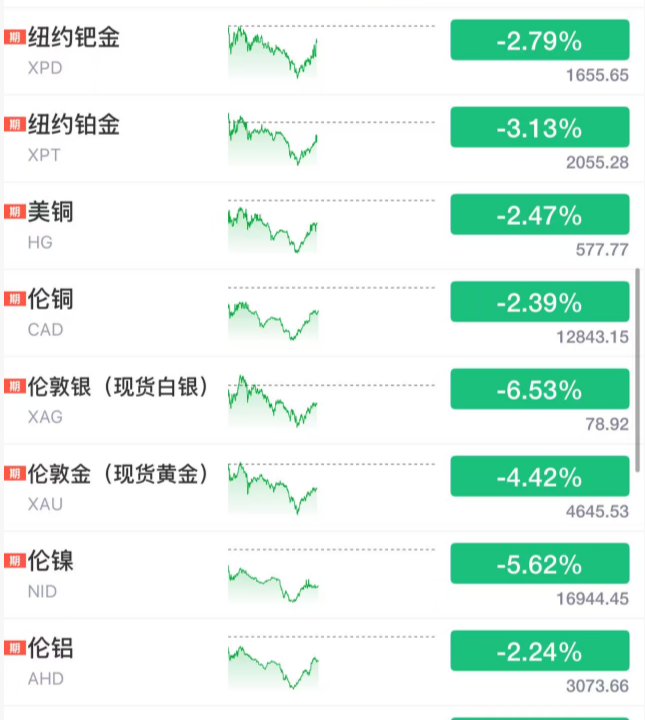
兄弟姐妹们,今天的市场,金银下跌导致了全球大跌,泰勒特意找来相关解读,希望给到大家情绪上的 安慰价值。 好的一面是,咱们这边收盘之后,外围市场稍微回暖,包括国际黄金白银在内的多种贵金属的价格,跌 幅已经有所收窄。 【导读】简单分析一下原因吧。 欧美股市的情绪也缓和了下来。 Tiger Brokers 新加坡市场策略师 James Ooi称:"我们看到的这波股市暴跌,部分原因是金银急跌后引发 的保证金追缴(margin call),另外也受到甲骨文(Oracle)500亿美元融资,以及更广泛的加密市场下 行拖累。围绕凯文·沃什可能出任美联储主席的政策不确定性也在打压市场情绪。虽然他看起来支持降 息,但他偏好缩减美联储资产负债表,整体仍意味着金融环境趋紧。" 新加坡 Lucerne Asset Management 投资主管 Marc Velan称:"本周开局可谓波澜起伏。这更像是典型的 去杠杆/流动性紧缩,而非单一催化剂所致。流动性最强的资产头寸拥挤,再叠加系统性卖出以及保证 金驱动的被动平仓,往往会首先冲击'最容易卖掉的资产'。贵金属的这次暴跌行情在速度和幅度上的特 征,更像是一次仓位出清式的调整,而非一次清 ...
国盛证券:力争“开门红”,还有哪些政策可期?
Xuan Gu Bao· 2026-02-02 09:08
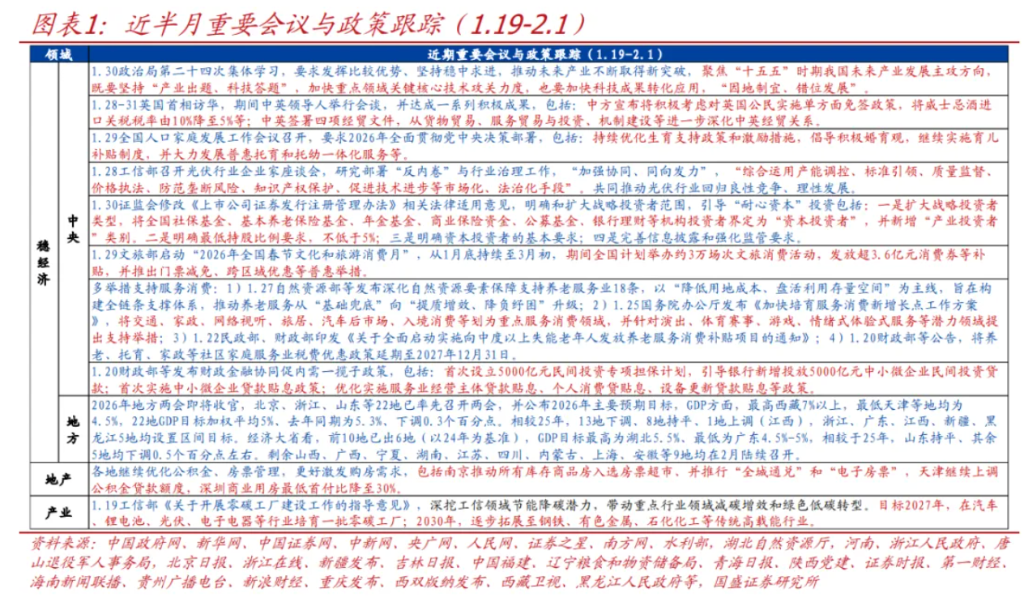
Core Viewpoint - Recent policies are focused on expanding domestic demand to achieve a "good start" for 2026, with six major focal points identified [1][2] Group 1: Major Policies - The UK Prime Minister's visit to China resulted in several positive outcomes, including visa exemptions and reduced import tariffs on whiskey [2][11][12] - Multiple measures to support service consumption were introduced, including a plan to issue subsidies for elderly care services and tax incentives for community service industries [2][21][26] - The Ministry of Finance announced a package of policies to promote domestic demand, including a 500 billion yuan special guarantee plan for private investment and interest subsidies for small and micro enterprises [2][27] - The China Securities Regulatory Commission (CSRC) revised regulations to attract "patient capital" by expanding the types of strategic investors and setting minimum shareholding requirements [2][19] - The local governments are entering the two sessions period, with an average GDP target of 5% across 22 regions, reflecting a slight decrease from the previous year [2][28] Group 2: Local Policies - Local two sessions are concluding, with 22 regions announcing their GDP targets, showing an average target of 5%, down 0.3 percentage points from last year [2][28] - Economic provinces have set varied GDP targets, with the highest being 5.5% for Hubei and the lowest being 4.5% for Guangdong [2][29] Group 3: Industry Policies - Various regions are optimizing housing fund and housing ticket management to stimulate housing demand, with initiatives like electronic housing tickets and increased loan limits [2][30][31] - The Ministry of Industry and Information Technology issued guidelines for the construction of zero-carbon factories, aiming to promote energy-saving and carbon reduction in key industries by 2027 [2][30]

财经早报:16宗港股IPO申请被中止审查 印度、沙特股市暴跌丨2026年2月2日
Sou Hu Cai Jing· 2026-02-02 00:25
这场贵金属市场"海啸",市场各方普遍认为,因美国总统特朗普提名凯文·沃什出任下一届美联储主席 而起。但随后金银"脱缰"重挫,则在于杠杆资金连续挤压下的踩踏效应。 "有无数人一夜归零甚至穿仓。"市场人士告诉上海证券报记者,在急涨行情下,国际期货市场中累积了 相当规模的杠杆头寸。当价格暴跌时,投资者被强制平仓,被动抛售,进而引发"滚雪球"般快速下行。 伊朗紧张局势有所缓解!特朗普希望与伊朗"能够达成协议",伊朗也重磅表态 当地时间2月1日,美国总统特朗普在海湖庄园回答记者有关伊朗问题时表示,希望"能够达成协议"。 来源:新浪证券 【头条要闻】 资金"踩踏式"出逃!黄金白银遭遇史诗级暴跌,后市怎么走? 恐慌性抛售,令国际金银价格上演了崩盘走势。1月31日凌晨(北京时间),伦敦现货黄金一度下跌超 12%,为40余年来最大单日跌幅;伦敦现货白银则创下历史最大日内跌幅纪录,一度跌超36%。截至收 盘,伦敦金跌9.25%,报4880.034美元/盎司;伦敦银跌26.42%,报85.259美元/盎司。COMEX黄金、白 银期货价格同步下挫。 "周末加班加点,下周一(2月2日)开盘实时估值将不再提供。"某三方机构人士向智通财经 ...
富国基金管理有限公司关于 富国中证光伏产业交易型开放式 指数证券投资基金投资关联方证券的公告
Sou Hu Cai Jing· 2026-02-01 23:14
Core Viewpoint - The announcement details the operational aspects of the "Fuguo Xinghe Mixed Securities Investment Fund," including investment management, subscription, redemption, and conversion processes, effective from February 4, 2026 [3][4][19]. Group 1: Fund Management and Investment Strategy - The fund primarily adopts a full replication method for investment, constructing a stock portfolio based on the composition and benchmark weights of the underlying index, the China Securities Photovoltaic Industry Index [1]. - The fund management company emphasizes adherence to legal and regulatory requirements in daily investment management to minimize tracking errors and protect the rights of fund shareholders [2]. Group 2: Subscription and Redemption Processes - The minimum subscription amount for the fund is set at RMB 1, while the minimum for direct sales is RMB 50,000 for the first subscription and RMB 20,000 for subsequent subscriptions [5][6]. - Redemption requests must not be less than 0.01 fund shares, and if the remaining balance is below this threshold, a full redemption is required [10]. - The redemption fee decreases based on the holding period, with specific rates for different durations [11]. Group 3: Conversion and Regular Investment - Fund shareholders can process conversion requests through direct sales channels, with only the redemption fee applicable for the outgoing fund [12][15]. - Regular investment options are available through the company's online trading system, with a minimum investment of RMB 10 [16]. Group 4: Fund Sales and Disclosure - The fund is available through direct sales and various financial institutions, including banks and securities companies [18]. - The fund's net asset value will be disclosed no later than the day following each open day through specified channels [19].

停牌!603980 筹划控制权变更
Shang Hai Zheng Quan Bao· 2026-02-01 15:17
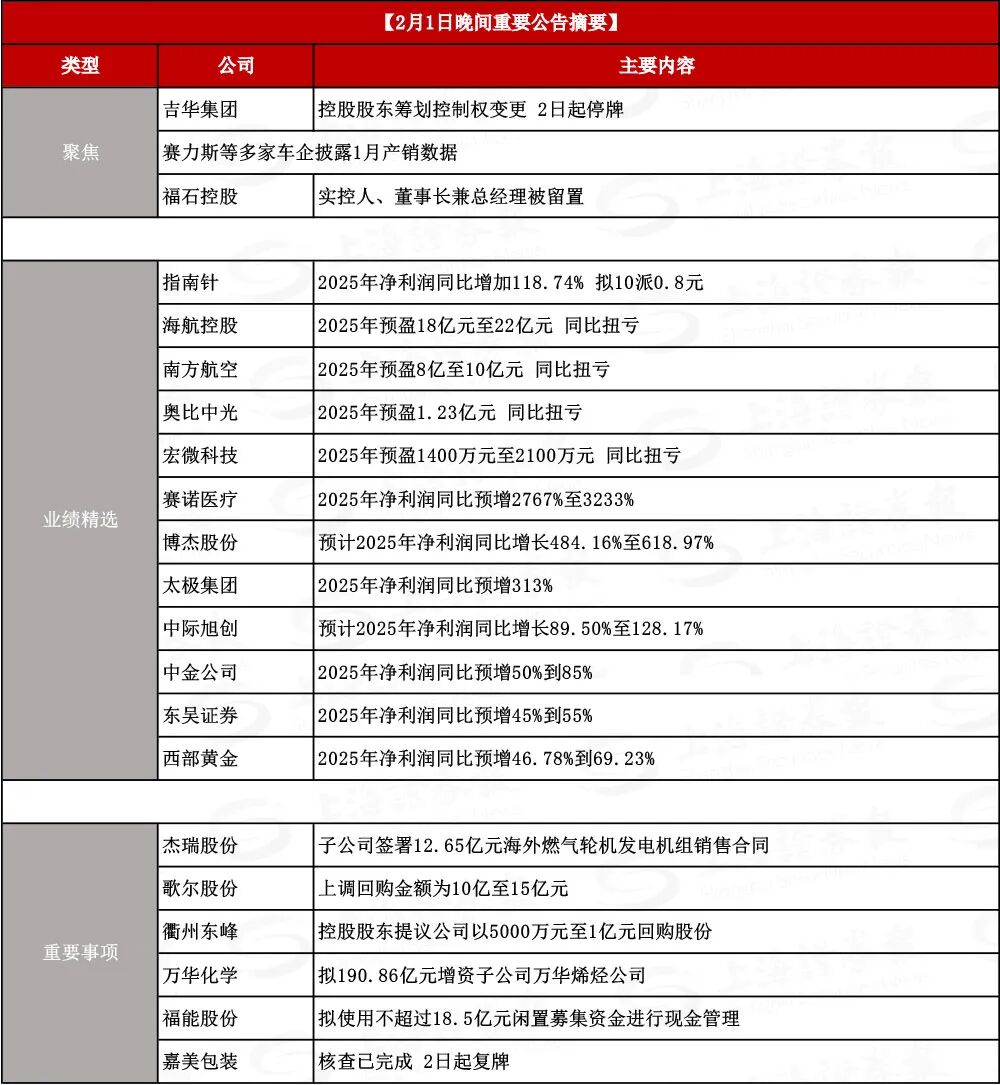
| | | 【2月1日晚间重要公告摘要】 | | --- | --- | --- | | 类型 | 公司 | 主要内容 | | | 吉华集团 | 控股股东筹划控制权变更 2日起停牌 | | 聚焦 | | 赛力斯等多家车企披露1月产销数据 | | | 福石控股 | 实控人、董事长兼总经理被留置 | | | 指南针 海航控股 | 2025年净利润同比增加118.74% 拟10派0.8元 2025年预盈18亿元至22亿元 同比扭亏 | | | | 11 11 - | | | 南方航空 | 2025年预盈8亿至10亿元 同比扭亏 | | | 奥比中光 | 2025年预盈1.23亿元 同比扭亏 | | | 宏微科技 | 2025年预盈1400万元至2100万元 同比扭亏 | | 业绩精选 | 赛诺医疗 | 2025年净利润同比预增2767%至3233% | | | 博杰股份 | 预计2025年净利润同比增长484.16%至618.97% | | | 太极集团 | 2025年净利润同比预增313% | | | 中际旭创 | 预计2025年净利润同比增长89.50%至128.17% | | | 中金公司 | 2025年净利 ...

债市窄幅震荡中等待新催化(2026年第5期)
Soochow Securities· 2026-02-01 05:13
Report Industry Investment Rating No information about the report industry investment rating is provided in the content. Core Viewpoints of the Report - This week (2026.1.26 - 2026.1.30), the yield of the 10 - year Treasury active bond 250016 decreased by 2bp from 1.83% last Friday to 1.81% this Friday. The bond market remained range - bound this week. Due to the Spring Festival, fundamental data may be announced in March and may be seasonally affected, with no obvious trading theme. After the extreme performance of the "stock - bond seesaw" in the third quarter of last year, the stock market is moving towards a "slow bull", and bonds lack an obvious trend. The January 2026 PMI data showed that the manufacturing PMI was 49.3%, down 0.8 percentage points from the previous month, indicating不畅 in cost transmission and limited expansion for enterprises. The central bank's new liquidity arrangement for non - bank institutions aims to strengthen liquidity control and gradually shift the policy rate to the overnight rate, not simply to loosen or tighten liquidity [9][10][15]. - This week (0126 - 0130), there were significant fluctuations in major asset classes. The short - end of US stocks, precious metals, and US Treasury yields adjusted significantly, and the US dollar slightly recovered. The market believes that the Fed's interest rate cut path in 2026 may be restrained. In 2026, the US economy faces five demand expansion factors, which may push the economic growth rate to 2.5% but also lead to inflation rising to a high of 3% - 3.5%, forming a "re - inflation" risk. The Fed paused its rate - cut cycle, and the future Fed's monetary policy still has high uncertainty [16][17]. Summary of Each Section 1. One - Week Viewpoints - **Analysis of 10 - year Treasury Bond Yield**: This week, the yield of the 10 - year Treasury active bond 250016 decreased by 2bp. Through daily analysis, factors such as government bond net payment, industrial enterprise profit data, expectations of new liquidity management tools, stock market trends, and the determination of the Fed Chairman candidate affected the yield fluctuations [9][10]. - **Analysis of 2026 January PMI Data**: The January 2026 manufacturing PMI was 49.3%, down 0.8 percentage points from the previous month. Production, new orders, and raw material inventory indexes decreased. The increase in the purchase price of major raw materials and the purchase volume, and the decrease in production activity business expectations, new order indexes, and ex - factory prices indicate cost transmission problems and limited expansion for enterprises [15]. - **Analysis of the Central Bank's Liquidity Arrangement for Non - bank Institutions**: The central bank may aim to strengthen liquidity control and gradually shift the policy rate to the overnight rate to control the range of money market interest rates [15]. - **Analysis of US Economic Data and the Trend of US Treasury Yields**: This week, major asset classes fluctuated significantly. The US economy in 2026 may face demand expansion factors, but also "re - inflation" risks. The Fed paused the rate - cut cycle, and the future monetary policy is highly uncertain. The US November 2025 durable goods orders increased, December PPI was higher than expected, and unemployment benefit data showed that the labor market may be stabilizing [16][17][18]. 2. Domestic and International Data Summary 2.1 Liquidity Tracking - **Open Market Operations**: From 2026/1/23 to 2026/1/30, the total net investment in open - market operations was 3805 billion yuan [32]. - **Interest Rate Comparison**: The money - market interest rates showed different trends compared with last week, and the issuance and yield of interest - rate bonds also had corresponding changes [33][34][36][37]. 2.2 Domestic and International Macroeconomic Data Tracking - **Steel and Metal Prices**: Steel prices generally declined, and LME non - ferrous metal futures official prices showed mixed trends [53]. - **Other Market Data**: Data on 5 - year and 10 - year Treasury bond futures, coking coal, and thermal coal prices, inter - bank certificate of deposit interest rates, Yu'E Bao yields, vegetable price indexes, RJ/CRB commodity and Nanhua industrial product price indexes, and Brent and WTI crude oil prices were provided [54][55][58][59][60][61][63]. 3. One - Week Review of Local Government Bonds 3.1 Primary Market Issuance Overview - **Issuance Scale and Structure**: This week, 68 local government bonds were issued in the primary market, with a total issuance amount of 439.275 billion yuan, including 207.003 billion yuan in refinancing bonds, 39.203 billion yuan in new general bonds, and 193.069 billion yuan in new special bonds. The repayment amount was 128.42 billion yuan, and the net financing amount was 310.854 billion yuan, mainly invested in comprehensive fields. Thirteen provinces and municipalities issued local government bonds, and five provinces and municipalities issued special refinancing special bonds for replacing hidden debts [64][66][69]. - **Early Redemption of Urban Investment Bonds**: This week, the total early redemption scale of urban investment bonds was 4 billion yuan, all from Chongqing. Since November 15, 2024, the total early redemption scale of national urban investment bonds was 120.647 billion yuan, with Chongqing having the highest scale [76][79]. 3.2 Secondary Market Overview - **Trading Volume and Turnover Rate**: This week, the local government bond stock was 55.39 trillion yuan, the trading volume was 365.157 billion yuan, and the turnover rate was 0.66%. The top three provinces with active trading were Sichuan, Zhejiang, and Shandong, and the top three active trading terms were 30Y, 10Y, and 20Y. The local government bond yields generally declined this week [82][84]. 3.3 This Month's Local Government Bond Issuance Plan The issuance plans of local government bonds in some regions such as Chongqing, Zhejiang, Tibet, and Tianjin from February 2 to February 6, 2026, were presented [86][87]. 4. One - Week Review of the Credit Bond Market 4.1 Primary Market Issuance Overview - **Overall Issuance**: This week, 360 credit bonds were issued in the primary market, with a total issuance amount of 307.398 billion yuan, a total repayment amount of 151.709 billion yuan, and a net financing amount of 155.689 billion yuan, an increase of 12.194 billion yuan compared with last week. Among them, urban investment bonds had a net financing amount of 16.74 billion yuan, and industrial bonds had a net financing amount of 138.949 billion yuan. By bond type, short - term financing bonds had a net financing amount of 62.98 billion yuan, medium - term notes had a net financing amount of 31.465 billion yuan, enterprise bonds had a net financing amount of - 6.805 billion yuan, corporate bonds had a net financing amount of 62.145 billion yuan, and private placement notes had a net financing amount of 5.904 billion yuan [88][91][92]. 4.2 Issuance Interest Rates The actual issuance interest rates of short - term financing bonds, medium - term notes, and corporate bonds changed this week. The issuance interest rate of short - term financing bonds decreased by 3.01bp, that of medium - term notes increased by 8.41bp, and that of corporate bonds decreased by 3.83bp [99]. 4.3 Secondary Market Transaction Overview - **Transaction Volume**: This week, the total credit bond trading volume was 596.755 billion yuan, with different trading volumes for different bond types and credit ratings [100]. - **Yield Changes**: The yields of national development bonds, short - term financing bonds, medium - term notes, enterprise bonds, and urban investment bonds showed different trends this week [102][103][105]. 4.4 Credit Spreads The credit spreads of short - term financing bonds, medium - term notes, enterprise bonds, and urban investment bonds generally showed a differentiated trend this week, and the credit spreads of urban investment bonds narrowed comprehensively [107][111][114]. 4.5 Grade Spreads The grade spreads of short - term financing bonds, medium - term notes, enterprise bonds, and urban investment bonds showed a differentiated trend, and the grade spreads of urban investment bonds narrowed comprehensively [116][121][128]. 4.6 Trading Activity This week, the top five most actively traded bonds in each bond type were listed. The industrial sector had the largest weekly trading volume of bonds, followed by public utilities, finance, optional consumption, and real estate [130][131]. 4.7 Issuer Credit Rating Changes The issuer credit ratings or outlooks of several companies such as Wuxi High - tech Zone Venture Capital Investment Holding Group Co., Ltd. were upgraded [132].
流动性与机构行为周度跟踪260201:央行新工具意义何在地方债发行放量期限压缩-20260201
Huafu Securities· 2026-02-01 05:11
Report Industry Investment Rating No information provided in the report. Core Viewpoints - The expected new tool of the central bank is likely different from the Fed's ONRRP, and narrowing the interest - rate corridor may have limited practical significance for the capital market. There is a possibility that the central bank will combine new tools with self - regulatory requirements to reduce the cost of banks absorbing non - bank inter - bank deposits [5][36][41]. - Affected by the Spring Festival, local government bond issuance in February is front - loaded. It is expected that the issuance scale of government bonds in February and March 2026 will be 2.15 trillion and 2.63 trillion respectively, and the net financing scale will be 1.38 trillion and 1.13 trillion respectively. The cumulative net financing scale of government bonds in the first quarter is about 3.70 trillion, which may still be lower than the 4.1 trillion in the same period in 2025 [7][59]. - Next week, the pressure of the central bank's policy tool maturity and government bond payment is still high, and the cash - withdrawal demand may increase near the Spring Festival. However, considering the central bank's loose tone, it is expected that the capital market will remain stable [10][68]. Summary by Directory 1. Money Market 1.1 This Week's Capital Market Review - OMO had a net injection of 5805 billion yuan this week. There was a 200 billion yuan MLF maturity on Monday, and the Ministry of Finance conducted a 150 billion yuan 1 - month treasury cash fixed - deposit operation on Wednesday with the winning bid rate remaining at 1.73% for three consecutive months. The capital tightened marginally at the beginning of the week but loosened later, with DR001 falling to around 1.33% [3][16]. - The trading volume of pledged repurchase declined continuously after Monday, and the overall scale of pledged repurchase rose oscillatingly before Thursday and dropped significantly on Friday. The net lending of large - scale banks fluctuated after a decline on Monday, while that of small and medium - sized banks rose continuously before Thursday and dropped on Friday but remained higher than last week. The overall net lending of banks fluctuated with a slightly lower center compared to last week. Non - bank rigid lending increased continuously, and non - bank rigid borrowing rose oscillatingly. The capital gap index rose on Monday, then declined continuously, and rose again on Friday. The season - adjusted index reached - 409.8 billion, slightly higher than - 496.1 billion last Friday, and the non - season - adjusted index was - 532.9 billion on Friday, still below the neutral level [4][24]. - The cross - month progress of the exchange market accelerated at the beginning of the week, and the gap compared with previous years was narrowing, but it was still relatively late overall. The cross - month progress of the inter - bank market institutions continued to lag, and the gap compared with previous years continued to widen, with more than 50% of the funds crossing the month on the last trading day. Overall, the institutions' cross - year progress was late, still at the latest level in the same period over the years, but the capital market remained loose at the end of the month under the central bank's support [4][28]. - The new tool expected by the central bank is likely different from the Fed's ONRRP. Narrowing the interest - rate corridor may mainly clarify existing rules and have limited practical significance for the capital market. There is a possibility that the central bank will combine new tools with self - regulatory requirements to reduce the cost of banks absorbing non - bank inter - bank deposits [5][36][41]. 1.2 Next Week's Capital Outlook - The issuance scale of 1 - year and 2 - year treasury bonds next week will drop to 130 billion and 120 billion respectively, and the treasury bond payment is expected to be about 245 billion yuan. The local government bond issuance scale of 15 regions such as Jiangxi, Guangdong, and Henan next week is 579.7 billion yuan, including 75.5 billion yuan of new general bonds, 134.3 billion yuan of new special bonds, and 369.9 billion yuan of refinancing bonds. The average issuance term of local government bonds in the first week of February decreased from 17.7 years in January to 16.1 years. Considering the time lag of payment, the actual payment scale of local government bonds is 478.7 billion yuan. The net payment scale of government bonds next week may drop to 460.4 billion yuan [6][43][45]. - Affected by the Spring Festival, local government bond issuance in February is front - loaded. It is expected that the local government bond issuance scale in February will reach 1.11 trillion yuan, and the treasury bond issuance scale will be 1.04 trillion yuan with a net financing of 420 billion yuan. The assumptions for government bond issuance in March remain unchanged. Overall, it is expected that the government bond issuance scale in February and March 2026 will be 2.15 trillion and 2.63 trillion respectively, and the net financing scale will be 1.38 trillion and 1.13 trillion respectively. The cumulative net financing scale of government bonds in the first quarter is about 3.70 trillion, which may still be lower than the 4.1 trillion in the same period in 2025 [7][56][59]. - The maturity scale of 7 - day reverse repurchase next week is 1761.5 billion yuan in total, and there will be a 700 - billion - yuan 3 - month buy - out repurchase maturity on Friday. The net payment scale of government bonds will drop from 515 billion yuan this week to 460.4 billion yuan, mainly concentrated on Friday with a scale of 308.3 billion yuan. Next Thursday (the 5th) is the reserve payment day for the first ten - day period. The new stock of Aide Technology on the Beijing Stock Exchange will be issued online on February 2nd, with the raised funds scale dropping to about 200 million yuan. Considering the central bank's loose tone, it is expected that the capital market will remain stable [63][68]. 2. Inter - bank Certificates of Deposit - The 1 - year Shibor rate decreased by 1.6 BP to 1.63% compared with January 23rd. The 1 - year AAA - rated inter - bank certificate of deposit secondary rate remained unchanged at 1.60% compared with last week [69]. - The issuance scale of inter - bank certificates of deposit decreased slightly less than the maturity scale this week, with a net repayment scale of 8.98 billion yuan, a decrease of 190 million yuan compared with last week. The net financing scales of state - owned banks, joint - stock banks, city commercial banks, and rural commercial banks were - 3 billion yuan, 1.28 billion yuan, - 6.13 billion yuan, and - 1.53 billion yuan respectively. The 3 - month certificate of deposit had the largest issuance volume, accounting for 42%, and the issuance proportion of 1 - year certificates of deposit increased by 14 pct to 30% compared with last week. The maturity scale of certificates of deposit next week is about 13.39 billion yuan, a decrease of 33.3 billion yuan compared with this week [73]. - The issuance success rates of state - owned banks, city commercial banks, and rural commercial banks decreased compared with last week, while that of joint - stock banks increased. Except for the relatively low issuance success rate of joint - stock banks, each bank was near the average level in recent years. The issuance spread of 1 - year certificates of deposit between city commercial banks and joint - stock banks narrowed [76]. - The willingness of money market funds in the primary market and other institutions, wealth management products, and fund companies in the primary and secondary markets to increase their holdings of certificates of deposit decreased this week. The relative strength index of certificates of deposit continued to decline seasonally, dropping by 7.2 pct to 15.7%, still at a neutral level in the same period over the years. In terms of different terms, the supply - demand indexes of 3 - month and 9 - month certificates of deposit increased, while those of other term varieties decreased [84]. 3. Bill Market - This week, bill interest rates first decreased and then increased, showing a narrow - range oscillation. As of January 30th, the 3 - month bill interest rate of state - owned and joint - stock banks remained unchanged at 1.45% compared with January 23rd, and the 6 - month bill interest rate decreased by 2 BP to 1.11% [91]. 4. Bond Trading Sentiment Tracking - This week, the yields of interest - rate bonds oscillated in a narrow range, the yields of credit bonds declined slightly, and most credit spreads narrowed slightly. Large - scale banks tended to increase their bond holdings, especially showing a significant increase in the willingness to increase their holdings of treasury bonds. Trading - type institutions tended to reduce their bond holdings overall, with securities companies' willingness to reduce holdings increasing, fund companies' willingness to increase holdings decreasing, but other institutions and products' willingness to increase holdings increasing. Allocation - type institutions tended to reduce their bond holdings overall, with insurance companies' and wealth management products' willingness to increase holdings decreasing, and small and medium - sized banks' willingness to reduce holdings decreasing [92].
如何理解 Warsh(沃什)的货币政策框架?:美联储将迎来供给侧改?者
Yin He Zheng Quan· 2026-01-31 11:00
Group 1: Monetary Policy Framework - Kevin Warsh's monetary policy framework emphasizes "rate cuts + balance sheet reduction + deregulation + strong dollar" as a coherent strategy[10] - Warsh believes that controlling the Federal Reserve's balance sheet is essential for effective interest rate cuts, as an uncontrolled balance sheet could lead to high long-term risk-free rates due to liquidity concerns[23] - He argues that inflation is a choice and that reducing the balance sheet can stabilize inflation expectations, allowing for lower interest rates without immediate inflationary risks[17] Group 2: Relationship with Fiscal Policy - Warsh advocates for collaboration between the Treasury and the Federal Reserve to clearly communicate future balance sheet goals, which could help stabilize inflation expectations[16] - He supports a return to a "Federal Reserve-Treasury accord" to ensure smooth coordination between fiscal and monetary policies, avoiding excessive reliance on the Fed for financing government deficits[16] - Warsh's approach suggests that fiscal expansion should not lead to a permanent increase in the Fed's balance sheet, aiming instead for a more market-driven credit supply[5] Group 3: Regulatory Environment - Warsh aligns with Trump on deregulation, proposing adjustments to the Supplementary Leverage Ratio (SLR) to boost demand for U.S. Treasuries and reduce regulatory burdens on smaller banks[21] - He criticizes the Dodd-Frank Act and Basel III capital requirements for concentrating credit resources in large financial institutions, which hinders lending to small businesses[21] Group 4: Dollar Strength and Market Implications - Warsh supports a relatively strong dollar, believing that its strength is linked to real returns and overall economic performance, particularly in a stable inflation environment[22] - He anticipates that a stable inflation outlook, combined with advancements in AI, could support higher economic growth while maintaining a strong dollar[27] - The market may perceive Warsh as a hawkish candidate due to his focus on balance sheet reduction and interest rate cuts, despite his collaborative approach with fiscal authorities[11]
2026 年,机构行为的新变化:交易增强,配置重构
Changjiang Securities· 2026-01-30 11:44
1. Report Industry Investment Rating - No relevant content provided. 2. Core Viewpoints - In 2026, the strategy differentiation of major financial institutions will reshape the bond market landscape. The trading attributes of banks will be enhanced, and the pressure to exchange floating profits will be reduced. If the regulatory constraints on interest - rate sensitivity indicators are relaxed, it may provide long - term bond allocation space for banks. Securities firms' proprietary trading will continue the aggressive strategy of "bond foundation, equity enhancement" with regulatory support. Wealth management will fully enter the "true net - value" era, with product closure and defensive allocation becoming the mainstream. Public funds are expected to repair the liability side through the new fee regulations, the duration strategy may be reopened, and the use of hedging tools will increase. Insurance institutions will focus on long - term allocation, increasing their allocation of long - duration interest - rate bonds and high - dividend assets. The overall trading attributes of the market will be enhanced, and the allocation strategies will gradually diversify [3]. 3. Summary by Related Catalogs 3.1 Bank - Overall, it shows the characteristics of "configuration adjustment and trading enhancement". In 2026, if China follows the Basel regulatory new rules, large banks are expected to release about 1 trillion yuan of government bond allocation space, and the ability to undertake long - term bonds will be marginally improved. The trading attributes of state - owned large banks are gradually strengthening, and they will continue to maintain high trading activity in 2026. If the cost - performance of inter - bank certificates of deposit rises in the future, the bond - allocation strength of rural commercial banks may moderately recover [15]. - Constrained by the deepening of the asset - liability term mismatch, the ability of large banks to undertake long - term bonds is limited. However, if China implements the adjusted international regulatory standards, it is estimated that about 1 trillion yuan of bond - allocation capacity will be added for large banks. In 2025, the AC account proportion of various banks decreased, and the OCI account proportion increased. In 2026, although the pressure on banks to make up for the performance gap by realizing floating profits will weaken, there are still incentives to realize floating profits [16][21]. - State - owned large banks' trading volume of 7 - 10Y treasury bonds and policy - financial bonds in 2025 increased, and the proportion of trading volume also increased compared with the previous two years, showing an active trading strategy. It is expected that this high trading activity will continue in 2026 [29]. - Since the beginning of 2025, affected by the new capital regulations and the decline in the cost - performance of certificates of deposit, the bond - allocation behavior of rural commercial banks in the secondary market has significantly shrunk. If the cost - performance of certificates of deposit recovers and the capital occupation pressure eases in 2026, the bond - allocation strength may moderately recover [32][33]. 3.2 Wealth Management - In 2026, wealth management will fully enter the "true net - value" operation mechanism. In terms of products, "fixed - income +", closed - end and minimum holding - period products will be used to deal with net - value fluctuations; in terms of operation, the management requirements for duration, leverage and liquidity will continue to increase, and the asset allocation will focus on stability and term matching [40]. - In 2026, in the context of low - interest rates and the full - completion of valuation rectification, the scale and number of "fixed - income +" products are expected to continue to grow. The proportion of "fixed - income +" products in fixed - income wealth management is expected to rise steadily [41][42]. - After the full - completion of valuation rectification, the net - value stability constraint of wealth management products has been significantly enhanced. The closed - end and quasi - closed - end operation characteristics of new products are expected to be further strengthened in 2026 [44]. - In 2026, wealth management institutions will pay more attention to the liquidity safety cushion. The proportion of high - liquidity assets in wealth management asset allocation is likely to remain relatively high [50]. - In 2026, wealth management drawdown is expected to be controllable and will change around interest - rate fluctuations. Wealth management institutions may deepen the application of multi - asset allocation strategies to reduce the impact of bond - market fluctuations on net value [52]. - In 2026, the allocation value of amortized - cost bond funds will be further highlighted. The re - investment demand of the expired funds of amortized - cost bond funds is expected to support the short - end credit - bond market [58]. 3.3 Public Funds - In 2026, with the implementation of the new fee regulations for public funds, the bond - market sentiment is expected to be moderately repaired, and the stability improvement of the liability side may create conditions for reopening the duration strategy. The development of innovative tools such as stock - bond constant ETFs is expected to introduce incremental funds, and the number of funds using the negative - duration strategy may increase. The supervision of customized funds and dividend mechanisms will continue to be optimized [65]. - In 2025, the leverage ratio of bond funds decreased, and the duration fluctuated greatly. In 2026, the liability - side and asset - side durations of public funds are expected to increase [66]. - The implementation of the new fee regulations for public funds in 2026 is expected to promote the moderate repair of the bond market and the internal optimization of the bond - fund pattern [71]. - In 2026, the pure - bond fund market may face product - pattern adjustment. The smooth development of stock - bond constant ETFs may bring incremental funds to the equity and interest - rate bond markets and weaken the traditional "stock - bond seesaw" effect in the short term [76]. - In 2026, the number of funds using the negative - duration strategy may increase to manage risk exposure in the context of low - interest rates and high volatility in the bond market [79]. - In 2026, there is still room for optimization of customized funds and dividend mechanisms in the public - fund industry. The regulatory authorities may put forward rectification requirements for customized funds with a high institutional - holding ratio and optimize the dividend mechanism [82][84]. 3.4 Insurance - In 2026, the investment strategy of insurance institutions is expected to shift from "trading" to "allocation - based". The turnover rate of interest - rate bonds such as treasury bonds has declined, and the asset - allocation structure will be further optimized [87]. - In 2025, affected by the regulatory reduction of the liability - side pricing ceiling, new - policy attractiveness weakened, and premium growth slowed down. Insurance funds preferred a Carry - based strategy, with a decline in the turnover rate of interest - rate bonds and a stable or rising allocation weight [88]. - As of Q3 2025, bonds still accounted for more than 50% of insurance - fund asset allocation, but the growth rate of equity investment was relatively fast. In 2026, if the new fee regulations weaken the cost - performance of bond funds, some insurance funds may shift to equity assets, but it will not significantly affect their bond - market allocation [94]. - In 2026, under the dual - system drive of the new asset - liability regulations and new accounting standards, insurance institutions will significantly increase their allocation of long - duration interest - rate bonds and high - grade general credit bonds and reduce the allocation of bank Tier 2 capital bonds. The proportion of participating insurance is expected to continue to increase, and the equity - asset allocation will focus on high - dividend and low - valuation stocks [100][101]. 3.5 Securities Firms' Proprietary Trading - In 2026, the bond - allocation of securities firms' proprietary trading will continue to focus on interest - rate bonds and high - grade credit bonds, and the equity - allocation is expected to achieve "both quantity and quality improvement" under regulatory encouragement, with a preference for standardized products such as broad - based index constituent stocks and liquid ETFs [103]. - From March 2021 to November 2025, the bond - holding scale of securities firms' proprietary trading increased, and the proportion of interest - rate bonds rose. In 2026, the bond - holding scale is expected to continue to grow, and the credit - bond allocation will continue to concentrate on high - grade bonds [104][105]. - In 2025, the floating - profit scale of securities firms' proprietary trading turned from negative to positive, and they showed advantages in stop - profit operation and holding - cost control [109]. - Regulatory support for securities firms' proprietary trading to increase equity - asset allocation has increased. In 2026, securities firms may further increase their equity - asset allocation, with a possible preference for standardized products [114].
