饮料

Search documents
每经热评丨宗馥莉“去娃哈哈”,难以完成的告别
Mei Ri Jing Ji Xin Wen· 2025-09-14 10:26
Core Viewpoint - The internal document leak reveals significant internal conflicts within the Wahaha empire, indicating a shift towards a new brand "Wah Xiaozong" controlled by Zong Fuli, which will replace the existing "Wahaha" brand starting from the 2026 sales year [1] Group 1: Brand Transition - The transition to "Wah Xiaozong" is not merely a brand upgrade but a complete rebranding effort, suggesting a strategic departure from the "Wahaha" identity [1] - Zong Fuli's decision to abandon the "Wahaha" brand is driven by the need to dissociate from the legacy of the late founder, Zong Qinghou, who has become a liability for the brand [1][4] - The "Wahaha" trademark is owned by the Wahaha Group, and any unilateral decision regarding its use requires unanimous consent from all shareholders, complicating Zong Fuli's ability to fully control the brand [1][2] Group 2: Legal and Historical Issues - The company faces complex historical issues, including disputes over employee stock ownership, stock buyback agreements, and the legality of trademark authorization, alongside ongoing family inheritance disputes [2] - Zong Fuli's attempt to transfer the "Wahaha" trademark to her controlled company was rejected by major shareholders, highlighting her limited control over the brand and the associated legal risks [2] Group 3: Market Challenges - The new brand "Wah Xiaozong" lacks the historical significance and emotional connection that "Wahaha" has built over nearly 40 years, making it unlikely to inherit the brand's estimated value of 90 billion [3] - The current beverage market is highly competitive, with established players like Yuanqi Forest and Nongfu Spring, making it difficult for a new brand without a compelling narrative or differentiation to succeed [3] - Unlike the case of Jia Duo Bao, which had a narrative of loss and consumer loyalty, "Wah Xiaozong" does not have a similar backstory to attract consumers or channel support [3] Group 4: Succession and Brand Integrity - Zong Fuli's legitimacy as a successor is questioned if she abandons the "Wahaha" brand, as it would undermine her perceived role as the rightful heir to the brand's legacy [4] - The emotional contract with consumers tied to the "Wahaha" brand is significant, and abandoning it for "Wah Xiaozong" could be seen as a betrayal, risking her reputation and market position [4][5] - The brand "Wahaha" is integral to Zong Fuli's strategy, and losing it could lead to a complete failure of her business ambitions [5]
食品饮料行业周报:白酒报表逐步出清,茅台动销好转-20250914
GUOTAI HAITONG SECURITIES· 2025-09-14 10:08
Investment Rating - The report assigns an "Overweight" rating to the food and beverage industry [1] Core Insights - The food and beverage sector is experiencing cyclical opportunities due to supply and demand clearing, with performance advantages evident in beverages, snacks, and raw materials. The financials of the liquor sector are improving, particularly for Moutai [3][4] Summary by Sections Investment Recommendations - The report suggests increasing holdings in growth stocks within beverages, snacks, and food sectors, highlighting the performance advantages. It recommends overweight positions in elastic liquor stocks such as Hong Kong-listed Zhenjiu Lidu, Shede Liquor, Shanxi Fenjiu, Luzhou Laojiao, and Jiu Gui Jiu. For stable mid-term holdings, it suggests Wuliangye, Guizhou Moutai, Yingjia Gongjiu, Jianshiyuan, and Guqingongjiu. In the beverage sector, it recommends increasing positions in leading companies like Dongpeng Beverage and Chengde Lulou, as well as Hong Kong-listed Nongfu Spring, Master Kong Holdings, and China Resources Beverage. For snacks and food raw materials, it suggests increasing holdings in Bailong Chuangyuan, Yanjinpuzi, Three Squirrels, and Ximai Foods, along with Hong Kong-listed Weilong Delicious. In the beer segment, it recommends increasing positions in Tsingtao Brewery, Zhujiang Brewery, and Bai Run Shares, as well as Hong Kong-listed China Resources Beer. For condiments and livestock, it suggests increasing holdings in Yili Group, New Dairy, Youran Livestock, Modern Farming, Baoli Foods, and Haitian Flavoring [8][9] Liquor Sector - The liquor sector is seeing a clearing of financials, with Moutai showing signs of improved sales. In Q2 2025, high-end, sub-high-end, and regional liquor revenues grew by 3%, declined by 5%, and decreased by 27% year-on-year, respectively. Net profits for these categories also showed a similar trend. The consumption environment is suppressing industry demand, leading to accelerated inventory reduction. Moutai's official data indicates a recovery in terminal sales as traditional festivals approach, with significant month-on-month growth observed since late August. The company emphasizes sustainable high-quality development, which may alleviate supply-demand conflicts and support pricing [9][10] Consumer Goods Sector - The consumer goods sector is characterized by structural growth, with beverages performing well, stable beer sales, and significant differentiation in snacks. The leading companies in condiments are showing advantages, while dairy products are experiencing marginal improvements. The report suggests that new consumer leaders in food additives, health products, beverages, and snacks have potential for future growth, driven by innovation and management strategies that could widen the gap with competitors [11]




娃哈哈内部文件流出!宗馥莉或另立门户,启用新品牌“娃小宗”
YOUNG财经 漾财经· 2025-09-14 09:15
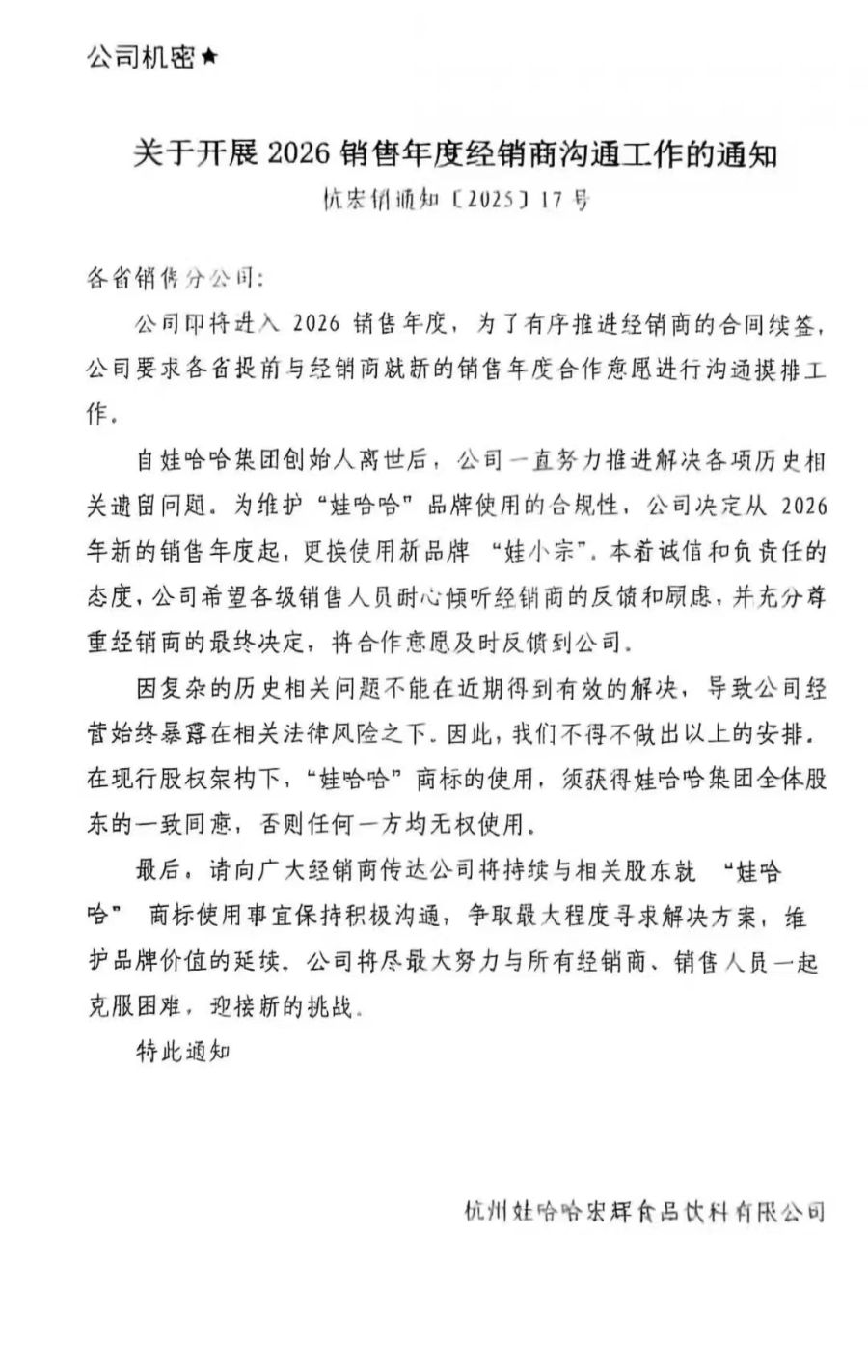
Core Viewpoint - The internal document from Wahaha indicates that the company, led by Zong Fuli, plans to launch a new brand "Wah Xiaozong" starting from the 2026 sales year, following the founder's passing and to address historical issues related to the brand [2] Group 1 - The internal notice mentions that since the founder's death, the company has been working to resolve various historical issues [2] - The decision to change to the new brand "Wah Xiaozong" is aimed at maintaining compliance in the use of the "Wahaha" brand [2] - The document states that under the current shareholding structure, the use of the "Wahaha" trademark requires unanimous consent from all shareholders, and any party cannot use it without such agreement [2]


娃哈哈将要变身“娃小宗”?股权之争未见分晓,宗馥莉再出险招
Hua Xia Shi Bao· 2025-09-14 09:03
Core Viewpoint - The article discusses the strategic moves by Wahaha Group's leader, Zong Fuli, in response to various pressures, including a potential new brand "Wah Xiaozong" and changes in company structure to strengthen control amid ongoing inheritance disputes and employee conflicts [2][3][4]. Group 1: Brand Strategy - On September 13, it was reported that Wahaha Group may adopt a new brand "Wah Xiaozong" starting from the 2026 sales year due to unresolved historical issues and legal risks associated with the current brand [3]. - The decision to change the brand is part of a broader strategy to address compliance risks related to the Wahaha trademark and complex equity issues [4]. - Zong Fuli has initiated the rebranding process as a means to gain more control over the company amidst ongoing disputes with her siblings and employees [4][5]. Group 2: Corporate Structure Changes - Several subsidiaries of Wahaha have been renamed to "Hongsheng" in September, indicating a shift towards consolidating control under Zong Fuli [4]. - The corporate restructuring includes changing the name of Hu Lin Wahaha Beverage Co., Ltd. to Hu Lin Hongsheng Beverage Co., Ltd., among others [4]. - The establishment of Hongsheng Group by Zong Fuli aims to enhance her influence over Wahaha Group, reflecting her commitment to strategic reform [4][5]. Group 3: Shareholding and Control Issues - Wahaha Group has a fragmented shareholding structure, with three major shareholders: a state-owned investment group, Zong Fuli, and an employee stockholding committee [5]. - The employee stockholding committee holds 24.6% of the shares, which poses a significant variable in the actual control of the company, especially amid ongoing legal disputes regarding stock buyback agreements [5][6]. - Zong Fuli has faced challenges in asserting control due to these disputes, leading her to take measures to strengthen her position within the company [6]. Group 4: Market Challenges - The introduction of the new brand "Wah Xiaozong" is seen as a risky move, as brand equity is crucial in the fast-moving consumer goods sector [6]. - The acceptance of the new brand by internal employees and external channels is uncertain, especially in a highly competitive beverage market [6]. - While these changes may cause short-term disruptions, they are viewed as necessary for long-term modernization and governance of the company [6].
“娃哈哈”商标争议?宗馥莉或启用新品牌“娃小宗”,半年前注册
2 1 Shi Ji Jing Ji Bao Dao· 2025-09-14 08:53
Group 1 - The core point of the article is that Wahaha Group, led by its head Zong Fuli, is planning to launch a new brand "Wah Xiaozong" starting from the 2026 sales year, following the founder's passing and ongoing issues related to the historical brand usage [1][3][7] - An internal document from Hangzhou Wahaha Honghui Food and Beverage Co., Ltd. indicates that the company is working to resolve historical issues and will seek the consent of all shareholders for the use of the "Wahaha" trademark [1][6] - The document, dated September 12, 2023, is confirmed by multiple companies under the control of Hongsheng Beverage Group, indicating that the new brand initiative is legitimate and not fabricated [3][6] Group 2 - The "Wahaha" trademark, valued at over 90 billion, has been subject to controversy, with the Wahaha Group applying for the transfer of 387 trademarks to Hangzhou Wahaha Food Co., Ltd. as of January 21, 2025 [7] - The company has indicated that due to uncertainties in the trademark transfer process, it is preparing to launch a new proprietary brand, which aligns with the introduction of "Wah Xiaozong" [7] - The "Wah Xiaozong" trademark application was filed by Hongsheng Beverage on February 19, 2025, covering various categories including beverages and food, with multiple registrations following in subsequent months [7]
娃哈哈内部文件流出!宗馥莉或另立门户,启用新品牌“娃小宗”
2 1 Shi Ji Jing Ji Bao Dao· 2025-09-14 08:32
9月13日,杭州娃哈哈宏辉食品饮料有限公司"关于开展2026销售年度经销商沟通工作的通知"的一份内 部文件流出,其中提及,"自娃哈哈集团创始人离世后,公司一直努力推进解决各项历史相关遗留问 题。"为维护"娃哈哈"品牌使用的合规性,公司决定从2026年新的销售年度起,更换使用新品牌"娃小 宗"。 (原标题:娃哈哈内部文件流出!宗馥莉或另立门户,启用新品牌"娃小宗") 娃哈哈集团掌门人宗馥莉主导的宏胜饮料,或启用新品牌"娃小宗"。 该文件还提到,在现行股权架构下,"娃哈哈"商标的使用,须获得娃哈哈集团全体股东的一致同意,否 则任何一方均无权使用。基于此,公司将征求广大经销商的意见,并持续与相关股东就"娃哈哈"商标使 用事宜保持积极沟通。9月14日上午,21世纪经济报道记者向娃哈哈集团相关人士求证消息,对方表示 对此事"无回应"。 ...
食品饮料周观点:白酒底部价值,大众品把握龙头-20250914
GOLDEN SUN SECURITIES· 2025-09-14 08:14
Investment Rating - The report maintains an "Increase" rating for the food and beverage industry, indicating a positive outlook for the sector [5]. Core Insights - The white liquor sector is showing signs of bottoming out, with the upcoming peak season expected to improve the fundamentals. The report highlights the long-term value of leading brands such as Kweichow Moutai and Wuliangye, while also identifying short-term elastic stocks like Luzhou Laojiao and Jiangsu Yanghe [1][2]. - In the beverage segment, Budweiser plans to expand its investment in Xiamen, while Baijiu's major shareholder is transferring shares, indicating confidence in the future of the company. The report emphasizes the importance of focusing on high-growth stocks and market leaders in the beverage sector [3]. - The snack industry is experiencing rapid growth, with the number of stores for "Mingming Hen Mang" surpassing 20,000. The report notes that the milk price is stabilizing, which may lead to opportunities in the dairy sector post-harvest season [4]. Summary by Sections White Liquor - Kweichow Moutai is leading the industry with a focus on product and channel transformation, aiming for market recovery as the peak season approaches. The report anticipates a gradual improvement in the fundamentals of the white liquor sector [2]. Beer and Beverage - Budweiser's strategic upgrade includes consolidating its operations in the Asia-Pacific region. The report suggests monitoring the recovery of the restaurant sector and the performance of leading beer brands like Yanjing Beer and Zhujiang Beer [3]. Snacks and Dairy - The snack market is characterized by intense competition, with leading brands leveraging scale and supply chain advantages. The report also notes a slight recovery in raw milk prices, indicating potential growth in the dairy sector [4].
娃哈哈内部文件流出!宗馥莉或另立门户
2 1 Shi Ji Jing Ji Bao Dao· 2025-09-14 07:54
Core Viewpoint - Wahaha Group, led by its head Zong Fuli, is planning to launch a new brand "Wah Xiaozong" starting from the 2026 sales year, following the founder's passing and ongoing trademark disputes [1][9]. Group 1: Brand Transition - The internal document from Hangzhou Wahaha Honghui Food and Beverage Co., Ltd. indicates the need to address historical issues related to the brand after the founder's death [1]. - The company will seek unanimous consent from all shareholders of Wahaha Group for the use of the "Wahaha" trademark, otherwise, no party can use it [1][9]. - The new brand "Wah Xiaozong" is set to replace the existing "Wahaha" brand, with the company actively communicating with distributors and shareholders regarding this transition [1][9]. Group 2: Trademark Ownership and Controversy - The "Wahaha" trademark, valued at over 90 billion, has been a subject of significant controversy, with ongoing transfer applications to move the trademark from Wahaha Group to Hangzhou Wahaha Food Co., Ltd. [9]. - As of February 2025, Wahaha Group is in the process of transferring 387 "Wahaha" series trademarks, with the application for transfer already submitted [9]. - The company has indicated that due to uncertainties in the trademark transfer process, it is prepared to launch a new proprietary brand [9]. Group 3: New Brand Development - The "Wah Xiaozong" trademark application was filed by Hongsheng Beverage, covering categories such as beer, convenience foods, and pharmaceuticals, with the application date being February 19, 2025 [9]. - Following the trademark application, Hongsheng Beverage has registered numerous "Wah Xiaozong" trademarks across various sectors, including dining, office supplies, and clothing [9]. - A new product under the "Wah Xiaozong" brand, a sugar-free tea drink named "Ningxiang Oolong," was revealed in May 2023 [10]. Group 4: Operational Changes - Since February 2023, Wahaha has closed 18 factories, including those in Shaanxi, while simultaneously investing 1 billion to establish a new beverage production base in Xi'an [12]. - Xi'an Hengfeng Beverage Co., Ltd., which is 90% owned by Hongsheng Beverage Group, has received approval for the new production base project, with Zong Fuli serving as the executive director [12].
宗馥莉或另立门户
Xin Jing Bao· 2025-09-13 15:53
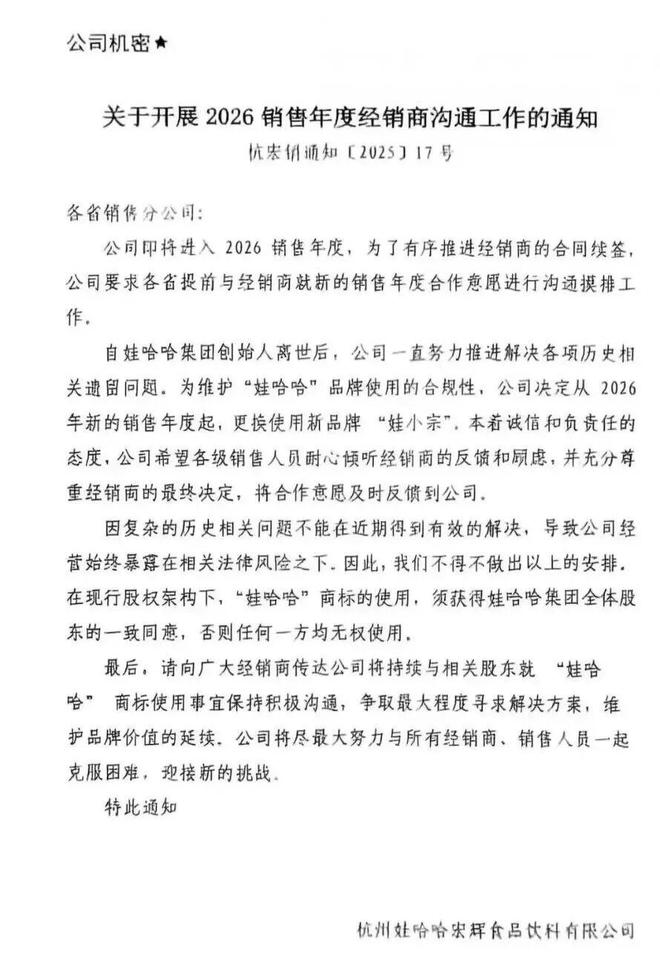
Core Points - The company will transition to a new brand "Wah Xiaozong" starting from the 2026 sales year to address historical issues and ensure compliance with brand usage [1][2] - The decision follows the passing of the founder of Wahaha Group, prompting the company to resolve various legacy issues [1][2] - The company emphasizes the importance of communication with distributors regarding their willingness to cooperate in the new sales year [2] Group 1 - The company has been working to resolve historical issues since the founder's passing [1][2] - The new brand "Wah Xiaozong" will be implemented to maintain compliance with brand usage [1][2] - The company acknowledges the legal risks associated with the current brand usage and aims to mitigate these through the rebranding [2] Group 2 - The company will maintain active communication with shareholders regarding the usage of the "Wahaha" trademark [2] - Distributors' feedback and concerns will be respected and considered in the transition process [2] - The company is committed to overcoming challenges alongside distributors and sales personnel [2]
香飘飘紧急公告:暂停绕地球
财联社· 2025-09-13 14:07
Core Viewpoint - The company announced the suspension of the "around the world" campaign due to an unspecified urgent issue, emphasizing the importance of consumer trust and the brand's connection with its audience [4][5][6]. Group 1: Announcement Details - The "around the world" campaign has been a significant part of the brand's identity since its inception, symbolizing consumer affection and recognition [3][6]. - As of September 13, 2025, the campaign is temporarily suspended while the company investigates the underlying cause of the issue [4][6]. - A special task force has been established to quickly identify the core problem and provide timely updates to the public [4][5]. Group 2: Operational Status - Despite the suspension of the campaign, the company's product production, distribution, and after-sales services remain normal and unaffected [5][6]. - The company assures consumers that they will be informed of any developments regarding the investigation through official channels [5][6].