电影

Search documents
AI正在撕裂好莱坞
Hu Xiu· 2025-09-11 00:30
在刚刚落幕不久的威尼斯电影节上,导演吉尔莫·德尔·托罗带来了他的最新作品《弗兰肯斯坦》。记者们都很关⼼⼀个"赛博朋克"的问题:这部关于⼈造 ⽣命失控的电影,是否在隐喻AI? 记者们之所以有此一问,是因为吉尔莫·德尔·托罗此前曾公开表态:他在制作《弗兰肯斯坦》时拒绝使用过多数字特效和绿幕。 我想要真实的场景。我不想要数字的。我不想要人工智能的。我不想要模拟的。我想要传统的工艺。我想要人来绘画、搭建、锤造、抹灰。 即使"陀螺"是奥斯卡最佳导演,也并非所有电影人都同意他的观点。就在今年的威尼斯电影节上,力挺AI介入电影创作的观点也大有市场。 威尼斯电影节甚至下设了一个Reply AI电影节,AI电影与"陀螺"的手工电影共聚一堂,共同接受观众的品评。 在AI横扫全球各行各业的大背景下,电影行业内部却正分裂成"支持AI"和"反对AI"的两大阵营。说这种分裂即将酝酿出一场"内战"也不过分。 分裂的一个重要原因显然是利益相关。在这波AI浪潮中,有些电影人正在或即将获益,他们自然支持AI;有些电影人担心被AI抢了饭碗,或更严重一 点,AI会毁掉电影这门艺术,砸了所有人的饭碗,自然反对AI。 这种争吵改变不了AI进入电影行业的 ...



服务消费怎样成为新的增长点(政策问答·回应关切)
Ren Min Ri Bao· 2025-09-10 21:56
Core Viewpoint - The Chinese government is emphasizing the importance of service consumption as a key driver for economic growth and improving people's livelihoods, with various policies being implemented to stimulate this sector [1][2]. Group 1: Service Consumption Growth - In the first seven months of this year, China's service retail sales increased by 5.2% year-on-year, indicating a rising share of service consumption [1]. - Domestic tourism saw significant growth, with 3.285 billion trips taken by residents in the first half of the year, a 20.6% increase compared to the previous year [1]. - The film market is performing well, with total box office revenue exceeding 39.2 billion yuan and over 909 million moviegoers by the end of August, both surpassing last year's figures [1]. - The concert market also showed strong performance, with ticket sales increasing by approximately 40% year-on-year in the first half of the year [1]. Group 2: Policy Initiatives - The Ministry of Commerce plans to implement a series of policies to enhance service consumption, focusing on optimizing and expanding service supply and stimulating the vitality of business entities [2]. - Initiatives include the "Service Consumption Season" to create new hotspots in service consumption and actions to improve service quality in response to public concerns [2]. - The government aims to enhance the dining industry, which is closely linked to daily life, by promoting events like "Chinese Food Festival" and "Taste Food with Movies" to cultivate dining consumption hotspots [2]. Group 3: Home Service Sector - In response to the growing demand for home services, the government will promote the expansion of home service supply and conduct vocational training to improve the skills and quality of home service personnel [3]. - Efforts will be made to establish a credit system for home services to create a favorable consumption environment [3]. - The government is committed to reforming and innovating in the service sector to attract high-quality services and foster new growth points in service consumption [3].
业界人士共话爱情电影创作与表达
Xin Hua She· 2025-09-10 10:23
Core Viewpoint - The sixth Lushan International Love Film Week forum, themed "Follow the Movie to Fall in Love," was held on September 10 in Lushan, Jiangxi, focusing on the creation and expression of love films in the new era [1] Group 1: Industry Insights - Film industry representatives and experts discussed strategies for creating and expressing love films, emphasizing the need for deep insights and genuine emotions to reveal the power of love films in everyday life [1] - The forum highlighted that young audiences are increasingly focused on personal growth and seek authentic emotional resonance in films [1] Group 2: Creative Direction - Creators are encouraged to root their work in real-life experiences and contemporary issues, using genuine emotions to depict the diverse and authentic nature of modern love [1] - The goal is to produce works that are both deeply moving and thought-provoking for the audience [1] Group 3: Research Findings - The forum released the "Love Film 'Heartbeat Index' Report," which analyzes audience satisfaction data from 2015 to 2025, systematically outlining the evolution of domestic love films [1]
AI抢饭碗还是送外挂?好莱坞大咖们吵翻了
3 6 Ke· 2025-09-10 09:53
Core Viewpoint - The film industry is experiencing a significant divide between supporters and opponents of AI, with concerns about job security and the artistic integrity of filmmaking at the forefront of the debate [3][5][6]. Group 1: Opposition to AI - Many filmmakers, including prominent figures, express fears that AI will take away jobs and undermine the art of filmmaking, leading to a loss of dignity and livelihood [6][7]. - The Writers Guild of America (WGA) has made AI protection a core demand during strikes, fearing that AI could reduce writers to mere "polishers" of AI-generated scripts, thus diminishing their roles and compensation [8][10]. - Artists like Red Sosen report significant income drops due to studios increasingly using AI tools for concept art, which they view as a direct threat to their livelihoods [10][13]. - Actors are concerned about their likenesses being cloned by AI without consent or compensation, raising issues of identity and artistic integrity [13][16]. - Major studios, including Disney and Universal, have taken legal action against AI companies for copyright infringement, highlighting the industry's sensitivity to intellectual property rights [17][20]. Group 2: Support for AI - Some filmmakers view AI as a powerful tool that can enhance creativity and reduce production costs, allowing for more ambitious storytelling [32][34]. - Directors like Damian Osser and James Cameron are exploring how AI can assist in visual effects and filmmaking processes without compromising artistic vision [34][37]. - The use of AI in projects like "Ancestra" demonstrates the potential for blending human creativity with AI-generated content, suggesting a collaborative future [40][46]. - AI is seen as a means to empower filmmakers, especially those with limited budgets, to tell unique stories that might otherwise be unfeasible [32][34]. - The industry is witnessing a shift where AI is perceived as an upgrade rather than a replacement, with technical experts leveraging AI to accomplish tasks that were previously impossible or prohibitively expensive [44][49]. Group 3: Future Implications - The impact of AI on the film industry is uneven, with the greatest threats to roles that are repetitive and execution-focused, while strategic and integrative roles may benefit from AI [53][56]. - Historical parallels are drawn to the advent of sound in film and the rise of CGI, suggesting that while AI may cause disruption, it could also lead to new artistic forms and job opportunities [53][56]. - Filmmakers are encouraged to embrace AI as a tool rather than fear it, as the ability to adapt and harness AI will be crucial for future success in the industry [56].

从全球到中国,娱乐及媒体行业展望(2025-2029)
Sou Hu Cai Jing· 2025-09-10 09:27
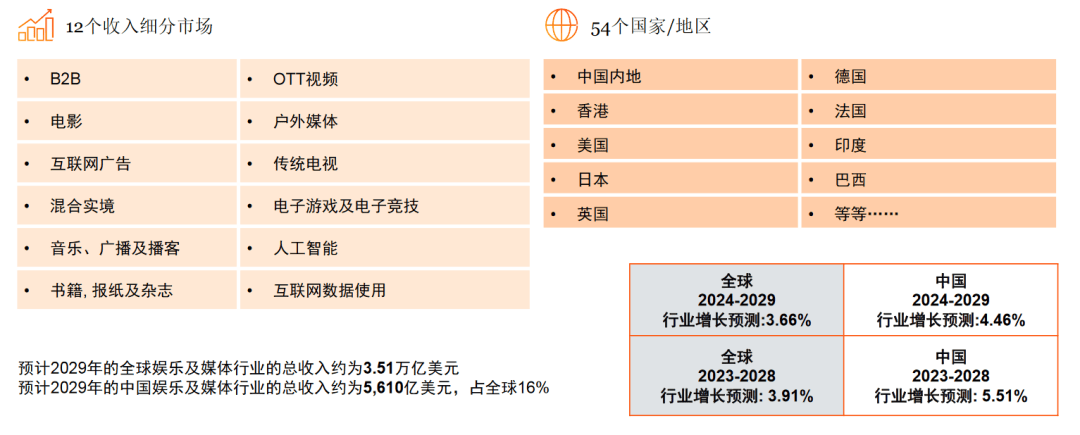
Global Overview and Macro Trends - The global entertainment and media industry is projected to reach approximately $3.51 trillion by 2029, with China's share expected to be around $561 billion, accounting for 16% of the global total [1] - The global entertainment and media industry is expected to grow at a compound annual growth rate (CAGR) of 3.7% from 2024 to 2029, while China's industry is forecasted to grow at a higher rate of 4.5% during the same period [2][11] - In 2024, the global industry is anticipated to recover balance with a total revenue growth of 5.5%, reaching $2.9 trillion [3] Key Opportunities in the Industry - The rise of generative artificial intelligence (AI) is enhancing efficiency and productivity, becoming a new way to conduct business across various sectors [4] - The challenge remains for consumers to allocate more discretionary income towards electronic products and devices, with advertising becoming a core driver of global growth in the industry [4] China's Entertainment and Media Industry - China's entertainment and media industry is expected to grow faster than the global average, with a projected CAGR of 5.51% from 2023 to 2028 [8] - The mixed reality market in China is forecasted to grow at a rate of 25.2% in 2024, with total revenue expected to reach $22.8 billion by 2029 [10] Internet Advertising - The internet advertising market in China is projected to reach approximately $220.4 billion by 2029, maintaining a stable growth trend [22] - The rapid growth of short video platforms and the application of AI-generated content (AIGC) are driving the internet advertising market [19][22] - By 2029, other display internet advertising is expected to account for 31% of the total revenue in the internet advertising sector [25] Film Industry - China's film market is expected to recover steadily, with a projected CAGR of 5.25% from 2024 to 2029, and its revenue share of the global market is anticipated to reach 22% by 2029 [31][34] - The domestic box office revenue for 2024 is estimated to be around $7.01 billion, representing 21.2% of the global box office [36] Video Games and Esports - China is the largest video game and esports market globally, with total revenue expected to grow at a CAGR of 5.73% to reach $82.7 billion by 2029 [43] - The share of social/casual games in China's total video game revenue is projected to increase from 85% in 2024 to 87% by 2029 [48] OTT Video - The OTT video industry in China is expected to grow at a CAGR of 3.0% from 2024 to 2029, while the global OTT video revenue is projected to grow at a higher rate of 6.36% during the same period [54]
第七届海南岛国际电影节·联想AI电影季征片全球启动
Nan Fang Du Shi Bao· 2025-09-10 07:55
Core Points - The "7th Hainan Island International Film Festival · Lenovo AI Film Season" has officially launched, aiming to create an innovative exchange platform for AI films in China, integrating technology and culture [1][2] - The event emphasizes the collaboration between AI technology and human creativity, with a focus on redefining the film narrative through AI [2][3] - The festival will feature a global call for submissions, with various evaluation categories to encourage participation and creativity [3][4] Group 1: Event Overview - The event is guided by the Hainan Island International Film Festival Committee and co-hosted by the AIAIA and Lenovo Group, showcasing a collection of artworks that highlight the intersection of AI and art [1] - Key figures from the film and art industry, including directors, artists, and technology experts, attended the launch, indicating strong industry support [1][2] Group 2: AI and Film Integration - The festival aims to leverage AI as a tool for expanding creative possibilities rather than replacing human creators, promoting a collaborative approach between AI and artists [2][3] - The AIAIA has established ethical guidelines emphasizing human-led creativity with AI collaboration, aiming to build a global community for AI art innovation [3][4] Group 3: Submission and Evaluation Process - The festival is open for global film submissions until early November, with multiple evaluation categories to recognize various aspects of filmmaking [3][4] - Special evaluation units will include innovative projects like the 72-hour AI microfilm hackathon and other initiatives aimed at fostering a diverse and inclusive film community [4][5] Group 4: Future Vision - The Hainan Island International Film Festival aims to position itself as a key cultural brand in the Hainan Free Trade Port, promoting international collaboration and showcasing quality film projects [6] - The festival's approach reflects a deep engagement with the evolving nature of film and creativity, addressing fundamental questions about the role of technology in artistic expression [6]

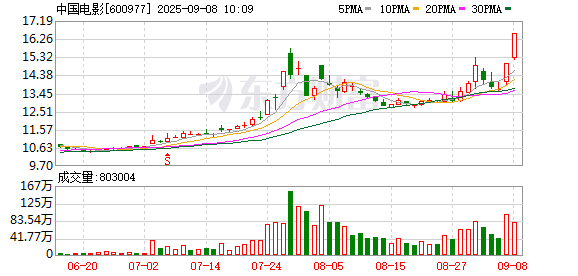
中国电影涨停走出2连板
Mei Ri Jing Ji Xin Wen· 2025-09-08 02:08
Group 1 - The core point of the article is that the Chinese film industry has experienced a significant stock price increase, with a two-day cumulative rise of 21.03% [2] Group 2 - On September 8, the Chinese film stocks hit the daily limit, marking a consecutive two-day increase [2] - The stock performance indicates a strong market interest and potential investor confidence in the Chinese film sector [2]

中国电影人闪耀三大国际影展
Huan Qiu Shi Bao· 2025-09-07 22:51
Group 1 - Chinese films have achieved significant recognition at major international film festivals in 2023, including awards for "The Land of the Living" at the Berlin International Film Festival, "Wild Times" at the Cannes Film Festival, and "Daytime Hanging" at the Venice Film Festival [1] - The Venice Film Festival has historically been a favorable platform for Chinese cinema, with renowned directors like Zhang Yimou, Ang Lee, and Hou Hsiao-hsien winning prestigious awards, particularly during Marco Müller’s tenure as chairman [3] - Despite the recent surge in box office success for Chinese films, there has been a relative quietness in terms of artistic achievements at major international festivals, with the last award for a Chinese film at Venice being in 2019 [3] Group 2 - Since the late 1980s and early 1990s, Chinese films have gained international attention through European film festivals, with notable films like "Red Sorghum" and "Farewell My Concubine" winning awards and enhancing the global profile of Chinese actors [4] - The new generation of filmmakers, represented by directors like Bi Gan and Wei Shujun, has been increasingly recognized at major film festivals, showcasing the potential and talent of young Chinese filmmakers [4] - Recent short films from Chinese directors have won multiple awards at Cannes, indicating a strong reserve of talent and creativity among the younger generation in the Chinese film industry [4]

中国年轻人,不去电影院了?
虎嗅APP· 2025-09-07 13:17
Core Viewpoint - The article discusses the significant decline in cinema attendance among young people in China, attributing it to poor viewing experiences and high costs associated with going to the movies [3][5]. Group 1: Cinema Expansion vs. Audience Decline - Despite the expansion of cinemas, with 13,000 theaters and 81,000 screens by 2024, total box office revenue has dropped to 42.5 billion yuan, a one-third decrease from the 64.15 billion yuan peak in 2019 [7][8]. - The annual attendance rate for cinemas reached a historical low of 5.7% in 2024, indicating that in a 100-seat theater, only about 5 to 6 people are watching a film [10]. - Major holiday periods, such as the Spring Festival, have seen attendance rates decline, with the 2024 Spring Festival showing only 4.2% attendance despite the release of well-received films [10][14]. Group 2: Dependence on Blockbusters and Holiday Releases - The cinema industry increasingly relies on a few blockbuster films and key holiday periods for revenue, with holiday box office accounting for over 70% of total revenue since 2022 [15]. - The Spring Festival has become the dominant box office period, with the 2018 Spring Festival generating 5.771 billion yuan in just seven days, making it the first month in Chinese film history to surpass 10 billion yuan [19]. - However, the competition for audience attention during these periods is fierce, with many films failing to attract viewers, leading to a high rate of film withdrawals from the schedule [19][24]. Group 3: Changing Audience Preferences - The average age of cinema-goers has increased from 27.7 years in 2021 to 32.5 years in 2025, indicating a shift in the demographic of movie audiences [35]. - Young people no longer view cinema attendance as a necessary social activity, opting instead for other forms of entertainment that are perceived as more convenient and cost-effective [35][36]. - The rising average ticket prices, which have increased by 16% in first-tier cities since 2014, further discourage attendance, with prices in lower-tier cities also rising significantly [33]. Group 4: Quality of Movie Experience - Many viewers report negative experiences in cinemas, including uncomfortable seating, poor cleanliness, and disruptive audience behavior, leading to a reluctance to return [28][32]. - The quality of films has also been criticized, with many viewers feeling that the actual content does not match the promotional material, resulting in disappointment [32][36]. - The perception that watching movies in theaters is no longer a worthwhile investment of time and money has contributed to the decline in attendance [28][36].
“最大公约数”,救不了中国电影
虎嗅APP· 2025-09-07 02:51
Core Viewpoint - The article discusses the current state of the Chinese film industry, highlighting the challenges it faces in retaining audiences and the impact of changing viewer demographics on box office performance [4][6][10]. Group 1: Box Office Performance - The summer box office in China reached nearly 120 billion, surpassing the same period last year, indicating a recovery despite earlier struggles [6]. - The top five films of the summer included "Nanjing Photo Studio," "Wandering Monster," "Chasing the Wind," "Lychee of Chang'an," and "Jurassic World: Rebirth," with the first three receiving ratings above 8 on Douban [6]. - "Nezha 2" achieved a remarkable box office of 15 billion, leading to mixed opinions on whether it expanded the market's potential or exhausted it [5][6]. Group 2: Audience Demographics - The total number of viewers during the summer season decreased by nearly 200 million compared to 2023, with an average cinema occupancy rate of only 6.9% [7][10]. - The average age of moviegoers increased from 27.7 years in 2021 to 32.5 years in 2023, suggesting that the same audience is simply aging [7][10]. Group 3: Industry Challenges - The article emphasizes that the Chinese cinema industry is losing its audience, with the relationship between viewers and films changing significantly over the years [7][10]. - The rapid growth of cinema infrastructure in lower-tier cities and the introduction of low-cost tickets previously attracted new audiences, but this growth has plateaued [9][10]. - The pandemic and subsequent cinema closures have disrupted the viewing habits of the new generation, leading to a decline in cinema attendance [10][11]. Group 4: Changing Consumption Patterns - The rise of alternative entertainment options, such as short videos and online games, has made it more challenging for cinemas to attract viewers [10][11]. - The cost of attending cinemas has increased, with ticket prices now averaging between 40 to 50 yuan or more, alongside the time commitment required for a film [13][12]. Group 5: Emotional Engagement and Content Strategy - The article suggests that films need to connect with social emotions to become relevant and generate discussions on social media, transforming them into "social currency" [14][15]. - Successful films like "The Disappeared Her" and "Nanjing Photo Studio" have effectively captured contemporary societal anxieties, leading to significant box office success [14][20]. - The focus on creating films that resonate with specific audience segments rather than attempting to appeal to the broadest possible audience is emphasized as a more sustainable strategy [20][18].