
锂电

Search documents
藏格矿业子公司藏格钾肥取得采矿许可证;赣锋锂业称拥有固态电池一体化布局
Mei Ri Jing Ji Xin Wen· 2025-10-10 14:47
Group 1: Cangge Mining (藏格矿业) - Cangge Mining's subsidiary, Golmud Cangge Potash Fertilizer Co., Ltd., has obtained the property rights certificate and mining license for the Chaka Salt Lake potash and magnesium mine, covering an area of 724.3493 square kilometers [1] - The mining rights will support long-term potash development, stabilize potassium chloride supply, and contribute to national food security while clarifying the legal basis for lithium resource development [1] - This acquisition enhances the company's core competitiveness by maximizing resource value through the comprehensive utilization of co-mined minerals such as lithium and boron [1] Group 2: Ganfeng Lithium (赣锋锂业) - Ganfeng Lithium has reported a significant stock price fluctuation, with a cumulative increase of over 20% in three consecutive trading days, indicating abnormal trading activity [2] - The company claims to have a complete integrated layout for solid-state batteries and commercial capabilities, with developments in key areas such as sulfide electrolytes and lithium metal anodes [2] - Ganfeng Lithium has launched high-energy density batteries suitable for low-altitude economy applications, achieving energy densities between 320Wh/kg and 550Wh/kg, and has established partnerships with well-known drone and eVTOL companies [2] Group 3: Guiguan Electric Power (桂冠电力) - Guiguan Electric Power reported a total power generation of 31.848 billion kWh in the first three quarters of 2025, representing a year-on-year increase of 14.89% [3] - The growth in power generation is primarily driven by an increase in hydropower generation, which rose by 21.93%, and a significant expansion in renewable energy capacity [3] - The company is well-positioned in the new power system construction due to its hydropower resource advantages and renewable energy layout, although it must remain vigilant regarding water flow fluctuations and changes in renewable energy consumption policies [3]



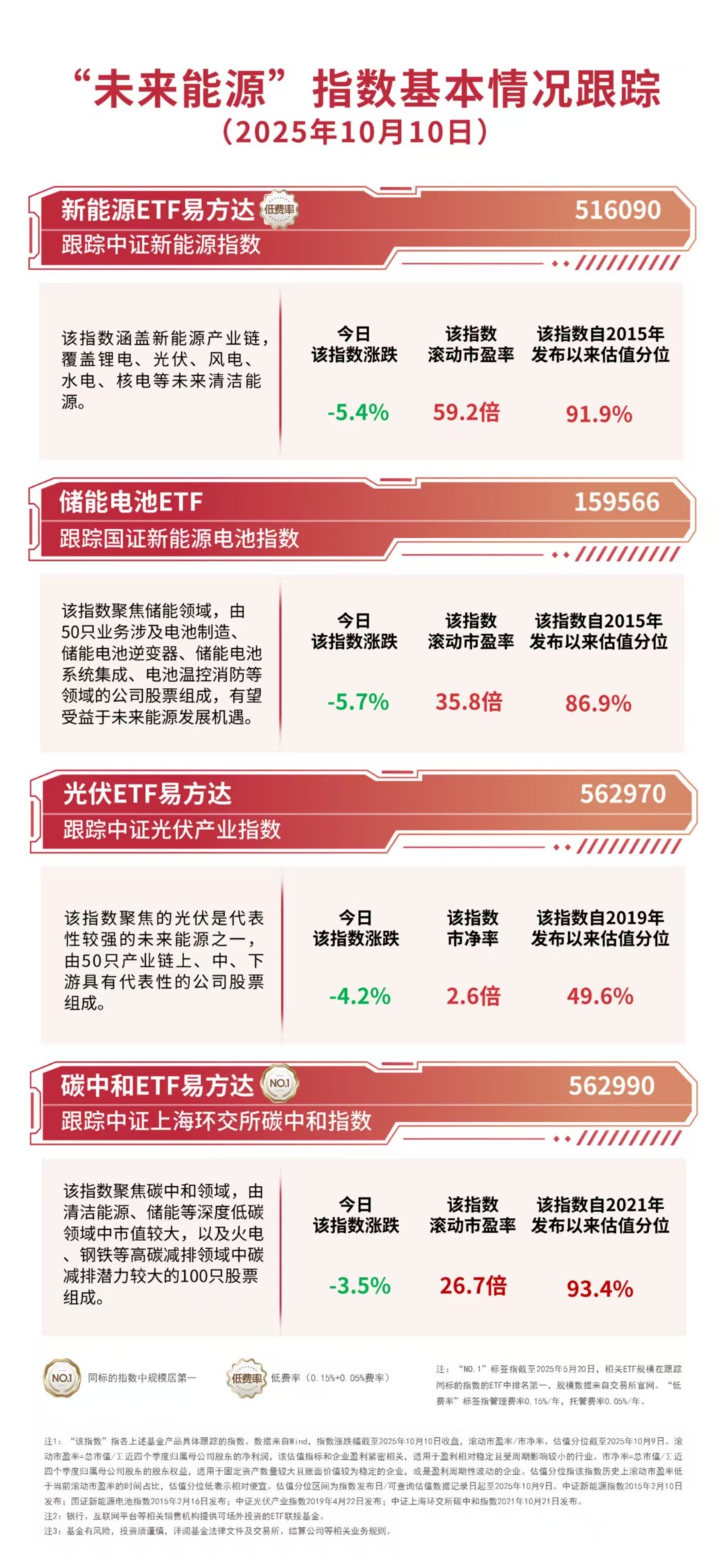
新能源板块集体调整,储能电池ETF(159566)今日获超5000万份净申购
Mei Ri Jing Ji Xin Wen· 2025-10-10 13:49
Core Insights - The renewable energy sector experienced a collective adjustment today, with significant declines in various indices, including a 5.7% drop in the National Renewable Battery Index and a 5.4% drop in the China Securities Renewable Energy Index [1][4]. Group 1: Index Performance - The National Renewable Battery Index fell by 5.7%, while the China Securities Renewable Energy Index decreased by 5.4% [1]. - The China Securities Photovoltaic Industry Index saw a decline of 4.2%, and the Shanghai Environmental Exchange Carbon Neutrality Index dropped by 3.5% [1]. Group 2: ETF Activity - The Energy Storage Battery ETF (159566) recorded over 50 million net subscriptions throughout the day, continuing a trend of attracting capital for six consecutive trading days, totaling over 500 million yuan [1]. - The ETF tracking the China Securities Renewable Energy Index has a rolling P/E ratio of 59.2 times, with a valuation percentile of 91.9% since its inception in 2015 [2]. - The ETF focused on energy storage, which tracks the National Renewable Battery Index, has a rolling P/E ratio of 35.8 times and a valuation percentile of 86.9% since its inception [2].

出口管制或为深远战略意图,继续看好电池和材料龙头
HTSC· 2025-10-10 12:37
Investment Rating - The report maintains an "Overweight" rating for the electric power equipment and new energy sector [5]. Core Viewpoints - The recent export controls on the lithium battery supply chain are expected to enhance the competitiveness of domestic lithium battery companies, with a focus on battery and material leaders [1][4]. - The export restrictions are aimed at products heavily reliant on the domestic supply chain and those with high technical requirements, which may lead to increased export prices and protect domestic companies' technological and market advantages [2][3]. - The report highlights the anticipated surge in storage demand, which is expected to accelerate the supply-demand inflection point, recommending leading companies in the battery and material segments [4]. Summary by Sections Export Controls - The export controls target products with high domestic supply chain dependency, such as artificial graphite and ternary precursors, which account for 98.5% and 89.8% of global production, respectively [2]. - High-tech products, including batteries with energy densities greater than 300Wh/kg and lithium iron phosphate with a density greater than 2.5g/cm3, are also included in the export restrictions [2]. Domestic Competitiveness - The report suggests that the export controls align with previous national policies aimed at enhancing the lithium battery supply chain, potentially increasing export prices and curbing disorderly competition [3]. - The restrictions on high-tech products and related equipment may limit overseas competitors, particularly Japanese and Korean battery manufacturers, thereby safeguarding the technological and market share advantages of domestic firms [3]. Recommendations - The report expresses optimism about domestic lithium battery companies with global competitiveness, particularly those with overseas production capacities, and recommends leading companies in the battery and material sectors [4]. - Specific recommendations include the company "新宙邦" (Xinjubang), with a target price of 60.80 CNY and a "Buy" rating [7][10].

10月锂电排产追踪:超预期旺季持续,全面进入上行周期
高工锂电· 2025-10-10 10:21
Core Viewpoint - The lithium battery industry is experiencing a significant upward trend driven by strong demand in both traditional and energy storage sectors, with production capacity tightening and a shift from passive capacity clearance to active inventory replenishment and competition for quality capacity [3][17]. Production and Capacity - In October, battery production exceeded expectations, with a 10% month-over-month increase from September's high base, and the top 20 battery manufacturers saw production increases of over 20%, with energy storage cells accounting for more than 40% of the output [3][6]. - The average operating rate in the industry is approaching 90%, with leading manufacturers operating at full capacity and second-tier manufacturers rapidly increasing their utilization rates [4]. Component Analysis - Production changes by component include: positive electrode up 0.7%, negative electrode up 5.8%, separator up 4.3%, and electrolyte up 4.2% [5]. - The energy storage sector is identified as the strongest marginal driver, with domestic energy storage bidding exceeding 270 GWh from January to August, a nearly twofold year-on-year increase [6]. Market Performance - The overseas market is also performing well, with the U.S. adding 27.65 GWh of new energy storage from January to August, doubling year-on-year; Europe is beginning to replenish orders after destocking, and regions like the Middle East, Latin America, and Southeast Asia are also seeing growth [7]. - Domestic sales of new energy heavy trucks exceeded 100,000 units from January to August, representing a year-on-year increase of over 180%, which is driving demand for power battery installations [8]. Supply Chain Dynamics - The production capacity for energy storage cells is tightening, enhancing the bargaining power and capacity influence of leading companies [9]. - The supply side is experiencing a shortage of energy storage specification cells, with many leading battery manufacturers reporting full production lines [10]. - If new production capacity does not come online quickly, the tight supply situation may persist until mid-2026 [11]. Material Costs and Pricing - The price of lithium hexafluorophosphate has surpassed 60,000 yuan per ton, leading to a chain reaction of price increases across electrolytes, with many companies nearing full production [11]. - The iron-lithium segment is experiencing a supply-demand imbalance, with the gap narrowing from 20% to around 10%, while the pricing power of leading companies remains strong [12]. - The cost pressures from rising material prices are being transmitted downstream, resulting in differentiated pricing for energy storage products [14]. Future Outlook - The industry is expected to maintain high prosperity from November to December, with the first quarter of next year likely to continue the trend of "not dull in the off-season," and limited month-over-month declines in production [15]. - The industry is entering a new proactive upward cycle, with market expectations for growth in the lithium battery supply chain, particularly in the energy storage sector, being revised upward for 2026 [16][17].
每日投行/机构观点梳理(2025-10-10)
Jin Shi Shu Ju· 2025-10-10 09:51
Group 1: Inflation and Economic Outlook - Citigroup economists expect a cooling in core CPI for September, projecting a rise of 0.28%, down from 0.35% in August, with housing inflation easing overall service inflation [1] - Barclays highlights that the rise in gold prices reflects increasing market distrust in the existing fiscal and monetary order, with major economies' debt exceeding 100% of GDP and a lack of political will for fiscal consolidation [1] - Dutch International Group anticipates a continued bull market for gold, forecasting an average price of $4,000 per ounce in Q4, driven by central bank purchases and geopolitical risks [1] Group 2: Bond Market and Eurozone Stability - Dutch International Group reports that the low volatility environment in the Eurozone makes current bond yield spreads highly attractive, with the 10-year French and Italian bond spreads tightening to 82 basis points [2] - The political crisis in France serves as a warning for Europe, with ongoing challenges in managing rising government debt and the need for structural reforms [2] - Mitsubishi UFJ analysts suggest that if France avoids early elections, the euro may regain an upward trend against the dollar [2] Group 3: Currency and Interest Rate Predictions - Dutch International Group indicates that the yen is becoming the preferred funding currency for carry trades, as expectations for low interest rates persist [4] - Capital Economics forecasts that the USD/JPY exchange rate will end at 150 by the end of 2025, with a potential rebound for the yen expected once the Bank of Japan resumes rate hikes [4] - Mizuho Securities maintains that the Bank of Japan will adopt a hawkish stance in the short term, despite reduced urgency for rate hikes [4] Group 4: Gold Market Projections - China International Capital Corporation predicts that gold prices could exceed $4,500 per ounce in Q1 of next year, driven by rising expectations for Fed rate cuts and geopolitical tensions [5] - The report emphasizes that while short-term factors may fade, the long-term bullish fundamentals for gold remain intact [5] Group 5: Energy Storage and Lithium Battery Industry - CITIC Securities identifies that the energy storage sector is at a pivotal point, with significant cost reductions and policy support driving demand and market penetration [6] - The report highlights that the lithium battery supply chain is expected to improve significantly as energy storage demand accelerates [6] Group 6: Superhard Materials and Coal Sector - CITIC Securities notes that recent export controls on superhard materials may accelerate industry consolidation, leading to potential price increases in the long term [7] - The coal sector is projected to experience sustained excess returns due to balanced supply and demand dynamics, with potential price upside in the upcoming quarter [7] Group 7: AI Industry Developments - CITIC Securities observes that advancements in AI technology are exceeding expectations, with significant progress in commercialization and monetization [7] - The report emphasizes the growing importance of computing power in the AI industry, highlighting opportunities in related sectors such as optical modules and fiber optics [7]
新能源板块大跌点评
Mei Ri Jing Ji Xin Wen· 2025-10-10 08:55
Core Viewpoint - The A-share market experienced a collective adjustment, with significant declines in major indices, particularly in the new energy sector, driven by profit-taking and new export controls on lithium batteries and related materials [1][5]. Market Performance - The Shanghai Composite Index fell by 0.94%, the Shenzhen Component Index dropped by 2.70%, the ChiNext Index decreased by 4.55%, and the North Star 50 Index declined by 1.24%. The total market turnover reached 2.53 trillion yuan [1]. Downward Drivers - The new energy sector faced a notable pullback due to profit-taking by investors and the announcement of export controls by the Ministry of Commerce and the General Administration of Customs, effective from November 8, 2025, targeting lithium batteries and related materials [5]. Impact of Export Controls - The export controls primarily affect high-performance products, marking a significant step for China from scale leadership to technological dominance. In the long term, this is expected to help build a dual moat of "technological barriers + supply chain advantages" [6]. - The announcement includes key manufacturing equipment for lithium batteries, which may temporarily impact overseas procurement and factory progress, while companies with existing overseas capacity may benefit [6]. Future Outlook - Demand for lithium batteries is expected to remain strong, particularly in the commercial vehicle sector, driven by policies promoting vehicle upgrades, decreasing battery costs, and improved charging infrastructure [7]. - The construction of data centers is projected to significantly increase the demand for renewable energy paired with storage batteries, with global shipments expected to reach 300 GWh by 2030, reflecting a CAGR of over 80% from 2024 to 2030 [7]. - The export controls are not new and are expected to have limited substantive impact, merely enhancing regulatory management while maintaining export advantages [7]. Solid-State Battery Developments - Recent breakthroughs in solid-state battery technology, particularly a new anion regulation technique developed by research institutions, address critical interface issues between solid electrolytes and lithium electrodes, enhancing battery performance and safety [8]. - Solid-state batteries are anticipated to find initial applications in demanding sectors such as aerospace, low-altitude economy, and robotics, where cost sensitivity is lower [9]. - The development of solid-state batteries is crucial for maintaining China's competitive edge in the global lithium battery market, as other countries are also advancing in this technology [9]. Investment Opportunities - Investors are encouraged to monitor the New Energy Vehicle ETF (159806) and the ChiNext New Energy ETF (159387), which have significant exposure to storage and solid-state technologies, representing over 65% of their holdings [9].
锂电出口管控加严,利好生产高端材料和有海外产能的公司:对商务部与海关总署公布对锂电池和相关材料实施出口管制的解读
Shenwan Hongyuan Securities· 2025-10-10 08:25
Investment Rating - The industry investment rating is positive, indicating an overweight outlook for the lithium battery sector due to recent export control measures [3][12]. Core Insights - The recent export controls on lithium batteries and related materials are expected to benefit companies with high-end product capabilities and overseas production capacity. The measures aim to prevent the uncontrolled spread of high-end lithium battery technologies and enhance China's bargaining power in international trade [3][4]. - The export restrictions are not expected to have a significant short-term impact on the battery, cathode, and anode sectors, as companies can still export through licensing and other means. The current energy density of exported liquid batteries is primarily between 200-280 Wh/kg, which means the new restrictions will have a limited effect [3][4]. - The report suggests focusing on companies like CATL, Yiwei Lithium Energy, and others that have overseas production capabilities, as the premium for high-end products is likely to increase under the new export control policies [3][4]. Summary by Sections Export Control Measures - On October 9, 2025, the Ministry of Commerce and the General Administration of Customs announced export controls on lithium batteries and artificial graphite anode materials, effective from November 8, 2025. This includes specific requirements for high energy density batteries and advanced cathode materials [3][4]. Impact on Industry - The export controls are designed to safeguard high-end technology from leaking abroad and to strengthen domestic industry competitiveness. The policy reflects a trend towards controlling the export of high-end products and technologies [3][4]. Investment Recommendations - The report recommends investors pay attention to battery manufacturers such as CATL, Yiwei Lithium Energy, and others, as well as material companies with overseas production like Hunan Youneng and others, due to their potential to benefit from the new export restrictions [3][4].



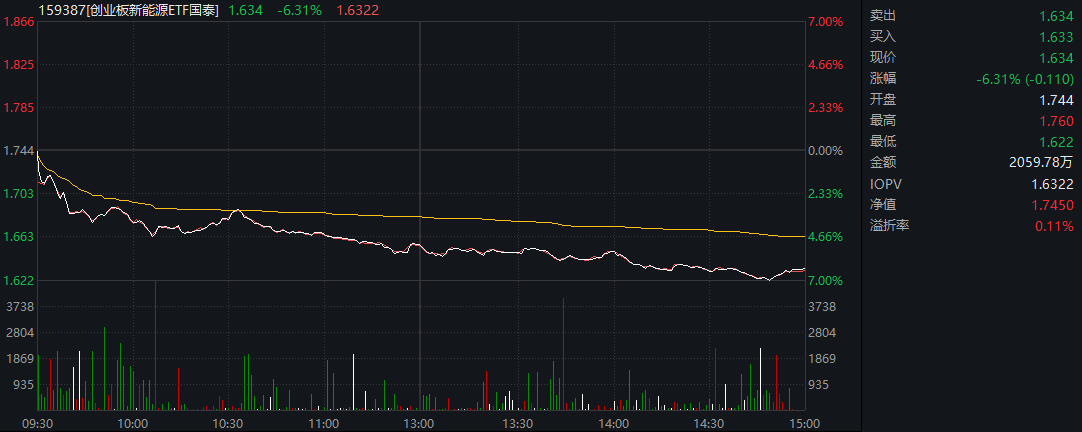
20cm速递|创业板新能源ETF国泰(159387)回调超6%,锂电行业排产增长引关注
Mei Ri Jing Ji Xin Wen· 2025-10-10 06:48
Core Viewpoint - The lithium battery industry is expected to see a production increase of 3% to 9% month-on-month and 21% to 50% year-on-year by October 2025, driven by strong demand from the automotive market and energy storage needs [1] Industry Summary - The battery, anode, and electrolyte sectors are projected to experience year-on-year growth exceeding 40%, primarily due to the peak season in the automotive market and rising energy storage demand [1] - The industry inventory cycle has entered a replenishment phase, with prices for materials such as lithium carbonate and lithium hydroxide increasing by 20% month-on-month, alongside rises in cell and electrolyte prices [1] - In the energy storage sector, domestic installations in August showed a year-on-year growth of 58% and a month-on-month growth of 63%, while the U.S. market experienced a 46% year-on-year growth despite short-term fluctuations due to ITC policy adjustments [1] - Solid-state battery technology is entering a critical industrialization window, with demonstration vehicle deployment expected in 2026-2027, and composite electrolytes anticipated to achieve mass production by Q4 2025 [1] - The market focus on the lithium battery sector is increasing, and under improved supply-demand dynamics, profitability in certain segments may see recovery [1] Company Summary - The Guotai Junan New Energy ETF (159387) tracks the Innovation Energy Index (399266), which has a maximum fluctuation of 20% [1] - This index selects listed companies involved in clean energy production, storage, and application, emphasizing firms with technological innovation capabilities and high growth potential [1] - The industry allocation primarily focuses on solar energy, wind energy, electric vehicles, and related equipment manufacturing, reflecting the overall performance of listed companies in the new energy and related supply chain [1]

光大期货碳酸锂日报(2025 年 10 月 10 日)-20251010
Guang Da Qi Huo· 2025-10-10 05:52
1. Report Industry Investment Rating No relevant content provided. 2. Core View of the Report - On October 9, 2025, the main contract of lithium carbonate futures rose 0.27% to 73,340 yuan/ton. The average price of battery - grade lithium carbonate remained at 73,550 yuan/ton, the average price of industrial - grade lithium carbonate remained at 71,300 yuan/ton, and the price of battery - grade lithium hydroxide (coarse particles) dropped 50 yuan/ton to 73,580 yuan/ton. The warehouse receipt inventory increased 670 tons to 42,379 tons [3]. - On October 9, the Ministry of Commerce and the General Administration of Customs announced export controls on multiple new - energy core materials from November 8, 2025. Three departments jointly announced the technical requirements for new - energy vehicles eligible for vehicle purchase tax exemptions from 2026 - 2027 [3]. - In terms of supply, the weekly output increased 119 tons to 20,635 tons. For demand, the weekly output of ternary materials increased 214 tons to 16,976 tons, and the weekly output of lithium iron phosphate increased 4,644 tons to 84,467 tons. In terms of inventory, the weekly inventory decreased 2,023 tons to 134,802 tons [3]. - After the holiday, the peak demand season, lithium carbonate inventory reduction, and firm lithium ore prices support the price. However, there are still expectations of project复产, and with the supplement of overseas imports, the tight domestic balance will gradually ease, and the price will fluctuate in the short term [3]. 3. Summary by Related Catalogs 3.1 Research Views - **Price Changes**: The main contract of lithium carbonate futures rose 0.27% to 73,340 yuan/ton. The average price of battery - grade lithium carbonate was stable, while battery - grade lithium hydroxide (coarse particles) dropped 50 yuan/ton. Warehouse receipt inventory increased 670 tons [3]. - **Policy News**: Export controls on new - energy core materials will be implemented from November 8, 2025. Technical requirements for new - energy vehicles eligible for purchase tax exemptions from 2026 - 2027 were announced [3]. - **Supply - Demand - Inventory Situation**: Supply increased 119 tons weekly. Demand for ternary materials and lithium iron phosphate increased. Inventory decreased 2,023 tons weekly [3]. - **Price Outlook**: Short - term price is expected to fluctuate due to demand support and supply - side factors [3]. 3.2 Daily Data Monitoring - **Futures and Spot Prices**: Futures prices of lithium carbonate and related products showed various changes. For example, the main contract of lithium carbonate futures rose 540 yuan/ton, and the continuous contract rose 840 yuan/ton. Some lithium ore prices decreased, while the price of six - fluorophosphate lithium increased 3,000 yuan/ton [5]. - **Price Spreads**: Some price spreads changed, such as the battery - grade lithium hydroxide and battery - grade lithium carbonate spread decreased 50 yuan/ton [5]. 3.3 Chart Analysis - **Ore Prices**: Charts show the price trends of lithium - containing ores like lithium spodumene concentrate, lithium mica, and phospho - lithium - aluminum stone from 2024 - 2025 [6][8][9]. - **Lithium and Lithium Salt Prices**: Charts display the price trends of metal lithium, battery - grade and industrial - grade lithium carbonate, and lithium hydroxide from 2024 - 2025 [10][11][13]. - **Price Spreads**: Charts present the trends of various price spreads, including the spread between battery - grade lithium hydroxide and battery - grade lithium carbonate, and the spread between battery - grade and industrial - grade lithium carbonate from 2024 - 2025 [17][18]. - **Precursor & Cathode Materials**: Charts show the price trends of ternary precursors, ternary materials, lithium iron phosphate, manganese acid lithium, and cobalt acid lithium from 2024 - 2025 [25][26][29]. - **Lithium Battery Prices**: Charts display the price trends of 523 square ternary cells, square lithium iron phosphate cells, cobalt acid lithium cells, and square lithium iron phosphate batteries from 2024 - 2025 [34][35][37]. - **Inventory**: Charts show the weekly inventory trends of downstream, smelters, and other links of lithium carbonate from February 20, 2025 - October 9, 2025 [39][40][42]. - **Production Costs**: The chart shows the production profit trends of lithium carbonate from different raw materials from 2024 - 2025 [43][44]. 3.4 Team Introduction - The research team includes Zhan Dapeng, Wang Heng, and Zhu Xi, who have rich experience and professional titles in the field of non - ferrous metals research and new - energy industry research [47][48]. 3.5 Company Contact Information - The company is located at Building 6, Lujiazui Century Financial Plaza, No. 729 Yanggao South Road, China (Shanghai) Pilot Free Trade Zone. The company's phone number is 021 - 80212222, and the fax is 021 - 80212200. The customer service hotline is 400 - 700 - 7979, and the postal code is 200127 [51][52].
锂电出口管控加严,利好生产高端材料和有海外产能的公司
Shenwan Hongyuan Securities· 2025-10-10 05:51
Investment Rating - The industry investment rating is "Overweight" indicating a positive outlook for the lithium battery sector [3][9]. Core Insights - The recent export control measures on lithium batteries and related materials by the Ministry of Commerce and the General Administration of Customs are aimed at preventing the uncontrolled spread of high-end lithium battery technologies and enhancing China's competitive edge in the global market [3]. - The export controls are expected to have limited short-term impact on the battery, cathode, and anode sectors, as companies can still export through licensing and other means [3]. - Companies with overseas production capacity and those producing high-end products are likely to benefit from these export restrictions, as the premium for high-end products is expected to increase [3]. Summary by Sections Export Control Details - Effective from November 8, 2025, the export control applies to lithium batteries with energy density ≥300wh/kg, high-density lithium iron phosphate, and related production equipment [3]. - The policy aims to mitigate risks of technology leakage and enhance negotiation leverage in international trade [3]. Impact on Industry - Current exports of liquid batteries mainly range from 200-280wh/kg, thus the new restrictions will have minimal effect on existing exports [3]. - The export control does not equate to a complete ban, allowing for continued exports through various channels [3]. Investment Recommendations - Recommended companies to watch include battery manufacturers such as CATL, Yiwei Lithium Energy, and others with overseas production capabilities [3]. - Material manufacturers with overseas capacity like Hunan Youneng and others are also highlighted as potential investment opportunities [3].