
房地产

Search documents
绿地控股近期新增诉讼案件1237件 累计金额56.58亿元
Zhong Guo Jing Ji Wang· 2025-12-31 08:53
Group 1 - The core point of the news is that Greenland Holdings has disclosed a significant increase in litigation cases, with a total of 1,237 new lawsuits amounting to 5.658 billion yuan from December 3 to December 27, 2025 [1] - Among the lawsuits, 1,148 cases involve the company as a defendant, totaling 4.391 billion yuan, with the majority being construction-related disputes [1] - The company is also facing 89 lawsuits as a plaintiff, amounting to 1.267 billion yuan, with a significant portion related to construction disputes [1] Group 2 - The real estate and infrastructure industry, where the company operates, is still in an adjustment phase, leading to considerable pressure from ongoing litigation [2] - The company is taking proactive measures to address these lawsuits, including forming specialized teams and enhancing oversight mechanisms to mitigate the impact on its operations [2] - There is uncertainty regarding the potential impact of these lawsuits on the company's future profits, which will depend on the outcomes of court rulings [2]

长城基金苏俊彦:展望2026年,对A股市场潜在空间依然乐观
Xin Lang Cai Jing· 2025-12-31 08:47
Core Viewpoint - The A-share market is expected to transition from a valuation-driven growth to a dual-driven growth model of both profit and valuation, with a shift from external demand to a resonance of both external and internal demand in 2026 [1][4]. Group 1: Market Outlook - The market is anticipated to show optimism, with a potential turning point for profit growth expected in 2026, supported by a gradual recovery in demand and a slowdown in supply growth [1][4]. - Internal demand is projected to recover due to two main factors: the current low proportion of household consumption in GDP, which has significant room for improvement, and the expected increase in fiscal spending in 2026 to support consumption [1][4]. Group 2: Key Investment Areas - Focus on the semiconductor and military industries, as the semiconductor sector is at a critical turning point, with domestic computing chips expected to achieve technological breakthroughs and performance realization [5]. - Attention to "anti-involution" related industries, where policies aimed at eliminating backward production capacity are expected to optimize supply-demand dynamics in chemicals and new energy sectors, leading to price stabilization and rebound [5]. - Emphasis on consumer sectors, particularly service consumption, which is a key area for future policy support, with fiscal subsidies likely to favor the recovery of the restaurant and service industries, further boosting food and beverage consumption [5]. - Real estate sector is expected to gradually stabilize as new construction areas are projected to fall below long-term equilibrium levels by the end of 2026 [5].
京投发展:成功发行2025年度第二期中期票据
Ge Long Hui· 2025-12-31 08:27
Group 1 - The company successfully issued the second phase of medium-term notes for the year 2025, with a total issuance amount of 440 million yuan [1] - The bond is named "Jingtou Development Co., Ltd. 2025 Second Phase Medium-Term Notes," with a code of 102585374 and a maturity period of 3 years [1] - The issuance interest rate for the bonds is set at 2.09%, with a repayment date scheduled for December 29, 2028 [1]

博时市场点评12月31日:2025交易收官,沪指收涨0.09%
Xin Lang Cai Jing· 2025-12-31 08:01
Economic Indicators - The official manufacturing PMI for December is reported at 50.1, an increase of 0.9 percentage points from the previous month, indicating a return to the expansion zone [2][8] - The non-manufacturing business activity index stands at 50.2%, up 0.7 percentage points from last month, also returning to the expansion zone [2][8] - The comprehensive PMI output index is at 50.7%, reflecting a 1.0 percentage point increase from the previous month, signaling overall economic recovery [2][8] Policy Developments - The National Development and Reform Commission and the Ministry of Finance announced a large-scale equipment update and consumption upgrade policy for 2026, with an initial funding of 62.5 billion yuan to support the replacement of old consumer goods [2][3] - The subsidy for purchasing new cars is set at 12% or 10% of the car price, with a maximum subsidy of 20,000 yuan or 15,000 yuan, maintaining the 2025 standards [2][3] - The scope of household appliance subsidies has been narrowed to six categories, with the subsidy rate for first-level energy-efficient appliances reduced from 20% to 15%, and the maximum subsidy per appliance decreased from 2,000 yuan to 1,500 yuan [2][3] Market Performance - On the last trading day of 2025, the Shanghai Composite Index rose by 0.09% to 3,968.84 points, while the Shenzhen Component Index fell by 0.58% to 13,525.02 points, and the ChiNext Index decreased by 1.23% to 3,203.17 points [5][11] - The market turnover was reported at 20,659.23 billion yuan, a decrease from the previous trading day [6][12] - The two-margin balance was recorded at 25,552.84 billion yuan, showing an increase from the previous day [6][12] Sector Analysis - The defense, media, and real estate sectors showed strong performance, with increases of 2.13%, 1.54%, and 1.13% respectively [5][11] - Conversely, the telecommunications, agriculture, forestry, animal husbandry, and electronics sectors experienced declines of 1.35%, 1.10%, and 1.02% respectively [5][11]
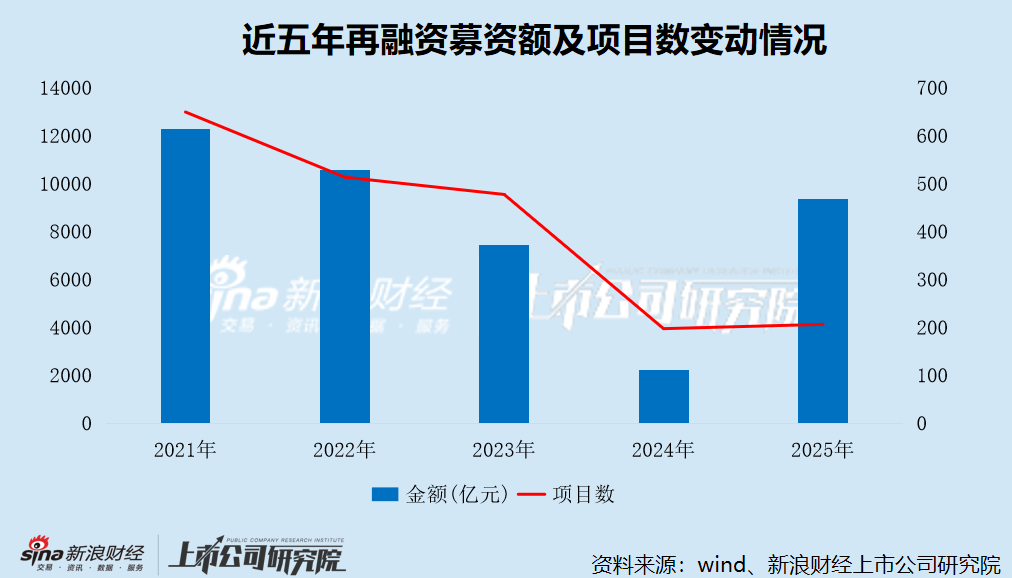
2025年A股再融资数据盘点:电子行业项目数量位列全行业第一(40个) 银行业募资额高居榜首(5200亿元)
Xin Lang Cai Jing· 2025-12-31 08:01
Core Insights - The A-share market in 2025 marked a significant milestone with the index crossing a decade threshold, market capitalization exceeding one trillion, and record trading volumes, driven by policy incentives and liquidity [1][8] Group 1: Overall Market Performance - The total refinancing scale reached 950.865 billion, a year-on-year increase of 326.17% [3][10] - The majority of the refinancing growth came from private placements, which totaled 887.732 billion, reflecting a 412.99% increase year-on-year [3][10] - The number of refinancing applications accepted was 251, with a 100% approval rate across all listed sectors [3][10] Group 2: Specific Financing Types - The total amount raised through convertible bonds was 63.133 billion, marking a 30.77% increase year-on-year [7][14] - No funds were raised through rights issues or preferred shares during the year [3][10] Group 3: Industry Breakdown - The banking sector led in fundraising through private placements, raising 520 billion, accounting for 58.58% of the total [5][12] - The electronics industry had the highest number of private placement projects at 30 [5][12] - The top five industries in terms of total fundraising included banking, electronics, non-bank financials, public utilities, and defense, collectively raising 708.618 billion, which is 79.82% of the total [5][12] Group 4: Convertible Bonds Industry Breakdown - The electronics sector also led in the number of convertible bond projects with 10 [7][14] - The real estate sector raised 13.3 billion through convertible bonds, representing 21.07% of the total [7][14] - The top five industries for convertible bond fundraising included public utilities, power equipment, electronics, and machinery, raising a total of 475.72 billion, which is 75.35% of the total [7][14]




房地产+地方债,金融如何“拆弹”?| 前瞻2026
Guo Ji Jin Rong Bao· 2025-12-31 07:23
Core Insights - The Chinese government is focusing on addressing deep-seated issues in the economy, particularly in real estate and local government debt, as part of its 2026 economic strategy [1][2] - The central economic work meeting emphasizes the need to stabilize the real estate market and manage local government debt risks in a coordinated manner [2][3] Group 1: Economic Strategy and Risk Management - The 2025 Central Economic Work Conference outlined eight key tasks, with a strong emphasis on risk management in critical areas [1] - The shift in policy focus from "stabilizing growth" to "stabilizing expectations and preventing systemic risks" reflects a strategic commitment to market-oriented and legal approaches to risk resolution [3][4] - The interconnectedness of real estate and local debt issues necessitates simultaneous solutions to prevent worsening conditions [2][3] Group 2: Policy Changes and Local Government Initiatives - The approach to real estate regulation is shifting from demand-side stimulation to supply-side management, focusing on controlling new supply, reducing inventory, and optimizing supply [4][5] - The central government is encouraging local governments to take proactive measures in managing their debts, marking a significant policy shift [4][5] - The need for local governments to improve investment effectiveness is highlighted, as past blind investments have led to unsustainable debt accumulation [4][5] Group 3: Financial Institutions and Market Dynamics - Financial institutions are expected to adopt a layered and categorized management approach to effectively address risks associated with real estate and local debts [7][8] - The challenges faced by financial institutions include mismatched risk-return profiles, limited resources in weaker regions, and profit pressures due to interest rate reductions [8][9] - Innovations in financial tools, such as debt-to-equity swaps and asset securitization, are anticipated to enhance the management of local government debts and stabilize the real estate market [10][11] Group 4: Long-term Implications for Financial Stability - Addressing the risks in real estate and local government debt is crucial for achieving financial stability and is seen as a foundational step towards becoming a "financial power" [11] - The resolution of these risks is expected to enhance the transparency and resilience of the Chinese financial system, making it more immune to external shocks [11][12] - The transition from a scale-driven to an efficiency-driven economic model is essential for achieving sustainable modernization in China [11][12]
收评:沪指今日涨0.09%全年涨18.41% 商业航天、AI应用方向走强
Zheng Quan Shi Bao Wang· 2025-12-31 07:14
Market Performance - The Shanghai Composite Index (沪指) experienced a slight increase of 0.09% while the Shenzhen Component Index (深证成指) and the ChiNext Index (创业板指) declined by 0.58% and 1.23% respectively [1][2] - Over 2,500 stocks in the market saw an increase [1][2] Sector Highlights - The commercial aerospace sector continued to show strength with stocks like Beidou Star Communication (北斗星通), Fenghuo Communication (烽火通信), and Leike Defense (雷科防务) reaching their daily limit [1][2] - AI application stocks also performed well, with BlueFocus Communication (蓝色光标) hitting a 20% limit up, alongside stocks like Zhangyue Technology (掌阅科技) and Desheng Technology (德生科技) [1][2] - The real estate sector was active, with Hefei Urban Construction (合肥城建) and Urban Development (城建发展) also reaching their daily limit [1][2] Yearly Performance - The Shanghai Composite Index recorded an annual increase of 18.41% [1][2] - The Shenzhen Component Index saw a yearly rise of 29.87% [1][2] - The ChiNext Index achieved a significant annual growth of 49.57% [1][2]
房地产+地方债,金融如何“拆弹”?
Guo Ji Jin Rong Bao· 2025-12-31 07:05
Core Insights - The Chinese government is focusing on addressing deep-seated issues in the economy, particularly in real estate and local government debt, as part of its 2026 economic strategy [1][2] - The central economic work meeting emphasizes the need to stabilize the real estate market and manage local government debt risks in a coordinated manner [1][2] Group 1: Economic Strategy - The 2025 Central Economic Work Conference outlined eight key tasks, with a strong emphasis on risk management in critical areas [1] - The shift in policy focus from "stabilizing growth" to "stabilizing expectations and preventing systemic risks" reflects a strategic change in addressing economic challenges [3] Group 2: Real Estate and Local Debt Risks - The interconnection between real estate prices and local government debt is highlighted, indicating that declining property values exacerbate debt issues [2] - Local government debt is primarily linked to infrastructure projects that often lack adequate returns, leading to increased risk of defaults as property values fall [2] Group 3: Policy Changes - The approach to real estate management is shifting from demand-side stimulation to supply-side management, focusing on controlling new supply and reducing inventory [4] - The central government is encouraging local governments to take proactive measures in managing their debts, marking a significant policy shift [4] Group 4: Financial Institutions' Role - Financial institutions are expected to adopt a more nuanced approach to risk management, focusing on categorization and management of risks associated with real estate and local debts [7] - The need for financial institutions to transition from reliance on collateral to assessing cash flow is emphasized, particularly in urban renewal projects [7] Group 5: Long-term Implications - Addressing real estate and local government debt risks is seen as crucial for achieving a "financially strong nation" and realizing "Chinese-style modernization" [11] - The resolution of these risks is expected to enhance the transparency and resilience of the financial system, making it more robust against external shocks [11]
房地产ETF(512200.SH)涨1.35%,张江高科涨6.68%
Jin Rong Jie· 2025-12-31 06:53
Group 1 - The A-share market showed mixed performance on December 31, with the cultural media and aerospace military sectors leading the gains. The real estate ETF (512200.SH) rose by 1.35%, and Zhangjiang Hi-Tech increased by 6.68% [1] - According to Kaiyuan Securities, the investment logic for the real estate sector is driven by several policy measures, including the Ministry of Housing and Urban-Rural Development promoting housing delivery, old housing updates, expansion of financing whitelist, and the implementation of existing housing sales regulations. The central bank is also facilitating affordable housing re-loans, and Beijing is optimizing purchase restrictions [1] - The market is witnessing a month-on-month increase in both new and second-hand housing transactions, indicating a marginal improvement in demand. Additionally, under a backdrop of proactive fiscal policy and moderately loose monetary policy, the acceleration of stockpiling and urban village renovations is improving the supply-demand relationship [1] - Although housing prices may experience slight fluctuations, the continuous policy support is expected to stabilize the industry, making the real estate ETF (512200.SH) a potential focus for investors [1]

美国购房可负担性有所改善 但首付仍是最大难题
Xin Lang Cai Jing· 2025-12-31 06:40
Core Insights - The current housing affordability for American buyers has improved due to lower mortgage rates, stabilized home prices, and an increase in available housing inventory [1][3][6] Group 1: Housing Market Trends - National home prices in the U.S. are approximately flat compared to the same period last year, with a slight increase of 0.3% [1][4] - The S&P CoreLogic Case-Shiller Home Price Index indicates significant variation in price changes across major metropolitan areas, with Chicago, New York, and Cleveland seeing the largest increases, while cities like Tampa, Phoenix, and Dallas experienced notable declines [4][5] - The average 30-year fixed mortgage rate is currently at 6.19%, down from over 7% at the beginning of the year, leading to substantial savings for buyers [2][5] Group 2: Buyer Behavior and Challenges - Buyers are responding positively to the market changes, as evidenced by an increase in the Pending Home Sales Index, which rose 3.3% month-over-month and 2.6% year-over-year, reaching its highest level in nearly three years [3][6] - Despite improvements in affordability, the challenge of saving for a down payment remains significant, with the average buyer needing about 7 years to save enough, which is still double the pre-pandemic level [2][5] - The homeownership rate in the U.S. has dropped to 65%, the lowest since 2019, indicating ongoing barriers to entry for potential homeowners [2][5] Group 3: Market Supply Dynamics - The number of active listings has increased by approximately 12% compared to last year, although it remains 6% lower than pre-pandemic levels, suggesting a gradual recovery in housing supply [2][5]