
氢能

Search documents
电力设备与新能源行业7月第3周周报:国常会提出规范新能源汽车产业竞争秩序-20250720
Bank of China Securities· 2025-07-20 10:31
Investment Rating - The report maintains an "Outperform" rating for the electric equipment and new energy industry [1] Core Insights - The State Council meeting emphasized the need for high-quality development in the new energy vehicle (NEV) industry, addressing irrational competition and promoting a regulated competitive environment, which is beneficial for the NEV sector [1] - According to the China Association of Automobile Manufacturers, NEV production and sales are expected to reach 6.968 million and 6.937 million units respectively in the first half of 2025, representing year-on-year growth of 41.4% and 40.3%, with NEV sales accounting for 44.3% of total new car sales [1] - The report highlights the clear trend towards the industrialization of solid-state batteries, suggesting a focus on related materials and equipment companies [1] - In the photovoltaic sector, the central economic work conference called for a comprehensive rectification of "involution" competition, leading to price increases in the upstream photovoltaic supply chain [1] - The hydrogen energy sector is seeing continuous policy support for industrialization, with recommendations to focus on electrolyzer manufacturers and companies benefiting from hydrogen infrastructure [1] Industry Dynamics - The electric equipment and new energy sector saw a 0.57% increase this week, with power generation equipment rising by 3.86% and the NEV index increasing by 2.62% [10] - The report notes that the photovoltaic sector experienced a decline of 2.53%, while the wind power sector fell by 0.27% [10] - The report indicates that the price of silicon materials has been supported by cost factors, with recent price adjustments reflecting a positive response to the "anti-involution" policy [1][15] - The report also mentions that the domestic lithium battery market is experiencing price fluctuations, with certain materials showing varying trends [14] Company Updates - Longi Green Energy is expected to report a net loss of 2.4 to 2.8 billion yuan for the first half of the year, while Tongwei Co. anticipates a net loss of 4.9 to 5.2 billion yuan [29] - Zhongke Electric is projected to achieve a net profit of 232 to 301 million yuan, marking a year-on-year increase of 235% to 335% [29] - The report highlights that Tianqi Lithium is expected to report a net profit of 0 to 155 million yuan for the first half of the year [29] - The report also notes that Tianqi Materials has signed a procurement agreement to supply at least 550,000 tons of electrolyte products by the end of 2030 [29]
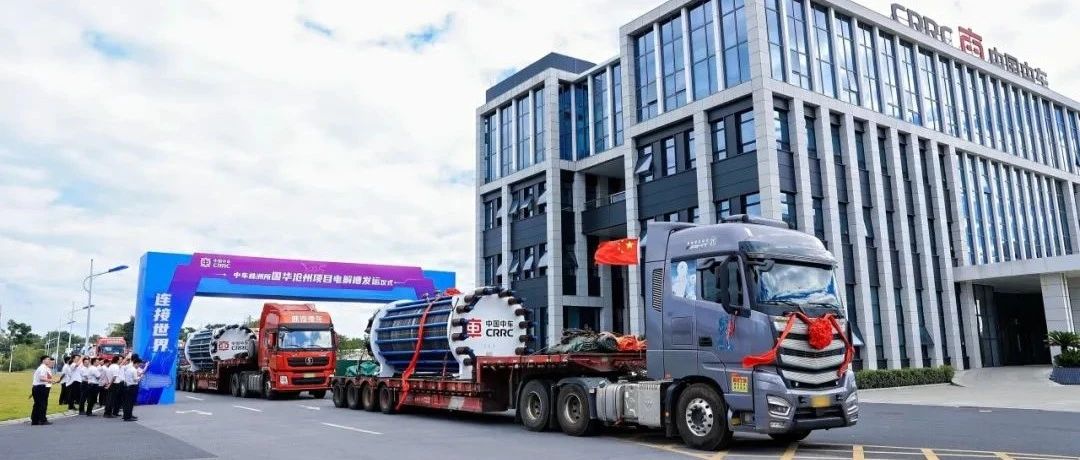
中车株洲所13台套1000Nm³/h电解槽成功发运!开启国华沧州“绿港氢城”新篇章
中关村储能产业技术联盟· 2025-07-20 04:18
Core Viewpoint - The delivery of 13 sets of self-developed 1000Nm³/h electrolyzers by CRRC Zhuzhou Institute marks a significant breakthrough in the domestic green hydrogen equipment sector, enhancing the scale and autonomy of hydrogen production in China [1][7]. Group 1: Technology and Safety Features - The electrolyzers utilize flexible hydrogen production technology and a multi-level safety defense system, featuring small chamber inspections and intelligent control modules to support flexible project regulation [3]. - A unique "intrinsic safety + triple sealing + online monitoring" protection system ensures leak prevention throughout the product's lifecycle [5]. - The system allows for a wide adjustment range of 30%-110%, with stable operation at 30% low load and a power adjustment rate of 8%/s [5][6]. Group 2: Efficiency and Intelligence - The direct current energy consumption is as low as 4.2-4.4 kWh/Nm³, with a temperature difference of ≤12°C and a voltage difference of ≤±3% [6]. - The electrolyzers feature automated operations with "one-click start-stop" and "one-click replacement" functionalities, enhancing operational intelligence [6]. Group 3: Environmental Impact and Future Plans - The Guohua Cangzhou "Green Port Hydrogen City" project aims to produce 100,000 tons of green ammonia annually, reducing carbon emissions by over 400,000 tons [7]. - The company emphasizes ongoing technological innovation to lower green hydrogen costs and promote large-scale applications, focusing on optimizing electrolyzer and power system integration [7]. - Future developments include the establishment of unmanned factories and intelligent diagnostic technologies to improve efficiency and safety [7][9].

吕梁:“氢”装上阵逐绿新赛道
Sou Hu Cai Jing· 2025-07-20 03:18
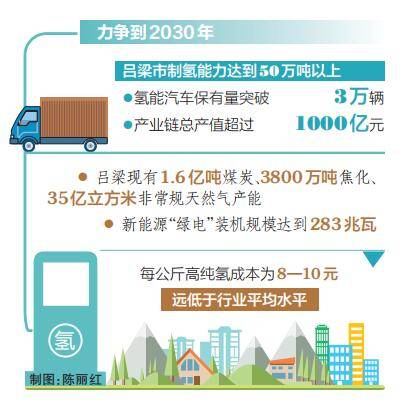
Core Viewpoint - Luliang is transitioning from coal dependency to a green, low-carbon economy by focusing on the hydrogen energy industry as a key driver for development [2][3]. Group 1: Hydrogen Industry Development - Luliang has established hydrogen energy as a priority in its "985" key industrial chain, with 15 supportive measures and an annual special fund of at least 100 million yuan [2]. - The city aims to achieve a hydrogen production capacity of over 500,000 tons by 2030, with more than 30,000 hydrogen vehicles and a total industrial output value exceeding 100 billion yuan [2]. - The region has a rich resource base for hydrogen production, including 160 million tons of coal, 38 million tons of coke, and 3.5 billion cubic meters of unconventional natural gas [3]. Group 2: Technological Advancements and Infrastructure - The first batch of 100 hydrogen heavy-duty trucks was launched in November 2022, with a second batch expected in December 2023, showcasing advancements in fuel cell technology and safety measures [3]. - Luliang has implemented a hydrogen fuel cell bus demonstration line, with the first five buses capable of a range exceeding 300 kilometers and zero carbon emissions [4]. - The city has established 11 hydrogen refueling stations and is accelerating the production of 300,000 hydrogen fuel cell vehicles annually [5]. Group 3: National Recognition and Future Prospects - Luliang was recently approved to join the national fuel cell vehicle demonstration city cluster, marking a significant milestone for the hydrogen industry in Shanxi province [4][5]. - The city’s hydrogen energy initiatives are expected to provide a model for collaborative industrial development across the country, enhancing the overall growth of the fuel cell vehicle sector [5].
逐新向高,创新场活力充沛(年中经济观察)
Ren Min Ri Bao· 2025-07-20 00:40
Group 1 - China's economy shows strong growth in high-tech manufacturing, with an increase of 9.5% in value added for large-scale high-tech manufacturing in the first half of the year [2] - Strategic emerging service industries also saw significant growth, with revenues increasing by nearly 10% from January to May [2] - The innovation-driven development strategy is gaining momentum, enhancing the vitality of innovation and driving economic growth [2] Group 2 - Traditional industries are undergoing upgrades, with companies like Xiangtan Steel focusing on high-end and specialty steel products to capture market demand [3][4] - The integration of advanced technologies such as AI and 5G in industries like coal mining is improving safety, efficiency, and environmental sustainability [5] - Companies are increasingly adopting innovative technologies to enhance productivity and reduce training times, as seen in Suzhou Huazhan Aerospace Electric Co. [5] Group 3 - The development of compound semiconductor industries is crucial, with companies like Huagong Technology achieving breakthroughs in laser wafer cutting equipment [6][7] - Innovation is essential for industries to withstand risks and enhance resilience, with a focus on addressing critical technological challenges [8] Group 4 - The transformation of scientific achievements into productive forces is accelerating, with companies like Xihai Biotechnology rapidly moving from research to industrial production [9] - Over 77% of R&D investment in China comes from enterprises, highlighting the importance of market-driven innovation [9] Group 5 - New industries are gradually emerging, with a focus on sectors such as marine technology and hydrogen energy, as demonstrated by the launch of China's first offshore CCUS project [12] - The development of new materials, such as high magnesium lightweight aluminum, is key to enhancing competitiveness in various fields [15] Group 6 - Private enterprises are becoming increasingly active in innovation, with sectors like integrated circuits and artificial intelligence seeing significant growth [16][17] - Foreign investment is shifting towards innovation-driven projects, as evidenced by new R&D facilities established by companies like Siemens in China [18] Group 7 - Continuous innovation efforts are supported by a robust talent pool, with China leading globally in the number of R&D personnel and STEM graduates [22] - The integration of education, technology, and talent development is crucial for fostering innovation and high-quality growth [21]
身家暴跌253亿,“煤老板”姚俊良失守山西首富
创业家· 2025-07-19 09:43
Core Viewpoint - The wealth of the Yao Junliang family has significantly declined, losing the title of Shanxi's richest family, with their fortune dropping from 329.1 billion to 76 billion yuan, a decrease of 253.1 billion yuan over recent years [6][15][20]. Group 1: Wealth Decline - The Yao Junliang family's wealth has shrunk by 253.1 billion yuan, falling to 76 billion yuan in the 2025 New Fortune 500 list, marking a significant decline from their previous high [6][15]. - The family has been overtaken by Wang Guangxi and Guo Tianshu of Yongtai Energy, as well as Yang Xia of Jinbo Biological, dropping to third place among Shanxi's wealthy [6][15]. - The family's wealth has been on a downward trend since 2022, when they reached a peak of 329.1 billion yuan [6][15]. Group 2: Business Performance - Meijin Energy, the family's main business, has faced declining revenues, with a peak revenue of 24.6 billion yuan in 2022, followed by a drop of 15.4% and 8.55% in subsequent years, leading to a revenue of 19.03 billion yuan in 2024 [15][20]. - The company's net profit has also plummeted, recording a loss of 1.143 billion yuan in 2023 after a profit of 2.541 billion yuan in 2021 [15][20]. - The hydrogen energy business, which the company has heavily invested in, has not yet become a significant revenue contributor, accounting for only 4.16% of total revenue [15][20]. Group 3: Historical Context - The Yao family has a long history in the coal industry, starting with Yao Junliang's father, Yao Juhuo, who founded Meijin Energy in the 1980s [10][12]. - The family has transitioned through three generations, with Yao Junliang currently leading the business and his son Yao Jinlong taking on significant roles [12][20]. - Meijin Energy has evolved into one of the largest independent producers of coking coal and has made strides into the hydrogen energy sector, although it remains heavily reliant on traditional coal and coke operations [12][20]. Group 4: Market Challenges - The company has faced significant challenges, including a structural imbalance between the prices and costs of coal and coke, leading to reduced profit margins [16][20]. - The steel industry's downturn has negatively impacted demand for coking coal, contributing to increased inventory levels and reduced production [18][20]. - The company's gross margin has declined sharply from 30.25% in 2021 to just 0.14% in the first quarter of 2025, indicating severe financial strain [20].
美锦能源上半年预亏逾4.8亿元 氢能业务遇成长阵痛
Zhong Guo Jing Ying Bao· 2025-07-18 20:21
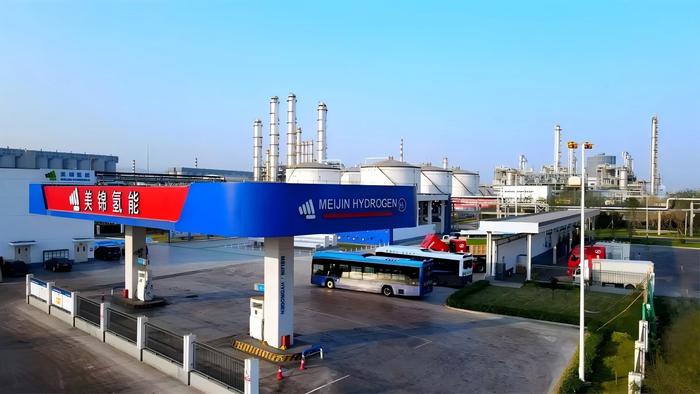
Core Viewpoint - Meijin Energy (000732.SZ) is expected to report a net loss of 480 million to 700 million yuan for the first half of 2025, showing a slight improvement from a loss of 683 million yuan in the same period last year, primarily due to declining coal and coke prices impacting profit margins [2] Group 1: Financial Performance - In 2022, Meijin Energy reported a net profit of 2.209 billion yuan, which plummeted to 289 million yuan in 2023, and further to a loss of 1.143 billion yuan in 2024, marking a year-on-year decline of 495.31% [2] - Revenue decreased from 24.6 billion yuan in 2022 to 19.031 billion yuan in 2024 [2] Group 2: Business Structure and Market Sensitivity - In 2024, Meijin Energy's coal and coke business accounted for 95.84% of its revenue, making it highly sensitive to fluctuations in coal and coke prices [3] - The International Energy Agency (IEA) predicts a 27% decline in global coal prices in 2025, further compressing traditional business profit margins [3] Group 3: Coke Price Trends - By the end of June 2025, the price of Shanxi premium dry coke fell to 1,225 yuan per ton, a decrease of 460 yuan per ton or 27.3% since early January, and down 845 yuan per ton or 40.82% year-on-year [3][4] - The decline in coke prices is attributed to weak demand from the steel industry and a surplus in supply, with expectations of a slow recovery in the second half of 2025 [4] Group 4: Hydrogen Energy Business - Meijin Energy has been strategically investing in the hydrogen energy sector since 2017, aiming to leverage its coke production to develop a complete hydrogen energy supply chain [5] - Despite being a leader in the hydrogen energy sector, the revenue contribution from this business remains low at 4.16% in 2024 [5] Group 5: Production and Sales Challenges - In 2024, the combined production of commercial vehicles from subsidiaries Feichi Technology and Qingdao Meijin was only 208 units, with total sales of 634 units, both showing a decline [6] - The hydrogen energy segment faced challenges due to policy changes, high hydrogen costs, and slow infrastructure development, leading to losses for both subsidiaries [6] Group 6: Project Delays - The completion of the Meijin Hydrogen Energy Headquarters Base Phase I has been postponed from June 2025 to June 2026 due to various construction delays [7] - The company has implemented measures to expedite project progress, including enhanced communication with contractors and increased resource allocation [7][8]

气候危机凸显氢能本色
GUOTAI HAITONG SECURITIES· 2025-07-18 12:13
Group 1: Hydrogen Energy Industry Insights - AEM hydrogen production is a significant trend in the hydrogen energy sector, with high potential for future development; the core of AEM hydrogen production lies in the AEM membrane, which has gained industry-wide recognition[2] - Polychemical currently has a market capitalization of 2.4 billion yuan[2] - Zhongyuan Neipei is a key player in the hydrogen energy industry chain in Henan Province, actively transitioning to hydrogen fuel cell components and recently signing a strategic cooperation agreement with Sunshine New Energy[2] Group 2: Market Context and Risks - The global warming crisis is accelerating, necessitating a reduction in carbon dioxide emissions; hydrogen energy is positioned as a crucial tool for industrial decarbonization and will likely become a major winner in carbon neutrality over the coming decades[5] - The hydrogen energy industry chain includes upstream hydrogen production, midstream storage and transportation, and downstream applications, with nearly 100 listed companies in the A-share market involved in hydrogen energy[5] - Risks include potential underperformance of industrial policies and technological breakthroughs not meeting expectations[3]


无锡首个电解水制氢示范项目-威孚PEM制氢工业应用项目投产启动
势银能链· 2025-07-18 05:18
Core Viewpoint - The article highlights the successful launch of the PEM hydrogen production project by Wuxi Weifu High Technology Group Co., Ltd., marking a significant milestone in the green hydrogen application demonstration in Wuxi, China. This project aims to promote energy-saving and carbon reduction in traditional manufacturing and facilitate the green transformation of the industry [3][7]. Group 1: Project Overview - The PEM hydrogen production project was inaugurated on July 16, 2023, with the theme "Hydrogen Drives the Future," attended by government officials, industry leaders, and experts [3]. - The project utilizes smart grid and PEM electrolysis technology, optimizing hydrogen production processes to achieve efficient renewable energy conversion, particularly for the automotive and industrial sectors [5]. Group 2: Technical Specifications - The hydrogen production station features a modular hydrogen production system developed by Weifu, maintaining a stable hydrogen production pressure of no less than 3.5 MPa and capable of operating within a power fluctuation range of 10-110% [5]. - The system's energy consumption is ≤5 kWh/Nm³-H₂, ensuring high-quality hydrogen for downstream applications [5]. Group 3: Strategic Implications - Weifu's president, Yin Zhenyuan, stated that the project's launch is a crucial step in transitioning from traditional automotive parts to zero-carbon equipment, aiming to enhance the hydrogen industry policy in Wuxi and Jiangsu Province [7]. - Since 2018, Weifu has focused on three main business areas: hydrogen utilization, production, and storage, establishing a comprehensive hydrogen industry ecosystem [7].

六地发布氢能政策:覆盖氢车应用/高速让利/氨醇特色产品
势银能链· 2025-07-18 05:18
Core Viewpoint - The article highlights the active development of the hydrogen energy industry across various regions in China, with specific policies and initiatives aimed at promoting hydrogen applications in transportation and manufacturing sectors [3][4][6][7][8][9][11]. Group 1: Regional Developments - Jiaxing has launched a demonstration program focusing on hydrogen heavy trucks, buses, and drones, with plans to establish at least 10 replicable demonstration scenarios by the end of the year [5]. - Chongqing has proposed a policy that offers up to 600,000 yuan in rewards for the development of new hydrogen fuel cell vehicle models, with specific exemptions from traffic restrictions for these vehicles [6]. - Inner Mongolia is prioritizing the development of hydrogen equipment manufacturing in key cities, establishing research and production bases for hydrogen technologies [7]. - Hainan aims to create a green hydrogen and methanol product chain as part of its low-carbon development strategy, targeting carbon peak by 2030 and carbon neutrality by 2060 [8]. - Qingdao is promoting a comprehensive hydrogen energy development strategy that includes production, storage, transportation, and application across various sectors [9][10]. - Liupanshui is providing subsidies for hydrogen vehicle highway tolls, encouraging the use of hydrogen energy vehicles within the city [11]. Group 2: Policy Initiatives - The policies introduced in various regions reflect a strong governmental push towards integrating hydrogen energy into transportation and industrial applications, showcasing a commitment to sustainable energy solutions [4][6][8][9]. - The initiatives include financial incentives, infrastructure development, and technology support aimed at fostering innovation and adoption of hydrogen technologies [5][6][7][8][9].
赵一德在调研开发区建设工作时强调深化改革创新 激发动力活力 推动开发区高质量发展迈出更大步伐
Shan Xi Ri Bao· 2025-07-18 00:21
Group 1 - The core viewpoint emphasizes the importance of developing economic and technological development zones to enhance innovation and drive high-quality growth [1][2] - The development zones are identified as key areas for reform and economic construction, requiring a focus on attracting investment, project construction, and enterprise services [1] - The integration of Xi'an and Xianyang is highlighted as a strategic initiative to promote collaborative development and enhance the economic scale of the Xianyang Economic Development Zone [1] Group 2 - The focus on high-tech development and industrialization in the Xianyang High-tech Zone is underscored, with an emphasis on leveraging technological innovation to drive new productive forces [2] - The importance of hydrogen energy as a growth opportunity is noted, with a call for comprehensive enterprise cultivation and project layout to expand application scenarios [2] - The need for a well-structured management model that aligns with the development stage of the development zones is emphasized, alongside the importance of leadership and a professional workforce [2]