焦炭

Search documents
美锦能源跌2.18%,成交额2.99亿元,主力资金净流出2994.83万元
Xin Lang Cai Jing· 2025-11-20 03:02
今年以来美锦能源已经2次登上龙虎榜,最近一次登上龙虎榜为7月10日,当日龙虎榜净买入5031.92万 元;买入总计1.99亿元 ,占总成交额比11.44%;卖出总计1.48亿元 ,占总成交额比8.55%。 资料显示,山西美锦能源股份有限公司位于山西省太原市迎泽区劲松北路31号哈伯中心12层,成立日期 1997年1月8日,上市日期1997年5月15日,公司主营业务涉及煤炭、焦化、天然气、氢燃料电池汽车为 主的新能源汽车等商品的生产销售。主营业务收入构成为:煤焦化产品及副产品97.45%,新能源车辆 及运营2.55%。 美锦能源所属申万行业为:煤炭-焦炭Ⅱ-焦炭Ⅲ。所属概念板块包括:天然气、煤化工、低价、清洁能 源、污水处理等。 11月20日,美锦能源盘中下跌2.18%,截至10:38,报5.39元/股,成交2.99亿元,换手率1.25%,总市值 237.35亿元。 资金流向方面,主力资金净流出2994.83万元,特大单买入790.81万元,占比2.65%,卖出767.47万元, 占比2.57%;大单买入4631.64万元,占比15.51%,卖出7649.82万元,占比25.62%。 美锦能源今年以来股价涨19. ...

《黑色》日报-20251120
Guang Fa Qi Huo· 2025-11-20 01:36
Report on the Steel Industry 1. Investment Rating No investment rating information is provided in the report. 2. Core View The steel market shows a weakening trend with falling prices and mixed production and inventory changes. The iron ore supply chain has a negative feedback basis, and it is not recommended to go long. For steel, with the decline in apparent demand and unsold inventory, a short - side attempt can be considered [1]. 3. Summary by Directory Steel Prices and Spreads - **Threaded Steel**: Spot prices in different regions (East, North, South) are between 3220 - 3300 yuan/ton, with a decline of 0 - 10 yuan/ton compared to the previous value. Futures contract prices also decreased, with the 05 contract down 23 yuan, the 10 contract down 18 yuan, and the 01 contract down 20 yuan [1]. - **Hot - Rolled Coil**: Spot prices in different regions are between 3220 - 3300 yuan/ton, with a change of - 10 - 10 yuan/ton. Futures contract prices decreased, with the 05 contract down 14 yuan, the 10 contract down 16 yuan, and the 01 contract down 9 yuan [1]. Cost and Profit - **Cost**: Steel billet price is 2970 yuan/ton (unchanged), and slab price is 3730 yuan/ton (unchanged). The cost of Jiangsu electric - furnace threaded steel is 3254 yuan/ton (unchanged), and the cost of Jiangsu converter threaded steel is 3189 yuan/ton, down 1 yuan [1]. - **Profit**: East China hot - rolled coil profit is - 77 yuan/ton, down 30 yuan; North China hot - rolled coil profit is - 147 yuan/ton (unchanged); East China threaded steel profit is - 127 yuan/ton, up 10 yuan; South China threaded steel profit is 43 yuan/ton (unchanged) [1]. Production - **Daily Average Hot - Metal Output**: It is 236.8 tons, up 2.6 tons or 1.1% [1]. - **Output of Five Major Steel Products**: It is 834.4 tons, down 22.4 tons or - 2.6%. Threaded steel output is 200.0 tons, down 8.5 tons or - 4.1%, including a 1.2 - ton or - 4.0% decrease in electric - furnace output and a 7.4 - ton or - 4.1% decrease in converter output. Hot - rolled coil output is 313.7 tons, down 4.5 tons or - 1.4% [1]. Inventory - **Inventory of Five Major Steel Products**: It is 1477.4 tons, down 26.2 tons or - 1.7%. Threaded steel inventory is 576.2 tons, down 16.4 tons or - 2.8%. Hot - rolled coil inventory is 410.5 tons, with a negligible change [1]. Transaction and Demand - **Building Materials Transaction Volume**: It is 9.2 tons, down 0.4 tons or - 4.1%. The apparent demand for five major steel products is 860.6 tons, down 6.3 tons or - 0.7%. The apparent demand for threaded steel is 216.4 tons, down 2.2 tons or - 1.0%. The apparent demand for hot - rolled coil is 313.6 tons, down 0.7 tons or - 0.2% [1]. Report on the Ore Industry 1. Investment Rating No investment rating information is provided in the report. 2. Core View The iron ore futures oscillated. Although the hot - metal output rebounded this week, there is limited room for further increase. With the current profit margin and inventory level of steel mills, it is not enough to trigger a negative feedback. It is expected that iron ore will show a high - level oscillation, and a wait - and - see approach is recommended for single - side trading [5]. 3. Summary by Directory Iron Ore - Related Prices and Spreads - **Warehouse Receipt Cost**: The warehouse receipt costs of various iron ore powders (Carol, PB, Brazilian Blend, Jinbuba) remained unchanged [5]. - **01 Contract Basis**: The basis of various iron ore powders increased slightly, with the basis of Carol powder up 0.5 yuan/ton or 2.4%, PB powder up 0.5 yuan/ton or 1.0%, Brazilian Blend powder up 0.5 yuan/ton or 0.8%, and Jinbuba powder up 0.5 yuan/ton or 1.0% [5]. - **Spread**: The 5 - 9 spread is 25.0 yuan/ton, up 1.5 yuan or 6.4%; the 9 - 1 spread is - 61.5 yuan/ton, down 3.5 yuan or - 6.0%; the 1 - 5 spread is 36.5 yuan/ton, up 2.0 yuan or 5.8% [5]. Spot Prices and Price Indexes - **Spot Prices at Rizhao Port**: The spot prices of various iron ore powders (Carol, PB, Brazilian Blend, Jinbuba) remained unchanged. The price of the Singapore Exchange 62% Fe swap is 104.5 dollars/ton, down 0.1 dollars or - 0.1%, and the Platts 62% Fe is 105.2 dollars/ton, down 0.1 dollars or - 0.1% [5]. Supply - **Arrival Volume at 45 Ports (Weekly)**: It is 2268.9 tons, down 472.3 tons or - 17.2%. - **Global Shipment Volume (Weekly)**: It is 3516.4 tons, up 447.4 tons or 14.6%. - **National Monthly Import Volume**: It is 11632.6 tons, up 1111.6 tons or 10.6% [5]. Demand - **Daily Average Hot - Metal of 247 Steel Mills (Weekly)**: It is 236.9 tons, up 2.7 tons or 1.1%. - **Daily Average Out - Port Volume at 45 Ports (Weekly)**: It is 327.0 tons, up 6.0 tons or 1.9%. - **National Monthly Pig Iron Output**: It is 6554.9 tons, down 49.7 tons or - 0.8%. - **National Monthly Crude Steel Output**: It is 7199.7 tons, down 149.3 tons or - 2.0% [5]. Inventory Change - **Inventory at 45 Ports (Weekly)**: It is 15114.45 tons, down 15.3 tons or - 0.1%. - **Imported Ore Inventory of 247 Steel Mills (Weekly)**: It is 9076.0 tons, up 66.1 tons or 0.7%. - **Inventory Availability Days of 64 Steel Mills (Weekly)**: It is 21.0 days, unchanged [5]. Report on the Coke and Coking Coal Industry 1. Investment Rating No investment rating information is provided in the report. 2. Core View Coke futures continued to decline, and the fourth round of price increases by mainstream coking enterprises has been fully implemented. Coking coal futures showed a weak downward trend. For both coke and coking coal, a short - side oscillation is expected, and a wait - and - see approach is recommended [8]. 3. Summary by Directory Coke - Related Prices and Spreads - **Coke Spot and Futures**: The prices of Shanxi and Rizhao Port quasi - first - grade wet - quenched coke (warehouse receipts) remained unchanged. The coke 01 contract is 1639 yuan/ton, down 11 yuan or - 0.6%, and the 05 contract is 1796 yuan/ton, up 1 yuan or 0.0% [8]. - **Basis and Spread**: The 01 basis is 7 yuan/ton, up 11 yuan; the 01 - 05 spread is - 157 yuan/ton, down 11 yuan [8]. - **Coking Profit**: The coking profit of the Steel Union (weekly) is - 54 yuan/ton, down 11 yuan [8]. Coking Coal - Related Prices and Spreads - **Coking Coal Spot and Futures**: The price of Shanxi medium - sulfur primary coking coal (warehouse receipt) remained unchanged, while the price of Mongolian 5 raw coal (warehouse receipt) is 1264 yuan/ton, down 27 yuan or - 2.1%. The coking coal 01 contract is 1140 yuan/ton, down 20 yuan or - 1.7%, and the 05 contract is 1211 yuan/ton, down 22 yuan or - 1.7% [8]. - **Basis and Spread**: The 01 basis is 125 yuan/ton, down 8 yuan; the 01 - 05 spread is - 71 yuan/ton, up 2 yuan [8]. - **Sample Coal Mine Profit**: The sample coal mine profit (weekly) is 569 yuan/ton, up 24 yuan or 4.2% [8]. Supply - **Coke Production (Weekly)**: The daily average output of all - sample coking plants is 63.0 tons, down 0.6 tons or - 0.9%, and the daily average output of 247 steel mills is 46.2 tons, up 0.1 tons or 0.2% [8]. - **Coking Coal Production (Weekly)**: The raw coal output of Fenwei sample coal mines is 853.8 tons, up 5.4 tons or 0.6%, and the clean coal output is 435.7 tons, up 2.7 tons or 0.6% [8]. Demand - **Hot - Metal Production (Weekly)**: The hot - metal output of 247 steel mills is 236.9 tons, up 2.7 tons or 1.1%. - **Coke Demand (Weekly)**: Reflected in the coke production requirements, with the change of coking plant and steel mill production [8]. Inventory Change - **Coke Inventory (Weekly)**: The total coke inventory is 879.4 tons, down 7.7 tons or - 0.9%. The inventory of all - sample coking plants, 247 steel mills, and ports all decreased [8]. - **Coking Coal Inventory (Weekly)**: The clean coal inventory of some coal mines is 87.6 tons, up 7.2 tons or 9.0%. The inventory of all - sample coking plants, 247 steel mills, and ports has different changes, with an overall median increase [8]. Supply - Demand Gap - **Coke Supply - Demand Gap (Weekly)**: It is - 5.5 tons, down 1.8 tons or - 32.5% [8].
《黑色》日报-20251119
Guang Fa Qi Huo· 2025-11-19 03:11
Group 1: Steel Industry Report Industry Investment Rating Not provided Core Viewpoints Steel prices are stable, but the basis is weakening. Coke coal prices have dropped significantly, while iron ore prices are rising. The overall demand for five major steel products is declining, and steel mills are reducing production. However, the daily average hot metal production has increased, which is expected to lead to a rebound in the output of finished steel products. In terms of different varieties, the production and inventory of rebar are decreasing, with relatively few contradictions. The supply and demand of hot-rolled coils are basically balanced, but the inventory is at a high level and has not been cleared, so the spread between hot-rolled coils and rebar will continue to converge. The port inventory of iron ore is continuously accumulating, and the supply of iron elements in the January contract is becoming more abundant, so it is not recommended to go long. On a single side, the apparent demand for steel is falling, and the inventory has not been cleared, so a short position can be considered [1]. Summary by Directory - **Prices and Spreads**: The spot prices of rebar and hot-rolled coils in different regions have shown different degrees of change. The prices of rebar 05, 10, and 01 contracts and hot-rolled coils 05, 10, and 01 contracts have all declined. The profit margins of steel products in different regions and production processes have also changed, with some showing an increase and some a decrease [1]. - **Cost and Profit**: The prices of steel billets and slab billets remain unchanged. The cost of electric furnace rebar in Jiangsu is stable, while the cost of converter rebar has decreased. The profit margins of hot-rolled coils in different regions have increased to varying degrees [1]. - **Production**: The daily average hot metal production has increased by 2.6 to 236.8, a rise of 1.1%. The production of five major steel products has decreased by 22.4 to 834.4, a decline of 2.6%. The production of rebar has decreased by 8.5 to 200.0, a decline of 4.1%, including a 4.0% decrease in electric furnace production and a 4.1% decrease in converter production. The production of hot-rolled coils has decreased by 4.5 to 313.7, a decline of 1.4% [1]. - **Inventory**: The inventory of five major steel products has decreased by 26.2 to 1477.4, a decline of 1.7%. The inventory of rebar has decreased by 16.4 to 576.2, a decline of 2.8%. The inventory of hot-rolled coils has remained basically unchanged [1]. - **Transaction and Demand**: The building materials trading volume has decreased by 3.7 to 9.6, a decline of 27.9%. The apparent demand for five major steel products has decreased by 6.3 to 860.6, a decline of 0.7%. The apparent demand for rebar has decreased by 2.2 to 216.4, a decline of 1.0%. The apparent demand for hot-rolled coils has decreased by 0.7 to 313.6, a decline of 0.2% [1]. Group 2: Iron Ore Industry Report Industry Investment Rating Not provided Core Viewpoints The iron ore futures continued to rebound yesterday. On the supply side, the global shipment volume of iron ore has increased week-on-week, while the arrival volume at 45 ports has continued to decline. However, based on recent shipment data, the average arrival volume in the future is expected to increase. On the demand side, the profit margin of steel mills has slightly declined, the hot metal production has increased, and the replenishment demand of steel mills has increased. From the data of five major steel products, it can be seen that the production and inventory are continuing to decline seasonally, the apparent demand is decreasing, and the demand is weakening. In terms of inventory, the port inventory is accumulating, but the inventory of deliverable products is low. The port clearance volume has increased, and the equity ore inventory of steel mills has risen. Looking forward, although the hot metal production has increased this week, there is limited room for further increase. The current profit margin and inventory level of steel mills are not sufficient to trigger a negative feedback. It is expected that iron ore will show a high-level oscillating trend, and a wait-and-see approach is recommended for single-side trading [5]. Summary by Directory - **Prices and Spreads**: The basis of iron ore 01 contract for different varieties has decreased to varying degrees. The 5 - 9 spread has decreased by 1.0 to 23.5, a decline of 4.1%. The 9 - 1 spread has decreased by 1.5 to -58.0, a decline of 2.7%. The 1 - 5 spread has increased by 2.5 to 34.5, an increase of 7.8% [5]. - **Supply**: The weekly arrival volume at 45 ports has decreased by 472.3 to 2268.9, a decline of 17.2%. The global weekly shipment volume has increased by 447.4 to 3516.4, an increase of 14.6%. The monthly national import volume has increased by 1111.6 to 11632.6, an increase of 10.6% [5]. - **Demand**: The weekly average daily hot metal production of 247 steel mills has increased by 2.7 to 236.9, an increase of 1.1%. The weekly average daily port clearance volume at 45 ports has increased by 6.0 to 327.0, an increase of 1.9%. The monthly national pig iron production has decreased by 49.7 to 6554.9, a decline of 0.8%. The monthly national crude steel production has decreased by 149.3 to 7199.7, a decline of 2.0% [5]. - **Inventory**: The weekly port inventory at 45 ports has decreased slightly by 0.1% to 15114.45. The weekly imported ore inventory of 247 steel mills has increased by 66.1 to 9076.0, an increase of 0.7%. The inventory available days of 64 steel mills remain unchanged at 21.0 days [5]. Group 3: Coke and Coking Coal Industry Report Industry Investment Rating Not provided Core Viewpoints Yesterday, the coke and coking coal futures both showed a weak downward trend. The spot price of coking coal in Shanxi has shown signs of loosening, and the auction price has reached the highest level of the year, providing cost support for coke. The fourth round of price increase for coke has been fully implemented, and it is expected to remain stable in the short term, but mainstream coking enterprises still have plans for further price increases. On the supply side, the production of some停产 coal mines in Shanxi, Luliang, Linfen, and Wuhai is expected to increase, but the production recovery is limited. The customs clearance of Mongolian coal has increased significantly since November, and the inventory at the port has continued to rise. On the demand side, the environmental protection restrictions in Tangshan have been lifted, the hot metal production has increased from a low level, the steel price has oscillated weakly, and the profit of steel mills has decreased, which has a certain suppression effect on the price increase of coke. In terms of inventory, the inventory of coking plants, ports, and steel mills has decreased slightly, and the overall inventory is slightly lower than the middle level, with a tight supply - demand situation for coke and passive destocking by downstream enterprises. For coking coal, the inventory of coking enterprises and ports has decreased, while the inventory of coal mines, coal washing plants, ports, and steel mills has increased, and the overall inventory is slightly higher than the middle level. It is recommended to take a bearish view on single - side trading with an oscillating range for coke between 1600 - 1750 and for coking coal between 1100 - 1250, and to wait and see for the time being [8]. Summary by Directory - **Prices and Spreads**: The prices of coke and coking coal contracts have decreased to varying degrees. The spreads between different contracts of coke and coking coal have also changed. The coking profit of Steel Union (weekly) and the profit of sample coal mines (weekly) have shown different trends [8]. - **Supply**: The daily average production of all - sample coking plants has decreased by 0.6 to 63.0, a decline of 0.9%. The daily average production of 247 steel mills has increased slightly by 0.1 to 46.2, an increase of 0.2%. The production of raw coal and clean coal has increased to varying degrees [8]. - **Demand**: The hot metal production of 247 steel mills has increased by 2.7 to 236.9, an increase of 1.1%. The demand for coke is related to the production of hot metal, and the production of coke has also shown a certain change [8]. - **Inventory**: The total inventory of coke has decreased by 7.7 to 879.4, a decline of 0.9%. The inventory of coking plants, steel mills, and ports has all decreased to varying degrees. The inventory of coking coal has also changed, with the inventory of some parties increasing and some decreasing [8]. - **Supply - Demand Gap**: The calculated supply - demand gap of coke has decreased by 1.8 to -5.5 [8].
山西焦化跌2.09%,成交额4307.50万元,主力资金净流出594.79万元
Xin Lang Cai Jing· 2025-11-19 02:06
Core Viewpoint - Shanxi Coking experienced a decline of 2.09% in stock price, with a current price of 4.21 CNY per share and a market capitalization of 10.787 billion CNY [1] Financial Performance - For the period from January to September 2025, Shanxi Coking reported operating revenue of 4.589 billion CNY, a year-on-year decrease of 15.84% - The net profit attributable to shareholders was -50.052 million CNY, representing a year-on-year decrease of 119.81% [2] Stock Market Activity - Year-to-date, Shanxi Coking's stock price has increased by 4.99%, but it has decreased by 3.66% over the last five trading days - The stock has seen a net inflow of 63.5265 million CNY on the last appearance on the "Dragon and Tiger List" on October 23, with total buy transactions amounting to 108 million CNY, accounting for 13.92% of total trading volume [1] Shareholder Information - As of September 30, 2025, the number of shareholders for Shanxi Coking was 76,900, a decrease of 1.91% from the previous period - The average circulating shares per person increased by 1.94% to 33,327 shares [2] Dividend Distribution - Since its A-share listing, Shanxi Coking has distributed a total of 2.167 billion CNY in dividends, with 692 million CNY distributed over the last three years [3] Institutional Holdings - As of September 30, 2025, the third-largest circulating shareholder is Guotai Zhenzheng Coal ETF, holding 50.9995 million shares, an increase of 31.1209 million shares from the previous period [3]

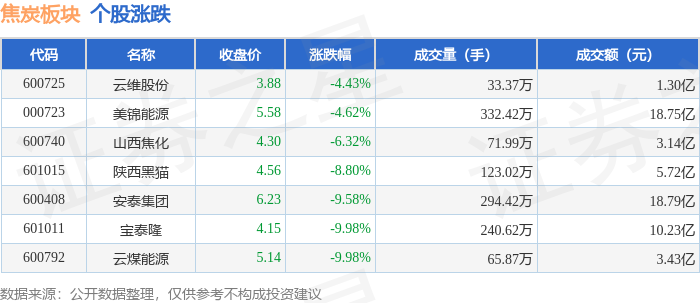
焦炭板块11月18日跌6.99%,云煤能源领跌,主力资金净流出8.08亿元
Zheng Xing Xing Ye Ri Bao· 2025-11-18 08:11
Core Insights - The coking coal sector experienced a significant decline of 6.99% on November 18, with Yunmei Energy leading the drop [1] - The Shanghai Composite Index closed at 3939.81, down 0.81%, while the Shenzhen Component Index closed at 13080.49, down 0.92% [1] Coking Coal Sector Performance - Key stocks in the coking coal sector showed notable declines, with the following closing prices and percentage changes: - Yunwei Co., Ltd. (600725): 3.88, -4.43% - Meijin Energy (000723): 5.58, -4.62% - Shanxi Coking Coal (600740): 4.30, -6.32% - Shaanxi Black Cat (601015): 4.56, -8.80% - Antai Group (600408): 6.23, -9.58% - Baotailong (601011): 4.15, -9.98% - Yunmei Energy (600792): 5.14, -9.98% [1] Capital Flow Analysis - The coking coal sector saw a net outflow of 808 million yuan from main funds, while retail investors contributed a net inflow of 752 million yuan [1] - Detailed capital flow for key stocks includes: - Yunwei Co., Ltd.: Main funds net outflow of 21.87 million yuan, retail net inflow of 18.09 million yuan - Shanxi Coking Coal: Main funds net outflow of 42.15 million yuan, retail net inflow of 25.34 million yuan - Yunmei Energy: Main funds net outflow of 43.20 million yuan, retail net inflow of 47.27 million yuan [2]


广发期货《黑色》日报-20251118
Guang Fa Qi Huo· 2025-11-18 07:05
钢材产业期现日报 投资咨询业务资格:证监许可 【2011】1292号 2025年11月18日 周敏波 Z0010559 | 钢材价格及价差 | | | | | | | --- | --- | --- | --- | --- | --- | | 品种 | 现值 | 前值 | 涨跌 | 某美 | 单位 | | 螺纹钢现货(华东) | 3220 | 3190 | 30 | 123 | | | 螺纹钢现货(华北) | 3240 | 3210 | 30 | 143 | | | 螺纹钢现货(华南) | 3320 | 3270 | 50 | 223 | | | 螺纹钢05合约 | 3147 | 3105 | 42 | 73 | | | 螺纹钢10合约 | 3192 | 3144 | 48 | 28 | | | 螺纹钢01合约 | 3097 | 3053 | 44 | 123 | | | 热卷现货(华东) | 3310 | 3260 | 50 | 8 | 元/吨 | | 热卷现货(华北) | 3210 | 3190 | 20 | -92 | | | 热卷现货(华南) | 3320 | 3270 | 50 | -3 | | | ...
《黑色》日报-20251118
Guang Fa Qi Huo· 2025-11-18 05:42
1. Report Industry Investment Ratings - No industry investment ratings are provided in the reports. 2. Core Views Steel Industry - The steel market shows mixed trends. The daily average hot metal output increased, but the production of five major steel products decreased. The supply - demand of rebar is relatively balanced after production and inventory reduction, while the supply - demand of hot - rolled coils is basically balanced with high - level inventory. There is a negative feedback basis in the iron element chain, and it is not recommended to go long. The spread between hot - rolled coils and rebar will continue to converge. It is advisable to close the long - coking coal and short - hot - rolled coil arbitrage. A short - side attempt can be made on a single - side basis [2]. Iron Ore Industry - The iron ore futures continued to rebound. The global shipment volume increased this week, and the port arrival volume decreased, but the subsequent average arrival volume is expected to rise. The demand side shows a weakening trend. The port inventory is accumulating, but the inventory of deliverable products is low. It is expected that the iron ore will show a high - level oscillating trend, and a wait - and - see attitude is recommended for single - side trading [4]. Coke and Coking Coal Industry - The coke and coking coal markets are also complex. The coking coal futures showed a low - level oscillating trend and a sharp decline at night. The coke futures followed the coking coal to fall at night. The spot prices of coking coal and coke are still at a high level this year, but the futures are under pressure. It is recommended to take a bearish view on single - side trading with a wait - and - see approach [8]. 3. Summary by Related Catalogs Steel Industry Prices and Spreads - Rebar and hot - rolled coil spot and futures prices generally rose. For example, the spot price of rebar in East China increased from 3190 yuan/ton to 3220 yuan/ton, and the 05 - contract price of rebar increased from 3105 yuan/ton to 3147 yuan/ton. Meanwhile, the profit of hot - rolled coils in different regions decreased, with the East China hot - rolled coil profit dropping from - 68 to - 94 yuan/ton [2]. Production - The daily average hot metal output increased by 2.6 to 236.8, a 1.1% rise. The production of five major steel products decreased by 22.4 to 834.4, a 2.6% decline. The rebar production decreased by 8.2 to 200.0, a 4.1% decline, and the hot - rolled coil production decreased by 4.5 to 313.7, a 1.4% decline [2]. Inventory - The inventory of five major steel products decreased by 26.2 to 1477.4, a 1.7% decline. The rebar inventory decreased by 16.4 to 576.2, a 2.8% decline, while the hot - rolled coil inventory remained basically unchanged [2]. Demand - The building materials trading volume increased by 3.0 to 13.4, a 28.4% rise. The apparent demand of five major steel products decreased by 6.3 to 860.6, a 0.7% decline. The apparent demand of rebar decreased by 2.2 to 216.4, a 1.0% decline, and the apparent demand of hot - rolled coils decreased by 0.7 to 313.6, a 0.2% decline [2]. Iron Ore Industry Prices and Spreads - The spot prices of some iron ore varieties in Rizhao Port increased, such as the price of Carajás fines increasing from 882.0 yuan/ton to 892.0 yuan/ton. The basis of some varieties changed, and the spreads between different contracts also showed different trends, like the 1 - 5 spread increasing from 27.0 to 29.0 [4]. Supply - The 45 - port weekly arrival volume decreased by 472.3 to 2268.9, a 17.2% decline, while the global weekly shipment volume increased by 447.4 to 3516.4, a 14.6% rise. The monthly national import volume increased by 1111.6 to 11632.6, a 10.6% rise [4]. Demand - The daily average hot metal output of 247 steel mills increased by 2.7 to 236.9, a 1.1% rise. The daily average port ore - clearing volume increased by 6.0 to 327.0, a 1.9% rise. The monthly national pig iron output decreased by 49.6 to 6555.0, a 0.8% decline, and the monthly national crude steel output decreased by 149.0 to 7200.0, a 2.0% decline [4]. Inventory - The 45 - port inventory increased slightly by 1.5 to 15129.71, and the imported ore inventory of 247 steel mills increased by 66.1 to 9076.0, a 0.7% rise [4]. Coke and Coking Coal Industry Prices and Spreads - The price of Shanxi quasi - first - grade wet - quenched coke (warehouse receipt) increased by 51 to 1713, a 3.1% rise, while the price of Rizhao Port quasi - first - grade wet - quenched coke (warehouse receipt) decreased by 11 to 1689, a 0.6% decline. The price of coking coal in some regions remained stable [8]. Supply - The daily average output of all - sample coking plants decreased by 0.6 to 63.0, a 0.9% decline, and the daily average output of 247 steel mills increased slightly by 0.1 to 46.2, a 0.2% rise. The production of raw coal and clean coal in coal mines increased [8]. Demand - The hot metal output of 247 steel mills increased, which is the demand for coke. The demand for coking coal is related to the production of coke [8]. Inventory - The total coke inventory decreased slightly, and the coking coal inventory showed different trends in different sectors, with some increasing and some decreasing [8].
国投期货黑色金属日报-20251117
Guo Tou Qi Huo· 2025-11-17 13:06
Report Industry Investment Ratings - Thread: ★★★ [1] - Hot-rolled coil: ★★★ [1] - Iron ore: ★★★ [1] - Coke: ★☆★ [1] - Coking coal: ★☆★ [1] - Silicon manganese: ★☆☆ [1] - Ferrosilicon: ★☆☆ [1] Core Viewpoints - The steel market has a short - term rebound supported by policy and environmental protection expectations, but its sustainability is to be observed. The iron ore market is expected to be mainly volatile, and the coke, coking coal, silicon manganese, and ferrosilicon markets are also likely to be in a volatile state [2][3][4] Summary by Related Catalogs Steel - Today's steel futures rebounded. In the off - season, the apparent demand for thread decreased, production declined, and inventory continued to fall. The demand for hot - rolled coils stabilized, production continued to decline, and the inventory accumulation slowed down. - Iron - making water production rebounded, but the downstream's ability to absorb was insufficient, the proportion of steel - mill losses increased, and there is a high possibility of further blast - furnace production cuts. - Real - estate investment decline continued to expand, infrastructure and manufacturing investment growth rates continued to fall, domestic demand was weak, and steel exports declined from a high level. - The previous adjustment of the futures was relatively sufficient, the support at the lower edge of the shock range increased, and short - term rebound was supported by policy and environmental protection expectations [2] Iron Ore - The iron - ore futures rebounded today and fluctuated recently. - On the supply side, global iron - ore shipments increased significantly this period, reaching a high level in the same period in recent years. Shipments from Australia and Brazil increased significantly, and shipments from non - mainstream countries also rebounded to a high level. The domestic arrival volume decreased to below the annual average. - On the demand side, steel demand was weak in the off - season, steel - mill losses intensified, and iron - making water was in a seasonal production - cut trend. - The iron - ore fundamentals became looser, and the futures are expected to fluctuate [3] Coke - The coke price rose today. Coking profits were still average, and daily production decreased slightly. Coke inventory decreased slightly, with downstream purchasing on demand and weak trader purchasing willingness. - The supply of carbon elements was abundant, downstream iron - making water was at a high level, but steel - mill profits were average, and there was strong willingness to cut raw - material prices. The coke futures were at a premium, and the price is expected to fluctuate [4] Coking Coal - The coking - coal price rose strongly today. The output of coking - coal mines increased slightly, spot auction transactions were normal, and transaction prices varied. Terminal inventory increased slightly. - The total coking - coal inventory increased slightly, and production - end inventory also increased slightly. Safety inspections were carried out in major coal - producing areas. - The supply of carbon elements was abundant, downstream iron - making water was at a high level, but steel - mill profits were average, and there was strong willingness to cut raw - material prices. The coke futures were at a premium, the coking - coal futures were at a discount to Mongolian coal, and the price is expected to fluctuate [5] Silicon Manganese - The silicon - manganese price rose today. On the demand side, iron - making water production rebounded to a high level. The weekly output of silicon manganese continued to decline slightly but was still at a high level, and inventory increased slowly. - The forward price of manganese ore from Comilog increased slightly, and the spot ore price fluctuated quickly. Manganese - ore inventory increased slightly, and contradictions were not prominent. The price had strong bottom support [6] Ferrosilicon - The ferrosilicon price rose today. On the demand side, iron - making water production rebounded to a high level. Export demand increased to about 40,000 tons, and the marginal impact was small. The output of magnesium metal increased, and secondary demand increased marginally. - Ferrosilicon supply decreased but remained at a high level, and on - balance inventory continued to decline. Due to the increase in electricity and semi - coke prices, the price is expected to be more likely to rise [7]
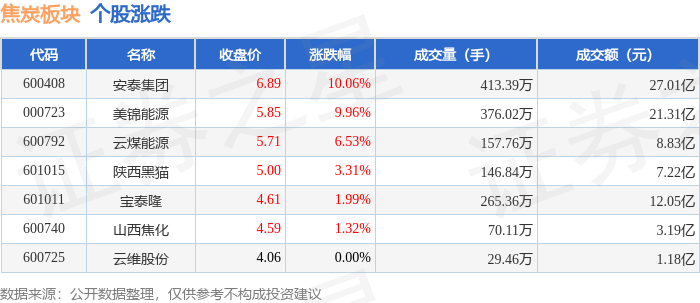
焦炭板块11月17日涨5.66%,安泰集团领涨,主力资金净流入1.42亿元
Zheng Xing Xing Ye Ri Bao· 2025-11-17 09:00
Core Viewpoint - The coking coal sector experienced a significant increase of 5.66% on November 17, with Antai Group leading the gains, while the overall stock indices showed a decline [1] Group 1: Market Performance - The Shanghai Composite Index closed at 3972.03, down 0.46% - The Shenzhen Component Index closed at 13202.0, down 0.11% [1] Group 2: Coking Coal Stocks Performance - Antai Group (600408) closed at 6.89, up 10.06% with a trading volume of 4.13 million shares and a turnover of 2.701 billion yuan - Meijin Energy (000723) closed at 5.85, up 9.96% with a trading volume of 3.76 million shares and a turnover of 2.131 billion yuan - Yunmei Energy (600792) closed at 5.71, up 6.53% with a trading volume of 1.58 million shares and a turnover of 883 million yuan - Shaanxi Black Cat (601015) closed at 5.00, up 3.31% with a trading volume of 1.47 million shares and a turnover of 722 million yuan - Baotailong (601011) closed at 4.61, up 1.99% with a trading volume of 2.65 million shares and a turnover of 1.205 billion yuan - Shanxi Coking Coal (600740) closed at 4.59, up 1.32% with a trading volume of 701,100 shares and a turnover of 319 million yuan - Yunwei Co. (600725) closed at 4.06, unchanged with a trading volume of 294,600 shares and a turnover of 118 million yuan [1] Group 3: Capital Flow Analysis - The coking coal sector saw a net inflow of 142 million yuan from main funds, while retail funds experienced a net outflow of 20.34 million yuan - The main funds' net inflow and outflow for key stocks are as follows: - Meijin Energy: 436 million yuan net inflow, 20.45% of total - Baotailong: 47.23 million yuan net inflow, 3.92% of total - Shanxi Coking Coal: 38.06 million yuan net inflow, 11.92% of total - Yunmei Energy: 31.12 million yuan net inflow, 3.53% of total - Shaanxi Black Cat: 27.09 million yuan net inflow, 3.75% of total - Yunwei Co.: 17.55 million yuan net outflow, -14.83% of total - Antai Group: 42 million yuan net outflow, -15.54% of total [2]


A股:周五缩量跌破4000点,不管现在几成仓,周一开盘请听我一句
Sou Hu Cai Jing· 2025-11-16 22:11
Core Viewpoint - Global stock markets have entered a correction phase, with major indices in the US and Europe declining, leading to a cautious sentiment in emerging markets. This backdrop has resulted in a similar adjustment in the A-share market, where the Shanghai Composite Index briefly reached a ten-year high before falling back below the 4000-point mark, indicating a shift to a "high-level fluctuation and weakening" phase [1]. Market Structure on Friday - The market reached a high of approximately 4030 points, marking a ten-year peak, but subsequently fell back, closing below 4000 points. The daily candlestick formed a "small bearish line with a long upper shadow," indicating significant selling pressure in the 4000-4030 range and a weakening bullish sentiment [2]. - Approximately 3300 stocks declined, while fewer than 2000 stocks rose, highlighting a structural market condition where the index's new high corresponds with a majority of stocks declining [3]. - Around 89 stocks hit the daily limit up, indicating that while there are still hotspots, the overall profit-making effect is limited to a few strong themes and leading stocks [4]. - Sectors such as pharmaceuticals, forestry, certain electrical appliances, and coking coal showed structural strength, while semiconductors and some consumer sectors experienced notable pullbacks, reflecting rapid sector rotation and a lack of solid main lines [5][6]. Volume and Moving Averages - Trading volume fell below 2 trillion, significantly lower than the volume levels observed when the index previously broke through 4000 points [7]. - The high-level volume contraction indicates insufficient willingness for new capital to enter the market, with more existing funds engaged in trading, leading to a cooling of short-term bullish expectations [8]. - The index closed below the 5-day and 10-day moving averages, signaling a clear short-term trend weakening. The breach of these averages typically indicates a transition from a strong upward trend to a phase of adjustment or consolidation [11]. Potential Market Scenarios for Monday - Two probable scenarios for Monday's market performance are outlined: 1. **Scenario One**: A low open followed by a rebound, potentially closing with a small bullish line if blue-chip stocks stabilize and high-growth sectors see capital inflow [13][14]. 2. **Scenario Two**: A low open followed by continued weak fluctuations, possibly closing with a small bearish line if previous strong sectors lack sustained capital support [16][18]. Defensive Strategies - Investors are advised to maintain a defensive posture, controlling overall positions to around 50% or lower, especially as the index fluctuates around the 4000-point mark [20]. - Focus on reducing exposure to high-flying stocks that have moved far from their moving averages, while considering defensive sectors with solid fundamentals and stable cash flows [22]. - The current high-level fluctuation phase suggests avoiding aggressive trading and instead waiting for clearer market direction before increasing positions [23].