
生物制造

Search documents
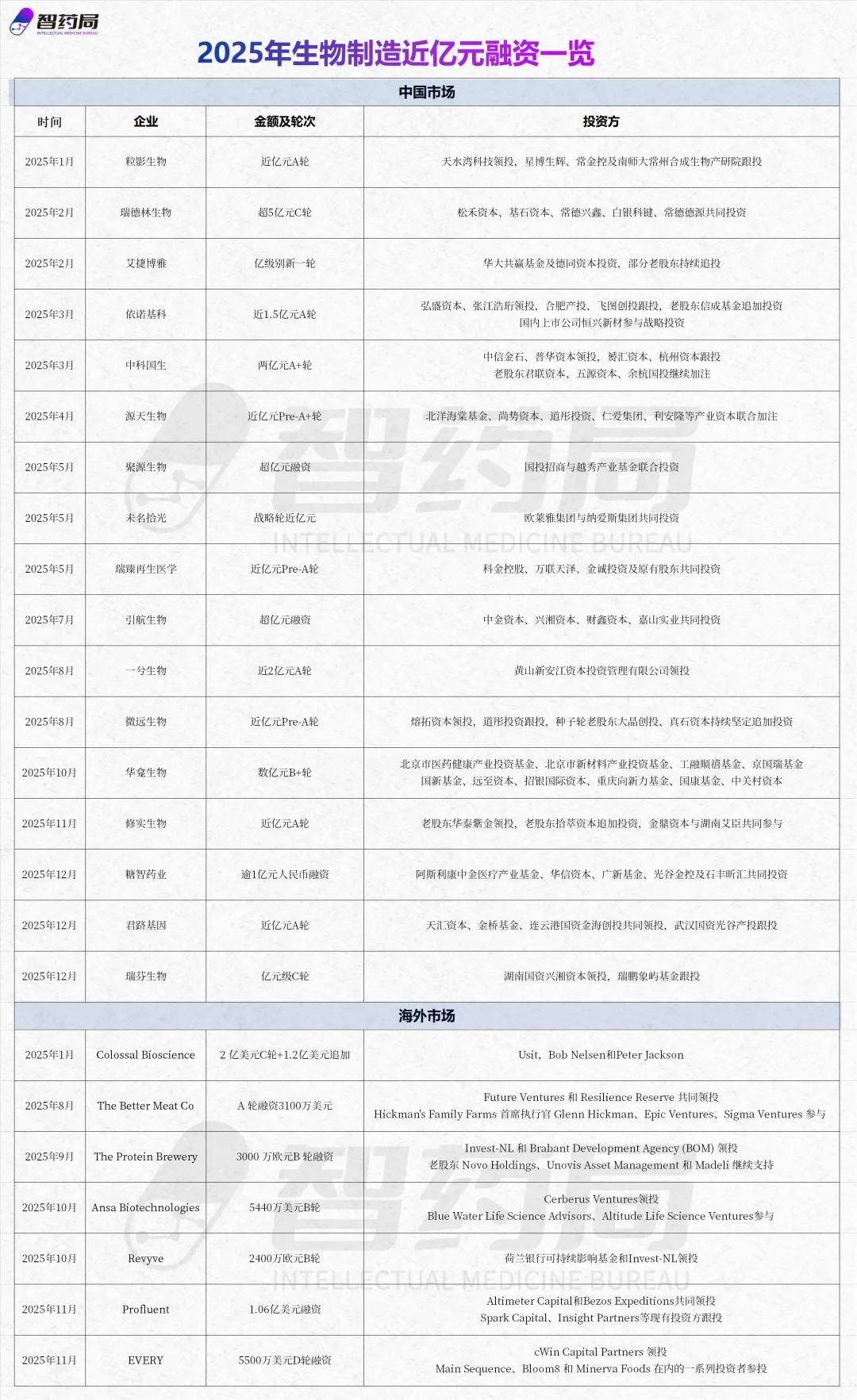
17家破亿,最高单笔5亿元!盘点2025年生物制造十大融资,国资深度参与!
Sou Hu Cai Jing· 2026-01-07 01:45
Core Insights - The biomanufacturing sector is poised for significant growth by 2025, driven by strategic investments from state-owned enterprises and leading public companies, establishing a solid foundation for industry capital [1][2] - Funding trends indicate a shift from early-stage R&D to capacity expansion and commercialization, with a notable increase in financing activities across the sector [2] Financing Events - In January 2025, Liying Biotechnology secured nearly 100 million yuan in Series A funding led by Tianshui Bay Technology [3] - In February 2025, Ruide Lin Biotechnology completed over 500 million yuan in Series C funding, marking the largest single financing event in the biomanufacturing sector for the year [6] - In March 2025, Zhongke Guosheng raised 200 million yuan in A+ round funding, with participation from CITIC Jinshi and PwC Capital [7][8] - In August 2025, Yixi Biotechnology completed nearly 200 million yuan in Series A funding, focusing on the production of human milk oligosaccharides [9][11] - In December 2025, Tangzhi Pharmaceutical raised over 100 million yuan, with investments from AstraZeneca and other funds, focusing on nucleotides and sugar science products [16] Industry Trends - The biomanufacturing industry is experiencing a collective confidence boost, as evidenced by 17 companies achieving financing close to or exceeding 100 million yuan in 2025 [2] - The overseas market is also thriving, with leading companies securing over $320 million in funding within a year, particularly in the fermented protein food sector [4] - Companies like Colossal Bioscience are pushing the boundaries of biotechnology, having raised significant funds to pursue ambitious projects such as reviving extinct species [17]

新赛道升级 塑造发展新优势
Jing Ji Ri Bao· 2026-01-06 22:35
Core Insights - The "15th Five-Year Plan" emphasizes the cultivation and expansion of emerging and future industries, aiming to create new pillar industries and strategically position future industries for growth [1] Group 1: Emerging Industries - During the "14th Five-Year Plan," China's emerging industries accelerated development, forming significant scale effects with several trillion-yuan market opportunities emerging by 2025 [2] - The commercial aerospace industry is on the verge of explosion, with advancements such as the successful launch of the Zhuque-3 rocket and accelerated deployment of satellite internet constellations [2] - The low-altitude economy is entering a commercial phase, marked by the issuance of operational certificates for manned civil unmanned aerial vehicles and the promotion of typical application scenarios by the Ministry of Transport [2] - New materials are crucial for breakthroughs in aerospace performance, with innovations in high-strength stainless steel and carbon fiber composites being utilized in key projects [2] Group 2: Energy Transition - China's energy transition has accelerated, establishing the world's largest power infrastructure and renewable energy systems, with plans to increase the share of renewable energy significantly by 2026 [3] - The "15th Five-Year Plan" aims to enhance emerging pillar industries, focusing on innovation in sectors like renewable energy, new materials, aerospace, and low-altitude economy [3] Group 3: Future Industries - Rapid advancements in future industries such as artificial intelligence, quantum information, and biomanufacturing have been noted, with significant breakthroughs achieved during the "14th Five-Year Plan" [4] - The development of 6G technology is prioritized, with expectations for commercial applications to begin around 2030, indicating a deep integration with AI [4][5] - Future industries are characterized by their potential to create new demands and economic forms, with quantum technology and nuclear fusion energy expected to play pivotal roles [6] Group 4: Market Opportunities and Challenges - Emerging industries are entering a rapid growth phase, with key scenarios being validated and replicable business models established, while future industries are still in the exploratory phase [7] - The uncertainty in future industries stems from both technological and commercial aspects, requiring significant R&D investment and policy support [8] - The collaboration between emerging and future industries is essential for driving new economic engines, with a focus on innovation and long-term value creation [9]
建设城乡融合宜居宜游的美丽幸福花园
Xin Lang Cai Jing· 2026-01-06 19:28
Core Viewpoint - The National Development and Reform Commission has officially issued the "Implementation Plan for Accelerating Green Transformation Development in the Chang-Zhu-Tan Ecological Green Heart," aiming to explore new models for green transformation and establish an ecological safety barrier in highly urbanized areas [1][2]. Group 1: Ecological and Environmental Initiatives - The plan emphasizes the integration of ecology and safety, focusing on enhancing air quality, water management, and solid waste treatment to improve the ecological environment of the green heart [1]. - Major ecological projects will be implemented, including soil erosion control, abandoned mine restoration, and forest quality improvement, to enhance biodiversity and ecological quality [1][2]. - The establishment of an ecological safety framework will be prioritized, with a focus on ecological corridor management and resilient city construction to strengthen safety resilience [1]. Group 2: Industrial and Economic Development - The plan aims to strengthen industrial support for the green heart by developing ecological agriculture, forestry, and tourism, promoting deep integration with culture, tourism, health, and sports [2]. - It encourages the green transformation of industries, including the establishment of technology innovation platforms in the ecological sector and the exit of outdated high-energy and high-emission capacities [2]. - Future industry clusters will be cultivated, focusing on life sciences, biomanufacturing, and health industries, as well as expanding applications in home and industrial robotics [2]. Group 3: Quality of Life and Community Development - The plan promotes the improvement of green infrastructure, including the construction of a 1,000-kilometer cycling and walking path network [2]. - It supports urban-rural green development, advocating for green building practices and the construction of beautiful rural areas [2]. - The promotion of a green lifestyle will be emphasized, leveraging high-quality ecological resources for ecological civilization education [2].
新赛道活力迸发 塑造经济发展新优势
Zheng Quan Ri Bao· 2026-01-06 16:28
Core Insights - During the "14th Five-Year Plan" period, China has made significant strides towards high-level technological self-reliance, with emerging and future industries showing robust vitality and growth potential [1][3] Emerging Industry Development - The emerging industries in China have rapidly developed and formed scale effects, with multiple trillion-yuan markets accelerating formation [2] - By 2025, China's commercial aerospace industry is on the brink of explosion, with significant advancements in reusable launch vehicles and satellite internet applications [2] - The low-altitude economy is also gaining traction, with the issuance of operational certificates for manned civil unmanned aerial vehicles marking the entry into commercial use [2] New Energy Industry - China has established the world's largest power infrastructure and renewable energy system, creating the most complete new energy industry chain globally [3] - The "15th Five-Year Plan" emphasizes the development of emerging pillar industries, including new energy, new materials, aerospace, and low-altitude economy [3] Future Industry Breakthroughs - Significant progress has been made in future industries such as artificial intelligence, quantum information, and biomanufacturing, with key breakthroughs achieved [4] - The integration of 6G and AI is becoming a consensus in the industry, with clear development directions emerging [4] - The biomanufacturing industry has expanded steadily, reaching a total scale of 1.1 trillion yuan, becoming a new economic growth point [4] Dual-Engine Development - Emerging and future industries, while both part of the "long slope, thick snow" track, have different development stages, leading to varying market opportunity release rhythms [6] - Emerging industries are entering a rapid growth phase, with vertical segments expected to explode in the next 3 to 4 years, while future industries will focus on technology and application exploration in the early stages of the "15th Five-Year Plan" [6] Investment and Market Dynamics - The future industries face challenges related to technological and commercial uncertainties, with unclear business models and long investment return cycles [7] - The "15th Five-Year Plan" period is seen as a critical window for future industries, with policy support and technological breakthroughs expected to drive development [7] - Investors are advised to focus on companies' core technology reserves and their progress in validating business value through application scenarios [8]
10亿,复旦科创旗下投资基金完成备案
FOFWEEKLY· 2026-01-06 10:05
Group 1 - The core viewpoint of the article is the successful launch of the Fudan Innovation Investment Fund, which has completed its private fund product filing and is now operational [1] - The total scale of the Fudan Innovation Investment Fund is 1 billion yuan, co-founded by Fudan Innovation Mother Fund, Shanghai Future Industry Fund, and Jing'an Capital, with additional investors including Zhejiang Longsheng Group and Anhui Jinbiandan Equity Investment [1] - The fund will focus on strategic emerging industries such as life health, artificial intelligence, integrated circuits, new energy, and new materials, as well as future industries like quantum technology, biomanufacturing, hydrogen energy, nuclear fusion energy, brain-computer interfaces, embodied intelligence, and sixth-generation mobile communication [1]

2025年存量上市公司总市值同比增长22.5%
Zheng Quan Ri Bao· 2026-01-05 16:45
报告显示,2025年,我国市值管理制度从理念倡导走向制度化、体系化、实践化。一是市值表现反映国 家战略导向。2025年,在集成电路、人工智能、高端制造、生物制造等涉及国家战略的新兴产业和重点 领域,上市公司市值表现较为突出。 本报讯(记者李乔宇)1月5日,中国上市公司协会发布2025年A股上市公司市值表现报告。报告显示,全 市场层面,截至2025年12月31日,上证指数从2025年初的3351.76点增长至3968.84点,上涨18.4%;截 至2025年底,A股上市公司共5469家,总市值123万亿元,其中2025年新增上市公司116家,2025年1月1 日前上市的存量公司5353家,2025年存量上市公司总市值同比增长22.5%。 从行业层面来看,2025年科技驱动型行业市值增幅较大,以制造业、科学研究和技术服务业为代表的高 新技术企业市值变化最突出,总市值较年初分别增长33.3%和32.1%。 二是政策指引更加体系化和精准化。近年来,监管部门陆续出台系列政策文件,并购重组、现金分红、 股份回购等制度不断完善,优化上市公司开展市值管理工作的"工具箱",引导上市公司关注自身投资价 值,推动公司内在价值与市场 ...
院士报告:面向2035的新材料研发与应用重点任务
材料汇· 2026-01-05 16:02
Core Viewpoint - The article emphasizes the critical need for new materials in various strategic sectors such as information technology, energy, advanced manufacturing, and healthcare to support China's goal of becoming a technology and manufacturing powerhouse by 2035 [2][4]. Group 1: New Generation Information Technology - The rapid development of AI, supercomputing, and cloud computing necessitates new information materials, particularly in advanced computing and storage [4]. - Traditional silicon-based materials are nearing their performance limits, prompting the exploration of two-dimensional semiconductor materials like graphene and transition metal dichalcogenides for next-generation chips [4][5]. - Quantum computing materials, including superconductors and topological materials, are emerging as pivotal technologies in the computing sector [5]. Group 2: Communication and Networking - The next decade will see the evolution of communication networks, requiring new devices and materials such as wide bandgap semiconductors and high-performance optical components [6]. - The development of high-performance laser and electro-optic modulators is essential for F6G optical communication systems [6][7]. - Chip output and all-optical interconnect technologies are crucial for enhancing computing power and energy efficiency in data centers [7]. Group 3: New Energy Materials - The photovoltaic industry is a competitive sector for China, with N-type monocrystalline silicon battery technologies becoming mainstream [9]. - There is a need for advancements in thin-film solar cells and new stacked solar cell materials to maintain global leadership in solar energy [9][10]. - The development of high-performance energy storage materials, including solid-state and sodium-ion batteries, is critical for the electrification of transportation and energy sustainability [10]. Group 4: Advanced Manufacturing and Equipment - High-performance materials are essential for aerospace, robotics, and marine engineering, with a focus on lightweight and durable materials [17][19]. - The development of advanced structural materials for high-speed trains and aerospace applications is necessary to meet stringent performance requirements [21][19]. - The military sector requires lightweight materials that can withstand extreme conditions, with a focus on new composite materials and wide bandgap semiconductors [23][22]. Group 5: Healthcare and Biomanufacturing - There is a growing demand for regenerative biomaterials that can facilitate tissue and organ repair, addressing clinical needs [25]. - Minimally invasive repair materials and devices are becoming a significant focus in high-end medical equipment development [26]. - The push for biomanufacturing materials, including bioplastics and bio-based chemicals, is crucial for reducing reliance on fossil resources and achieving sustainability goals [27].

华熙生物副总裁邹松岩答21:加速布局韩国医美与生物制造
2 1 Shi Ji Jing Ji Bao Dao· 2026-01-05 11:57
Group 1 - The core viewpoint is that Huaxi Bio sees the South Korean market as a crucial area for international expansion, particularly in the rapidly growing medical aesthetics industry [2] - The China-Korea Business Forum highlighted discussions on manufacturing innovation, supply chain cooperation, and new consumer markets, with over 400 attendees from both countries [2] - Biomanufacturing is identified as a strategic high ground in the global technological revolution, with the "14th Five-Year Plan" emphasizing the need for forward-looking layouts in biomanufacturing and other future industries [2] Group 2 - Huaxi Bio, established in 2000 and listed on the STAR Market in 2019, specializes in the research and production of bioactive materials, holding a 44% share in the global hyaluronic acid raw material market and 70% in the domestic market [3] - The company entered the South Korean market in 2002 and has expanded into pharmaceuticals, medical aesthetics, cosmetics, and functional foods, with a new subsidiary established in Seoul in 2023 [3] - In the pharmaceutical sector, Huaxi Bio collaborates with top Korean companies in eye drops and joint injection products, while in medical aesthetics, its products cover over 90% of local production companies [3]

——未来产业周报第4期(2025/12/28-2026/1/3):脑机接口产业化提速,机器人场景创新,氢能向电网调节者转变-20260105
Shenwan Hongyuan Securities· 2026-01-05 06:36
Group 1: Quantum Technology - The "quantum + supercomputing" integration innovation platform has been established in Chengdu, deploying China's first 550-qubit coherent optical quantum computer, enabling the collaboration of classical high-performance computing and quantum computing [7][8] - The deployment of the 550-qubit quantum computer fills the gap in the central and western regions of China for quantum computing capabilities, establishing a complementary regional computing power structure with eastern regions [8][9] Group 2: Biological Manufacturing - The first sugar science key laboratory in Beijing has been approved, co-established by Huaxi Biological and Peking University, focusing on precise manufacturing and functional applications of sugars [10][11] - Huaxi Biological aims to leverage this laboratory to enhance its capabilities in synthetic biology, expanding from hyaluronic acid production to comprehensive sugar biological research [11] Group 3: Hydrogen Energy and Nuclear Fusion - The world's first 30 MW pure hydrogen gas turbine has achieved stable operation, marking a significant step in hydrogen energy transitioning from a "power consumer" to a "grid regulator" [12][13] - The EAST nuclear fusion device has confirmed the existence of a density-free regime, providing critical physical evidence for efficient operation of fusion reactors [18][19] - The Chinese Academy of Sciences has completed the manufacturing of all ITER correction coil procurement packages, marking a significant achievement in domestic R&D capabilities for nuclear fusion components [22] Group 4: Brain-Computer Interface - Neuralink plans to begin mass production of brain-computer interface devices in 2026, aiming to automate surgical procedures and enhance device performance [23][24] - The "Beijing Brain No. 1" system has been implanted in five spinal cord injury patients, achieving clinical breakthroughs, with plans for clinical trials to start in mid-2026 [26][27] - The "Guangdong-Hong Kong-Macao Greater Bay Area Brain Science and Central Nervous System Disease AI Innovation Alliance" has been launched, focusing on research and development in brain science and related technologies [28] Group 5: Embodied Intelligence - Woan Robotics has gone public in Hong Kong, focusing on household scenarios with plans to launch a humanoid household robot in January 2026 [29][30] - The "Qiyuan Q1," the world's first small-sized humanoid robot with full-body force control, has been released, targeting research and interactive applications [33][34] Group 6: Future Industry Catalysts - A table has been organized detailing key catalytic events for six future industries in 2026, including important conferences and technological milestones [36][38]

未来产业周报第4期:脑机接口产业化提速,机器人场景创新,氢能向电网“调节者”转变-20260105
Shenwan Hongyuan Securities· 2026-01-05 03:15
Group 1: Quantum Technology - The "quantum + supercomputing" integration innovation platform has been established in Chengdu, deploying China's first 550-qubit coherent optical quantum computer, achieving a synergy between classical high-performance computing and quantum computing [7][8] - The deployment of the 550-qubit quantum computer fills the gap in mid-western China for quantum computing capabilities and complements eastern regions like Hefei and Beijing [8] Group 2: Biomanufacturing - The first sugar science key laboratory in Beijing has been approved, co-established by Huaxi Biological and Peking University, focusing on precise manufacturing and functional applications of sugars [10][11] - Huaxi Biological aims to leverage this laboratory to enhance its capabilities in synthetic biology, expanding from hyaluronic acid production to comprehensive sugar biological research [11] Group 3: Hydrogen Energy and Nuclear Fusion - The world's first 30 MW pure hydrogen gas turbine has achieved stable operation, marking a significant step in hydrogen energy transitioning from a "power consumer" to a "grid regulator" [12][14] - The EAST nuclear fusion device has confirmed the existence of a density-free zone, providing critical physical evidence for efficient fusion reactor operation [18][19] - The ITER correction coil procurement package has been fully manufactured, showcasing China's 100% independent research and development capabilities in key components for nuclear fusion [22] Group 4: Brain-Computer Interface - Neuralink plans to begin mass production of brain-computer interface devices in 2026, aiming to automate surgical procedures and enhance device performance [24][25] - The "Beijing Brain One" system has been implanted in five spinal cord injury patients, with plans for clinical trials to start in mid-2026 [28][29] - The "Guangdong-Hong Kong-Macao Greater Bay Area Brain Science and Central Nervous System AI Innovation Alliance" has been launched, with a total fund of 1.16 billion yuan for brain science projects [30] Group 5: Embodied Intelligence - Woan Robot has been listed on the Hong Kong Stock Exchange, focusing on household scenarios with plans to launch a humanoid household robot in January 2026 [32][33] - The "Shangwei Qiyuan" brand has entered the personal robot market with the release of the world's first small-sized humanoid robot, emphasizing its application in research and interaction [37][38] Group 6: Future Industry Catalysts - A table has been compiled detailing key catalytic events for six future industries in 2026, including important conferences and technological milestones [40][41]