
生鲜电商

Search documents
叮咚买菜启动“寻味中国”计划 打造地道食材供应链
Zheng Quan Ri Bao Wang· 2025-09-15 09:20
Core Insights - The article highlights the strategic expansion of Dingdong Maicai's "Taste of China" initiative, focusing on sourcing and promoting local delicacies and ingredients across the nation [1][4] - The company has signed over 30 million yuan in direct procurement orders for the Yangtze River Delta hairy crabs, indicating a significant investment in regional specialties [1] - Dingdong Maicai aims to enhance its supply chain and product offerings by introducing unique regional products, such as the Qinghai-Tibet Plateau hairy crabs, which challenge traditional perceptions of crab sourcing [2][3] Group 1 - Dingdong Maicai's "Taste of China" plan is a key component of its "Good Products" strategy, which currently includes nearly 300 SKUs across various categories, including fruits, vegetables, and snacks [1][3] - The Yangtze River Delta hairy crabs are expected to see a doubling in sales compared to last year, showcasing the growth potential of regional specialty products in the national market [1] - The company has established a direct procurement model in the Qinghai-Tibet Plateau, ensuring high-quality crabs that are free from feed and drugs, with a low-density farming approach [2] Group 2 - The "Taste of China" initiative aims to bring local ingredients to a wider audience, enhancing consumer choices while providing branding opportunities for local farmers [4] - Dingdong Maicai's strategy emphasizes the importance of sourcing directly from producers and maintaining quality control, differentiating itself from competitors focused on price and efficiency [4] - The company has successfully promoted regional vegetables, such as Gobi vegetables, achieving over 10 million units sold, indicating a strong consumer interest in local flavors [3]

黄河口大闸蟹开捕!叮咚买菜签下超3000万订单
Qi Lu Wan Bao Wang· 2025-09-15 00:18
Core Insights - The opening ceremony for the 2025 Yellow River Estuary hairy crab season took place on September 13, marking the start of this year's crab season with a significant partnership between the fresh e-commerce platform Dingdong Maicai and local suppliers, resulting in contracts exceeding 300 million yuan [1] - The unique saline-alkaline environment of the Yellow River Estuary contributes to the distinctive taste of its hairy crabs, which are characterized by firm, sweet meat with a hint of brininess, setting them apart from crabs from traditional freshwater regions [2] - The overall production of Yellow River Estuary hairy crabs is expected to increase by approximately 5% compared to last year, benefiting local crab farmers and enhancing consumer offerings [2] - Dingdong Maicai has established a strong consumer recognition for Yellow River Estuary hairy crabs, with increasing repurchase rates and positive customer feedback highlighting their freshness and value [3] - The company has developed a comprehensive cold chain logistics system to ensure the quick and safe delivery of live crabs to consumers, enhancing the overall customer experience and competitiveness of local seafood [3] - Dingdong Maicai is expanding its crab sourcing beyond traditional regions, including the Qinghai-Tibet Plateau, which produces a unique variety of hairy crab, thereby broadening consumer access to diverse crab flavors [4] - The establishment of a "landmark crab matrix" by Dingdong Maicai allows for a stable supply of various regional crabs, ensuring that consumers can enjoy different crab varieties throughout the year [5] - The partnership with Dingdong Maicai provides local crab farmers with a reliable sales channel, boosting market confidence and facilitating the recognition of Yellow River Estuary hairy crabs among consumers [6]
叮咚买菜20250901
2025-09-02 00:42
Summary of Dingdong Maicai Conference Call Company Overview - **Company**: Dingdong Maicai - **Industry**: Instant Retail Key Financial Metrics - **Q2 2025 GAAP Net Profit**: 1.1 billion CNY, up 59.7% YoY, with a net profit margin of 1.8% [2][3] - **GMV (Gross Merchandise Volume)**: 6.5 billion CNY, up 4.5% YoY [3] - **Revenue**: 5.98 billion CNY, up 6.7% YoY [3] - **Monthly Active Users (MAU)**: Over 10 million, with a daily active user (DAU) count of approximately 2.2 million [13] - **Average Revenue Per User (ARPU)**: 308 CNY [4] User Behavior and Market Dynamics - **Monthly Order Frequency**: Users placed an average of 4.4 orders per month, showing a slight increase from 4.3 orders YoY [4] - **Conversion Rate**: 64%, up 3.3 percentage points YoY [4] - **Core User Contribution**: Core users (30% of total) contribute over 68% of GMV, with an average monthly order frequency of 8.1 [6][7] Regional Performance - **Key Market**: Jiangsu, Zhejiang, and Shanghai contribute over 89% of GMV, with Shanghai's GMV growing by approximately 3.5% [5] - **Profit Margins**: Shanghai's net profit margin exceeds 5%, while Jiangsu and Zhejiang's margins are between 1% and 2% [5][11] Strategic Initiatives - **"Four Seasons Strategy"**: Focuses on good products, good users, good service, and good mindset [6] - **SKU Management**: Planned elimination of approximately 4,000 SKUs by mid-2025 to enhance product quality and regional characteristics [12] - **Supply Chain Strength**: Emphasizes direct sourcing (over 85% for fresh products) and has 12 self-operated factories [8][9] Competitive Advantages - **Product Strength**: Fresh products account for over 55% of sales, with a gross margin of 28%-30% [8] - **Supply Chain Efficiency**: Average loss rate is around 1.5%, with fresh product loss below 3% [8] - **Warehouse Strategy**: Over 300 front warehouses in Shanghai, allowing for flexible and efficient supply chain management [8] Future Growth Plans - **Expansion of Front Warehouses**: Plans to open approximately 50 new warehouses annually, with a focus on Jiangsu and Zhejiang regions [17] - **Product Development**: Continued focus on fresh products while expanding into other categories like baby products and baked goods [15] - **ToB Business Growth**: Currently a small portion of revenue, but potential for growth in domestic and international markets [20] International Strategy - **Overseas Markets**: Currently exploring opportunities in Hong Kong, Saudi Arabia, and Dubai, with a focus on partnerships rather than direct warehouse establishment [21] Conclusion Dingdong Maicai demonstrates strong financial performance and user engagement, with strategic initiatives aimed at enhancing product quality and expanding market presence. The company is well-positioned to leverage its supply chain strengths and competitive advantages in the growing instant retail sector.
被遗忘的社区团购
投资界· 2025-08-31 07:15
Core Viewpoint - Community group buying has been recognized as a significant failure in the internet industry, with major players incurring substantial losses and ultimately leading to a rapid decline in the sector's viability [1][3]. Group 1: Industry Overview - The community group buying sector experienced explosive growth in 2020, followed by a swift decline, with major companies like Meituan and Pinduoduo reporting cumulative losses exceeding 80 billion yuan from 2020 to 2024 [1][3]. - Major players such as Meituan, Pinduoduo, Alibaba, and Didi invested heavily in community group buying, with Alibaba's Taocai Cai reportedly spending at least 20 billion yuan to secure a top market position [4][3]. - The community group buying model was initially seen as a cost-effective alternative to traditional retail, with lower prices and reduced delivery costs compared to other models like front warehouses [6][8]. Group 2: Business Model Analysis - Community group buying utilized a "next-day delivery + self-pickup" model, significantly reducing operational costs compared to traditional delivery methods [6][4]. - The model aimed to streamline supply chains by minimizing intermediaries, reducing markup rates from 45% to below 20% [8]. - Despite its initial promise, the community group buying sector faced challenges such as high operational costs, limited profit margins, and regulatory scrutiny, leading to a decline in market viability [10][14]. Group 3: Market Dynamics - By mid-2022, Pinduoduo and Meituan held a combined market share of 76%, but both companies shifted focus towards reducing losses rather than aggressive competition [12][14]. - The community group buying sector's struggles were exacerbated by the rise of instant retail, which offered a more efficient and profitable alternative, leading to questions about the future viability of community group buying [22][24]. - Instant retail's market size reached 650 billion yuan in 2023, significantly overshadowing community group buying, which faced increasing competition from established players like JD and Alibaba [22][24].



被遗忘的社区团购
远川研究所· 2025-08-28 13:06
Core Viewpoint - Community group buying is recognized as a significant failure in the internet industry, characterized by rapid rise and fall within a year, leading to substantial losses for major players like Meituan and Pinduoduo [3][4][6]. Group 1: Industry Overview - The community group buying sector saw explosive growth in 2020, driven by major companies' aggressive investments, but faced a sharp decline by 2021, with Meituan's new business segment projected to incur losses exceeding 80 billion yuan from 2020 to 2024 [3][4][12]. - Major players like Pinduoduo, Alibaba, and Didi also reported significant losses in their community group buying ventures, highlighting the industry's overall financial struggles [4][6]. Group 2: Business Model Analysis - Community group buying was initially seen as a cost-effective model, offering prices 20% lower than traditional supermarkets and significantly reducing delivery costs compared to other models [21][25]. - The model utilized a "next-day delivery + self-pickup" approach, which helped lower operational costs by 40% compared to instant retail [22][25]. - Despite its initial promise, the model faced challenges such as high operational costs, limited profit margins, and regulatory scrutiny, leading to a decline in market viability [28][34]. Group 3: Competitive Landscape - By mid-2022, Pinduoduo and Meituan held a combined market share of 76%, but both companies faced difficulties in sustaining profitability, with Meituan opting to significantly scale back its operations [31][34]. - The competition intensified with the rise of instant retail, which offered a clearer path to profitability and attracted consumer attention away from community group buying [57][63]. Group 4: Future Outlook - The community group buying sector is expected to continue facing challenges due to its inherent limitations in profitability and the increasing competition from instant retail, which has already surpassed community group buying in market size [57][63]. - The strategic positioning of companies within the sector varies, with Pinduoduo focusing on community group buying as a core business, while Meituan views it as a means to an end, leading to divergent paths for the two companies [53][56].

这几家企业,让地方国资整个投资亏损几十亿元
Sou Hu Cai Jing· 2025-08-28 09:20
Group 1: Local State-Owned Capital Investment Challenges - Local state-owned capital is increasingly becoming a "booster" for regional economic development, with investment decisions impacting both the preservation and appreciation of state assets and the optimization of local industrial layout and economic structure [1] - A series of investment failures by local state-owned enterprises, such as Nanjing Pukou High Investment in Baojun Automobile and Qingdao Guoxin in Meiri Fresh, reveal issues like insufficient risk assessment, weak post-investment management, and misjudgment of industry dynamics [1][2][5] Group 2: Case Study - Nanjing Pukou High Investment and Baojun Automobile - Nanjing Pukou High Investment's investment of 2.5 billion yuan in Baojun Automobile is characterized as "blindly advancing under the wind" of the new energy vehicle industry [2] - Baojun faced severe operational difficulties, including a broken capital chain, leading to bankruptcy reorganization after failing to achieve mass production and facing management issues [2][3] - The case highlights the over-reliance on the founder's background and superficial planning while neglecting hidden risks like governance structure flaws and inadequate funding management [3][4] Group 3: Case Study - Qingdao Guoxin and Meiri Fresh - Qingdao Guoxin's strategic investment of 2 billion yuan in Meiri Fresh was initially seen as a benchmark for local state-owned enterprises collaborating with internet companies [5] - However, Meiri Fresh faced a severe crisis, closing most of its front warehouses and ultimately delisting from NASDAQ due to unsustainable business practices and excessive cash burn [5][7] - The failure reflects a common issue among local state-owned enterprises: over-reliance on brand effects without sufficient validation of the business model's profitability [8] Group 4: Case Study - Shenzhen Capital and Royole Technology - Shenzhen Capital's investment in Royole Technology was based on its claim of having the world's first foldable flexible screen technology, but this did not translate into commercial success [10][12] - Royole's products struggled in the market due to high prices, software compatibility issues, and a disconnect between technology and market demand, leading to bankruptcy [11][12] - The investment lesson emphasizes the need for a dual evaluation system of "technology + market" to avoid being misled by technological advancements without commercial viability [13] Group 5: Case Study - Suzhou Yuanhe Holdings and Tongcheng Life - Suzhou Yuanhe Holdings invested significantly in Tongcheng Life, which later declared bankruptcy due to poor management and intense competition from larger players [14][16] - The failure illustrates the tendency of local state-owned enterprises to follow industry trends without adequately assessing long-term value and regulatory risks [16] Group 6: Case Study - China Merchants Capital and S.F. Express - China Merchants Capital's investment in S.F. Express, a second-tier express brand, faced challenges as the market became dominated by larger players, leading to cash flow issues and eventual bankruptcy [19][20] - The case underscores the importance of thorough due diligence on parent companies and the necessity of active post-investment governance to prevent financial deterioration [20] Conclusion - Investment failures are a normal market outcome, and local state-owned enterprises' engagement in venture capital is commendable for supporting local industry ecosystems [21] - However, significant losses should prompt a reassessment of investment strategies, emphasizing the need to return to fundamental value, respect market rules, and enhance decision-making mechanisms to achieve sustainable development [21]

线上拼购,重塑餐饮食材供应链
Xin Hua Ri Bao· 2025-08-26 21:50
Core Insights - The launch of the Lian Cai Pin Gou platform in Wuxi marks its first operation outside Henan, aiming to connect over 20,000 small and medium-sized catering businesses in the Su-Xi-Chang region through a digital supply chain [1][2] Group 1: Platform Overview - Lian Cai Pin Gou is designed to address high procurement costs and inefficiencies in the food supply chain by utilizing digital technology to create a direct transaction ecosystem from farms to restaurants [1][2] - The platform's core features include collective procurement, competitive pricing, and bulk purchasing, which help small catering businesses access high-quality ingredients at lower costs [2] Group 2: Market Potential - The Su-Xi-Chang region is identified as a strategic location due to its significant agricultural product trading volume exceeding 60 billion yuan annually and its proximity to major wholesale markets [2] - The platform aims to expand to cities like Hangzhou, Shenyang, Changsha, and Guangzhou, targeting an annual transaction volume of 30 billion yuan within three years [2] Group 3: Technological Innovation - The platform employs a bidding system that allows clients to submit procurement quantities, with the entire process from demand submission to bidding completion taking only 60 minutes, resulting in a cost reduction of 8% to 10% [3] - Advanced technologies such as artificial intelligence and blockchain are integrated to enhance food safety, quality control, and price transparency throughout the supply chain [3] Group 4: Service Commitment - The establishment of the platform in just 82 days demonstrates a commitment to efficient service and support for the development of the fresh e-commerce sector in the region [4] - The local government emphasizes a service-oriented approach to foster a favorable business environment, aiming to support the growth of enterprises and the overall industry [4]
【行业资讯】上周俄罗斯电商圈发生了哪些大事?(0816-0822)
Sou Hu Cai Jing· 2025-08-25 13:06
Group 1: Ozon's Performance and Market Trends - Ozon's beauty category orders exceeded 1.11 billion rubles in the first half of 2025, with a 27% increase in active buyers and a significant rise in consumer ordering frequency [1] - The number of beauty sellers on the platform reached 87,000, with nearly 3 million product categories available [1] - Male beauty consumption saw explosive growth, with sales doubling and hair mask sales increasing fourfold; children's cosmetics demand also tripled [1] Group 2: Fraud and Seller Challenges - A new type of fraud has emerged on Ozon, where scammers use bulk reservations to "invisibly" extort sellers, impacting product visibility and sales [2] - The number of active sellers on Ozon and Wildberries has declined for the first time, dropping from 1.28 million to 1.26 million, a decrease of about 2% due to rising commission and logistics costs [6] Group 3: Wildberries Innovations - Wildberries launched the WB Plus model to enhance logistics efficiency by requiring sellers to stock products in a dedicated warehouse in China [3] - The platform introduced an interactive picking list for the FBS model, allowing real-time updates and sorting by various dimensions to improve operational accuracy [5] Group 4: E-commerce Market Dynamics - The Russian e-commerce market is projected to grow by 28.3% in 2025, with large platforms like Ozon and AliExpress capturing over 60% of the market share [10] - The number of small and medium enterprises adopting self-built online stores increased by 18%, with their sales growth rate surpassing that of platform sellers [7] Group 5: Consumer Spending Trends - Russian families' average budget for back-to-school supplies ranges from 15,000 to 35,000 rubles, with 58% opting for a combination of online and offline shopping [8] - There is a significant interest in launching personal brands, particularly in fashion and beauty, with a 40% increase in interest over the past year [9] Group 6: Fresh Produce E-commerce - The fresh produce e-commerce market in Russia grew by 28.8% in Q2 2025, reaching 385 billion rubles, although the growth rate has slowed compared to the previous year [11] - Labor shortages and rising delivery costs are major factors contributing to the slowdown in growth [12] Group 7: Intellectual Property Enforcement - In the first half of 2025, Russian e-commerce platforms removed 2.8 million infringing products, with a total of 9.6 million items removed since early 2023 [13] - Platforms are implementing measures like "digital arbitration" to combat counterfeit goods, although challenges in enforcement remain [13] Group 8: Warehouse Market Trends - The Moscow warehouse market is experiencing its first rental decline in seven years, with average rents dropping to 119,000 rubles per square meter [15] - Increased supply is expected to raise vacancy rates, leading to intensified market competition [15]

朴朴超市因APP违规被点名通报 CEO陈兴文会认真整改吗?
Sou Hu Cai Jing· 2025-08-25 09:13
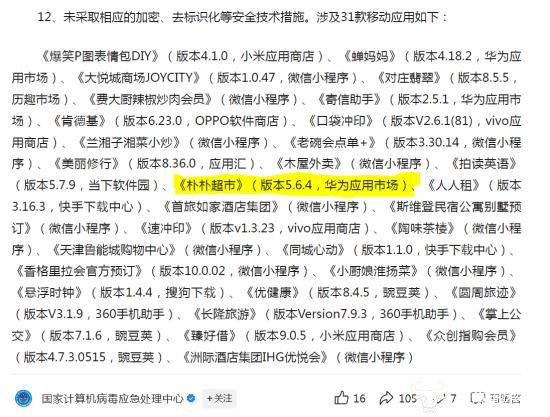
Group 1 - The National Computer Virus Emergency Response Center detected 70 mobile applications, including "Pupu Supermarket," for illegal collection and use of personal information between July 2 and July 29, 2025 [1] - The specific version 5.6.4 of "Pupu Supermarket" was reported for not implementing necessary security measures such as encryption and de-identification [1] - The problematic version 5.6.4 is no longer available for download on the Huawei App Market, with the latest version 5.6.8 released on August 7 [2] Group 2 - "Pupu Supermarket" faced prior issues in 2020 for not clearly informing users about all privacy permissions requested [7] - In July 2023, the company was monitored by the Fuzhou Market Supervision Administration for pesticide residue exceeding safety standards in a product, but no legal action was taken due to sufficient traceability documentation provided by the company [7] - CEO Chen Xingwen, who has a background in advertising, founded "Pupu Supermarket" in 2016 after recognizing opportunities in the fresh e-commerce sector and is reportedly in talks with leading investment banks for a potential IPO in Hong Kong [8]
叮咚买菜(DDL.US)涨逾6% 连续11个季度实现Non-GAAP盈利
Zhi Tong Cai Jing· 2025-08-22 16:47
Core Insights - Dingdong Maicai (DDL.US) shares rose over 6%, closing at $2.36 [1] - The company reported Q2 revenue of 5.98 billion yuan, a year-on-year increase of 6.7% [1] - Gross Merchandise Volume (GMV) reached 6.5 billion yuan, reflecting a year-on-year growth of 4.5% [1] - Total order count increased by 5.5% year-on-year [1] - Dingdong Maicai achieved a net profit of 100 million yuan, marking a year-on-year growth of 59.7% and the sixth consecutive quarter of profitability [1] - Non-GAAP net profit was 130 million yuan, up 23.9% year-on-year, achieving Non-GAAP profitability for 11 consecutive quarters [1]