
证券业

Search documents
国债期货周报:债市情绪回暖,期债窄幅震荡-20260130
Rui Da Qi Huo· 2026-01-30 08:59
1. Industry Investment Rating - There is no information about the industry investment rating in the report. 2. Core Viewpoints of the Report - The sentiment in the bond market has continued to improve, but the momentum for further decline in interest rates is insufficient. The planned issuance of local government bonds may indicate that the supply pressure in February is advancing, and the market's concerns about the imbalance between supply and demand have not been fully alleviated. The large - scale net injection of MLF this month has reduced the market's expectation of a reserve - requirement ratio cut in the first quarter. Additionally, although the equity market has cooled down under regulatory policy adjustments, market expectations remain optimistic, which may continue to suppress the bond market. It is expected that interest rates will fluctuate within a narrow range in the short term, and the market is still waiting for new incremental information to make a directional choice [105]. 3. Summary According to the Table of Contents 3.1. Market Review - **Weekly Data**: The 30 - year and 2 - year Treasury bond futures' main contracts fell by 0.34% and 0.02% respectively, while the 10 - year and 5 - year main contracts rose by 0.11% and 0.01% respectively. The trading volumes of the TF and T main contracts increased, while those of the TS and TL main contracts decreased. The open interests of the TF, TS, and TL main contracts decreased, while that of the T main contract increased [13][22][30]. 3.2. News Review and Analysis - **Domestic News**: In Q4 2025, the balance of RMB real - estate loans was 51.95 trillion yuan, a year - on - year decrease of 1.6%, with a full - year reduction of 963.6 billion yuan. The balance of real - estate development loans was 13.16 trillion yuan, a year - on - year decrease of 3.0%, with a full - year reduction of 357.5 billion yuan. The balance of personal housing loans was 37.01 trillion yuan, a year - on - year decrease of 1.8%, with a full - year reduction of 676.8 billion yuan. In 2025, the total profit of large - scale industrial enterprises was 7.3982 trillion yuan, a year - on - year increase of 0.6%, and in December, the profit increased by 5.3% year - on - year. The National Tax Work Conference proposed to strengthen the standardization of tax incentives. The State Council issued a work plan to cultivate new growth points in service consumption [33][34]. - **Overseas News**: The Fed maintained the benchmark interest rate at 3.50% - 3.75%. The US Senate failed to advance the government appropriation bill, and the US federal government faced a partial shutdown crisis [35]. 3.3. Chart Analysis - **Spread Changes**: The spread between 10 - year and 5 - year Treasury bond yields widened, while the spread between 10 - year and 1 - year yields narrowed. The spreads between the 2 - year and 5 - year, and 5 - year and 10 - year main contracts widened. The inter - period spread of the 10 - year contract narrowed, while that of the 30 - year contract widened. The inter - period spread of the 5 - year contract narrowed, and that of the 2 - year contract widened [43][49][53]. - **Main Contract Position Changes**: The net short positions of the top 20 holders in the T Treasury bond futures' main contract increased significantly [66]. - **Interest Rate Changes**: The 2 - week and 1 - week Shibor rates rose, while the overnight and 1 - month Shibor rates fell. The DR007 weighted average rate rebounded to around 1.59%. The yields of Treasury bonds fluctuated within a narrow range, with the 1.7 - year yield falling by 0.3 - 1.8bp, and the 10 - year and 30 - year yields changing to 1.81% and 2.26% respectively. The spreads between Chinese and US 10 - year and 30 - year Treasury bond yields widened [70][77]. - **Central Bank's Open - Market Operations**: The central bank conducted 1.7615 trillion yuan in reverse repurchases in the open market, with 1.181 trillion yuan maturing, and 200 billion yuan in MLF maturing, achieving a net injection of 530.5 billion yuan [81]. - **Bond Issuance and Maturity**: This week, the total bond issuance was 1.026865 trillion yuan, with a total repayment of 776.835 billion yuan, and a net financing of 250.029 billion yuan [86]. - **Market Sentiment**: The central parity rate of the RMB against the US dollar was 6.9678, with a cumulative appreciation of 251 basis points this week. The spread between the offshore and on - shore RMB narrowed. The 10 - year US Treasury bond yield rose, and the VIX index declined. The 10 - year Chinese Treasury bond yield declined, and the A - share risk premium increased slightly [90][96][101]. 3.4. Market Outlook and Strategy - **Domestic Fundamentals**: In Q4 2025, China's GDP increased by 4.5% year - on - year, and the full - year GDP growth rate reached 5.0%. In December, industrial added value was higher than market expectations, fixed - asset investment continued to shrink, and social retail sales were lower than the previous value. In December, the profit of large - scale industrial enterprises increased by 5.3% year - on - year, and the full - year profit increased, reversing the three - year downward trend. China's economic growth showed a pattern of "strong external demand and weak domestic demand" and "strong supply and weak demand" [104]. - **Overseas Situation**: The US government appropriation bill failed to pass the vote, and the federal government faced a shutdown crisis. The Fed maintained the benchmark interest rate unchanged in January, indicating that inflation was still high, employment growth was sluggish, but concerns about the downward risk of the labor force were alleviated [104].
货币“新工具”会是什么样?
China Post Securities· 2026-01-30 08:30
1. Report Industry Investment Rating No information about the report industry investment rating is provided. 2. Core Viewpoints of the Report - The background and operation mode of the Fed's overnight reverse repurchase tool (ON RRP) are inconsistent with the current orientation of domestic monetary policy operations. There is no need to separately establish a liquidity recovery tool for non - bank institutions in China [9][22]. - The central bank's new policy tools may revolve around implementing the narrowing of the interest rate corridor and liquidity rescue, and the form is different from ON RRP [9][12]. - The central bank's tool innovation will advance along the existing policy direction, and the policy goal of stable operation of capital interest rates is clear, with a generally neutral short - term market impact [34]. 3. Summary According to the Directory 3.1 China's Central Bank: "Providing Liquidity to Non - bank Institutions" and "Narrowing the Interest Rate Corridor" - "Providing liquidity to non - bank institutions" is a mechanism arrangement under specific scenarios, aiming to prevent financial risks and block the spread of risks to the financial system [9]. - The central bank has long aimed to narrow the interest rate corridor, but relevant tools have not been clearly implemented. Future new tools to narrow the interest rate corridor will not target non - bank institutions [10][11][12]. 3.2 The Fed: Overnight Reverse Repurchase, Interest Rate Corridor, and Liquidity Rescue Tools 3.2.1 Overnight Reverse Repurchase (ON RRP): The Lower Limit of the "Floor System" after QE - The ON RRP is implemented by the New York Fed at a fixed time through its open - market operating system, with counterparts including non - bank institutions such as money market funds. It has become a normalized tool for short - term liquidity management [14][15][19]. - The core background for the Fed to form the lower limit of the "floor system" through ON RRP is the large amount of liquidity redundancy caused by quantitative easing, which makes the reserve interest rate ineffective as the lower limit of the interest rate corridor. There is no need for China to set up a similar tool currently [19][22]. 3.2.2 Liquidity Rescue Tools: Money Market Fund Liquidity Facility, etc. - The Fed has created a series of emergency or temporary policy tools, such as the Money Market Mutual Fund Liquidity Facility (MMLF), which can effectively block the spread of risks in the financial system and maintain the continuous operation of the short - term capital market [24][25]. 3.3 Policy Conjecture: Causes of Capital Interest Rate Deviation and Speculation on Policy Tools 3.3.1 Large Deviations of Capital Interest Rates are Related to Policy Regulation and Bank Liabilities - Historically, large deviations of capital prices from policy interest rates are related to policy regulation and bank liabilities. Bank liabilities are one of the core factors determining capital prices [30]. 3.3.2 The New Monetary Policy Tools will Focus on Implementing the Narrowing of the Interest Rate Corridor and Liquidity Rescue - One new tool will target the implementation of "narrowing the interest rate corridor", operating on banks or primary dealers, and may be a "deposit facility" for primary dealers to regulate the lower limit of capital lending prices [32]. - The other new tool will target the implementation of "liquidity rescue", which may be established after the revision of the "Central Bank Law" or bypass direct liquidity provision to non - bank institutions through mechanism design [33].
2月新规来了 事关你我生活
Shang Hai Zheng Quan Bao· 2026-01-30 04:52
Group 1 - The People's Bank of China and other regulatory bodies have established new regulations regarding cash payment services, effective from February 1, 2026, which require businesses to support cash payments and maintain reasonable change availability [1] - Financial institutions are mandated to sell appropriate products through suitable channels to suitable clients, with a focus on risk assessment and differentiation between professional and ordinary investors, starting February 1, 2026 [2] - The China Securities Regulatory Commission has clarified the conditions for the acceptance of commitments in administrative law enforcement, enhancing the protection of investors' rights and improving enforcement efficiency, effective from February 1, 2026 [3] Group 2 - New regulations prohibit online trading platforms from forcing merchants to adopt specific refund policies or pay unreasonable fees, effective from February 1, 2026 [4] - The "Live E-commerce Supervision Management Measures" will regulate the use of artificial intelligence in live commerce, preventing misleading advertising and requiring clear identification of AI-generated content, starting February 1, 2026 [5] - The "Management Measures for Quality Safety Commitment Certificates of Agricultural Products" will require certain agricultural products to have a commitment certificate ensuring compliance with safety standards, effective from February 1, 2026 [6] Group 3 - The "Administrative Law Enforcement Supervision Regulations" will incorporate the results of enforcement supervision into the evaluation of the effectiveness of the rule of law government, effective from February 1, 2026 [8] - The "Unified Social Credit Code Management Measures" will implement lifecycle management of the unified social credit code for organizations, ensuring accurate identification and tracking, effective from February 1, 2026 [8] - The "National Reading Promotion Regulations" aim to enhance reading accessibility, particularly in underdeveloped areas, and provide support for vulnerable groups, effective from February 1, 2026 [8]
宏观杠杆率持续上升 结构优化成调控关键
Zhong Guo Jing Ying Bao· 2026-01-30 04:35
Core Viewpoint - The macro leverage ratio in China is projected to rise to 302.4% by the end of 2025, indicating a significant increase in debt levels relative to nominal GDP, necessitating structural optimization of leverage to support economic growth effectively [1][2]. Summary by Sections Macro Leverage Ratio Trends - The macro leverage ratio increased by 0.1 percentage points from 302.3% at the end of Q3 2025 to 302.4% at the end of Q4 2025. For the entire year, it rose by 11.7 percentage points, driven by low debt growth in the household and corporate sectors, while government debt expanded significantly [2]. - By the end of 2025, the debt balances of non-financial enterprises, households, and government sectors grew by 7.8%, 0.5%, and 17.0% respectively, leading to a total debt balance increase of 8.2%, while nominal GDP only grew by 4.0% [2]. Sectoral Contributions to Leverage Ratio - The rise in the macro leverage ratio was primarily driven by the corporate and government sectors, while the household sector continued to reduce its leverage. Factors such as the adjustment in the real estate market and slow income growth led households to decrease debt and increase savings [3]. - Government investment projects and a recovering corporate financing demand, supported by proactive fiscal policies, contributed to the increase in debt levels in the corporate and government sectors [3]. Future Outlook and Policy Recommendations - The monetary policy in 2026 is expected to maintain a moderately loose stance, which may lead to continued growth in corporate and government debt, putting upward pressure on the macro leverage ratio. However, this could be offset by an increase in nominal GDP growth [4]. - Recommendations for optimizing leverage structure include supporting financing for private SMEs and technology firms, while controlling the debt expansion of state-owned enterprises. This approach aims to stabilize the leverage ratio in the household sector and promote sustainable economic growth [5][6]. - The government is encouraged to increase fiscal spending in social welfare areas, which could enhance consumer spending potential. For instance, a 1% interest subsidy on household loans could reduce interest burdens significantly and stimulate consumption growth [6].
债市早报:资金面维持稳中有松;债市震荡偏强
Jin Rong Jie· 2026-01-30 03:31
Group 1: Domestic News - President Xi Jinping met with UK Prime Minister Starmer, emphasizing the need for a long-term stable comprehensive strategic partnership between China and the UK, focusing on mutual trust and win-win economic cooperation in various sectors including education, healthcare, finance, and technology [2] - The Ministry of Civil Affairs plans to explore the establishment of a civil affairs technology innovation fund through investment and financing channels to support the development and application of suitable technology products, aiming for significant advancements by 2030 [3] - The State Council issued a work plan to accelerate the cultivation of new growth points in service consumption, encouraging financial institutions to increase credit support for relevant business entities, which is expected to play a crucial role in driving high-quality economic development during the 14th Five-Year Plan period [4] Group 2: Commodity Market - The World Gold Council reported that China's gold investment and consumption demand is expected to reach a historical high in 2025, with total demand projected at 1,003 tons, a 6% year-on-year increase, and a monetary value of 796 billion yuan (approximately 111 billion USD), marking a 53% surge [5] Group 3: Bond Market - On January 29, the bond market showed a mixed performance, with the 10-year government bond yield slightly decreasing by 0.05 basis points to 1.8155%, while the 10-year policy bank bond yield increased by 0.65 basis points to 1.9575% [11] - The central bank conducted a reverse repurchase operation of 354 billion yuan with a fixed rate of 1.40%, resulting in a net cash injection of 143.8 billion yuan for the day [8] - The convertible bond market experienced a collective decline, with major indices dropping by 0.70% to 0.96%, and a total trading volume of 87 billion yuan, reflecting a significant increase from the previous trading day [15]

每日债市速递 | 央行公开市场单日净投放2532亿
Wind万得· 2026-01-29 22:56
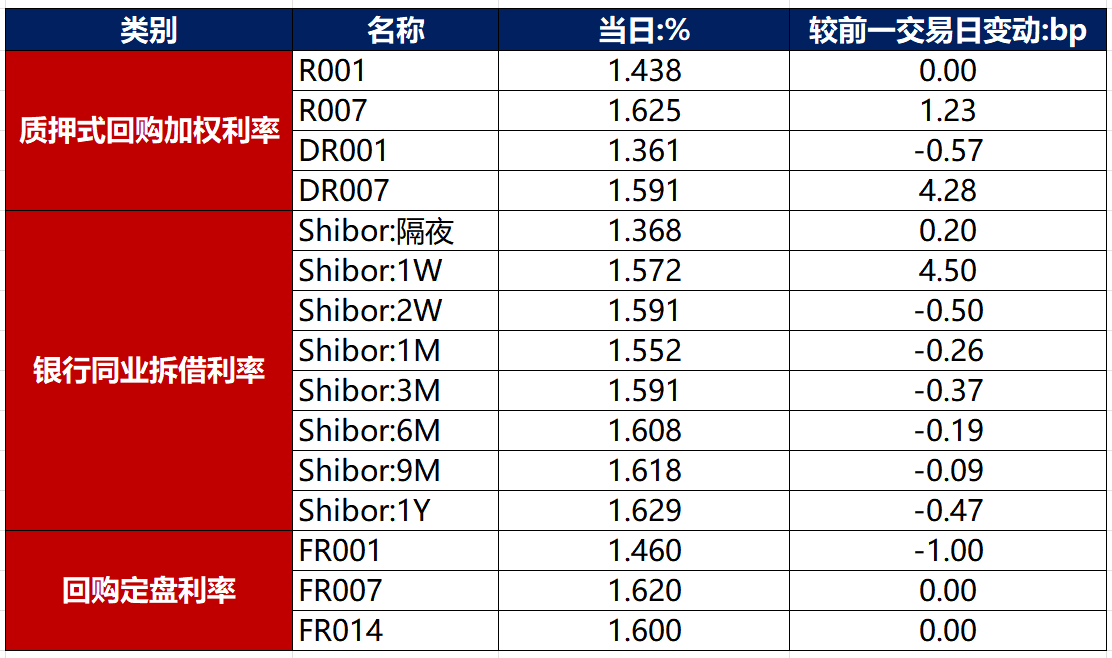
Market Overview - The central bank conducted a reverse repurchase operation of 312.5 billion yuan for 7-day terms at a fixed rate of 1.40%, with a net injection of 253.2 billion yuan after accounting for 59.3 billion yuan in reverse repos maturing on the same day [3][4] - The interbank market liquidity remained stable and slightly loose, with the overnight repo weighted average rate (DR001) decreasing to around 1.24% [5][6] - The latest one-year interbank certificates of deposit (CD) transactions were around 1.64%, unchanged from the previous day [8] Bond Market - The 30-year treasury futures contract rose by 0.17%, while the 10-year and 5-year contracts fell by 0.02% and 0.01%, respectively [12] - Recent trends in AAA-rated local government bonds showed varying yield spreads across different maturities [10][11] Key News - The Central Rural Work Conference emphasized stabilizing grain and oil production and enhancing agricultural infrastructure, aiming for a significant increase in grain production capacity [13] - The State Council announced the implementation of the Value-Added Tax Law from January 1, 2026, detailing taxable transactions and taxpayer classifications [13] - The core value added of the digital economy in 2024 is projected to be 14,089.1 billion yuan, accounting for 10.5% of GDP, with the digital technology application sector contributing the largest share [14] Bond Events - The first real estate asset-backed security (ABS) for thermal power led by GCL Group was listed on the Shanghai Stock Exchange [18] - CITIC Securities plans to pay interest on a perpetual subordinated bond of 2.1 billion yuan at a coupon rate of 2.05% [18] - CIFI Holdings' offshore debt restructuring has officially taken effect, with a debt reduction of approximately 38 billion yuan [19] Risk Monitoring - Recent non-standard asset risks in urban investment include various private equity funds and trust plans facing default risks [20]

金银价创新高,引发全球“贵金属抢购”潮
Huan Qiu Shi Bao· 2026-01-29 22:40
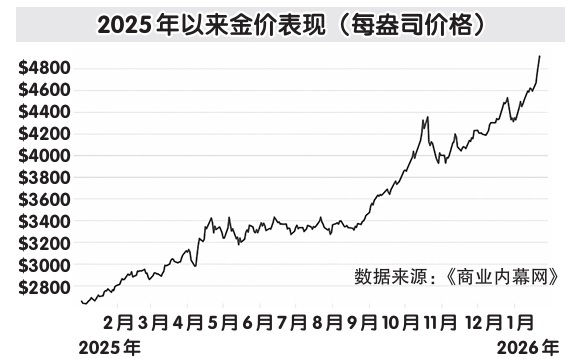
Core Viewpoint - The international market for gold and silver has seen a significant surge in prices, with gold nearing $5600 and silver approaching $120, reflecting a year-to-date increase of approximately 50% [1][3]. Group 1: Market Demand - There is a global frenzy for precious metals, with record-high sales reported by the Royal Mint in the UK, leading to system overload due to unprecedented demand [3]. - Retail investors have been actively entering the gold and silver markets, with an average daily net inflow of $1.5 million into gold and $700,000 into silver last year [4]. - In Turkey, retail investors are willing to pay a premium of $9 per ounce over the London benchmark price for silver due to high demand [4]. Group 2: Influencing Factors - The recent surge in gold prices coincides with the U.S. dollar hitting a four-year low, prompting investors to sell U.S. assets as a hedge against perceived economic instability [5]. - Analysts suggest that the current rise in gold prices is not solely driven by panic but reflects a gradual shift in how investors view gold as a neutral store of value rather than just a crisis hedge [5]. Group 3: Industrial Demand for Silver - The demand for silver is being bolstered by its applications in rapidly growing industries such as electric vehicles, semiconductors, and solar energy, which adds additional price-driving factors [6]. - Analysts warn that while silver prices are currently strong, they are susceptible to significant price drops after substantial increases [6]. Group 4: Future Price Predictions - Major financial institutions like Deutsche Bank and Morgan Stanley have set optimistic year-end price targets for gold, with predictions reaching $6000 and $5700 respectively [7]. - The strong industrial demand for silver, particularly in the photovoltaic sector, is expected to provide solid fundamental support for silver prices, despite potential impacts on downstream industries [7].
今明两年,家里有大量现金的人或将面临大麻烦?你怎么看?
Sou Hu Cai Jing· 2026-01-29 08:20
Core Viewpoint - In the post-pandemic era, Chinese residents' savings willingness has surged, with total deposits reaching an astonishing 9.9 trillion yuan in Q1 2023, averaging 3.3 trillion yuan per month, driven by risk aversion and future concerns [1] Group 1: Reasons for Increased Savings - The first reason for increased savings is the unpredictable risks associated with investment channels such as stocks, funds, and real estate, making bank deposits a safer option [3] - The second reason is the desire to accumulate sufficient funds to prepare for potential risks like unemployment, illness, and retirement, as families feel insecure without a certain amount of cash [3] Group 2: Concerns About Holding Cash - Holding large amounts of cash may lead to difficulties due to inflation eroding purchasing power, with current price levels significantly higher than in the past [5] - Investment channels are limited, with the real estate market under pressure and fund investments carrying loss risks, making it hard for many to keep up with inflation through bank deposits [5] - Continuous decline in deposit interest rates since the second half of 2021 has exacerbated anxiety among cash holders, as rates above 4% are now rare [5] Group 3: Counterarguments to Cash Holding Concerns - Holding substantial cash provides a sense of security and ensures a stable living condition over time, contrasting with those without savings who face greater challenges amid rising prices [7] - Current bubbles in real estate and stock markets suggest that cautious investors may choose to wait for market adjustments before making investments, preserving their wealth [7] - For risk-tolerant investors, a diversified asset allocation strategy remains viable, allowing for a mix of bank deposits, government bonds, and equity funds to mitigate risks while seeking higher returns [9] Group 4: Conclusion - Holding cash is not inherently negative; a rational investment mindset and proper asset allocation are essential for wealth preservation and growth in a complex economic environment [10]

美联储暂停降息,黄金仍飙涨近5600美元
Huan Qiu Lao Hu Cai Jing· 2026-01-29 07:25
1月29日凌晨,美联储召开2026年首次议息会议,宣布将基准利率维持在3.5%至3.75%的区间,符合市 场预期。此前,美联储已分别在去年9月、10月和12月连续三次降息25个基点。 决议公布后,国际金价强势上攻,一度逼近5600美元。截至发稿,现货黄金徘徊在5500美元的高位,日 内涨幅约2.3%,2026年开年以来已累计涨超28%,涨逾1200美元。白银价格同样大涨,现货白银突破 119美元/盎司,刷新历史纪录。 这一情绪也传导至A股市场。29日早盘,贵金属概念集体爆发,招金黄金9天6板,中国黄金5连板,湖 南黄金4连板,四川黄金、晓程科技、山金国际、兴业银锡等纷纷高开。 事实上,机构对黄金的看多预期早已提前释放。此前,已有多家机构相继上调黄金目标价。其中,摩根 士丹利将2026年下半年的黄金目标价提高至5700美元,当前金价距这一目标仅一步之遥。美银和法国兴 业均看高至6000美元,德意志银行则预测年内金价有望触及6000-6900美元。 中信证券在研报中指出,本轮金价走势多被地缘因素和市场情绪主导。此外,各国央行购金潮也是本轮 黄金大牛市的直接驱动力。如中国人民银行已连续14个月增持黄金,2025年全 ...
从美国的ONRRP机制谈起:利率非银流动性工具怎么看
CAITONG SECURITIES· 2026-01-29 03:08
Group 1: Report Industry Investment Rating - Not provided in the report Group 2: Core Views of the Report - The probability of the new tool being similar to the US ONRRP is low, and it is more likely to be a relending mechanism similar to the previous SFISF [1][3] - There is a certain probability of the implementation of overnight reverse repurchase measures [4] Group 3: Summary by Relevant Catalog 1. From the US ONRRP 1.1 US ONRRP Establishment Background - Before the 2008 financial crisis, the US followed the "deposit reserve scarcity framework", and the Fed regulated market interest rates through open - market operations of Treasury bonds [8] - After the 2008 financial crisis, the Fed's balance sheet expanded significantly, and the traditional method of controlling the federal funds rate was no longer effective. To prevent interest rate loss of control, the Fed introduced IOER in 2008 and ONRRP in 2013 [10][12] 1.2 ONRRP Key Points - ONRRP is a key monetary policy tool for absorbing excess liquidity and controlling the short - term interest rate floor in an environment of "excess reserves and policy rate loss of control" [2][13] - The main participants are money market funds and government - supported enterprises. Commercial banks rarely participate due to IOER > ONRRP and ONRRP mechanism limitations [2][13] - Money market funds and cash pools can obtain rights to a large general collateral pool held by the Fed through transactions with primary dealers [2][13] 2. How to View the "Mechanism Arrangement for Non - bank Liquidity"? - The new tool is unlikely to be similar to ONRRP. The current market is not in a state of abundant liquidity, and the probability of the central bank recovering liquidity is low. Also, there are many issues to be explored for the central bank to conduct overnight reverse repurchase transactions with non - banks [21][22] - The "mechanism arrangement for providing liquidity to non - bank institutions under specific scenarios" is likely a non - bank relending mechanism similar to that in the bond market, which can form a ceiling for the interbank lending rate when non - bank liquidity is tight [24][25] - There is a certain logical probability of the implementation of overnight reverse repurchase measures. Overseas mainly uses overnight reverse repurchases, and DR001 has been relatively stable since 2025. If the overnight reverse repurchase mechanism is established, overnight OMO may replace 7 - day OMO as the new policy rate [4][26]