造船

Search documents
黄奇帆:今后十年人民币将逐步升值至6.0左右
Bei Jing Shang Bao· 2025-12-21 14:43
Group 1 - China's foreign trade achievements are a natural result of deep transformation and high-quality development in the manufacturing sector over the past decade [2] - China's industrial added value accounts for 32% of the global total, establishing a "one-third" structure where Chinese manufacturing represents one-third, developed countries one-third, and other developing countries one-third [2] - China has formed global competitive advantages in five key sectors: automotive, shipbuilding, high-speed rail, power equipment, and renewable energy (photovoltaics) [2] Group 2 - The structure of foreign investment in China continues to optimize, with actual foreign investment doubling over the past decade to an average of approximately $120 billion annually [3] - Foreign-funded enterprises contribute about 30% of national exports, 50% of high-value-added equipment and electronic product exports, and 15% of industrial and commercial tax revenue [3] - Exports have shifted from a focus on processing trade to a cluster-based export model with embedded domestic value [3] Group 3 - China should promote a balanced approach to imports and exports, enhance trade quality, and increase the internationalization of the Renminbi [4] - An appropriate appreciation of the Renminbi is suggested to enhance purchasing power and promote import growth, aiming for a doubling of per capita GDP in USD terms over the medium to long term [4] Group 4 - It is recommended to moderately reduce export tax rebates based on industry differences and overall needs, reallocating fiscal resources to domestic welfare and innovation [5] - There is an emphasis on improving minimum wage standards and implementing paid leave to promote common prosperity and consumption upgrades [5] Group 5 - The need to prevent "involution" domestically from affecting international trade is highlighted, with a focus on enhancing the brand value and overall profit levels of Chinese manufacturing [6] - China aims to improve service trade, targeting that by 2040, service trade will account for 20% of the total volume of goods and service trade, aligning with the global average [6]


中美博弈收场?现实比想象严峻:美国谈不上败北,是难以继续上桌
Sou Hu Cai Jing· 2025-12-20 07:55
Core Insights - The article discusses the evolving dynamics of the US-China competition, emphasizing that the focus has shifted from a binary win/lose perspective to a more nuanced understanding of industrial resilience and technological capabilities [1][3]. Group 1: Technology and Manufacturing - The article highlights the importance of semiconductor manufacturing, noting that while export controls have raised barriers, China has made significant progress in mature processes and components, although it remains a net importer of integrated circuits [5][7]. - It emphasizes the role of advanced packaging technologies and domestic equipment in reducing systemic risks, despite existing gaps in top-tier equipment [7][11]. - The growth of China's electric vehicle exports and the integration of various components in the supply chain are presented as evidence of the country's manufacturing capabilities [9][12]. Group 2: Industrial and Military Integration - The article outlines how the civilian manufacturing sector is increasingly supporting military production, with rapid iteration cycles enabled by close collaboration among suppliers and manufacturers [11][12]. - It discusses the role of unmanned systems and electronic warfare in modern military strategies, highlighting the need for cost-effective solutions in the face of rapid technological advancements [13][14]. - The article points out that the US still holds advantages in certain advanced technologies, but its manufacturing sector faces challenges that could impact military readiness [13][14]. Group 3: Geopolitical Context and Future Outlook - The article presents a comparative analysis of defense spending as a percentage of GDP, indicating that China is building its military capabilities steadily rather than aggressively [14][15]. - It suggests that both nations are focusing on sustainable development, which may reduce confrontational actions and increase competitive strategies [16]. - The article concludes that the long-term competition will be characterized by coexistence, strategic adjustments, and deeper industrial restructuring, urging stakeholders to focus on manufacturing and engineering capabilities [16][17].
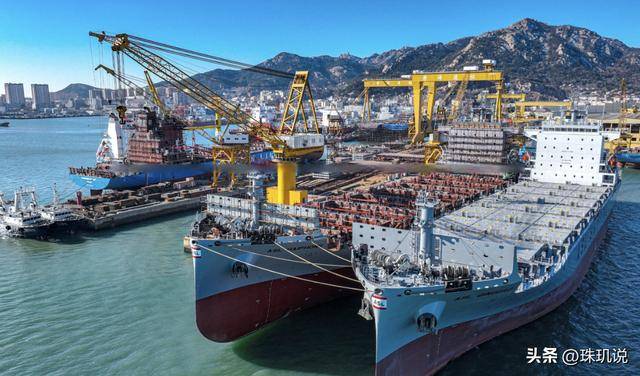
*ST松发最新公告:下属公司签约2艘11.4万载重吨原油/成品油运输船建造合同
Sou Hu Cai Jing· 2025-12-19 10:24
Core Viewpoint - *ST Songfa (603268.SH) announced the signing of contracts for the construction of two oil/product tankers with a total deadweight of 114,000 tons, with a contract value estimated between 100 million to 200 million USD, expected to be delivered in the first half of 2027 [1] Group 1 - The contracts were signed by the company's subsidiary, Hengli Shipbuilding (Dalian) Co., Ltd [1] - The total contract amount is approximately 100 million to 200 million USD [1] - The delivery of the vessels is scheduled for the first half of 2027 [1]

*ST松发:下属公司签约2艘11.4万载重吨原油/成品油运输船
Zheng Quan Shi Bao Wang· 2025-12-19 10:13
Core Viewpoint - *ST Songfa has signed contracts for the construction of two oil/product tankers, with a total contract value estimated between 100 million to 200 million USD, expected to be delivered in the first half of 2027 [1] Group 1 - The company’s subsidiary, Hengli Shipbuilding (Dalian) Co., Ltd., is responsible for the construction of the two tankers [1] - Each tanker has a deadweight tonnage of 114,000 tons [1] - The contracts have recently become effective, indicating a commitment to future growth in the shipping sector [1]
美国媒体刊文:放弃关于中国的这个想法吧!
Huan Qiu Shi Bao· 2025-12-19 07:35
Core Viewpoint - The article argues that China is not "in trouble" as some in the U.S. claim, and the U.S. should abandon the notion of "defeating China" [1] Group 1: Economic and Trade Relations - The article highlights the U.S.'s initial confidence in defeating China in trade, which has been proven to be misplaced as China has demonstrated its strength in this area [1] - Despite the GDP gap, China leads significantly in critical future-oriented sectors such as rare earth production, solar capacity, electric vehicles, and industrial robotics [2] - A recent report from the U.S.-China Economic and Security Review Commission states that China is at the forefront of quantum communication and making rapid advancements in quantum computing and sensing [2] Group 2: Technological Advancements - China is making significant strides in chip technology, with reports indicating efforts to master lithography technology [2] - The article emphasizes China's advancements in electric vehicles, clean energy, and robotics, which are crucial for future competitiveness [2] Group 3: Military Capabilities - While the U.S. maintains the strongest military globally, China is rapidly catching up, particularly in naval capabilities with its latest aircraft carriers [3] - The article acknowledges China's economic and demographic challenges but notes that the government's "14th Five-Year Plan" is addressing these issues [3] Group 4: Soft Power and Perception - China's soft power is gaining traction in the U.S., as evidenced by the popularity of platforms like TikTok and the positive experiences of American tourists in China [3] - The article suggests that Americans are beginning to reassess China's global standing, indicating a shift in perception [3] - The article has sparked positive reactions among American netizens, advocating for more cooperation with China, while also drawing attention from Japanese netizens who criticize their own right-wing views [3]
180天造一艘邮轮!中国造船业垄断全球近七成,美造船业慌了?
Sou Hu Cai Jing· 2025-12-18 12:55
Core Insights - China's shipbuilding industry has maintained its global leadership for 16 consecutive years, capturing nearly 70% of the global market share in new orders and undelivered vessels in the first half of this year [1] Group 1: Financial Support and Talent - The shipbuilding industry in China benefits from strong financial backing from state-owned institutions, allowing for lower interest rates and longer loan terms compared to Western counterparts [3][5] - The development of skilled talent is crucial, with experience gained from projects like the Liaoning, Shandong, and Fujian aircraft carriers contributing to a pool of proficient shipbuilders and engineers [9][11] Group 2: Industrial System and Efficiency - China's complete industrial system enables the production of everything from core equipment to key components, making it unique among global competitors [13] - The efficiency of Chinese shipbuilding has significantly improved, with the time to build large container ships reduced from 28 months to 16 months through digital modeling and streamlined processes [17][19] Group 3: Technological Advancements - China has successfully developed advanced technologies in shipbuilding, including aircraft carriers, large cruise ships, and LNG carriers, previously dominated by Western nations [21] - The Fujian aircraft carrier features innovative technologies such as conventional power with electromagnetic catapults, achieving a 98% domestic production rate [21][23] Group 4: Market Position and Standards - China's shipbuilding industry is increasingly recognized for its quality and efficiency, leading to a growing preference among global shipowners for Chinese shipyards over traditional partners in South Korea and Japan [29][31] - The industry is transitioning from following international standards to setting its own, with innovations in low-carbon technologies and smart control systems aligning with global trends towards carbon neutrality [36][38] Group 5: Future Outlook - The integration of AI and robotics in ship design and manufacturing enhances precision and efficiency, positioning China's shipbuilding sector as a leader in both competitiveness and environmental standards [39][41] - The journey from a follower to a leader in the global shipbuilding market reflects a solid foundation built on consistent efforts and technological advancements, contributing to national pride and industrial strength [43]
12月18日中船防务AH溢价达128.32%,位居AH股溢价率第25位
Jin Rong Jie· 2025-12-18 09:30
Group 1 - The Shanghai Composite Index rose by 0.16% to close at 3876.37 points, while the Hang Seng Index increased by 0.12% to 25498.13 points [1] - China Shipbuilding Defense's A/H premium reached 128.32%, ranking 25th among A/H stocks [1] - At the close, China Shipbuilding Defense's A-shares were priced at 27.11 yuan, down by 1.09%, and H-shares were at 13.12 HKD, up by 0.54% [1] Group 2 - China Shipbuilding Defense Equipment Co., Ltd. is a major shipbuilding enterprise under China Shipbuilding Group, originally established as Guangzhou Shipyard International Co., Ltd. [1] - The company was listed in Shanghai and Hong Kong in 1993, becoming the first A+H share listed shipbuilding enterprise in China [1] - To promote industry consolidation and enhance competitiveness, China Shipbuilding Defense acquired several companies in 2014 and 2015, integrating quality shipbuilding assets in South China [1] - The company aims to become a leading enterprise in the global marine and heavy equipment market, focusing on technology and service excellence [1]

鲍韶山:美国想要“权力下放”,这是一场高风险的赌局
Guan Cha Zhe Wang· 2025-12-17 00:39
Group 1 - The 2025 National Security Strategy (NSS) report emphasizes a need for the U.S. to adjust its global strategy, moving away from the illusion of maintaining permanent dominance and towards a modular system that shares risks and costs with allies and partners [1][5][39] - The report reflects a significant ideological battle over the concept of multipolarity, with differing views on its implications for U.S. dominance and global order [4][5] - The NSS aims to maintain U.S. leadership through a structured alliance system while recognizing the need for allies to take on more responsibilities, including increased defense spending and military deployments [13][14][25] Group 2 - The NSS acknowledges the structural weaknesses in U.S. industrial capacity, particularly in ammunition production and supply chain vulnerabilities, which could undermine military readiness [19][20][23] - The report highlights the reliance on foreign suppliers for critical materials, such as rare earth elements, which poses a risk to U.S. defense capabilities [20][26] - The NSS indicates a shift towards a state of "permanent near-war," where competition occurs continuously across multiple domains, rather than only during crises [17][39] Group 3 - The NSS report's success hinges on the ability to mobilize industrial capacity rapidly, enhance supply chain resilience, and foster deeper cooperation among allies [41][42] - The report suggests that U.S. allies may begin to question the reliability of American commitments, leading to a potential shift in their defense strategies and partnerships [25][29][37] - The NSS reflects a high-risk strategy that relies on the willingness of other nations to bear costs and responsibilities, which may not be sustainable if trust in U.S. capabilities erodes [43][44]

“过去还能列出与中国的差距,现在无从下笔”
Guan Cha Zhe Wang· 2025-12-16 12:42
【文/观察者网 王一】"过去,我们在撰写内部报告时,总会列出各行业与中国还存在多少年的技术差 距。但现在,这样的报告已经很难再写出来了。"韩国产业通商资源部东北亚通商科科长金德九(音 译)12月16日在一场论坛上如此坦言。 韩国《韩民族日报》当天在报道中指出,这番话表明,随着中国制造业和高端产业的迅猛发展,市场格 局已与过去截然不同。 报道称,韩国政府资助的智库"韩国产业经济贸易研究院"(KIET)16日在首尔举办了一场名为"韩国产 业对华战略转型与合作新方向"的论坛,旨在探讨韩国"应对中国挑战"的策略,中国的产业竞争力已紧 追甚至超越了韩国。 据报道,包括金德九在内的与会人士普遍认为,无论是在钢铁、石化、造船等传统重工业领域,还是在 自动驾驶电动车、电池、人工智能(AI)、机器人、可再生能源等未来产业领域,中国都在全面超越 韩国,韩国的产业战略亟须调整。 在当天的主题发言中,韩国金融研究院高级研究员池万洙指出,中国政府"致力于发展制造业",并直 言"韩国的'快速跟踪'经济发展模式正面临危机"。 他分析称,中国吸取了美国的经验教训,后者曾将制造业工厂大规模外迁,导致就业减少并引发政治和 社会不稳定,如今中国正 ...

广发证券:散货船+油轮复苏 需求二次加速阶段已至
Zhi Tong Cai Jing· 2025-12-16 06:15
智通财经APP获悉,广发证券发布研报称,Q4基数下降+终端运价改善+外部不确定性缓和,造船业已 迎来需求拐点,重视明年造船行业的贝塔复苏。2021-2024年的造船市场以集装箱叠加LNG船为核心驱 动力,25年造船市场在美国301冲击下回落。该行认为26年开始船舶需求市场进入2.0阶段。2026年的造 船行情有望类比2019年的工程机械,需求的二次加速有望激发估值中枢抬升。 广发证券主要观点如下: 1月新船订单首次同比转正,散货船和油轮边际拐点已至 根据clarksons,11月新船订单cgt/dwt/金额同比增速3.5%/37.6%/20.1%,全面转正;10-11月散货船和油轮 的订单增速较快,散货船订单载重吨同比分别+87.32%/+0.33%,油轮订单载重吨同比分别 +24.34%/284%。后续有望进一步上修,且散货船和油轮的新船价格指数有所回暖。全年累计新船订单 已达到1.16亿dwt,下半年行业回暖驱动订单加速。Q4基数下降+终端运价改善+外部不确定性缓和,造 船业已迎来需求拐点,重视明年造船行业的贝塔复苏。 散货船:西芒杜铁矿正式投产,高产量+长运距带来海岬型船额外运力需求 根据wind,西芒 ...