
黑色金属冶炼和压延加工业

Search documents
“反内卷”政策预计会继续ING
Sou Hu Cai Jing· 2025-08-30 06:05
Core Viewpoint - The Producer Price Index (PPI) in July showed a month-on-month decline of 0.2%, marking the first narrowing of the decline since March this year, indicating a potential stabilization in industrial prices [2][3]. Group 1: PPI Trends - In July, the prices in coal mining, black metal smelting, photovoltaic equipment manufacturing, cement manufacturing, and lithium-ion battery manufacturing saw a reduced month-on-month decline of 1.9, 1.5, 0.8, 0.3, and 0.1 percentage points respectively, contributing to a reduced downward impact on PPI by 0.14 percentage points compared to the previous month [3]. - The month-on-month decline in PPI was primarily influenced by a series of "anti-involution" policies that have led to a rebound in product prices in cyclical industries, as evidenced by the futures price trends of coal, steel, and cement [3][4]. Group 2: Year-on-Year PPI Analysis - The year-on-year PPI in July decreased by 3.6%, maintaining the same decline as the previous month, with the PPI growth rate remaining in negative territory for 34 consecutive months [4]. - The "anti-involution" policy is seen as a significant factor in the month-on-month improvement of PPI, addressing the core issue of low-price competition driven by supply-demand imbalances [4][5]. Group 3: Future Outlook - The ongoing "anti-involution" policies are expected to continue supporting the month-on-month improvement of PPI, but the extent of this improvement and whether the year-on-year growth can turn positive will require further observation [5]. - To solidify the effects of the "anti-involution" policies, it is crucial to restore domestic demand; otherwise, competitive pressures among enterprises may intensify [6].


望变电气: 2025年半年度报告
Zheng Quan Zhi Xing· 2025-08-29 16:18
Core Viewpoint - The report highlights the significant growth in revenue and profit for Chongqing Wangbian Electric (Group) Co., Ltd. in the first half of 2025, driven by strong performance in the power transmission and distribution equipment sector and the oriented silicon steel business. Financial Performance - The company achieved operating revenue of 1.836 billion RMB, an increase of 28.81% compared to the same period last year [3] - Total profit reached 69.79 million RMB, up 75.57% year-on-year [3] - Net profit attributable to shareholders was 546.32 million RMB, reflecting a 57.02% increase [3] - The net cash flow from operating activities was 198.31 million RMB, a significant recovery from a negative cash flow in the previous year [3] Business Segments - The power transmission and distribution equipment segment generated revenue of 1.143 billion RMB, a 46.72% increase year-on-year, primarily due to higher sales of transformers [3] - The oriented silicon steel segment reported revenue of 636 million RMB, a 5.50% increase, driven by a rise in sales volume [3] Industry Context - The power transmission and distribution equipment industry is a strategic and foundational sector for China's economic development, with products widely used in renewable energy, high-end equipment, and new infrastructure [5] - The demand for power equipment is expected to grow significantly due to the ongoing energy transition and the increasing penetration of renewable energy sources [5][6] - The total installed power generation capacity in China reached approximately 3.65 billion kW in the first half of 2025, with solar and wind power showing substantial growth [6][7] Technological Advancements - The company is focusing on high-end, intelligent, and green development, with significant investments in R&D for advanced transformer series and smart power distribution equipment [17] - The oriented silicon steel products have achieved domestic leading quality standards, with a focus on high-grade products that are essential for transformer manufacturing [12][13] Market Position - The company maintains a leading position in the railway traction transformer sector and is expanding its international market presence [8] - It has established long-term strategic partnerships with major clients, including State Grid and China Power Construction, enhancing its competitive edge [8] Future Outlook - The company plans to increase its overseas business share and deepen its market penetration in Europe and the Middle East, aiming for sustainable high-quality growth [17] - The ongoing development of high-performance magnetic materials and smart power systems is expected to further strengthen the company's market position [17]

静海区多家企业入围2025中国民营企业500强榜单
Sou Hu Cai Jing· 2025-08-29 10:30
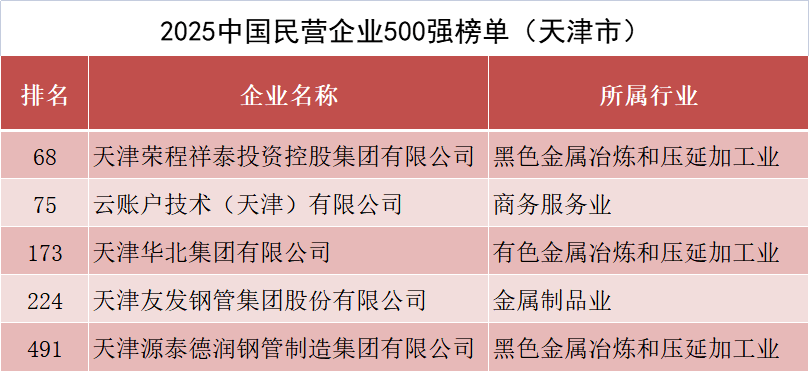
Group 1 - The "2025 China Top 500 Private Enterprises" report indicates that the threshold for entry has increased to 27.023 billion yuan, with total revenue reaching 4.305 trillion yuan, an average of 861.02 million yuan per enterprise, reflecting a growth of 2.72% year-on-year [1] - Total assets of the top 500 private enterprises amount to 51.15 trillion yuan, with an average of 1.023 billion yuan per enterprise, showing a growth of 2.62% [1] - The net profit of these enterprises is 1.8 trillion yuan, averaging 360.5 million yuan per enterprise, which represents a growth of 6.48% [1] Group 2 - In the Jinghai District, two private enterprises, Tianjin Youfa Steel Pipe Group Co., Ltd. and Tianjin Yuantai Derun Steel Pipe Manufacturing Group Co., Ltd., made it to the "2025 China Top 500 Private Enterprises" list [1] - The same two companies, along with Tianjin Baolai Steel Co., Ltd., Aima Technology Group Co., Ltd., and Tianjin New Energy Recycling Resources Co., Ltd., are included in the "2025 China Top 500 Private Manufacturing Enterprises" list [1] - The private enterprises in Jinghai District are showing strong growth and diversification, particularly in core sectors such as steel pipe manufacturing, new energy, and technology equipment [2] Group 3 - Tianjin Youfa Steel Pipe Group Co., Ltd. has maintained its position as an industry leader for three consecutive years [2] - Aima Technology Group Co., Ltd. is increasing its market share in the electric vehicle sector [2] - Tianjin New Energy Recycling Resources Co., Ltd. is playing a demonstrative role in the green and low-carbon transition [2] Group 4 - The rankings of Tianjin enterprises in the "2025 China Top 500 Private Enterprises" include Tianjin Rongcheng Xiangtai Investment Holding Group Co., Ltd. at 68th, Yunzhang Account Technology (Tianjin) Co., Ltd. at 75th, and others [3] - In the "2025 China Top 500 Private Manufacturing Enterprises," Tianjin Rongcheng Xiangtai Investment Holding Group Co., Ltd. ranks 49th, followed by Tianjin Youfa Steel Pipe Group Co., Ltd. at 162nd [4]


南钢申请一种复合板叠板压平方法专利,有效提高了瓢曲的不锈钢复合板压平效率
Jin Rong Jie· 2025-08-29 04:08
Group 1 - Nanjing Steel Co., Ltd. has applied for a patent for a method of flattening stacked composite plates, indicating innovation in composite plate manufacturing technology [1] - The patent application was filed on June 2025, with the publication number CN 120551231 A, highlighting the company's ongoing commitment to research and development [1] - The method involves several steps, including stacking composite plates, aligning them with a flattening machine, and applying pressure to achieve the desired flatness, showcasing advanced manufacturing techniques [1] Group 2 - Nanjing Steel Co., Ltd. was established in 1999 and is primarily engaged in the smelting and rolling of ferrous metals, indicating its long-standing presence in the industry [1] - The company has a registered capital of 616,509.1011 million RMB and has invested in 58 enterprises, reflecting its active role in the market [1] - Nanjing Steel has participated in 5,000 bidding projects and holds 4,635 patents, demonstrating its significant involvement in innovation and competitive positioning within the industry [1]

7月工业企业利润降幅收窄,高技术制造业利润大幅回升
Ge Lin Qi Huo· 2025-08-28 08:58
Group 1: Investment Rating - Not provided Group 2: Core Viewpoints - In July, the decline in profits of large-scale industrial enterprises narrowed, and the profits of the manufacturing industry, especially high-tech manufacturing, rebounded significantly year-on-year. Whether this trend can continue is worthy of attention. The implementation of anti-involution policies and the narrowing of the year-on-year decline in PPI are beneficial to the year-on-year recovery of industrial enterprise profits [3][14] Group 3: Summary by Relevant Content Operating Income and Profit - From January to July, large-scale industrial enterprises achieved operating income of 78.07 trillion yuan, a year-on-year increase of 2.3%. In July, the operating income of large-scale industrial enterprises increased by 0.9% year-on-year. The total profit was 402.035 billion yuan, a year-on-year decrease of 1.7%. In July, the profit of large-scale industrial enterprises decreased by 1.5% year-on-year [1][4] - From January to July, private industrial enterprises' total profit increased by 1.8% year-on-year, and in July, their profit increased by 2.6% year-on-year [4] - From January to July, large-scale manufacturing enterprises achieved a total profit of 3.02 trillion yuan, a year-on-year increase of 4.8%. In July, manufacturing profits increased by 6.8% year-on-year, 5.4 percentage points faster than in June [2][7] - In July, the profit of raw material manufacturing turned from a 5.0% decline in June to a 36.9% increase. The consumer goods manufacturing industry decreased by 4.7%, with the decline narrowing by 3.0 percentage points compared to June. The profit of high-tech manufacturing turned from a 0.9% decline in June to an 18.9% increase [2][7] - Industries with relatively fast year-on-year profit growth from January to July include the ferrous metal smelting and rolling processing industry (5175.9%), non-ferrous metal mining and dressing industry (39.1%), etc. Industries with relatively large year-on-year profit declines include the coal mining and washing industry (-55.2%), ferrous metal mining and dressing industry (-33.7%), etc. [8] Operating Income Profit Margin - From January to July, the operating income profit margin of large-scale industrial enterprises was 5.15%, a year-on-year decrease of 0.25 percentage points. The manufacturing industry was 4.46%, slightly higher than the same period last year but about one percentage point lower than the same period in 2019. The mining industry was 16.75%, still higher than the same period in 2019. The production and supply of electricity, heat, gas, and water was 6.92%, better than the same period last year and higher than the same period in 2019 [2][9] Asset - Liability Ratio - At the end of July, the asset - liability ratio of large-scale industrial enterprises was 57.9%, a year-on-year increase of 0.3 percentage points. The asset - liability ratio of large-scale manufacturing enterprises was 57.2%, a year-on-year increase of 0.1 percentage point. Both are at the highest levels for the same period in the past decade [3][10] Accounts Receivable and Inventory - At the end of July, the average collection period of accounts receivable of large-scale industrial enterprises was 69.8 days, a year-on-year increase of 3.4 days, and that of large-scale manufacturing enterprises was 70.8 days, a year-on-year increase of 2.9 days, both at the highest levels for the same period since 2015, putting pressure on corporate cash flow [3][13] - From January to July, the cumulative year-on-year growth of finished product inventory of large-scale industrial enterprises was 2.4%. Industrial enterprises controlled a small year-on-year increase in finished product inventory under the circumstances of falling ex-factory prices, negative year-on-year net profit growth, longer accounts receivable periods, and rising debt ratios [3][13]
破发股友发集团副总拟减持 A股募38亿IPO东兴证券保荐
Zhong Guo Jing Ji Wang· 2025-08-28 06:34
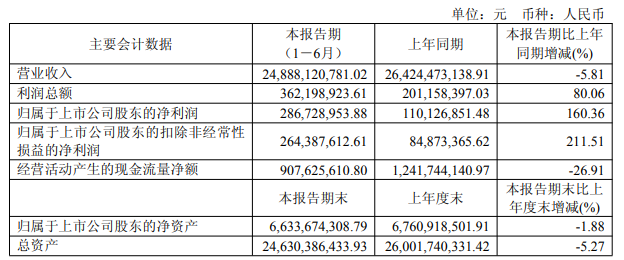
Core Viewpoint - The announcement of share reduction by a senior executive of Youfa Group highlights the company's ongoing financial adjustments and market conditions affecting its stock performance [1][2]. Group 1: Share Reduction Announcement - Youfa Group's senior executive, Han Deheng, plans to reduce his holdings by up to 3,954,750 shares, which is 0.27% of the total share capital and 25% of his holdings, due to personal financial needs [1]. - The shares to be sold are part of the total 15,819,000 shares held by Han, which represents 1.09% of the company's total share capital [1]. Group 2: Stock Performance and Financials - Youfa Group's stock price peaked at 18.53 CNY per share shortly after its IPO on December 7, 2020, but has since fallen below the initial offering price, indicating a current state of underperformance [2]. - The total funds raised from the IPO amounted to 18.26 billion CNY, with a net amount of 17 billion CNY after deducting issuance costs [2]. - In the first half of 2025, Youfa Group reported a revenue of 24.89 billion CNY, a decrease of 5.81% year-on-year, while net profit increased by 160.36% to 2.87 billion CNY [3][4]. Group 3: Financial Metrics - The company's net profit attributable to shareholders, excluding non-recurring gains and losses, was 2.64 billion CNY, reflecting a significant increase of 211.51% compared to the previous year [3][4]. - The net cash flow from operating activities was reported at 9.08 billion CNY, showing a decline of 26.91% from the previous year [4]. - As of the end of the reporting period, the total assets of Youfa Group were 24.63 billion CNY, down 5.27% from the previous year, and the net assets attributable to shareholders were 6.63 billion CNY, a decrease of 1.88% [4].

工业企业利润持续改善, 中下游行业“反内卷”仍需更多支持
Sou Hu Cai Jing· 2025-08-28 01:41
Core Insights - The cumulative profit of industrial enterprises above designated size fell by 1.7% year-on-year from January to July, with a significant narrowing of the decline in July to 1.5%, down 2.8 percentage points from the previous month [1] - The "Two New" policies, focusing on large-scale equipment updates and consumer goods replacement, have significantly contributed to profit growth in new momentum industries, particularly in equipment manufacturing [1][5] - In July, profits in specific sectors such as electronic and electrical machinery manufacturing, general component manufacturing, and food and beverage equipment manufacturing saw substantial year-on-year increases of 87.9%, 15.3%, and 11.3% respectively [1] Industrial Performance - The industrial added value for enterprises above designated size grew by 5.7% year-on-year in July, despite a 1.1 percentage point decline in growth rate compared to previous months, remaining above the average of the past five years [3] - Export growth in July was recorded at 7.2%, surpassing the ten-year average of 3.6% for the same period, driven by "grabbing exports" and "grabbing Two New" initiatives [3] - The "anti-involution" effect has been reflected in the prices of raw materials, with significant reductions in price declines for various industries, contributing to a decrease in the overall impact on the Producer Price Index (PPI) [3] Profit Recovery - From January to July, profits in the raw materials manufacturing sector increased by 10% year-on-year, accelerating by 3.2 percentage points compared to the previous period, with the steel processing industry turning profitable [5] - Small and medium-sized industrial enterprises showed signs of profit recovery in July, with profits turning from declines of 7.8% and 9.7% in June to increases of 1.8% and 0.5% respectively [6] - The overall industrial production maintained rapid growth in July, although challenges such as weak effective demand and low profit levels persist [6] Future Outlook - The "anti-involution" strategy is expected to focus on controlling increments while optimizing existing resources, leading to a gradual support for industrial profit growth [7] - With the expected normalization of supply and demand following extreme weather disruptions, industrial profits are anticipated to continue a mild recovery trend, with monthly year-on-year growth potentially turning positive [7] - Upcoming policies, including a new 500 billion yuan financial tool aimed at supporting infrastructure and strategic emerging industries, are expected to provide stable demand support [7][8]
2025年1-7月工业企业效益数据点评:利润率端边际改善,工企利润实现降幅收窄
BOHAI SECURITIES· 2025-08-27 11:49
Group 1: Profit Trends - The profit of industrial enterprises above designated size decreased by 1.7% year-on-year from January to July 2025, with a narrowing decline compared to previous months[1] - In July, the profit decline was 1.5%, indicating a slight improvement in the trend[1] - The operating revenue increased by 2.3% year-on-year during the same period, a decrease of 0.2 percentage points from June[3] Group 2: Factors Influencing Performance - The industrial added value grew by 6.3% year-on-year, a slight decline of 0.1 percentage points from June[3] - The PPI (Producer Price Index) growth rate continued to decline due to external uncertainties and extreme weather conditions affecting construction and material demand[3] - The revenue profit margin for January to July was 5.15%, down 4.6% year-on-year, but the decline was less severe than in June, contributing positively to profit growth[3] Group 3: Sector Performance - Among 41 industrial sectors, 19 achieved positive profit growth from January to July, an increase in the growth breadth compared to June[4] - High-tech manufacturing sectors, particularly computer and communication equipment manufacturing, showed significant profit growth, reflecting advancements in AI and semiconductor industries[4] - Different types of enterprises exhibited varied profit growth trends, with private, state-owned, and joint-stock enterprises showing marginal improvements, while foreign-invested enterprises saw a slight decline[3] Group 4: Future Outlook and Risks - Future profit growth for industrial enterprises will depend on stabilizing domestic demand and pricing policies, especially in light of ongoing extreme weather conditions[4] - Risks include potential underperformance of extreme weather impacts and uncertainties in the external environment affecting domestic economic stability[5]
2025年上半年黑色金属冶炼和压延加工业企业有6265个,同比增长0.9%
Chan Ye Xin Xi Wang· 2025-08-27 03:06
Core Insights - The report highlights the growth in the number of enterprises in the black metal smelting and rolling processing industry, with a total of 6,265 enterprises as of the first half of 2025, reflecting an increase of 56 enterprises year-on-year, which is a growth rate of 0.9% [1] Industry Overview - The black metal smelting and rolling processing industry accounted for 1.2% of the total industrial enterprises in China as of the first half of 2025 [1] - The threshold for scale industrial enterprises was raised from an annual main business income of 5 million yuan to 20 million yuan starting from 2011 [1] Related Companies - The report mentions several listed companies in the industry, including CITIC Special Steel, Hebei Steel, Zhongnan Shares, Benxi Steel Plate, and others [1] Research Background - The data is sourced from the National Bureau of Statistics and compiled by Zhiyan Consulting, a leading industry consulting firm in China, which specializes in providing in-depth industry research reports and investment forecasts [1]


1-7月钢铁行业利润同比增5175%
Guo Jia Tong Ji Ju· 2025-08-27 02:11
Core Insights - From January to July, the total profit of industrial enterprises above designated size in China reached 40,203.5 billion yuan, a year-on-year decrease of 1.7% [1] - Among these enterprises, state-controlled enterprises reported a profit of 12,823.4 billion yuan, down 7.5% year-on-year; joint-stock enterprises achieved a profit of 29,742.5 billion yuan, down 2.8%; foreign and Hong Kong, Macao, and Taiwan-invested enterprises saw a profit of 10,216.7 billion yuan, an increase of 1.8%; private enterprises reported a profit of 11,183.7 billion yuan, also up 1.8% [1] - The mining industry experienced a profit of 4,930.9 billion yuan, a significant decline of 31.6%; the manufacturing sector achieved a profit of 30,235.8 billion yuan, an increase of 4.8%; and the electricity, heat, gas, and water production and supply industry reported a profit of 5,036.8 billion yuan, up 3.9% [1] Industry Performance - In the first seven months, the profit situation of major industries is as follows: the agricultural and sideline food processing industry saw a profit increase of 14.5%; electrical machinery and equipment manufacturing grew by 11.7%; non-ferrous metal smelting and rolling processing increased by 6.9%; computer, communication, and other electronic equipment manufacturing rose by 6.7%; general equipment manufacturing grew by 6.4%; electricity and heat production and supply increased by 6.3%; specialized equipment manufacturing rose by 3.2%; automotive manufacturing grew by 0.9% [2] - Conversely, the non-metallic mineral products industry declined by 5.6%; the textile industry decreased by 6.5%; the chemical raw materials and chemical products manufacturing industry fell by 8.0%; the oil and natural gas extraction industry dropped by 12.6%; and the coal mining and washing industry saw a dramatic decline of 55.2% [2] - The black metal smelting and rolling processing industry reported a total profit of 643.6 billion yuan, a staggering year-on-year increase of 5,175.4% [2] - For the first six months, the profit of the black metal smelting and rolling processing industry was 462.8 billion yuan, reflecting a year-on-year increase of 13.7 times, the highest growth rate among all 31 industrial categories [2][3]