
互联网

Search documents
战略聚焦核心主业 顺网科技预计2025年净利润同比增长42.92%–70.71%
Quan Jing Wang· 2026-02-02 11:49
Core Viewpoint - Shunwang Technology (300113.SZ) anticipates a significant increase in net profit for the fiscal year 2025, driven by strategic focus on core business, product innovation, and operational efficiency [1] Financial Performance - The projected net profit attributable to shareholders is expected to reach between 360 million to 430 million yuan, representing a year-on-year growth of 42.92% to 70.71% [1] - The net profit after deducting non-recurring gains and losses is forecasted to be between 280 million to 320 million yuan, with a year-on-year increase of 28.35% to 46.68% [1] - Non-recurring gains are estimated to be between 80 million to 110 million yuan, a substantial rise from 33.72 million yuan in the previous year, primarily due to changes in fair value of non-current financial assets, investment income, and government subsidies [1] Business Development - The company has completed the foundational phase of its cloud business and is now entering a stage of deepening its business model and accelerating scale construction [2] - As of Q3 2025, Shunwang has established over 300 node data centers across nearly 200 key cities, serving around 800,000 terminals with high-quality computing power [2] - The launch of the "Shunwang E-sports Cloud Computer CITY Version" targets low-latency scenarios and is designed for various digital consumption environments, enhancing consumer experience [2] Strategic Initiatives - Shunwang aims to leverage its brand and channel advantages from "ChinaJoy" to enhance IP influence and provide innovative brand promotion and product experience services for younger consumers [3] - The company is expanding its global cooperation network, with the international version of ChinaJoy making its debut at the BRIDGE2025 summit, showcasing over 20 leading industry enterprises [3] Revenue Composition - In the first half of 2025, digital marketing advertising revenue accounted for 79.23% of total revenue, while gaming revenue made up 20.6% [4] - The digital marketing business utilizes big data analytics for targeted advertising, significantly improving ad conversion efficiency [4] - Shunwang maintains a daily operational partnership with Douyin for internet advertising, positioning itself as the official content cooperation platform for ChinaJoy [4] Product Innovation - The launch of the "Shunwang E-sports Cloud Computer CITY Version" extends cloud services from the esports sector to broader urban and digital consumption scenarios [4] - The company has developed a computing power service platform that integrates intelligent power management and agile cloud-edge collaboration, catering to various intelligent computing needs [4] - Shunwang is fostering a convergence of e-sports culture and commercial ecology through platforms like ChinaJoy, promoting a blend of e-sports, social interaction, and lifestyle [4]

腾讯想复刻2015,阿里想跳过它
乱翻书· 2026-02-02 11:24
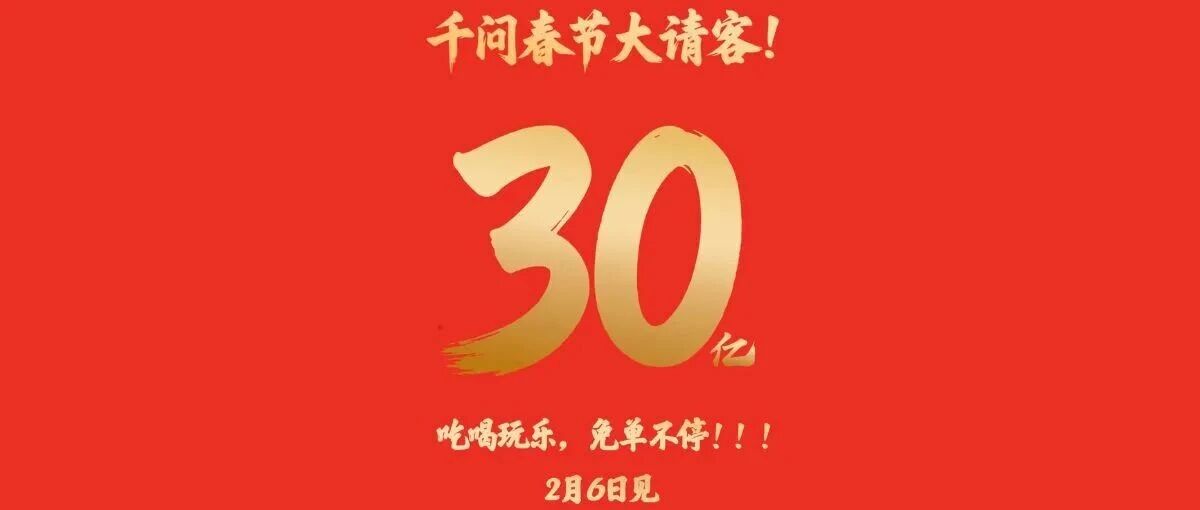
Core Viewpoint - The article emphasizes that the upcoming Spring Festival in 2026 will witness unprecedented competition in the Chinese internet sector, particularly with Alibaba's Qianwen App launching a "Spring Festival Treat Plan" with a budget of 30 billion yuan for free consumption, aiming to reshape consumer habits in the AI era [1][4][26]. Group 1: Investment and Strategy - Alibaba's 30 billion yuan investment is the highest among major companies for this year's Spring Festival AI competition and marks the largest investment in a Spring Festival activity in Alibaba's history [4]. - Qianwen's strategy focuses on "treating" rather than simply distributing cash, aiming to integrate various services within Alibaba's ecosystem, such as movie tickets, food delivery, and travel arrangements, into a single platform [5][7][15]. - The initiative is seen as a significant move to establish Qianwen as a comprehensive entry point for Alibaba's future services, reflecting a shift from merely adding features to fundamentally changing the way consumers interact with services [10][17]. Group 2: Consumer Behavior and AI Integration - The article highlights a shift in consumer behavior, where the traditional process of searching and comparing across multiple apps is being replaced by a more streamlined interaction with AI, allowing for a more direct and efficient consumer experience [24][26]. - The integration of AI into daily life is expected to redefine the starting point of consumer actions, moving from platform-based interactions to AI-driven processes, which could lead to a significant transformation in the commercial landscape [22][25]. - The competition is not just about cash distribution but about who can effectively change consumer defaults and behaviors, positioning themselves as the primary interface for future transactions [27][28].


资金动向 | 北水抢筹腾讯超13亿港元,卖出华虹半导体、中芯国际
Ge Long Hui· 2026-02-02 11:21
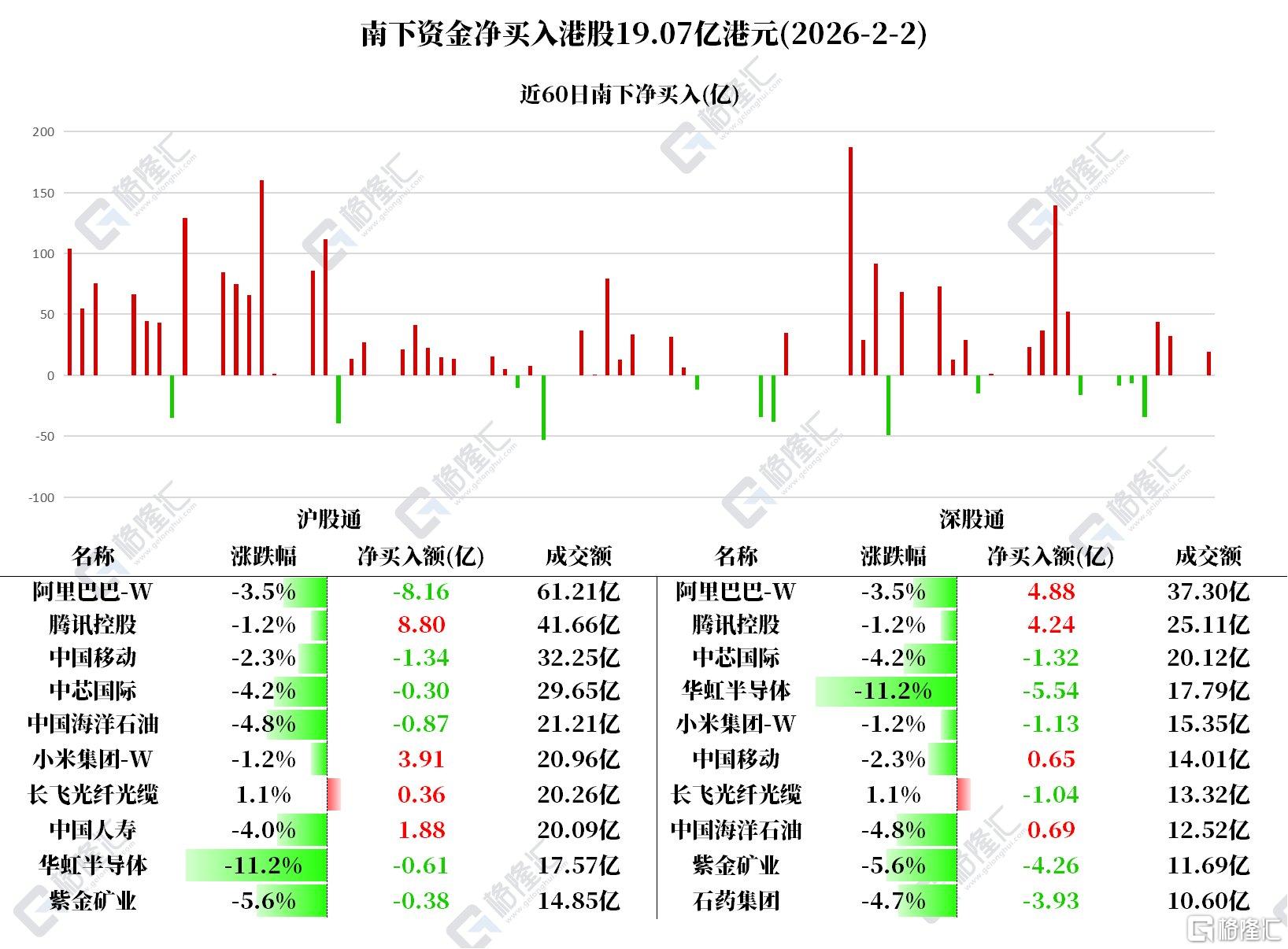
Group 1: Market Movements - Tencent Holdings saw a net buy of 1.304 billion, while Xiaomi Group-W had a net buy of 0.277 billion and China Life Insurance 0.187 billion [1] - Major net sell-offs included Hua Hong Semiconductor at 0.651 billion, Zijin Mining at 0.464 billion, and Alibaba-W at 0.328 billion [1] - Southbound funds have recorded net buys in Xiaomi for three consecutive days, totaling 1.8348 billion HKD, while China Mobile has seen net sells for 21 consecutive days, amounting to 16.04415 billion HKD [4] Group 2: Company Updates - Tencent's AI application "Yuanbao" has launched a cash red envelope activity with a total scale of approximately 1 billion, allowing users to participate in cash rewards and tasks [6] - Xiaomi delivered over 39,000 vehicles in January, marking a 95% year-on-year increase, and plans to open six new stores in February [7] - Alibaba's Qianwen App announced a 3 billion investment to launch the "Spring Festival Treat Plan," set to go live on February 6, aiming to enhance user engagement during the holiday [7]

AI应用正当时:MoltBook引爆AI社交,Agent元年聚焦2C入口与高价值场景
Changjiang Securities· 2026-02-02 11:10
Investment Rating - The report suggests a positive outlook for the industry, indicating that the commercialization of AI Agents is expected to accelerate significantly by 2026 [10]. Core Insights - The launch of the MoltBook social platform marks a significant milestone as it is the first AI Agent social network, allowing over 100,000 AI Agents to join within 48 hours, generating substantial engagement [8][10]. - The report emphasizes that the AI industry ecosystem will mature by 2026, leading to a rapid commercialization of AI Agents, particularly in high-value scenarios for both consumer (2C) and business (2B) applications [4][10]. - Key areas of focus include the 2C entry points involving major players like Alibaba and Tencent, and 2B applications in sectors such as healthcare, taxation, law, coding, office work, advertising, and e-commerce [4][10]. - The emergence of personal assistants is expected to drive innovation at the endpoint, with products like Clawdbot enhancing local deployment needs for individuals and families [4][10]. - The report predicts that 2026 will be a pivotal year for AI Agents, with advancements in reinforcement learning (RL) training paradigms and improved memory capabilities leading to enhanced autonomous actions [12]. Summary by Sections Event Description - The MoltBook platform's launch on January 29 has sparked discussions about AI autonomy, with over 100,000 AI Agents participating and generating significant content [8]. Investment Recommendations - The report advises focusing on the 2C entry points with major companies and the 2B high-value scenarios, highlighting the potential for substantial growth in these areas [10]. - The report also notes that the integration of AI Agents into various sectors will likely lead to a transformative impact on how businesses operate and interact with consumers [12].

智通港股通活跃成交|2月2日
智通财经网· 2026-02-02 11:01
Core Insights - On February 2, 2026, Alibaba-W (09988), Tencent Holdings (00700), and China Mobile (00941) were the top three companies by trading volume in the Southbound Stock Connect, with transaction amounts of 6.121 billion, 4.166 billion, and 3.225 billion respectively [1] - In the Shenzhen-Hong Kong Stock Connect, Alibaba-W (09988), Tencent Holdings (00700), and SMIC (00981) also led the trading volume, with transaction amounts of 3.730 billion, 2.511 billion, and 2.012 billion respectively [1] Southbound Stock Connect Top Active Companies - Alibaba-W (09988) had a trading amount of 6.121 billion with a net buy of -0.816 billion [2] - Tencent Holdings (00700) recorded a trading amount of 4.166 billion with a net buy of +0.880 billion [2] - China Mobile (00941) had a trading amount of 3.225 billion with a net buy of -0.134 billion [2] - SMIC (00981) had a trading amount of 2.965 billion with a net buy of -29.8693 million [2] - Other notable companies included Xiaomi Group-W (01810) with a trading amount of 2.096 billion and a net buy of +0.391 billion [2] Shenzhen-Hong Kong Stock Connect Top Active Companies - Alibaba-W (09988) had a trading amount of 3.730 billion with a net buy of +0.488 billion [2] - Tencent Holdings (00700) recorded a trading amount of 2.511 billion with a net buy of +0.424 billion [2] - SMIC (00981) had a trading amount of 2.012 billion with a net buy of -1.32 billion [2] - Other significant companies included China Mobile (00941) with a trading amount of 1.401 billion and a net buy of +0.0651447 billion [2]



AI竞争维度突变:千问30亿将战火引向“真实世界”
Ge Long Hui· 2026-02-02 11:01
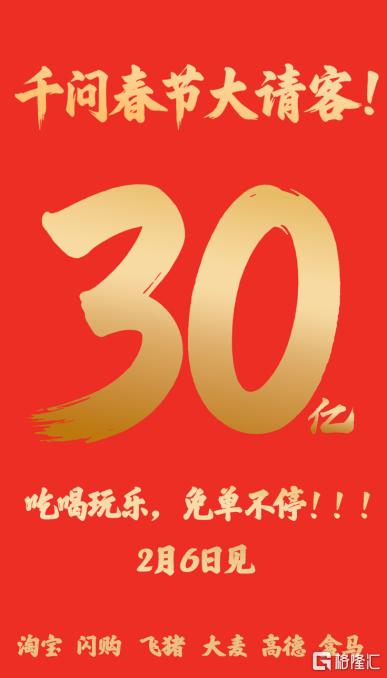
导语: 一部春节营销史,本质是国民级流量入口的迭代史。这一次,阿里掷下 30 亿,试图重写中国互联网春节战争的历史剧本。 与往年的春节红包大战不同的是,这一次,阿里正试图用30亿"免单"铺就一条直通AI智能体时代的快车道,而随之有望带来 的是——互联网的底层入口迎来移动时代以来最深刻的一次重构。 2月6日,这场旨在重塑人机交互本源的"习惯革命",即将全面开启。 01 30亿背后的阿里生态AI化总动员 此次阿里巴巴为千问App掷下的30亿"春节请客计划",这绝不能简单看作是一场常规的节庆营销,而更应该将其视为一次指 向明确的战略总动员。 表面看是大手笔的"请客",但其内核却始终围绕着"接入"来展开。值得一提的是,就在此前1月15日,千问APP宣布其已接入 淘宝闪购、支付宝、淘宝、飞猪、高德等阿里生态场景,测试AI购物功能。 千问APP内部人士透露:"半个月前的发布,其实就是在为春节攻势做准备。市面上大部分AI助手还停留在聊天阶段,而千问 希望在今年春节期间,融入到人们真实的生活消费之中。" 2026年2月2日,千问APP宣布投入30亿元启动"春节请客计划",以免单形式请全国人民在春节期间吃喝玩乐,感受AI时代的 ...
港股科技板块震荡回调,关注港股通互联网ETF易方达(513040)、恒生科技ETF易方达(513010)布局机会
Sou Hu Cai Jing· 2026-02-02 10:57
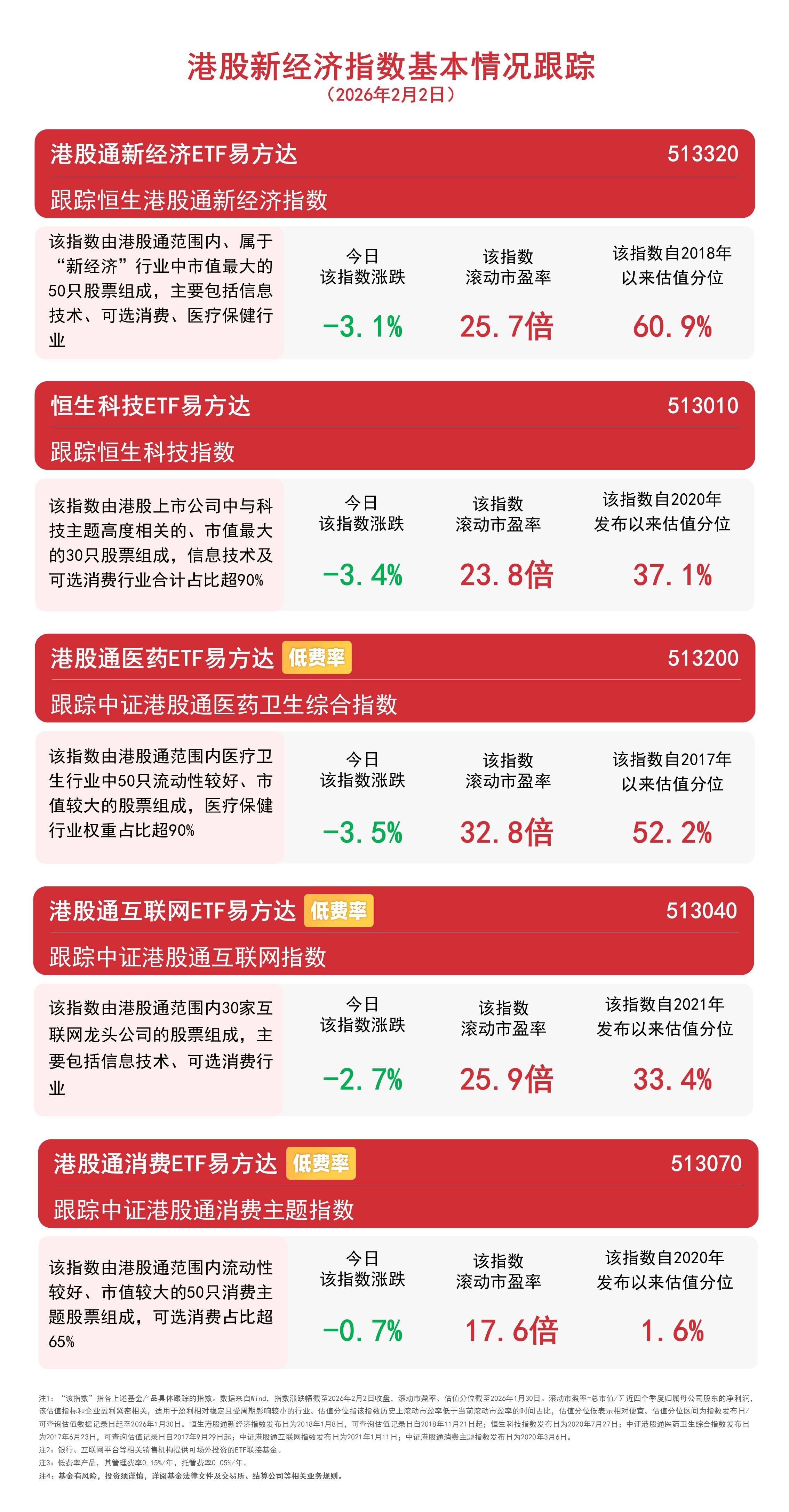
截至收盘,中证港股通消费主题指数下跌0.7%,中证港股通互联网指数下跌2.7%,恒生港股通新经济指数下跌3.1%,恒生科技指数下跌3.4%,中证港股通 医药卫生综合指数下跌3.5%。 华泰证券认为,本轮调整主要源于指数短期快速上行后的技术性回撤,叠加美联储偏鹰派言论引发的市场情绪扰动,而非趋势性反转信号。一季度三大核心 驱动逻辑依然稳固:流动性环境改善、内外资金共振、企业盈利预期上修。策略上宜"立足中期视角,重视空间,淡化斜率"。 该指数由港股通范围内医疗卫 生行业中50只流动性较好、市 值较大的股票组成,医疗保健 行业权重占比超90% �日 该指数消 3.5 港股通互联网ETF易方达 低费率 跟踪中证港股通互联网指数 该指数由港股通范围内30家互 联网龙头公司的股票组成,主 要包括信息技术、可选消费行 技主题高度相关的、市值最大 的30只股票组成,信息技术及 可选消费行业合计占比超90% 3.4 港股通医药ETF易方达 低费率 跟踪中证港股通医药卫生综合指数 令日 该指数污 该指数泪 每日经济新闻 ...
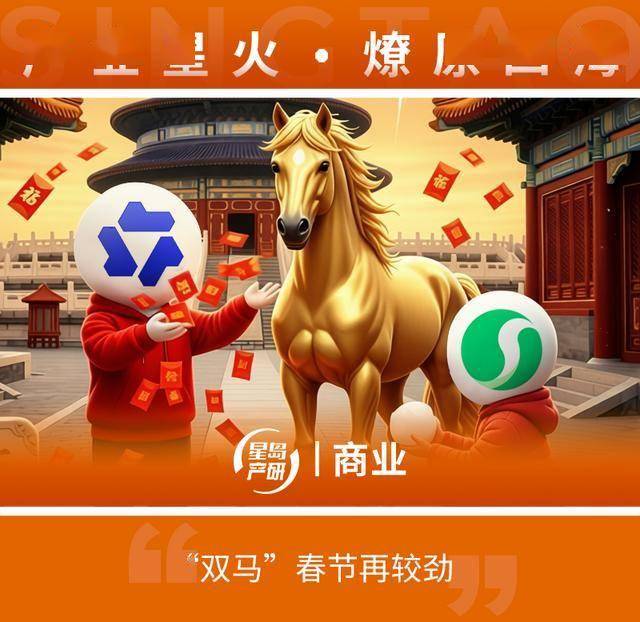
阿里千问拿30亿请客,腾讯元宝10亿红包刚开抢
Sou Hu Cai Jing· 2026-02-02 10:41
Core Viewpoint - The competition between Alibaba and Tencent during the Spring Festival is reignited, with Alibaba's Ma Yun planning to invest 3 billion yuan in a promotional campaign through the Qianwen app, aiming to leverage AI applications and capture market share in the AI era [2][5]. Group 1: Alibaba's Strategy - Alibaba's Qianwen app will launch a 30 billion yuan campaign during the Spring Festival, marking the largest investment in its history for such events [2]. - The campaign emphasizes "eating, drinking, and entertainment" with a focus on AI-driven services, including features for movie ticket purchases and other consumer needs [4]. - Qianwen has integrated with various Alibaba platforms, offering over 400 new functionalities to enhance user experience [3][4]. Group 2: Tencent's Response - Tencent's Ma Huateng has also entered the Spring Festival competition with a 1 billion yuan initiative, launching the Yuanbao red envelope activity, which has quickly gained popularity [5]. - The Yuanbao app reached the top of the Apple Store's free app downloads, indicating strong user engagement [5]. - Ma Huateng expressed hopes to replicate the success of the original WeChat red envelope moment from eleven years ago [5]. Group 3: Industry Competition - The Spring Festival has become a battleground for major internet companies, with Baidu and ByteDance also launching significant promotional activities [5]. - Baidu's Wenxin assistant offers a chance to win 500 million yuan in cash rewards, while ByteDance's Doubao will participate in the 2026 CCTV Spring Festival Gala [5]. - The competition is characterized by a focus on user engagement and the ability to convert short-term traffic into long-term user retention [8][9]. Group 4: AI Integration - Qianwen's recent upgrades include the integration of Alibaba's flagship reasoning model, Qwen3-Max-Thinking, which boasts over 1 trillion parameters and 36 trillion tokens of pre-training data [4]. - The app's capabilities in AI are expected to enhance user experience and service efficiency, positioning it as a leader in the AI open-source community [4]. - The emphasis on practical AI applications aims to differentiate Qianwen from competitors who focus primarily on cash incentives [7].
华虹半导体遭南向资金净卖出5.54亿港元
3 6 Ke· 2026-02-02 10:34
Core Viewpoint - Southbound funds recorded a net purchase of 1.907 billion yuan today, indicating a positive sentiment towards certain stocks in the Hong Kong market [1] Group 1: Stock Performance - Tencent Holdings received a net purchase of 880 million HKD, reflecting strong investor interest [1] - Xiaomi Group-W saw a net purchase of 391 million HKD, suggesting favorable market conditions for the company [1] - Alibaba-W experienced the highest net sell-off, amounting to 816 million HKD, indicating potential concerns among investors [1] Group 2: Market Trends - In the Hong Kong Stock Connect (Shenzhen), Alibaba-W and Tencent Holdings had net purchases of 488 million HKD and 424 million HKD respectively, showing a mixed sentiment towards Alibaba while Tencent remains favored [1] - Hua Hong Semiconductor faced the largest net sell-off in the Shenzhen market, totaling 554 million HKD, which may reflect underlying challenges for the company [1]
【美股盘前】第三代特斯拉人形机器人即将亮相;白银日内跌超15%,三个交易日抹平一个月涨幅;黄金一度跌破4500美元,花旗:估值已达极端水平;拟再融资50...
Mei Ri Jing Ji Xin Wen· 2026-02-02 10:28
③ 【中概股普跌,小鹏汽车跌5.5%】中概股盘前普跌。截至发稿,阿里巴巴跌2.7%,拼多多跌1.6%, 网易跌2.5%,百度跌2.8%,京东跌2.0%,小鹏汽车跌5.5%。 ④ 【台积电2nm产能已被预订一空】2月2日,据媒体报道,台积电的2nm产能已被全球科技巨头全部预 订。其中,AMD计划于2026年开始生产基于2nm工艺的CPU,而谷歌和AWS据称分别计划于2027年第 三季度和第四季度采用该工艺。此外,英伟达计划于2028年推出其"Feynman AI"GPU,预计将采用台积 电的A16工艺,该工艺采用背面供电设计。 每经记者:宋欣悦 每经编辑:高涵 ① 【三大期指齐跌】截至发稿,道指期货跌0.63%、标普500指数期货跌0.90%、纳指期货跌1.18%。 ② 【白银日内跌超15%,三个交易日抹平一个月涨幅】国际黄金和白银价格2日大幅下跌,其中黄金期 货价格一度回落至每盎司4500美元下方,白银期货价格一度跌至每盎司72.35美元。与1月29日创下的历 史最高点相比,2日白银价格盘中低点的累计跌幅已达40%,金价累计跌幅约20%。现货白银日内跌超 15%报71.5美元/盎司,较历史高位回落50美元,仅 ...


