
医药生物

Search documents
万亿资金南下,买了啥?
Shang Hai Zheng Quan Bao· 2025-09-13 06:17
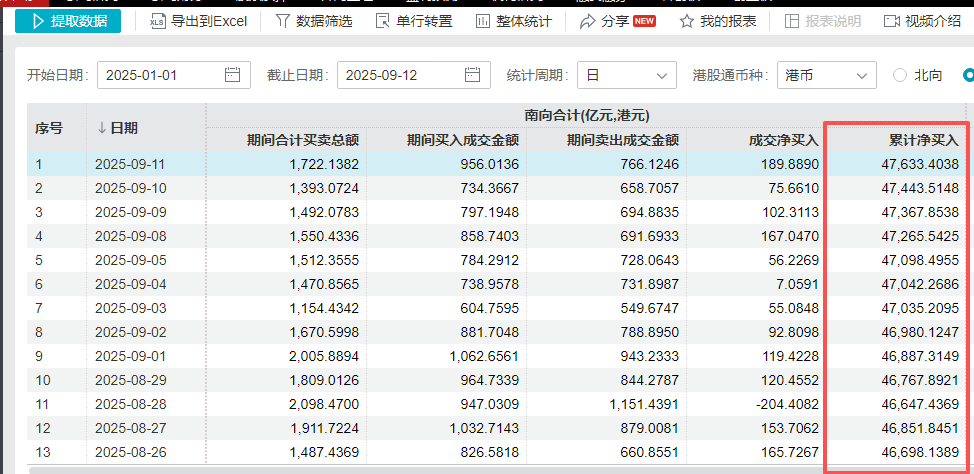
Group 1 - Significant capital inflow into Hong Kong stocks has been observed, with net inflows exceeding 1 trillion HKD this year, more than doubling compared to the same period in 2024 [1][5] - The top three stocks attracting southbound capital this year are Alibaba, Meituan, and China Construction Bank, with Alibaba alone seeing net purchases exceeding 100 billion HKD [1][11] - The sectors receiving the most attention from southbound funds include consumer discretionary retail, banking, non-bank financials, and pharmaceutical biotechnology, with consumer discretionary retail netting 178.29 billion HKD [7][8] Group 2 - Southbound funds have consistently recorded net inflows for nine consecutive trading days in September, with over 30 billion HKD net inflow in the first week of September alone [3][1] - The cumulative net purchase amount of southbound funds since the launch of the mutual market access mechanism has surpassed 4.7 trillion HKD, with the current year's net purchases accounting for 22% of this total [5][1] - Analysts suggest that the revaluation of Chinese assets is ongoing, particularly with the expectation of interest rate cuts by the Federal Reserve, which may lead to a bullish trend in Hong Kong stocks [1][13] Group 3 - The investment focus is expected to remain on sectors such as technology, pharmaceuticals, consumption, and manufacturing, which are considered core assets in China [14][13] - The valuation of Hong Kong stocks is perceived to be attractive, especially as global funds reassess Chinese assets, indicating a high long-term allocation value [14][13] - Companies benefiting from policy support and trends in AI development, as well as undervalued consumer firms expected to improve performance, are highlighted as key investment opportunities [14][13]

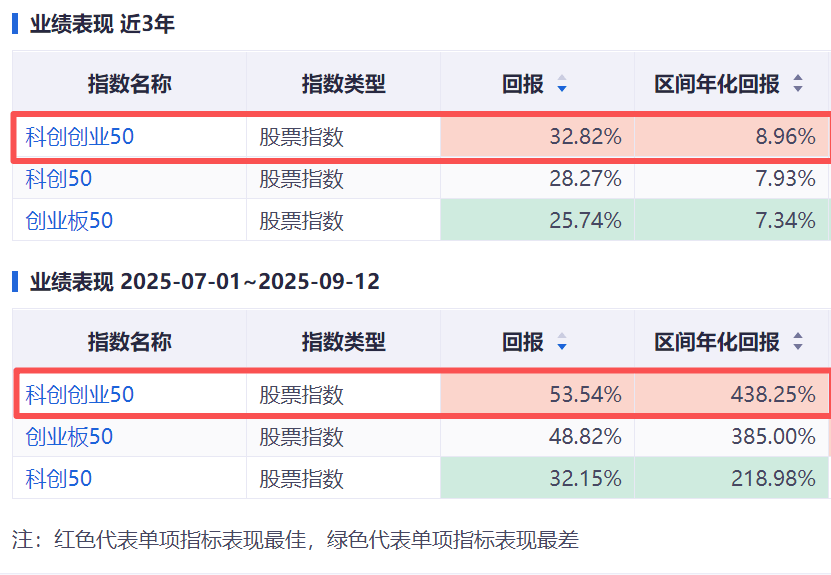
北京辖区上市公司2025年半年度经营业绩分析报告
Zheng Quan Ri Bao· 2025-09-12 15:44
Core Insights - Beijing-listed companies demonstrated resilience and strong performance in the first half of 2025, contributing significantly to the overall economic development of the region [1][2]. Financial Performance - In the first half of 2025, Beijing-listed companies generated total revenue of 12.5 trillion yuan, accounting for 35.79% of total A-share market revenue, and net profit of 1.45 trillion yuan, representing 45.23% of total A-share net profit [2]. - The net cash flow from operating activities reached 4.54 trillion yuan, making up 61.24% of the total cash flow from operations in the A-share market [2]. - A total of 167 companies achieved both revenue and profit growth, including 52 central enterprise-controlled companies, 17 local state-owned companies, and 89 private companies, highlighting a dual growth pattern of state-owned and private enterprises [2]. Sector Contributions - The financial sector, comprising 21 A-share banks and non-bank financial companies, reported total revenue of 2.71 trillion yuan and net profit of 867.6 billion yuan, representing 59.07% and 59.85% of the total for A-share financial companies, respectively [3]. - Central enterprise-controlled companies accounted for 91.02% of total revenue and 94.51% of total net profit among Beijing-listed companies, with 135 such companies contributing significantly to overall performance [4]. Emerging Industries - New quality productivity sectors showed remarkable growth, with the automotive industry revenue increasing by 44.07%, electrical equipment by 32.07%, and defense industry by 28.30% [7]. - Private enterprises played a crucial role in this growth, with 73.53% of companies reporting over 50% revenue growth being private [8]. R&D Investment - Total R&D investment by Beijing-listed companies reached 188.9 billion yuan, accounting for 23.70% of the total market, with state-owned enterprises contributing 78.27% of this amount [9][10]. - The leading sectors in R&D investment included construction decoration (65.98 billion yuan), communications (24.31 billion yuan), and computing (18.86 billion yuan) [10]. Market Capitalization - As of August 31, 2025, the total market capitalization of Beijing-listed companies was 23.07 trillion yuan, representing 22.18% of the total market, with a year-on-year increase of 12.16% [11]. - There are four companies with a market capitalization exceeding one trillion yuan, including Agricultural Bank (2.24 trillion yuan) and Industrial and Commercial Bank (2 trillion yuan) [11]. Shareholder Returns - Nearly 100 listed companies in Beijing have established dividend plans for over three years, with more than 50 companies disclosing interim dividend plans [12].
73股股东户数连降 筹码持续集中
Zheng Quan Shi Bao Wang· 2025-09-12 13:19
Core Insights - The article highlights a trend of decreasing shareholder accounts among 452 companies, indicating a concentration of shares, with some companies experiencing declines for over three consecutive periods [1][2]. Group 1: Shareholder Account Trends - 73 companies have reported a continuous decrease in shareholder accounts for more than three periods, with the most significant decline being 12 periods for ST Huawen, which saw a cumulative decrease of 14.42% [1]. - ST Jinglun has also shown a continuous decline for 11 periods, with a total decrease of 36.88% in shareholder accounts [1]. - Other companies with notable declines include Guotou Fengle, Ruida Futures, and Hahai Huaton, indicating a broader trend in the market [1]. Group 2: Market Performance - Among the companies with decreasing shareholder accounts, 25 have seen their stock prices rise, while 48 have experienced declines, with notable increases for ST Qingyan (34.32%), ST Jinglun (31.46%), and Changshan Pharmaceutical (18.56%) [2]. - 11 companies outperformed the Shanghai Composite Index during this period, with ST Qingyan, ST Jinglun, and Changshan Pharmaceutical showing relative returns of 24.04%, 16.96%, and 10.24%, respectively [2]. Group 3: Industry and Sector Analysis - The industries with the highest concentration of companies experiencing declining shareholder accounts include machinery equipment (16 companies), basic chemicals (7 companies), and pharmaceutical biology (6 companies) [2]. - The distribution of these companies is primarily in the main board (37 companies) and the ChiNext board (36 companies) [2]. Group 4: Institutional Interest - In the past month, 11 companies with decreasing shareholder accounts have been subject to institutional research, with notable frequency for companies like Tengya Precision and Haide Control, receiving 3 and 2 institutional inquiries, respectively [2]. - The companies with the highest number of institutional participants include AVIC Optoelectronics (72 institutions), Guilin Sanjin (21 institutions), and Minexplosion Optoelectronics (16 institutions) [2].
56股今日获机构买入评级 11股上涨空间超10%
Zheng Quan Shi Bao Wang· 2025-09-12 13:15
Group 1 - A total of 56 stocks received buy ratings from institutions today, with 57 buy rating records published [1] - Luzhou Laojiao received the highest attention, with two buy rating records [1] - Among the stocks rated, 11 have an upside potential exceeding 10%, with Mango Super Media having the highest potential at 40.02% [1] Group 2 - Seven stocks received their first institutional attention today, including Haoyue Nursing and Hebei Steel Resources [1] - The average increase for stocks with buy ratings today was 0.42%, outperforming the Shanghai Composite Index [1] - The pharmaceutical and biotechnology sector was the most favored, with 11 stocks listed in the buy rating list [1] Group 3 - Notable stocks with significant upside potential include Jinpai Home and Taihe New Materials, with potential increases of 27.75% and 23.89% respectively [1] - The power equipment and basic chemicals sectors also attracted institutional interest, each with five stocks listed [1]
科创板百元股达66只,寒武纪-U股价最高
Zheng Quan Shi Bao Wang· 2025-09-12 13:05
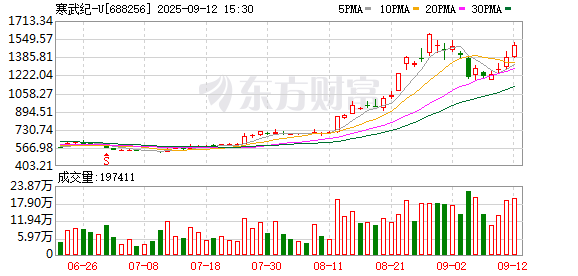
Core Insights - The average stock price on the STAR Market is 40.18 yuan, with 66 stocks priced over 100 yuan, and the highest priced stock is Cambrian-U at 1488.00 yuan, which increased by 7.28% [2][3]. Stock Performance - On the STAR Market, 253 stocks rose while 327 stocks fell today. Among the stocks priced over 100 yuan, the average increase was 1.09%, with 34 stocks rising and 32 stocks declining [2][3]. - Cambrian-U leads with a closing price of 1488.00 yuan, followed by Maolai Optics at 408.30 yuan and Yuanjie Technology at 373.71 yuan [2][3][4]. Premium Analysis - The average premium of stocks priced over 100 yuan relative to their issue price is 390.70%, with Cambrian-U, Baile Tianheng, and Anji Technology showing premiums of 2210.92%, 1316.15%, and 1314.30% respectively [2][3]. Industry Distribution - The stocks priced over 100 yuan are concentrated in the electronics, pharmaceutical, and computer industries, with 30, 13, and 9 stocks respectively [2][3]. Capital Flow - There was a net outflow of 1.259 billion yuan from stocks priced over 100 yuan today, with significant inflows into Chipone Technology, Cambrian-U, and Aojie Technology [3]. - The total margin financing balance for stocks priced over 100 yuan is 80.419 billion yuan, with Cambrian-U, SMIC, and Haiguang Information having the highest financing balances [3][4].

只有小孩才做选择,这一指数竟能涵盖当下四大景气赛道!
Sou Hu Cai Jing· 2025-09-12 12:35
Group 1 - The current market trend is characterized by a strong institutional focus on various sectors, including pharmaceuticals, technology, and new energy, leading to increased volatility and the risk of missing investment opportunities [1][6] - The China Securities Innovation and Entrepreneurship 50 Index (CSI 50) encompasses four major thriving sectors, providing a comprehensive representation of emerging industries [2][6] - The CSI 50 index has shown superior performance, with a return rate exceeding 50% since July, outperforming both the ChiNext 50 and the Science and Technology 50 indices [3][5] Group 2 - The CSI 50 index has a year-to-date return of 53.54%, significantly higher than the ChiNext 50's 48.82% and the Science and Technology 50's 32.15% [5] - The index's balanced industry distribution across AI, energy storage, domestic chips, and biomedicine contributes to its high success rate in the current market [6][7] - The index's ETFs, such as E Fund and Huaxia, have become popular due to their strong performance and low management fees, with E Fund's ETF achieving a return rate of nearly 109% in the past year [8][9] Group 3 - The enhanced strategy ETF from GF Fund has demonstrated notable excess returns of 1.52% and 4.48% over one and three years, respectively, showcasing effective market judgment [11][13] - The CSI 50 ETF's cross-market allocation allows it to benefit from the differentiated advantages of both the Science and Technology Board and the ChiNext, aligning with the trend of technological innovation [13]
科创板系列指数震荡上行,科创板50ETF(588080)、科创综指ETF易方达(589800)等助力分享科创红利
Sou Hu Cai Jing· 2025-09-12 11:58
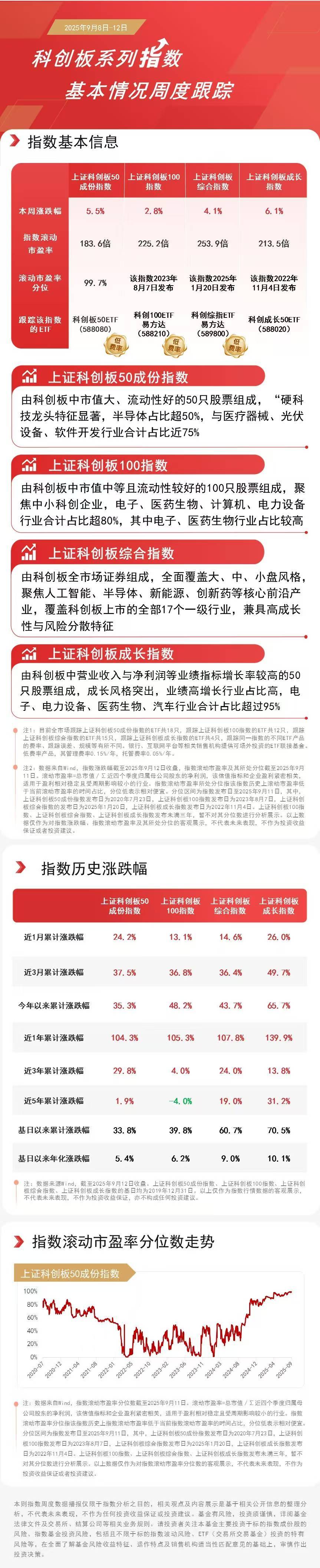
Core Insights - The Shanghai Stock Exchange Science and Technology Innovation Board (STAR Market) indices have shown significant growth, with the STAR Growth Index rising by 6.1%, the STAR 50 Index by 5.5%, the STAR Composite Index by 4.1%, and the STAR 100 Index by 2.8% this week [1][3]. Index Performance - The STAR 50 Index has a rolling price-to-earnings (P/E) ratio of 183.6 times, while the STAR 100 Index stands at 225.2 times, the STAR Composite Index at 253.9 times, and the STAR Growth Index at 213.5 times [3]. - The STAR 50 ETF (588080) has the lowest annualized tracking error of 0.22% among similar ETFs over the past year [1]. Sector Focus - The STAR 100 Index comprises 100 medium-sized stocks with good liquidity, focusing on small and medium-sized innovative enterprises, with over 80% of its composition in the electronics, biopharmaceuticals, computers, and electrical equipment sectors [5]. - The STAR Composite Index covers all market securities, focusing on core industries such as artificial intelligence, semiconductors, new energy, and innovative pharmaceuticals, encompassing all 17 primary industries listed on the STAR Market [5]. - The STAR Growth Index consists of 50 stocks with high growth rates in revenue and net profit, with over 95% of its composition in the electronics, electrical equipment, biopharmaceuticals, and automotive sectors [5]. Historical Performance - Over the past month, the STAR Growth Index has increased by 26.0%, while the STAR 50 Index has risen by 24.2%, the STAR Composite Index by 14.6%, and the STAR 100 Index by 13.1% [7]. - Year-to-date, the STAR Growth Index has surged by 65.7%, compared to 35.3% for the STAR 50 Index, 48.2% for the STAR 100 Index, and 43.7% for the STAR Composite Index [7]. - In the past year, the STAR Growth Index has shown a cumulative increase of 139.9%, while the STAR 50 Index and STAR 100 Index have increased by 104.3% and 105.3%, respectively [7].
创业板指自4月低点大涨64%,仅两成个股跑赢,10倍股仅此一只
Feng Huang Wang· 2025-09-12 11:27
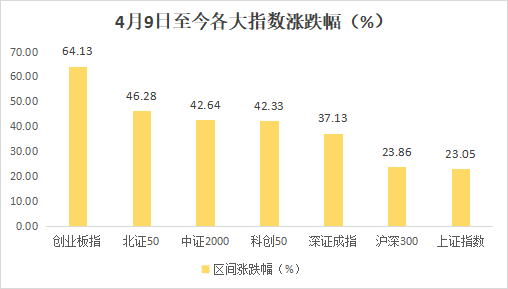
Group 1 - The major indices have reached new highs for the year, with the ChiNext Index showing the strongest performance, up 64.13% since the low on April 9 [1] - Other indices such as the North Securities 50, CSI 2000, and Sci-Tech 50 have also seen significant increases of 46.28%, 42.64%, and 42.33% respectively, indicating a strong growth style and small-cap performance [1] Group 2 - Among over 5,500 stocks in the market, only 1,029 have outperformed the ChiNext Index, which is less than one-fifth of the total [2] - The top-performing stock, Shangwei New Materials, has achieved a staggering increase of 1,294.93%, being the only stock to reach a tenfold increase since April 9 [2] - There are four stocks with over 500% gains, 73 stocks with over 200% gains, and 398 stocks with over 100% gains during the same period [2] Group 3 - The high-performing stocks are primarily concentrated in industries such as machinery, electronics, power equipment, and pharmaceutical biology [3]

数据复盘丨有色金属、房地产等行业走强 龙虎榜机构抢筹10股
Zheng Quan Shi Bao Wang· 2025-09-12 10:21
Market Overview - On September 12, the Shanghai Composite Index closed at 3870.60 points, down 0.12%, with a trading volume of 10,938 billion yuan [2] - The Shenzhen Component Index closed at 12,924.13 points, down 0.43%, with a trading volume of 14,271.18 billion yuan [2] - The ChiNext Index closed at 3020.42 points, down 1.09%, with a trading volume of 6,803.15 billion yuan [2] - The total trading volume of both markets was 25,209.18 billion yuan, an increase of 831.93 billion yuan compared to the previous trading day [2] Industry Performance - Strong performance was observed in sectors such as non-ferrous metals, real estate, steel, electronics, construction decoration, and pharmaceutical biology [4] - The non-ferrous metals sector saw the highest net inflow of funds, amounting to 15.99 billion yuan [5] - Other sectors with significant net inflows included pharmaceutical biology (5.65 billion yuan), textiles and apparel (3.44 billion yuan), and real estate (3.24 billion yuan) [5] - Conversely, sectors such as electronics, computing, and communication experienced the largest net outflows, with electronics seeing a net outflow of 77.16 billion yuan [5] Stock Performance - A total of 1,865 stocks rose while 3,161 stocks fell, with 74 stocks hitting the daily limit up and 8 stocks hitting the limit down [4] - *ST Weir achieved the highest consecutive limit-up days at 6, followed by *ST Asia Pacific with 5 consecutive limit-ups [4] - 67 stocks received net inflows exceeding 1 billion yuan, with Shanzi Gaoke leading at 11.05 billion yuan [8] - Conversely, 143 stocks experienced net outflows exceeding 1 billion yuan, with Luxshare Precision seeing the highest outflow at 25.1 billion yuan [10] Institutional Activity - Institutional funds had a net outflow of approximately 8.86 billion yuan, with 10 stocks seeing net purchases and 11 stocks seeing net sales [11] - The stock with the highest net purchase by institutions was Shanzi Gaoke, with a net inflow of about 1.23 billion yuan [11] - The stock with the highest net sale was Chip Original, with a net outflow of approximately 8.98 billion yuan [11]




目瞪口呆!股价一天暴涨120%
Zhong Guo Ji Jin Bao· 2025-09-12 08:24
Market Overview - A-shares experienced slight adjustments with the Shanghai Composite Index closing down 0.12%, the Shenzhen Component down 0.43%, and the ChiNext down 1.09% [2] - A total of 1,926 stocks rose while 3,373 stocks fell, with 74 stocks hitting the daily limit up [3][4] - The total trading volume reached 25,483.12 billion, with a total of 2429 varieties traded [4] Sector Performance - The storage chip sector saw significant gains, with companies like Jingzhida and Demingli hitting the daily limit up. Micron announced a price increase of 20% to 30% for storage products [5] - The computing chip leader, Cambrian, briefly rose over 9%, surpassing 1,520 yuan, reclaiming the title of "stock king" from Kweichow Moutai [7] - The non-ferrous metals sector also performed well, with companies like Northern Copper and Shengda Resources hitting the daily limit up [7] Real Estate and Financial Sector - Real estate stocks saw a midday surge, with Rongsheng Development and Huaxia Happiness hitting the daily limit up [9] - Financial stocks, including banks and brokerages, generally declined, with Shanghai Pudong Development Bank dropping over 3% [11][12] Hong Kong Market - The Hong Kong market experienced a significant rise, with major indices increasing by over 1% [13] - Alibaba's stock rose over 5% due to reports of using self-developed chips for AI model training, and the launch of its next-generation model architecture [14] - Evergrande Property surged over 23% amid news of potential interest from bidders [14] - Yaojie Ankang-B's stock price skyrocketed over 120% following the announcement of clinical trial approval for its core product [14]
