
互联网电商

Search documents
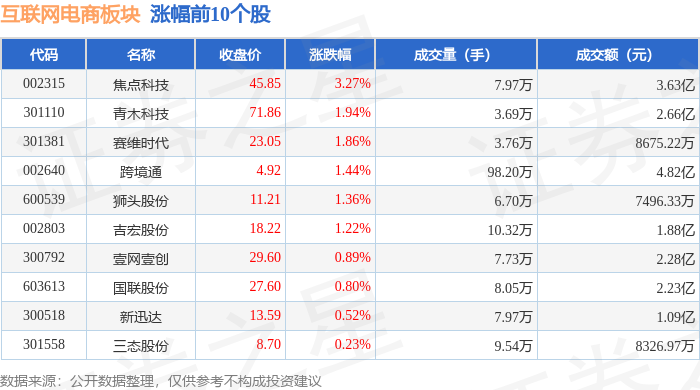
互联网电商板块10月24日涨0.59%,焦点科技领涨,主力资金净流出928.58万元
Zheng Xing Xing Ye Ri Bao· 2025-10-24 08:27
Core Insights - The internet e-commerce sector experienced a rise of 0.59% on October 24, with JiaoDian Technology leading the gains [1] - The Shanghai Composite Index closed at 3950.31, up 0.71%, while the Shenzhen Component Index closed at 13289.18, up 2.02% [1] Summary by Category Stock Performance - JiaoDian Technology (002315) closed at 45.85, up 3.27% with a trading volume of 79,700 shares and a transaction value of 363 million yuan [1] - Other notable performers included: - QingMu Technology (301110) at 71.86, up 1.94% [1] - SaiWei Times (301381) at 23.05, up 1.86% [1] - KuaJingTong (002640) at 4.92, up 1.44% [1] - ShiTou Co., Ltd. (600539) at 11.21, up 1.36% [1] Market Capital Flow - The internet e-commerce sector saw a net outflow of 9.29 million yuan from institutional funds, while retail investors contributed a net inflow of 50.61 million yuan [2] - The overall market sentiment indicated a mixed response, with some stocks experiencing declines, such as LiangHui Co., Ltd. (300464) down 2.16% [2]


消费市场规模稳步扩大,经济增长主引擎作用明显,聚焦港股消费ETF(513230)布局机遇
Mei Ri Jing Ji Xin Wen· 2025-10-24 03:00
Group 1 - The core viewpoint of the articles highlights the active performance of new consumption concept stocks in the Hong Kong market, with a notable increase in the overall consumption market size and its significant contribution to economic growth [1][2] - The total retail sales of consumer goods in China reached 32.4 trillion yuan from January to August this year, showing a year-on-year growth of 4.6%, which is an increase of 1.1 percentage points compared to the entire last year [1] - The contribution rate of final consumption expenditure to GDP growth in the first half of the year was 52%, an increase of 7.5 percentage points compared to the previous year [1] Group 2 - The Hong Kong Consumption ETF (513230) tracks the CSI Hong Kong Stock Connect Consumption Theme Index, encompassing leading companies in both new consumption and internet e-commerce sectors, including brands like Pop Mart, Lao Pu Gold, and Miniso [2] - The ETF features a diverse range of stocks across various consumption fields, highlighting the prominent technology and consumption attributes of the included companies [2]

机构称IP产业方兴未艾,聚焦港股消费ETF(513230)布局机遇
Mei Ri Jing Ji Xin Wen· 2025-10-23 07:31
Group 1 - The Hong Kong stock market showed a mixed performance with the Hang Seng Technology Index dropping by 1.8% at one point but closing down only 0.81% at midday, while the Hang Seng Index and the National Enterprises Index fell by 0.09% and 0.18% respectively [1] - Major technology stocks exhibited weak performance, and new consumption concept stocks generally declined, with the Hong Kong Consumption ETF (513230) experiencing a slight drop [1] - Shanghai's consumer market showed signs of recovery, with the total retail sales of consumer goods reaching 12,302.77 billion yuan in the first three quarters of the year, reflecting a year-on-year growth of 4.3%, which is an increase of 2.6 percentage points compared to the first half of the year [1] Group 2 - Huajin Securities noted that the macroeconomic environment is shifting, with economic growth slowing and increased competition leading to a policy focus on both "safety and development" [2] - The latest planning from higher authorities may emphasize expanding domestic demand and achieving technological self-reliance, driven by ongoing trade frictions and pressures on exports [2] - The Hong Kong Consumption ETF (513230) tracks the CSI Hong Kong Stock Connect Consumption Theme Index, encompassing leading companies in both new consumption and internet e-commerce sectors, highlighting a strong technology and consumption attribute [2] Group 3 - Pop Mart announced its Q3 performance on October 21, reporting an expected revenue growth of 245%-250% for the third quarter of 2025 compared to the same period in 2024, with domestic revenue increasing by 185%-190% and overseas revenue by 365%-370% [1] - Institutions believe that the IP industry is thriving, and Pop Mart, as a leader in trendy toys, is expected to demonstrate significant growth potential in the short, medium, and long term [1]
年内提振消费政策措施持续落地,消费新业态、新场景不断拓展,消费潜力持续释放
Mei Ri Jing Ji Xin Wen· 2025-10-23 05:49
Group 1 - The core viewpoint of the news highlights that Pop Mart's latest performance report shows a year-on-year revenue growth rate of 245%-250% in the third quarter, with overseas markets being a key growth driver and strong performance in the domestic market [1] - According to the National Bureau of Statistics, the total retail sales of consumer goods in the first three quarters of 2025 increased by 4.5% year-on-year, accelerating by 1.2 percentage points compared to the same period last year and by 1 percentage point compared to the entire previous year [1] - Analysts suggest that there is a "high cut low" allocation demand in the market, with the consumer sector attracting new capital attention as it is seen as a valuation low point [1] Group 2 - The Hong Kong Stock Consumer ETF (513230) tracks the CSI Hong Kong Stock Connect Consumer Theme Index, packaging leading internet e-commerce companies and new consumption, covering various fields in Hong Kong's consumer sector [2] - The ETF includes new consumption leaders such as Pop Mart, Lao Pu Gold, and Miniso, as well as internet e-commerce giants like Tencent, Kuaishou, Alibaba, and Xiaomi, highlighting the prominent technology and consumption attributes [2]
泡泡玛特第三季度业绩发布:整体收益同比增长245%至250%,聚焦港股消费ETF(513230)布局机遇
Mei Ri Jing Ji Xin Wen· 2025-10-22 02:45
Core Viewpoint - The Hong Kong stock market experienced a collective decline, with the Hang Seng Index falling 0.5% to below 26,000 points, while large tech stocks faced a downturn. However, innovative drug and new consumption sectors showed strength, indicating mixed market dynamics [1]. Group 1: Market Performance - The Hang Seng Index dropped 0.5%, and the Hang Seng Tech Index fell by 0.82% [1] - Major tech stocks declined across the board, while innovative drug stocks and new consumption stocks mostly rose [1] - The Hong Kong consumption ETF (513230) saw a slight decline, with holdings like Pop Mart rising over 6% [1] Group 2: Company Performance - Pop Mart, referred to as "the Moutai for young people," reported a 245% to 250% year-on-year increase in overall revenue for Q3 2025 [1] - Specifically, Pop Mart's revenue in China grew by 185% to 190%, with offline channels increasing by 130% to 135% and online channels surging by 300% to 305% [1] - The overseas market for Pop Mart experienced a remarkable growth rate of 365% to 370% year-on-year [1] Group 3: Future Outlook - Guotai Junan Securities maintains a bullish outlook for the Hong Kong stock market in Q4, suggesting that short-term fluctuations will not alter the overall bullish trend [1] - The potential return of foreign capital due to the Federal Reserve's interest rate cuts could exceed expectations, further supporting the market [1] - Continued inflow of southbound funds is anticipated, which may drive the Hong Kong market upward [1] Group 4: ETF Composition - The Hong Kong consumption ETF (513230) tracks the CSI Hong Kong Stock Connect Consumption Theme Index, encompassing leading companies in both internet e-commerce and new consumption sectors [2] - The ETF includes major players like Pop Mart, Lao Pu Gold, Miniso, Tencent, Kuaishou, Alibaba, and Xiaomi, highlighting its strong tech and consumption attributes [2]
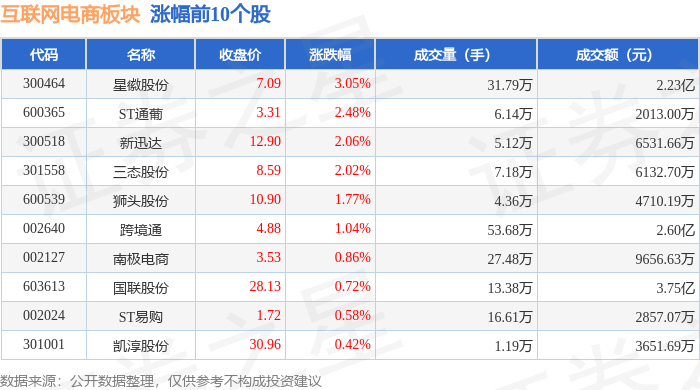
互联网电商板块10月21日跌0.1%,壹网壹创领跌,主力资金净流出1109.48万元
Zheng Xing Xing Ye Ri Bao· 2025-10-21 08:29
Core Viewpoint - The internet e-commerce sector experienced a slight decline of 0.1% on October 21, with 壹网壹创 leading the drop, while the overall market indices showed positive performance with the Shanghai Composite Index rising by 1.36% and the Shenzhen Component Index increasing by 2.06% [1][2]. Market Performance - The closing prices and percentage changes of notable stocks in the internet e-commerce sector are as follows: - 星徽股份: 7.09, +3.05% - ST通葡: 3.31, +2.48% - 新迅达: 12.90, +2.06% - 三态股份: 8.59, +2.02% - 狮头股份: 10.90, +1.77% - 跨境通: 4.88, +1.04% - 南极电商: 3.53, +0.86% - 国联股份: 28.13, +0.72% - ST易购: 1.72, +0.58% - 凯淳股份: 30.96, +0.42% [1]. Capital Flow - On the same day, the internet e-commerce sector saw a net outflow of 11.09 million yuan from institutional investors, while retail investors contributed a net inflow of 5.33 million yuan [2][3]. - The capital flow for specific stocks indicates: - 跨境通: 18.58 million net inflow from institutions, -16.55 million from retail - 青木科技: 16.08 million net inflow from institutions, -1.34 million from retail - ST易购: 6.62 million net inflow from institutions, -1.37 million from retail [3].

分红能力盘点:消费服务篇:自由现金流资产系列15
Huachuang Securities· 2025-10-21 01:13
Group 1: Stable Cash Flow Assets - Pharmaceutical commerce has a cash flow ratio of 55% in Q2 2025, indicating a stable cash flow generation capacity since 2021[11] - The hotel and catering industry shows a cash flow ratio of 49% in Q2 2025, with an average cash flow ratio of 50% from 2016 to 2024[18] - General retail has a cash flow ratio of 49% in Q2 2025, supported by reduced capital expenditures and inventory depletion[25] - Telecom operators maintain a cash flow ratio of 39% in Q2 2025, benefiting from stable demand and high user retention[32] Group 2: Improving Cash Flow Assets - The trade sector exhibits a cash flow ratio of 63% in Q2 2025, significantly improved due to reduced capital expenditures and inventory shrinkage[41] - The potential shareholder return rate for the trade sector is 7.1%, while the actual return is only 1.9%, indicating substantial room for dividend release[44] Group 3: Assets Under Pressure - The tourism and scenic area sector has a cash flow ratio of 21% in Q2 2025, with profitability still below pre-pandemic levels[51] - Professional services show a cash flow ratio of 13% in Q2 2025, with a significant decline in profitability due to weak demand[55] - Medical services have a cash flow ratio of 25% in Q2 2025, with profitability under pressure and limited dividend release potential[61] - The education sector has a cash flow ratio of 52% in Q2 2025, but profitability remains constrained post-regulatory changes[67] Group 4: High Expenditure Assets - The automotive services and IT services sectors are still in a high expenditure phase, with capital expenditures exceeding 1.5 in Q2 2025, indicating a new cycle of high spending driven by technological advancements[3]
今年以来南向资金净流入额已超1.1万亿元,聚焦港股消费ETF(513230)布局机遇
Sou Hu Cai Jing· 2025-10-20 06:12
Group 1 - The core viewpoint is that the Hong Kong stock market is experiencing a recovery, with significant inflows from southbound funds and a positive outlook for the fourth quarter [1][2] - The Hang Seng Technology Index rose by 3.21%, while the Hang Seng Index and the National Enterprises Index increased by 2.41% and 2.46%, respectively, with the Hang Seng Index gaining over 600 points to reach 25,855 points [1] - Southbound funds have seen a net inflow exceeding 1.1 trillion yuan this year, marking the highest level for the same period in history, indicating strong interest in the Hong Kong stock market [1] Group 2 - Cathay Pacific Securities believes that the bullish trend in the Hong Kong stock market will continue in the fourth quarter, driven by the benefits of AI narratives for internet giants and the potential return of foreign capital due to the Federal Reserve's interest rate cuts [2] - The Hong Kong Consumption ETF (513230) tracks the CSI Hong Kong Stock Connect Consumption Theme Index, encompassing leading companies in both internet e-commerce and new consumption sectors, highlighting a strong tech and consumption attribute [2]




浙商早知道-20251020
ZHESHANG SECURITIES· 2025-10-19 23:30
Group 1: Key Recommendations - The report highlights the strong growth potential of the company "October Rice Field" (09676) in the health food sector, driven by the launch of new products and expansion into high-potential sales channels [6] - The company has exceeded expectations in both new product sales and channel expansion, with corn products emerging as a significant growth driver alongside rice products [6] - Revenue projections for "October Rice Field" are estimated at 6.951 billion, 8.371 billion, and 9.884 billion yuan for 2025-2027, reflecting year-on-year growth rates of 21%, 20%, and 18% respectively [6] Group 2: Industry Insights - The mechanical equipment sector is experiencing a cyclical reversal and growth, emphasizing the importance of self-sufficiency and domestic substitution due to trade tensions [8] - The report suggests that the military industry is poised for growth, with increased domestic demand and potential for foreign trade expansion leading to a revaluation of the sector [10] - The telecommunications industry is expected to maintain steady growth, with significant opportunities arising from advancements in computing power and satellite internet technologies [10][11] Group 3: Investment Opportunities - The report identifies generative recommendation technology as a key area for investment, with major internet companies exploring its potential to enhance business outcomes [11] - Companies that successfully implement generative recommendation technology are expected to achieve substantial commercial value, surpassing industry averages [11] - Catalysts for growth in this area include improved advertising conversion rates and successful implementation by leading internet firms [11]
京东集团-SW(09618):核心零售利润亮眼,外卖UE持续改善:——京东集团-SW(9618.HK)2025Q3业绩前瞻
Guohai Securities· 2025-10-17 10:51
Investment Rating - The report maintains a "Buy" rating for JD Group-SW (9618.HK) [1][8] Core Insights - JD Group is expected to achieve total revenue of 295.9 billion yuan in Q3 2025, representing a year-over-year growth of 13.6%. Product revenue is projected at 224.8 billion yuan (YoY +9.9%), while service revenue is expected to reach 71.1 billion yuan (YoY +27.5%) [4][7] - The report anticipates a Non-GAAP net profit of 4.3 billion yuan for Q3 2025, a significant decrease of 68% year-over-year, with a Non-GAAP net profit margin dropping by 3.6 percentage points to 1.4% [4][7] - JD Retail's revenue is projected to grow by 10% year-over-year to 247.9 billion yuan, with a core GMV growth of 10% and an operating profit margin increase of 0.3 percentage points to 5.5% [4][7] - The logistics segment is expected to see revenue growth of 11% year-over-year, reaching 49.3 billion yuan, benefiting from the overall growth of the express delivery market [4][7] Financial Forecasts - For 2025-2027, the revenue forecasts are adjusted to 1,325.3 billion yuan, 1,420.0 billion yuan, and 1,512.8 billion yuan respectively. The corresponding net profits are projected at 22.0 billion yuan, 37.7 billion yuan, and 51.5 billion yuan [7][8] - The report estimates a diluted EPS of 7.31 yuan for 2025, increasing to 16.93 yuan by 2027 [6][8] - The target market capitalization for JD Group in 2026 is set at 565.2 billion yuan, corresponding to a target price of 177 yuan per share [7][8]
