农业科技

Search documents
一起为梦想奋斗、为幸福打拼
Ren Min Ri Bao· 2025-12-31 23:45
Group 1: Agricultural Development - China's grain production increased from 13,657 billion jin in 2021 to 14,297.5 billion jin in 2025 during the "14th Five-Year Plan" period, highlighting the significant contributions of farmers [2] - The collaboration between China Agricultural University and Hebei Quzhou County aims to achieve an annual yield of over 1.5 tons per mu for winter wheat and summer corn through the "Green Ton Half Grain" initiative [2] - The successful yield measurement in October showed a total yield of 1,557.4 kg per mu for winter wheat and summer corn in a demonstration area [2] Group 2: Military and Defense - The first electromagnetic catapult aircraft carrier, Fujian, was officially commissioned, marking a significant milestone for the Chinese Navy [4] - The personnel involved in the Fujian aircraft carrier expressed a strong sense of responsibility and commitment to enhancing naval capabilities [4] Group 3: Technology and Innovation - The founder of Yushu Technology emphasized the importance of technological innovation in the robotics industry, particularly in humanoid robots, as highlighted by President Xi's New Year address [5] - Yushu Technology focuses on the independent research and development of key components for quadruped and humanoid robots, aiming to enhance their commercial viability [5][6] - Plans for the new year include launching more advanced robots and increasing research investment to meet industry demands [6] Group 4: Cultural Heritage and Preservation - The Palace Museum is set to celebrate its 100th anniversary in 2025, with a focus on enhancing cultural heritage preservation and public engagement [8] - The museum plans to continue its efforts in restoring and showcasing valuable artifacts, including the "Hundred Years of Guardianship" exhibition featuring national treasures [8] Group 5: Community Development - The reconstruction of homes in Cuoang Village, Tibet, following a devastating earthquake, reflects the community's resilience and commitment to building a better future [9] - Villagers actively participated in the rebuilding process, showcasing a strong sense of ownership and pride in their new homes [9] Group 6: Maritime Industry - The Hainan Free Trade Port officially commenced full island closure operations on December 18, 2025, prompting increased interest from shipping companies [10] - Efforts to streamline the ship registration process have significantly reduced processing times, enhancing the attractiveness of Hainan as a maritime hub [10] - The number of registered vessels in "China Yangpu Port" has reached 82, leading the nation in total deadweight tonnage among free trade ports [10]
苏韵润疆 产业为桥 以协作之“力”激活伊犁全面发展新动能
Xin Hua Ri Bao· 2025-12-30 23:52
Core Insights - The collaboration between Jiangsu and Xinjiang is transforming the economic landscape of the Ili River Valley through various industrial projects and employment initiatives, enhancing local livelihoods and fostering sustainable development [1][4][17] Group 1: Industrial Development - Jiangsu's assistance has led to the establishment of 96 aid projects with a total funding of 1.276 billion yuan, focusing on building a robust industrial support system in the Ili region [1] - The Ili County textile industrial park has grown to host 22 textile and apparel companies, achieving an output value of over 2.5 billion yuan in 2024, a 43% increase year-on-year, and employing 4,067 people, with 76% being ethnic minorities [2][15] - The XuZhou (Kuytun) Technology Industrial Park has reported an annual output value exceeding 3.8 billion yuan in 2024, becoming a model for cross-regional cooperation [3] Group 2: Employment and Skills Training - Jiangsu's initiatives have created over 9,031 jobs in 2024, with a 17% increase from the previous year, and 5,700 of these jobs are held by ethnic minorities [15][16] - The establishment of a vocational training base has trained 9,432 individuals in various skills, significantly improving employment opportunities for local residents [11][10] - A job fair organized in May 2025 provided 2,000 job opportunities across various sectors, with an average salary of 5,000 yuan, showcasing the commitment to diverse employment options [14] Group 3: Agricultural and Consumer Products - The "Su Agricultural Science" brand has successfully launched a raspberry juice product, achieving over 1,000 orders within five days, highlighting the potential of local agricultural products in the market [7] - The establishment of the "Su Yun Yi Qing · Ili Specialty Agricultural Products Marketing Center" has facilitated partnerships with 68 cooperatives and enterprises, enhancing the sales of Ili's agricultural products [8] - Jiangsu's support has led to the establishment of 49 rural revitalization demonstration points, promoting various economic crops and benefiting over 20,000 farmers [3] Group 4: Investment and Economic Growth - Jiangsu's investment in Ili has resulted in over 90 billion yuan in industrial output, with 16 enterprises achieving over 1 billion yuan in annual output [6] - The successful landing of projects like the 450,000-spindle textile project has pushed the textile industry output in Ili to over 8 billion yuan [5] - Jiangsu's collaboration has attracted significant investments from various sectors, including a 3.5 billion yuan heating and ventilation industrial park, expected to create over 400 jobs upon completion [5] Group 5: Cultural and Tourism Development - The development of tourism infrastructure is projected to attract over 12.5 million visitors by 2025, significantly boosting local employment in hospitality and related sectors [15] - Jiangsu's initiatives have transformed winter tourism, generating 30,000 jobs in the winter season alone, as local residents capitalize on tourism opportunities [15]
“三农”新蓝图已绘就!——河南省专家结合河南实际解读中央农村工作会议精神
He Nan Ri Bao· 2025-12-30 23:31
Core Insights - The Central Rural Work Conference emphasizes the importance of ensuring stable and safe supply of grain and key agricultural products as a top priority for building a strong agricultural nation [2] - The conference outlines key agricultural and rural development tasks, focusing on enhancing grain production capacity and promoting agricultural modernization through technology and innovation [5] Group 1: Grain Security - The conference highlights the need to stabilize grain and oil production and implement a new round of actions to increase grain production capacity by a billion jin [2] - Experts stress that Henan, as a major grain-producing province, plays a crucial role in national food security and must actively implement the central government's directives [2] - The focus is on improving grain yield through the integration of quality land, seeds, machinery, and methods, while also promoting technological, green, quality, and brand agriculture [2] Group 2: Agricultural Technology - The conference calls for strengthening key agricultural technology research and efficient application of scientific achievements to develop new agricultural productivity [5] - Experts emphasize the importance of addressing industry challenges through targeted technological advancements, particularly in the sesame industry, where Henan leads in production [5] - Successful transformation of scientific research into practical applications is deemed essential for agricultural innovation [5] Group 3: Rural Income and Employment - The conference stresses the need to promote stable income growth for farmers and establish a mechanism to ensure the profitability of grain farmers [4] - A comprehensive approach is advocated to enhance farmers' income beyond traditional farming, focusing on the entire agricultural value chain [4] - Support for returning entrepreneurs and enhancing employment opportunities for migrant workers is highlighted as vital for rural revitalization [6][7] Group 4: Disaster Prevention and Climate Resilience - The conference underscores the importance of enhancing meteorological monitoring and disaster prevention capabilities in agriculture [3] - Measures will be taken to improve early warning systems and integrate meteorological data into agricultural practices to shift from passive to proactive disaster management [3] - The goal is to protect over 88 million acres of high-standard farmland and ensure food security in the face of climate change [3]
吉安和瑞祥农业科技有限公司成立,注册资本500万人民币
Sou Hu Cai Jing· 2025-12-30 16:52
Core Viewpoint - A new company, Ji'an Hexiang Agricultural Technology Co., Ltd., has been established with a registered capital of 5 million RMB, focusing on various agricultural and technological services [1] Group 1: Company Overview - The legal representative of Ji'an Hexiang Agricultural Technology Co., Ltd. is Chen Xin [1] - The company is jointly owned by Qingdao Hexiang Agricultural Technology Co., Ltd. (60% stake) and Shanghai Lianxingji Ecological Agriculture Co., Ltd. (40% stake) [1] - The company is registered in Jiangxi Province, specifically in Ji'an City, Taihe County [1] Group 2: Business Scope - The business scope includes animal husbandry, breeding of livestock and poultry, veterinary drug management, and animal diagnosis [1] - The company is also involved in agricultural scientific research, technology services, development, consulting, and promotion [1] - Additional services include smart agricultural management, agricultural production management, livestock sales, and sales of agricultural machinery and veterinary instruments [1] Group 3: Regulatory and Operational Details - The company is classified under the national standard industry of scientific research and technical services, specifically in technology promotion and application services [1] - The business operations are subject to approval by relevant authorities, and the company must adhere to the terms of its business license [1] - The operational period is set until December 30, 2025, with no fixed end date thereafter [1]
博时市场点评12月30日:两市继续分化,沪指收盘微跌
Xin Lang Cai Jing· 2025-12-30 08:29
Market Overview - The Shanghai Composite Index closed slightly down, while the Shenzhen Component and ChiNext Index recorded gains, with total trading volume increasing to 2.16 trillion yuan [1][5] - The market anticipates two interest rate cuts totaling 50 basis points by the Federal Reserve next year, influenced by political factors such as the U.S. midterm elections and the appointment of a new Fed chair [1][8] - China's export scale and trade surplus have reached historical highs this year, indicating resilience in export structure and direction, with expectations for continued strong performance in exports next year amid improving Sino-U.S. trade relations [1][8] Digital Currency Developments - The People's Bank of China has introduced a digital yuan action plan, with a new framework set to launch on January 1, 2026, transitioning from a cash-based to a deposit currency model [2][9] - This upgrade is expected to create a win-win situation for businesses and individuals, providing interest income and a wider range of financial products, while also incentivizing commercial banks [2][9] Tariff Adjustments - The State Council's tariff adjustment plan for 2026 will implement lower temporary import tariffs on 935 items starting January 1, 2026, aimed at enhancing the linkage between domestic and international markets [2][10] - The plan focuses on high-quality development and open markets, reducing tariffs on key components and advanced materials, and dynamically adjusting tariff structures to support industrial development [10] Agricultural Policy - The Central Rural Work Conference emphasized the importance of agricultural modernization and set key tasks for 2026, including enhancing grain production and improving agricultural policies to stabilize prices and increase farmers' income [4][11] - The conference aims to strengthen agricultural technology and equipment, which could lead to long-term investment opportunities in the agricultural sector and stimulate county-level consumption [4][11] Market Performance - On December 30, the A-share market showed mixed results, with the Shanghai Composite Index at 3965.12 points (down 0.004%), Shenzhen Component at 13604.07 points (up 0.49%), and ChiNext Index at 3242.90 points (up 0.63%) [5][12] - The oil and petrochemical, automotive, and non-ferrous metals sectors saw the highest gains, while retail, real estate, and public utilities experienced the largest declines [5][13] Capital Tracking - The market's trading volume reached 21,617.04 billion yuan, showing an increase from the previous trading day, with the margin financing balance also rising to 25,517.34 billion yuan [6][14]
从关键词读懂2025丨锚定新质生产力 产业发展开启多元“融合”
Sou Hu Cai Jing· 2025-12-30 02:16
Core Insights - The article emphasizes the acceleration of new productive forces and the deepening of industrial transformation and upgrading, with "integration" becoming a prominent theme in industrial development [1] Group 1: Industrial Growth and Trends - The expected growth rate of industrial added value for the year is 5.9%, while digital industry revenue is projected to increase by 9%, and the scale of the core artificial intelligence industry is anticipated to exceed 1 trillion yuan [1] - The integration of traditional and emerging industries, as well as the precise alignment of digital technology with the real economy, is highlighted as a key driver for breaking down industry barriers and enhancing growth potential [1] Group 2: Cross-Industry Collaboration - The collaboration between ByteDance and ZTE to launch the "Doubao Phone" and the introduction of AI glasses by Li Auto and Alibaba exemplify the trend of cross-industry terminal creation, reflecting the broader wave of industrial integration expected in 2025 [2] - In agriculture, traditional practices are evolving into smart agriculture through partnerships with emerging industries, showcasing the role of technology in enhancing efficiency and reducing costs [2] Group 3: Automotive Innovations - The rapid development of new energy vehicles is creating an inclusive innovation ecosystem, with companies like Dongfeng Motor collaborating with Huawei and others to advance intelligent driving systems and semiconductor production [3] Group 4: Multi-Dimensional Integration - The pearl industry in Zhejiang is merging with digital and green economies, creating a comprehensive ecosystem with a market scale exceeding 50 billion yuan, while Harbin is developing a composite business model around its ice and snow theme [4] - Experts predict that ongoing breakthroughs in artificial intelligence will further expand the scope of industrial integration, fostering new business models and driving economic growth [4] Group 5: Digital and Real Economy Fusion - In Ulanqab, the establishment of data centers and a significant investment in computing power are enhancing the integration of digital and real economies, with a computing power scale reaching 120,000 P [5] - The procurement of digital technology by enterprises has increased by 10.2%, indicating a solid advancement in the fusion of digital and real sectors [6] Group 6: Intelligent Manufacturing - The announcement of the first batch of 15 leading intelligent factories marks a significant leap in the intelligent transformation of manufacturing, with these factories achieving deep integration of new information technologies and advanced manufacturing [6] - The intelligent factory of Zoomlion showcases high efficiency with an 80% application rate of AI technologies, setting new records in the construction machinery sector [6] Group 7: Future Prospects - The Ministry of Industry and Information Technology forecasts a 9% growth in telecommunications and software business revenue, with the artificial intelligence industry expected to exceed 1 trillion yuan [7] - The integration of technology and industry is seen as a key catalyst for driving digital upgrades in the real economy, reshaping industrial development models [7] Group 8: Innovation and Policy Support - The integration of technological and industrial innovation is being actively promoted by government policies, indicating a clear path for practical exploration across various sectors [8] - The collaboration between academia and industry is yielding significant technological advancements, enhancing the competitiveness of various sectors [9]
从关键词读懂2025|锚定新质生产力 产业发展开启多元“融合”
Xin Hua Wang· 2025-12-30 01:53
Core Insights - The overall industrial added value is expected to grow by 5.9% year-on-year, with digital industry revenue increasing by 9%, and the core AI industry exceeding one trillion yuan by 2025, indicating a significant transformation and upgrade in industries driven by new productivity and integration [1][7]. Group 1: Cross-Industry Integration - ByteDance and ZTE launched the "Doubao Phone," while Li Auto introduced its first AI glasses, Livis, and Alibaba released six Quark AI glasses, reflecting a trend of cross-industry terminal creation as part of the broader industrial integration wave expected in 2025 [2]. - Traditional agriculture is evolving into smart agriculture through collaboration with emerging industries like low-altitude economy and new materials, exemplified by the use of agricultural drones for precision farming [2]. - In the automotive sector, companies like Dongfeng Motor are collaborating with Huawei and other firms to develop intelligent driving systems and innovative technologies in solid-state batteries and hydrogen energy [3]. Group 2: Multi-Dimensional Integration Trends - The pearl industry in Zhejiang is integrating with the digital and green economies, creating a comprehensive ecosystem with a market size exceeding 50 billion yuan [4]. - Harbin is developing a composite business model around its ice and snow theme, promoting collaboration across various sectors, including equipment manufacturing and cultural tourism [4]. - Experts predict that ongoing breakthroughs in AI and other technologies will further expand the scope of industrial integration, fostering new business models and driving economic growth [4]. Group 3: Digital and Real Economy Integration - In Ulanqab, the "Grassland Cloud Valley" has become a key node in the "East Data West Computing" project, hosting 67 data centers with a total investment exceeding 260 billion yuan and a computing power scale of 120,000 P [5]. - The latest tax data indicates a 10.2% year-on-year increase in corporate spending on digital technologies, with traditional industries seeing a 7.6% rise in digital equipment purchases [6]. - The first batch of 15 leading smart factories has been announced, marking a significant leap in the intelligent transformation of the manufacturing sector [6]. Group 4: Innovation and Integration - The Chinese Academy of Sciences is working on projects that translate laboratory innovations into industrial applications, emphasizing the importance of integrating technology and industry [8]. - Recent government policies highlight the strategic importance of integrating technological and industrial innovation, guiding practical explorations across various sectors [8]. - The rapid pace of technological innovation in China is enhancing industrial competitiveness and accelerating the commercialization of scientific achievements [9]. Group 5: Future Outlook - By 2025, AI is expected to play a crucial role in transforming industries, acting as a catalyst for the transition from laboratory innovations to market applications [10]. - AI is evolving from a mere tool to a central component of industrial ecosystems, driving structural optimization and guiding future industry development [10].
“数据+算法+场景”,提供生产、销售等农业决策建议 一套人工智能巡园系统推广超200万亩(经济新方位·新场景新动能)
Ren Min Ri Bao· 2025-12-29 22:05
Group 1 - The central economic work conference emphasizes the importance of innovation-driven development and the cultivation of new growth drivers through the integration of technology and industry [1] - The State Council issued implementation opinions to accelerate the cultivation and large-scale application of 22 key areas for new scenarios [1] - The series of reports titled "New Economic Orientation: New Scenarios and New Dynamics" aims to explore the construction and opening of application scenarios to support high-quality economic and social development [1] Group 2 - The company utilizes IoT sensors and AI technology to enhance agricultural management, allowing for real-time monitoring and precise irrigation based on environmental conditions [2][3] - The integration of data collection, AI processing, and scenario application forms a closed-loop system that optimizes agricultural decision-making [3][4] - The AI-driven system has been implemented across over 2 million acres in regions like Guangxi and Sichuan, and has expanded into international markets, particularly in Southeast Asia [4][5] Group 3 - The company collaborates with research institutions to continuously optimize algorithms and adapt devices for practical applications in agriculture [4] - The AI system not only aids in production but also extends to pre- and post-production processes, enhancing market prediction capabilities [5] - The system's ability to learn from user interactions improves its diagnostic accuracy and scenario coverage, creating a positive feedback loop for ongoing optimization [5]
中国经济:顶压前行 向新向优
Xin Hua She· 2025-12-29 06:51
岁末回望 2025年的中国经济 交出了一份不平凡的答卷 充分挖掘经济潜能 2025年 我国坚持扩大内需这个战略基点 大力提振消费扩大有效投资 不断开拓发展新空间 持续释放发展潜能 这是2025年12月2日在吉林市北大湖滑雪度假区拍摄的国内自主研发生产的缆车。《中国冰雪产业发展研究报告(2025)》显示,2025年中国冰雪产业规模预 计突破万亿元大关,中国冰雪经济活力持续释放,已成为提振消费、促进区域高质量发展的重要引擎。 2025年3月4日,员工在山东省莱西市望城街道凯盛浩丰现代设施农业产业园智慧玻璃温室内忙碌。该温室采用国产超白减反无影玻璃,透光率高,可保证射 入的自然光线得到充分利用。我国正加快发展农业新质生产力,以科技赋能粮食生产、储存、加工全链条,推动"汗水农业"向"智慧农业"加速迈进。 形机器人为代表的具身智能产业规模,正在以惊人的增速实现跨越式发展。 这是2025年9月10日在内蒙古库布其沙漠拍摄的达拉特旗光伏基地。该基地将治沙与新能源产业相融合,在库布其沙漠腹地实现了"板上发电、板下种植、板 间养殖"的立体生态循环模式。2025年,一块块蓝色光伏板在北疆构筑起一道一望无际的"光伏长城",成为生态 ...

汗水农业向智慧农业加速迈进,今年农业科技相关企业注册量创新高
Qi Cha Cha· 2025-12-29 03:26
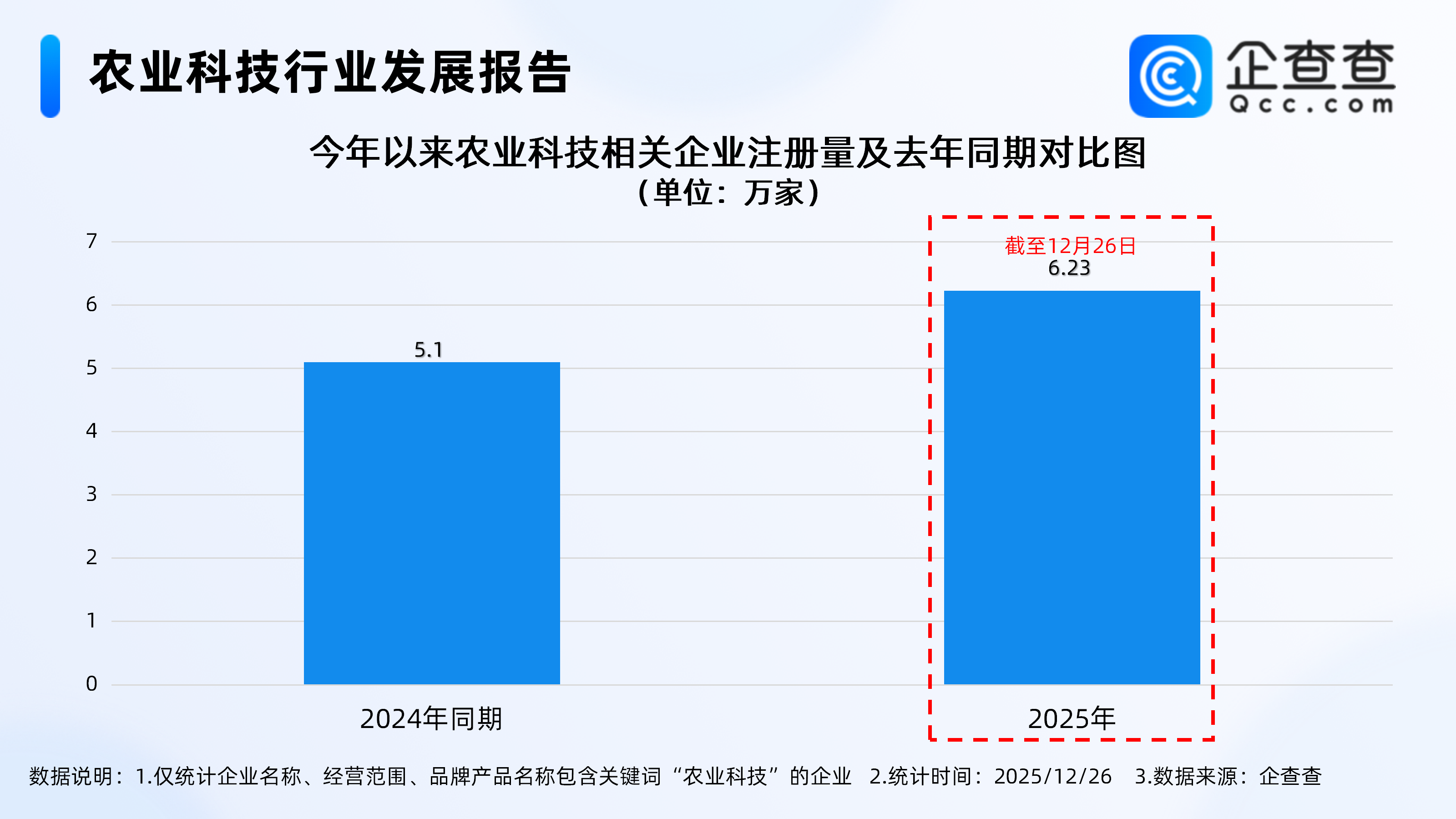
Core Viewpoint - The National Development and Reform Commission emphasizes the development of new agricultural productivity and the promotion of agricultural technology to enhance innovation and efficiency in the sector [1] Group 1: Agricultural Technology Development - The government aims to strengthen the agricultural technology innovation system and enhance the overall effectiveness of agricultural technology [1] - There is a focus on implementing actions to address shortcomings in agricultural machinery and promoting the development of high-end and regionally suitable agricultural equipment [1] - The initiative includes the construction of smart agriculture, expanding the application of big data, agricultural robots, and artificial intelligence in rural areas [1] Group 2: Agricultural Technology Enterprises - As of December 26, there are 430,000 existing agricultural technology-related enterprises in China [5][7] - The registration of agricultural technology enterprises has shown a significant increase, with 62,300 new registrations in 2023, marking a 22.12% year-on-year growth and the highest in the past decade [2][5] - The majority of these enterprises (31.94%) have been established for 5-10 years, while those established for 1-3 years and 3-5 years account for 21.29% and 18.44%, respectively [7] Group 3: Regional Distribution and Industry Classification - Agricultural technology enterprises are primarily concentrated in the East China region, accounting for 27.12% of the total [9] - Over 60% of these enterprises belong to the scientific research and technical services sector, with 65.11% classified under this category [11] - Other classifications include agriculture, forestry, animal husbandry, and fishery (22.03%) and wholesale and retail (7.39%) [11]