
工业机器人

Search documents
数读中国 数读2025 | 四个关键字解码工业和信息化发展新成效
Ren Min Wang· 2026-01-21 08:18
Core Insights - In 2025, the industrial and information technology system aims to achieve new industrialization amidst complex domestic and international changes, focusing on quality improvement and reasonable growth in quantity [1] Group 1: Economic Performance - The equipment manufacturing industry above designated size saw a year-on-year growth of 9.2% [4] - The added value of high-tech manufacturing increased by 9.4% year-on-year [4] - The production of industrial robots increased by 28% year-on-year [6] - New energy vehicle sales reached 16.49 million units, marking a year-on-year growth of 28.2% [6] Group 2: Technological Advancements - Over 30 key technologies have been reserved in the first phase of 6G technology trials [5] - The added value of the integrated circuit and electronic special materials industries grew by 26.7% and 23.9% year-on-year, respectively [6] Group 3: Industrial Development - More than 35,000 basic-level, over 8,200 advanced-level, and over 500 excellent-level smart factories have been established [4] - 15 leading smart factories have been cultivated [4] - Over 8,000 national green factories have been nurtured [5] Group 4: Investment Growth - Investment in the aerospace and aviation equipment manufacturing sectors achieved double-digit growth [6]

财政金融促内需六项新政,谁获益?
Sou Hu Cai Jing· 2026-01-21 07:14
Core Viewpoint - The Chinese government is implementing a series of fiscal and financial policies aimed at boosting domestic demand, with a focus on increasing fiscal spending, supporting consumption, and enhancing residents' income through various channels [2][3][10]. Fiscal Policy Overview - In 2026, the fiscal deficit, total debt, and overall spending will be maintained at necessary levels, ensuring that overall spending increases and key areas are strongly supported [2][3]. - The deficit rate for 2025 is set at around 4%, with new government debt issuance expected to reach 11.86 trillion yuan, significantly higher than previous years [2]. Key Policies - The fiscal and financial package includes six policies, four of which focus on stimulating private investment, while the other two aim to promote consumption [5][10]. - Specific measures include loan interest subsidies for small and micro enterprises, personal consumption loans, equipment upgrade loans, and guarantees for private investment [5][7][8]. Support for Private Investment - A new special guarantee plan for private investment has been introduced, increasing the credit guarantee limit and risk-sharing ratio to encourage banks to lend more [6][10]. - The maximum guarantee amount for individual enterprises has been raised to 20 million yuan, with the government covering up to 40% of the risk [6]. Consumption Support Measures - Personal consumption loans will now benefit from a 1% interest subsidy, with the maximum subsidy amount per transaction increased from 500 yuan to 3,000 yuan [9]. - The scope of eligible consumption areas has expanded to include digital, green, and retail sectors, alongside existing categories [9]. Focus on Technology and Innovation - The government will prioritize support for technological self-reliance and innovation, with a 10% increase in central government spending on technology in 2025 [11]. - Policies will include tax incentives and financial support for technology innovation and integration with industry [11]. Regulatory Adjustments - Starting April 1, 2026, export tax rebates for certain products will be canceled to promote efficient resource use and reduce environmental impact [12]. - The government is committed to standardizing fiscal subsidies and addressing any irregularities in local subsidy practices [12][13]. Tax and Fiscal Reforms - Ongoing reforms will clarify fiscal responsibilities between central and local governments, particularly in public services [13]. - The tax system will be reformed to adapt to new economic realities, including the digital economy [13].

稳、进、新、活 2025年工业和信息化发展呈现四大特点
Zhong Guo Xin Wen Wang· 2026-01-21 06:40
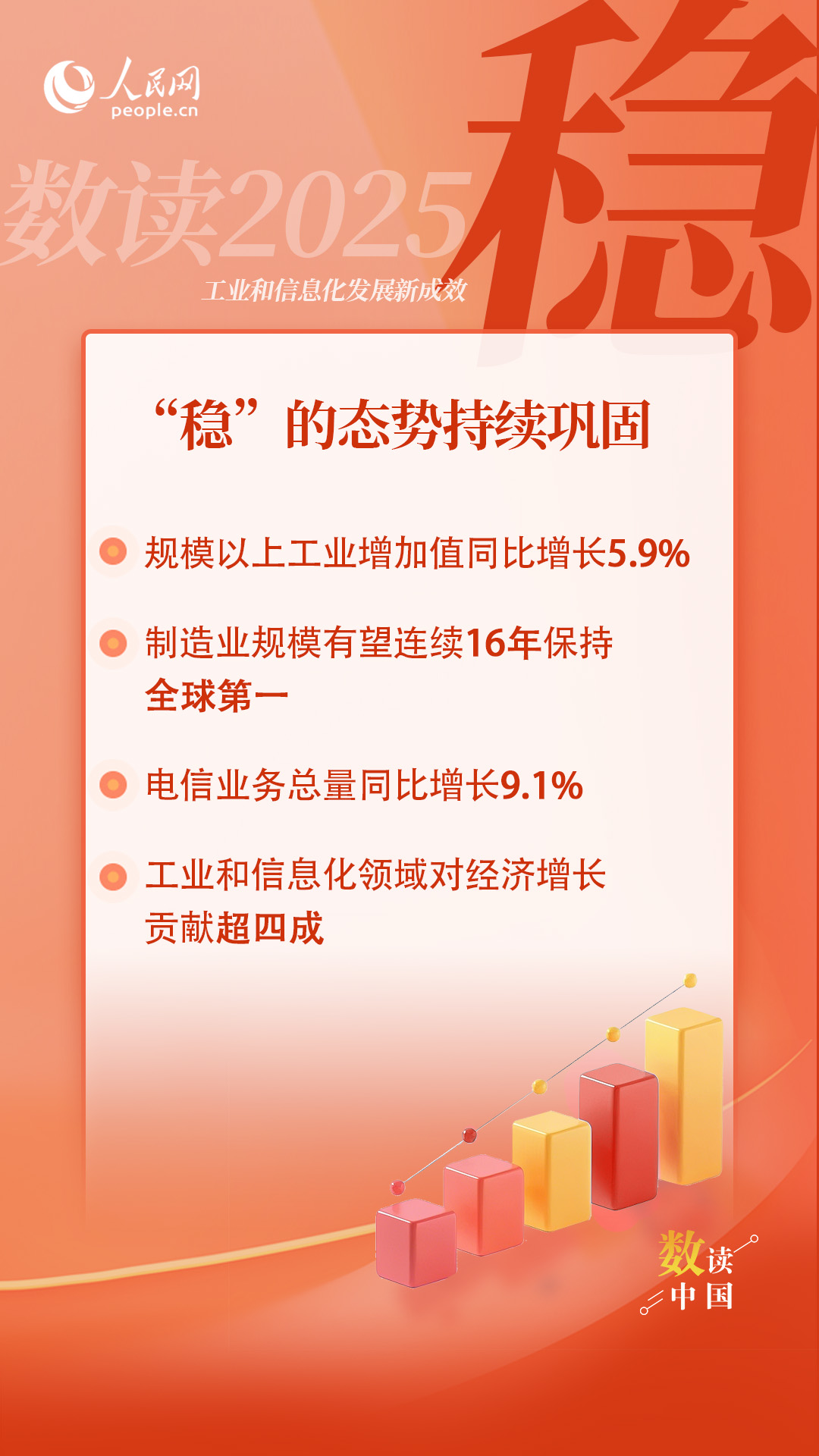
Core Viewpoint - The development of the industrial and information technology sectors in 2025 is characterized by four main features: stability, progress, innovation, and vitality, reflecting a commitment to high-quality development and the achievement of key economic goals. Group 1: Stability - The industrial economy has maintained a stable growth trajectory, with the added value of industrial enterprises above designated size increasing by 5.9% year-on-year, and the manufacturing sector's contribution to GDP remaining stable [1] - The telecommunications business volume grew by 9.1% year-on-year, contributing over 40% to overall economic growth, reinforcing its role as an economic stabilizer [1] Group 2: Progress - The pace of high-quality development has accelerated, with the added value of equipment manufacturing and high-tech manufacturing increasing by 9.2% and 9.4% year-on-year, respectively, outpacing overall industrial growth by 3.3 and 3.5 percentage points [2] - The establishment of over 35,000 basic-level and 8,200 advanced-level smart factories has been achieved, alongside the cultivation of 15 leading smart factories, indicating solid progress in the digital transformation of manufacturing [2] Group 3: Innovation - Significant advancements in technology and industry innovation have been made, with breakthroughs in major equipment such as ultra-large diameter shield machines and heavy-duty gas turbines, and over 300 key technologies developed in the first phase of 6G testing [3] - The added value of integrated circuits and electronic materials increased by 26.7% and 23.9% year-on-year, respectively, while the production of industrial robots rose by 28%, and new energy vehicle sales reached 16.49 million, up 28.2% [3] Group 4: Vitality - Reforms in key areas have been accelerated, with actions taken to reduce corporate burdens and clear overdue payments, creating a more vibrant business environment [4] - The cultivation of specialized and innovative small and medium-sized enterprises has seen over 140,000 such firms established, with high-tech enterprises reaching 504,000, indicating a robust growth in the industrial sector [4]
稳、进、新、活,2025工业经济成绩单来了!
Xin Hua Wang· 2026-01-21 06:13
Group 1 - The core viewpoint of the article highlights the achievements in industrial and information technology development in China by 2025, emphasizing qualitative improvements and reasonable quantitative growth in the industrial economy [1] - The industrial and information sectors contribute over 40% to economic growth, characterized by stability, progress, innovation, and vitality [1] Group 2 - The added value of large-scale equipment manufacturing and high-tech manufacturing industries increased by 9.2% and 9.4% year-on-year, respectively [6] - More than 35,000 basic-level, over 8,200 advanced-level, and over 500 excellent-level smart factories have been established, along with the cultivation of 15 leading smart factories [6] - A total of 8,000 national green factories have been cultivated [6] Group 3 - The first phase of 6G technology trials has resulted in the formation of over 300 key technology reserves [10] - The added value of the integrated circuit and electronic special materials industries increased by 26.7% and 23.9% year-on-year, respectively [10] Group 4 - The production of industrial robots increased by 28% year-on-year [11] - The sales of new energy vehicles reached 16.49 million units, representing a year-on-year growth of 28.2% [11] - 5G and optical networks have been integrated into 97 of the 100 national economic categories [11]
工信部:近期已启动第二阶段6G技术试验,AI已渗透领航级智能工厂70%以上业务场景
Hua Er Jie Jian Wen· 2026-01-21 06:07
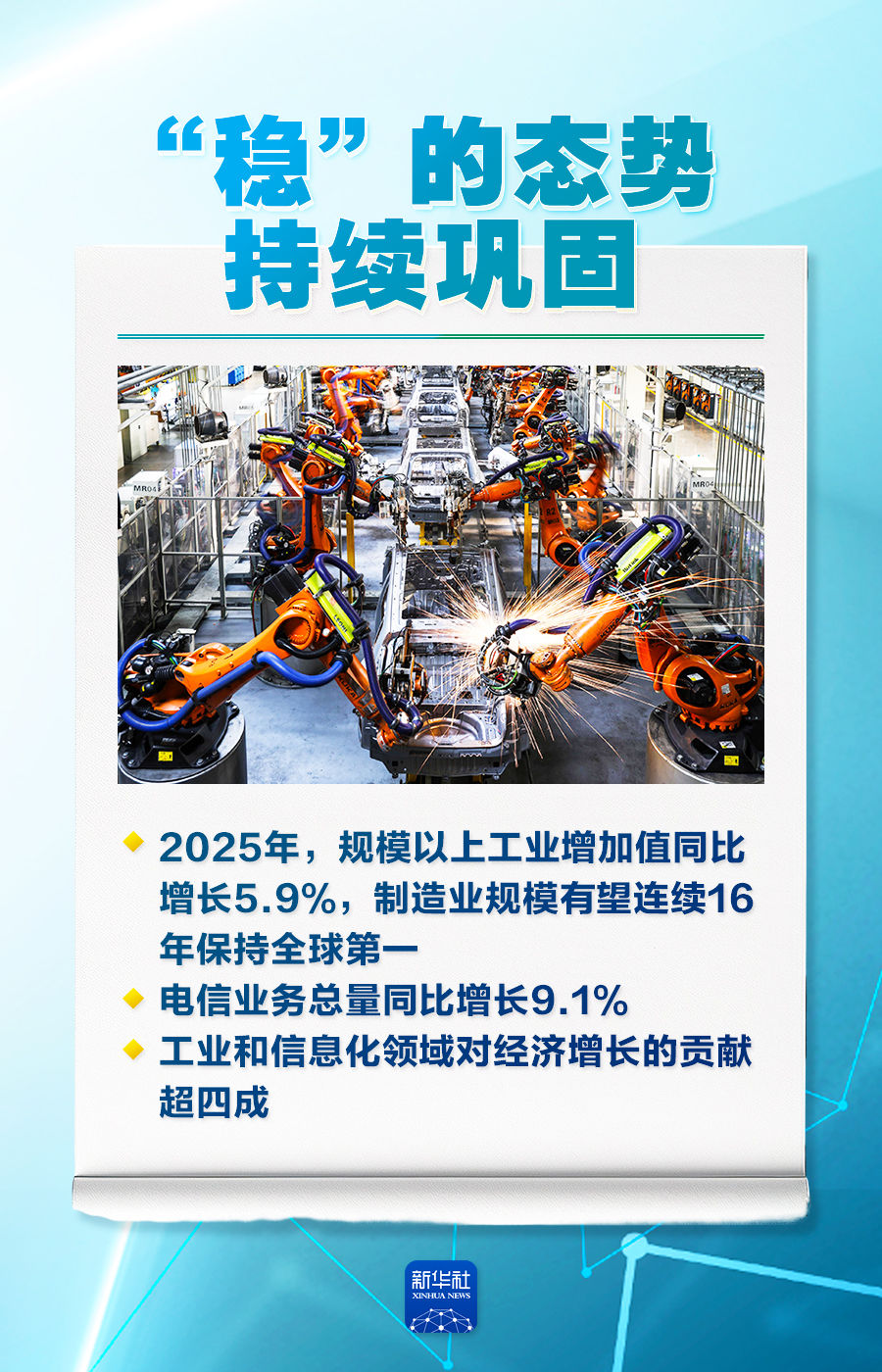
Core Viewpoint - The press conference highlighted China's significant advancements in industrial and information technology development, with a focus on 5G and AI, aiming for high-quality growth and innovation by 2025 [1][6]. Group 1: 5G and 6G Development - China has established 4.838 million 5G base stations, covering all towns and 95% of administrative villages, with over 1.2 billion 5G users [3][50]. - The country holds 42% of the global share of essential 5G standard patents, and the first phase of 6G technology trials has been completed, with over 300 key technologies reserved [3][50]. Group 2: AI and Emerging Industries - By 2025, the core AI industry in China is expected to exceed 1.2 trillion yuan, with over 6,000 AI companies anticipated [5][6]. - AI applications have penetrated over 70% of business scenarios in leading smart factories, with more than 6,000 vertical models developed [8][28]. Group 3: Technological Innovations - Innovations in materials such as perovskite, permanent magnet materials, and power batteries are at an internationally advanced level, with significant advancements in quantum technology [4][22]. - The manufacturing sector has seen a 28% increase in industrial robot production and a 28.2% rise in new energy vehicle sales [17][23]. Group 4: Support for Future Industries - The Ministry of Industry and Information Technology (MIIT) plans to support local governments in developing future industries and increase investment from government funds [9][24]. - A focus on training and developing a workforce skilled in both AI and manufacturing is emphasized to address employment restructuring due to technological advancements [10][39]. Group 5: Small and Medium Enterprises (SMEs) - In 2025, the value added by industrial SMEs is projected to grow by 6.9%, with over 14,000 specialized and innovative SMEs cultivated [12][44]. - The MIIT will implement a "14th Five-Year Plan" to enhance the development environment for SMEs and ensure timely payments to them [45][46]. Group 6: Information Infrastructure - The construction of information infrastructure has been prioritized, with significant advancements in mobile and fixed networks, including 5G and gigabit optical networks [49][50]. - The MIIT aims to enhance the application of information infrastructure across various sectors, ensuring continuous upgrades and technological advancements [51].
划重点!2026年将更多财政资金用在这些方面
Sou Hu Cai Jing· 2026-01-21 03:25
Group 1: Fiscal Policy and Economic Support - The Chinese government plans to issue 1.3 trillion yuan in ultra-long-term special bonds in 2025 to support "two new" and "two heavy" initiatives, indicating a more proactive fiscal policy aimed at stabilizing the economy [1][2] - The fiscal deficit rate is set at around 4%, with new government debt totaling 11.86 trillion yuan, significantly higher than previous years, to enhance counter-cyclical adjustments [1][2] - The government aims to boost consumption by allocating 300 billion yuan for a trade-in program, expected to generate over 2.6 trillion yuan in related sales [1] Group 2: Support for Employment and Social Welfare - The central government has allocated 66.74 billion yuan for employment subsidies and increased funding for social insurance and public health services, enhancing residents' consumption capacity [1][3] - The government is committed to maintaining necessary levels of fiscal deficit and total debt to ensure sustained support for key areas, focusing on boosting consumption and social welfare [3] Group 3: Policies to Encourage Private Investment - New policies include a loan interest subsidy for small and micro enterprises in key industries, with a subsidy rate of 1.5% for loans up to 50 million yuan [4] - A special guarantee plan for private enterprises will provide support for medium to long-term loans needed for business expansion and upgrades, with a maximum guarantee of 20 million yuan per enterprise [4] - A risk-sharing mechanism for private enterprise bonds will help reduce financing barriers, supported by central government funds [4][8] Group 4: Optimizing Consumption Support Policies - The consumer loan interest subsidy policy has been enhanced, allowing for higher subsidy amounts and broader coverage, including credit card installment payments and new consumption sectors [7] - The implementation period for these consumer loan subsidies has been extended to the end of 2026, increasing accessibility for a wider range of financial institutions [7] Group 5: Government Procurement and Market Regulation - The government aims to optimize procurement processes by establishing a comprehensive legal framework and ensuring fair treatment of all market participants [9] - Continuous efforts will be made to regulate fiscal subsidies and improve the management of government procurement to foster a more competitive market environment [9]
工信部:2025年工业和信息化发展呈现“稳”“进”“新”“活”四个特点
Xin Hua Cai Jing· 2026-01-21 03:20
Core Viewpoint - The press conference held by the State Council Information Office highlighted the achievements in industrial and information development by 2025, showcasing four key characteristics: stability, progress, new momentum, and vitality. Group 1: Stability - The industrial and information sector has maintained a stable growth trajectory, with the added value of large-scale industries increasing by 5.9% year-on-year, and the manufacturing sector's contribution to GDP remaining stable, keeping its position as the world's largest for 16 consecutive years [1] - The total telecommunications business volume grew by 9.1% year-on-year, contributing over 40% to economic growth, effectively acting as a "ballast" for the economy [1] Group 2: Progress - The focus on high-quality development has accelerated, with the added value of equipment manufacturing and high-tech manufacturing increasing by 9.2% and 9.4% year-on-year, respectively, outpacing overall industrial growth by 3.3 and 3.5 percentage points [2] - The establishment of over 35,000 basic-level and 8,200 advanced-level smart factories has been achieved, alongside the cultivation of 15 leading smart factories, indicating solid progress in the digital transformation of manufacturing [2] Group 3: New Momentum - Significant advancements in technology and industry innovation have been made, with breakthroughs in major equipment such as ultra-large diameter shield machines and heavy-duty gas turbines, and over 300 key technologies reserved for 6G [3] - The added value of integrated circuits and electronic materials increased by 26.7% and 23.9% year-on-year, respectively, while industrial robot production rose by 28%, and new energy vehicle sales reached 16.49 million, up 28.2% [3] Group 4: Vitality - Reforms in key areas have been accelerated, with actions taken to reduce corporate burdens and clear overdue payments, creating a more vibrant business environment [4] - The cumulative cultivation of over 140,000 specialized and innovative small and medium-sized enterprises has been achieved, with high-tech enterprises reaching 504,000, indicating a robust ecosystem for innovation [4]
【IPO前哨】左手能源右手机器人,科大智能港股IPO的底气与挑战
Sou Hu Cai Jing· 2026-01-21 02:29
Core Viewpoint - Keda Intelligent has initiated its dual listing process on the Hong Kong Stock Exchange after 15 years on the A-share market, aiming to leverage its position in the digital energy and intelligent robotics sectors, despite facing challenges in business adjustments and industry competition [2]. Group 1: Business Overview - Keda Intelligent operates in two key sectors: digital energy and intelligent robotics, aligning with the trends of "new infrastructure" and "industrial intelligence" [3]. - The digital energy segment is the company's foundational business, with a product matrix that includes core devices such as integrated circuit breakers and distribution terminal units. The company ranks first in the FTU market and second in the integrated circuit breaker market in China [3]. - In the intelligent robotics sector, Keda Intelligent provides products like industrial robots and inspection robots, achieving the highest cumulative revenue in the industrial robot market from 2020 to 2024 [5]. Group 2: Financial Performance - Keda Intelligent's revenue has shown significant volatility, with 2023 revenue at 3.025 billion RMB, dropping to 2.687 billion RMB in 2024, and recovering to 1.904 billion RMB in the first three quarters of 2025 [6][7]. - The company recorded a net loss of 171 million RMB in 2023, turning profitable in 2024 with a net profit of 61.57 million RMB, and further increasing to 73.48 million RMB in the first three quarters of 2025 [6]. - The digital energy business accounted for 78.2% of total revenue in 2024, while the intelligent robotics segment saw a significant decline, with a 42.8% drop in revenue in 2024 [6][7]. Group 3: Market Challenges - The decline in the intelligent robotics business is attributed to both industry cycles and strategic adjustments, with a 21.3% actual revenue drop when excluding the impact of divested subsidiaries [8]. - Increased competition from companies like Siasun Robot and Estun in the AI-enabled and high-end customization sectors is further squeezing market space for Keda Intelligent [8]. Group 4: Future Prospects - The upcoming IPO in Hong Kong presents both opportunities and challenges for Keda Intelligent, with the potential to benefit from the 4 trillion RMB investment plan by the State Grid, which is expected to drive demand for digital energy solutions [9]. - The international capital platform of the Hong Kong market may help the company expand its overseas market presence, which currently accounts for less than 2% of its revenue [10]. - The company views the Hong Kong listing as a new starting point for strategic upgrades, focusing on enhancing R&D, optimizing business structure, and expanding market space to achieve a dual-driven growth model [10].


财政部:中小微企业贷款贴息政策重点支持汽车等重点产业链
Cai Jing Wang· 2026-01-21 02:13
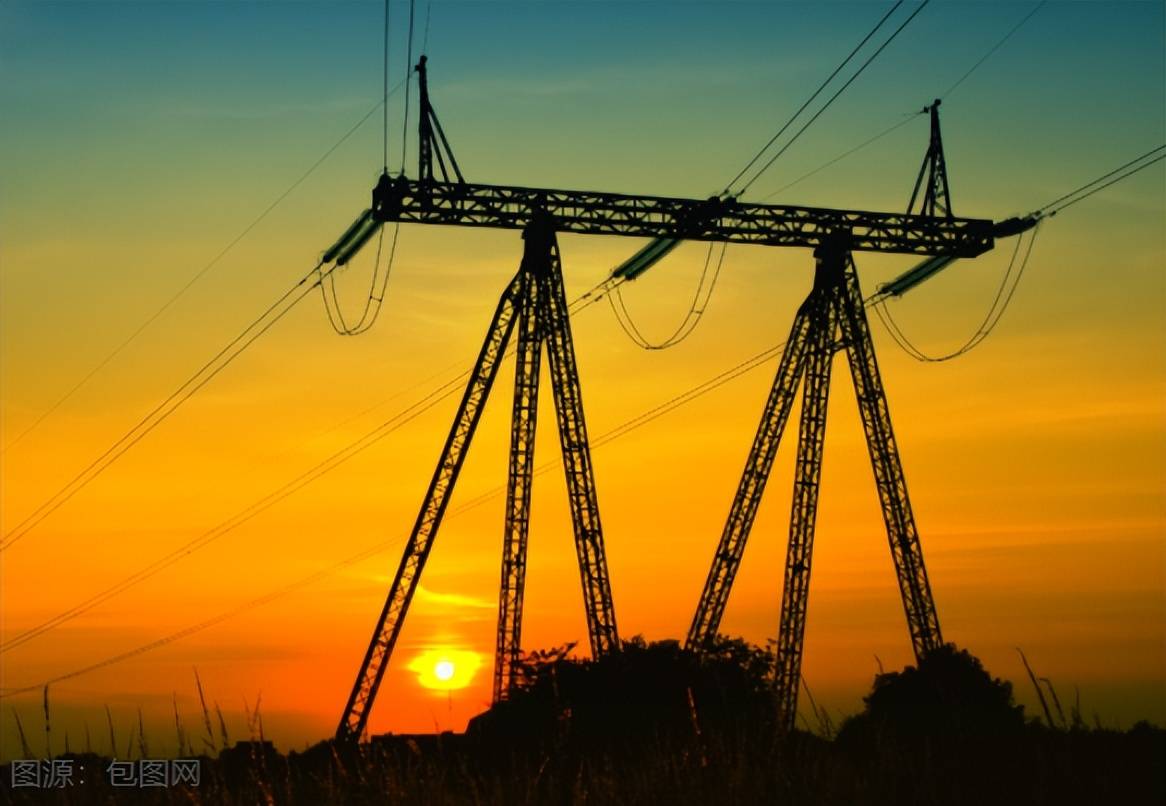
Group 1 - The Ministry of Finance announced a new loan interest subsidy policy aimed at supporting the development of small and micro enterprises [1] - The policy focuses on providing loan subsidies to enterprises in 14 key industries, including new energy, automotive, industrial robots, medical equipment, and mobile communication devices [1] - The initiative also targets upstream and downstream industries, as well as production systems and services in technology, logistics, information, and software [1]
工信部:人工智能为工业经济增长注入强劲动力
Xin Lang Cai Jing· 2026-01-21 02:12
1月21日,国新办举行新闻发布会介绍2025年工业和信息化发展成效。工业和信息化部副部长张云明表 示,2025年,工信部着力推进科技创新和产业创新深度融合,深入实施关键核心技术攻关,产业基础再 造工程,重大技术装备攻关工程。人工智能为工业经济增长注入强劲动力,工业机器人产量同比增长 28%,新能源汽车新车销量达1649万辆,同比增长28.2%。新兴领域投资增势良好,航空航天器及设备 制造等行业投资实现两位数增长。 ...