
有色金属冶炼和压延加工业

Search documents
德福科技:2025年预盈9700万元—1.25亿元 同比扭亏为盈
Zheng Quan Shi Bao Wang· 2026-01-21 08:41
Core Viewpoint - Defu Technology (301511) expects a turnaround in profitability with a projected net profit attributable to shareholders of 97 million to 125 million yuan for 2025, compared to a loss of 245 million yuan in the same period last year [1] Group 1: Financial Performance - The company anticipates a significant improvement in net profit, indicating a recovery from previous losses [1] - The expected profit range for 2025 represents a substantial increase, reflecting a positive shift in financial health [1] Group 2: Market Demand and Product Performance - There is a notable recovery in downstream market demand, contributing to the company's improved performance [1] - The company has achieved a significant increase in the shipment volume of its main products year-on-year, driven by customer relationships and technological advancements [1] Group 3: Product Development and Profitability - Continuous product iteration and upgrades have been a focus for the company, enhancing its product offerings [1] - The proportion of high-value products, such as lithium battery copper foil and electronic circuit copper foil, has significantly increased, leading to improved average processing fees and overall profitability [1]
众源新材(603527.SH):全资子公司收到高新技术企业证书
Ge Long Hui A P P· 2026-01-21 07:45
格隆汇1月21日丨众源新材(603527.SH)公布,公司的全资子公司安徽永杰铜业有限公司于近日收到安徽 省工业和信息化厅、安徽省财政厅、国家税务总局安徽省税务局联合颁发的《高新技术企业证书》,证 书编号:GR202534001830,发证日期:2025年10月28日,有效期三年(即2025年、2026年、2027年)。 根据国家有关规定,经认定的高新技术企业连续三年享受国家高新技术企业所得税等优惠政策,即按 15%的税率缴纳企业所得税。该税收优惠政策不影响公司此前发布的经营业绩的财务数据。 ...

嘉元科技股价涨5.4%,东兴基金旗下1只基金重仓,持有7.14万股浮盈赚取16.14万元
Xin Lang Cai Jing· 2026-01-21 05:57
Group 1 - The core viewpoint of the news is that 嘉元科技 (Jia Yuan Technology) experienced a stock price increase of 5.4%, reaching 44.10 yuan per share, with a trading volume of 493 million yuan and a turnover rate of 2.69%, resulting in a total market capitalization of 18.798 billion yuan [1] - 嘉元科技 is located in Meizhou, Guangdong Province, and was established on September 29, 2001. It was listed on July 22, 2019. The company's main business involves the research, production, and sales of various high-performance electrolytic copper foils [1] - The revenue composition of 嘉元科技 is as follows: lithium battery copper foil accounts for 83.77%, other income 12.64%, and standard copper foil 3.58% [1] Group 2 - From the perspective of fund holdings, 东兴基金 (Dongxing Fund) has one fund heavily invested in 嘉元科技. The 东兴数字经济混合发起A (Dongxing Digital Economy Mixed Fund A) held 71,400 shares in the third quarter, representing 5.22% of the fund's net value, ranking as the tenth largest holding [2] - The 东兴数字经济混合发起A fund was established on January 16, 2024, with a latest scale of 28.2888 million yuan. Year-to-date return is 0.64%, ranking 7764 out of 8844 in its category; the one-year return is 47.64%, ranking 2052 out of 8091; and since inception, the return is 66.12% [2] - The fund manager of 东兴数字经济混合发起A is 周昊 (Zhou Hao), who has been in the position for 2 years and 7 days, with total assets under management of 51.35 million yuan. The best fund return during his tenure is 69.25%, while the worst is 68.91% [2]

2025年1-11月有色金属冶炼和压延加工业企业有10938个,同比增长6.2%
Chan Ye Xin Xi Wang· 2026-01-21 04:00
上市公司:焦作万方(000612),铜陵有色(000630),合金投资(000633),中钨高新(000657), 国城矿业(000688),北方铜业(000737),常铝股份(002160),东方锆业(002167),楚江新材 (002171),宝武镁业(002182),融捷股份(002192),海亮股份(002203) 2016-2025年1-11月有色金属冶炼和压延加工业企业数统计图 数据来源:国家统计局,智研咨询整理 知前沿,问智研。智研咨询是中国一流产业咨询机构,十数年持续深耕产业研究领域,提供深度产业研 究报告、商业计划书、可行性研究报告及定制服务等一站式产业咨询服务。专业的角度、品质化的服 务、敏锐的市场洞察力,专注于提供完善的产业解决方案,为您的投资决策赋能。 相关报告:智研咨询发布的《2026-2032年中国有色金属行业市场发展现状及竞争格局预测报告》 2025年1-11月,有色金属冶炼和压延加工业企业数(以下数据涉及的企业,均为规模以上工业企业,从 2011年起,规模以上工业企业起点标准由原来的年主营业务收入500万元提高到年主营业务收入2000万 元)为10938个,和上年同期相比,增加 ...


中国一冶取得动力机器套筒预埋件高精度预埋方法专利
Sou Hu Cai Jing· 2026-01-20 02:49
声明:市场有风险,投资需谨慎。本文为AI基于第三方数据生成,仅供参考,不构成个人投资建议。 来源:市场资讯 国家知识产权局信息显示,中国一冶集团有限公司、武汉一冶钢结构有限责任公司取得一项名为"一种 动力机器套筒预埋件高精度预埋方法"的专利,授权公告号CN116497863B,申请日期为2023年3月。 天眼查资料显示,中国一冶集团有限公司,成立于1990年,位于武汉市,是一家以从事有色金属冶炼和 压延加工业为主的企业。企业注册资本241772.739016万人民币。通过天眼查大数据分析,中国一冶集 团有限公司共对外投资了133家企业,参与招投标项目5000次,财产线索方面有商标信息182条,专利信 息5000条,此外企业还拥有行政许可891个。 武汉一冶钢结构有限责任公司,成立于2004年,位于武汉市,是一家以从事建筑安装业为主的企业。企 业注册资本12000万人民币。通过天眼查大数据分析,武汉一冶钢结构有限责任公司共对外投资了1家企 业,参与招投标项目2631次,专利信息579条,此外企业还拥有行政许可47个。 ...
2025年全国煤炭开采和洗选业产能利用率为69.8%
Guo Jia Tong Ji Ju· 2026-01-20 01:49
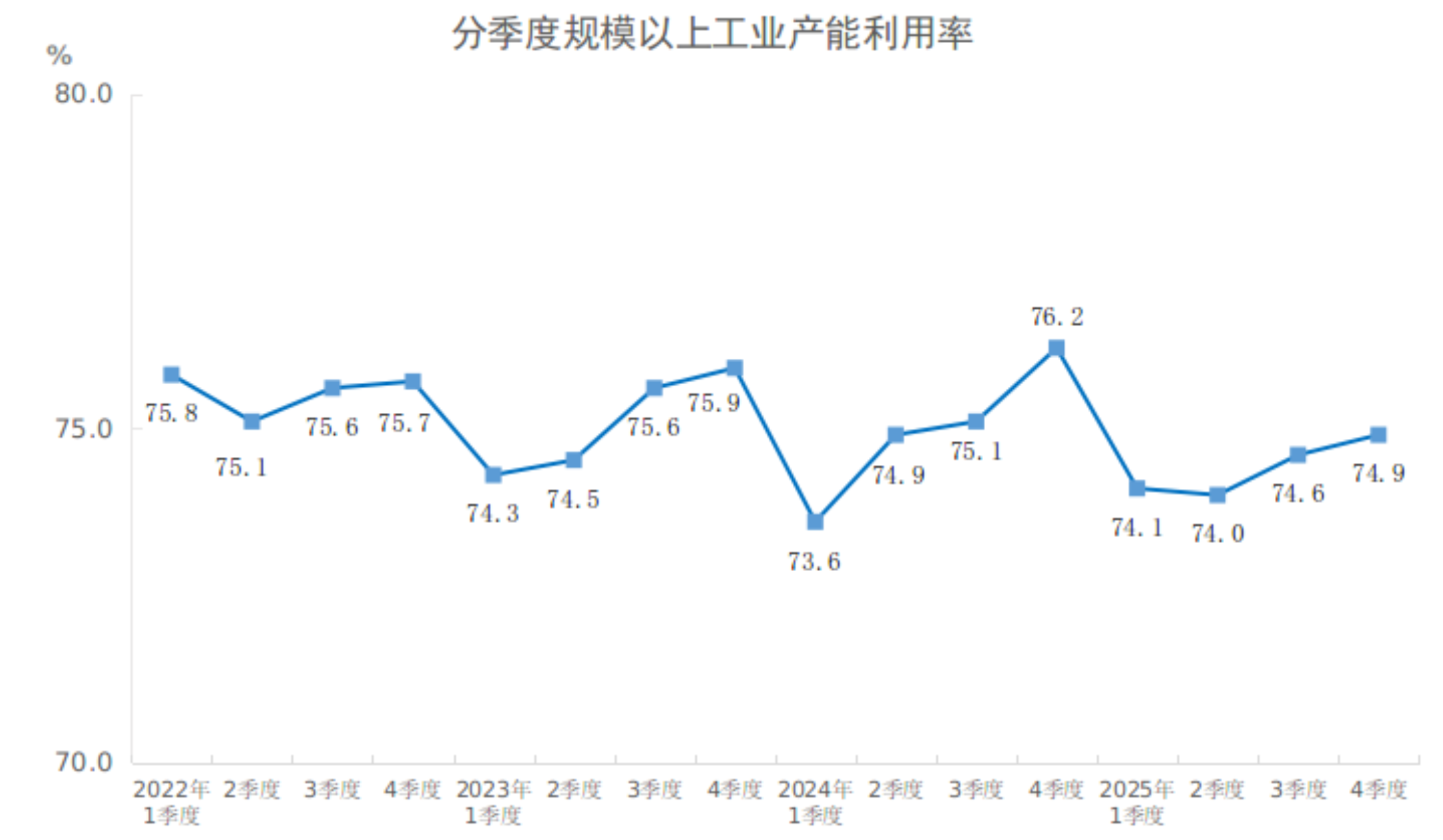
Core Viewpoint - The national industrial capacity utilization rate for large-scale enterprises in Q4 2025 is reported at 74.9%, showing a 0.3 percentage point increase from Q3 but a 1.3 percentage point decrease compared to the same period last year [1][4]. Group 1: Overall Industrial Capacity Utilization - The overall industrial capacity utilization rate for the entire year of 2025 is 74.4%, which is a decrease of 0.6 percentage points from the previous year [6]. - The Q4 capacity utilization rate for the mining industry is 71.7%, down 3.9 percentage points year-on-year [6]. - The manufacturing industry shows a Q4 capacity utilization rate of 75.2%, reflecting a decrease of 1.2 percentage points compared to the previous year [6]. - The electricity, heat, gas, and water production and supply industry has a Q4 capacity utilization rate of 74.0%, which is a decline of 0.8 percentage points year-on-year [6]. Group 2: Industry-Specific Capacity Utilization - In Q4 2025, the coal mining and washing industry has a capacity utilization rate of 69.1%, down 4.8 percentage points from the previous year [3][6]. - The food manufacturing industry reports a capacity utilization rate of 68.5%, a decrease of 2.2 percentage points year-on-year [6]. - The textile industry has a Q4 capacity utilization rate of 77.1%, down 1.7 percentage points compared to the previous year [6]. - The chemical raw materials and chemical products manufacturing industry shows a capacity utilization rate of 74.1%, down 2.3 percentage points year-on-year [6]. - The black metal smelting and rolling industry has a capacity utilization rate of 78.5%, which is an increase of 0.4 percentage points from the previous year [6]. - The automotive manufacturing industry reports a capacity utilization rate of 76.0%, down 1.2 percentage points year-on-year [6]. - The computer, communication, and other electronic equipment manufacturing industry has a capacity utilization rate of 79.7%, reflecting a slight increase of 0.3 percentage points compared to the previous year [6].
盘前公告淘金:复牌!上海国资拟入主江化微,华是科技实控人变更、盈方微重大资产重组;湖南裕能2025年净利同比预增94%-136%
Jin Rong Jie· 2026-01-20 01:43
Important Events - Yidian Tianxia has resumed trading after the suspension for verification [1] - Jianghuai Microelectronics will have its actual controller changed to Shanghai State-owned Assets Supervision and Administration Commission, and its stock has resumed trading [1] - Huas Technology's actual controller has changed to Zheng Jianbo, and its stock has resumed trading [1] - Yingfang Microelectronics plans to acquire 100% shares of Shanghai Xiaokeli and Fujide China, which is expected to constitute a major asset restructuring, and its stock has resumed trading [1] - Hualing Cable has terminated the acquisition of Xingxin Aerospace's controlling stake, which provides supporting products for Shenzhou series spacecraft, Chang'e series detectors, and various launch vehicles [1] - Rongsheng Development's subsidiary plans to acquire 100% equity of Yingde Jihong and Yingde Jiyue for 40 million yuan [1] - Donghua Software plans to establish a wholly-owned subsidiary, Donghua Zhizhi, with an investment of 300 million yuan [1] - Zhongwei Semiconductor is about to launch its first non-volatile memory chip [1] - Xingqi Eye Medicine's SQ-24071 eye drops have received clinical trial approval [1] Contracts & Project Bids - Pingzhi Information has pre-qualified for an intelligent computing service project worth approximately 489 million yuan [1] - Nanshan Aluminum plans to invest 437 million USD to build a 250,000-ton annual electrolytic aluminum project in Indonesia [1] - Yian Technology's controlling company has signed a project entry contract to create a benchmark project for high-quality amorphous alloy (liquid metal) [1] - Jiangxi Copper has signed a three-year cooperation framework agreement with the Ordnance Material Department, expecting to sell 9.7 billion yuan worth of copper rods and other products annually [1] - Wutong Holdings' wholly-owned subsidiary did not win the bid for the Agricultural Bank of China mobile SMS long number agency service project, which is expected to have a significant adverse impact on the company's future operating performance [1] Operations & Performance - Hunan Yuneng expects a net profit increase of 94%-136% year-on-year in 2025, driven by a rebound in lithium carbonate prices enhancing overall profitability [1] - Jilin Carbon Valley anticipates a net profit increase of 92.81%-135.66% year-on-year in 2025 [1] - Fulai Anticipates a net profit increase of 81.67%-127.08% year-on-year in 2025 [1] - Dingtong Technology expects a net profit increase of 120% year-on-year in 2025, with significant growth in high-speed communication product business [1] - Chengdu Huamei anticipates a net profit increase of 74%-109% year-on-year in 2025, with Q4 net profit expected to grow by 458%-614% quarter-on-quarter [1] - Anfu Technology expects a net profit increase of 28.55%-50.91% year-on-year in 2025 [1] - Dinglong Co. anticipates a net profit increase of 34.44%-40.20% year-on-year in 2025 [1] - Mingtai Aluminum expects a net profit increase of 12%-14% year-on-year in 2025 [1] - Huace Testing anticipates a net profit increase of 10%-11% year-on-year in 2025 [1] - Xianglu Tungsten Industry expects a net profit of 125 million to 180 million yuan in 2025, with tungsten metal raw material prices continuing to rise throughout the year [1] Financing & Capital Increase - Jiangxi Copper plans to register and issue debt financing instruments not exceeding 25 billion yuan [2] - Goldwind Technology has terminated the public REITs application and issuance work [2] - Huichuan Technology is planning to issue H-shares and list on the Hong Kong Stock Exchange [2]

核心CPI涨幅扩大
Jing Ji Ri Bao· 2026-01-19 22:15
Group 1: Consumer Price Trends - The overall consumer price index (CPI) is stable and gradually improving, with a year-on-year increase of 0.7% for 2025, which is an increase of 0.2 percentage points compared to the previous year [2][3] - CPI experienced significant monthly fluctuations in January and February due to the Spring Festival, with January rising by 0.5% and February falling by 0.7%. From March to July, CPI remained stable with fluctuations between -0.1% and 0.1% [2] - Food prices decreased by 1.5% for the year, contributing approximately 0.27 percentage points to the CPI decline, while energy prices fell by 3.3%, impacting CPI by about 0.25 percentage points [2] Group 2: Core CPI and Industrial Prices - The core CPI has been rising since March 2025, maintaining a year-on-year increase of over 1% for four consecutive months from September to December, with December seeing a rise of 1.2% [3] - The Producer Price Index (PPI) decreased by 2.6% for the year, but the decline narrowed in the second half, with a reduction of only 1.9% in December, the smallest since September 2024 [4] - Prices in the coal mining and processing sectors turned upward after nine months of decline, with December prices rising by 1.3% and 0.8% respectively, contributing to the narrowing of the PPI decline [4] Group 3: Industrial Development and Price Increases - The high-quality development and transformation of industries have led to price increases in certain sectors, with significant growth in manufacturing driven by advancements in artificial intelligence and green technologies [5] - Prices for integrated circuit packaging and testing, external storage devices, and wearable smart devices increased by 2.0%, 0.7%, and 0.1% respectively, reflecting the impact of new production capabilities [5]
明泰铝业(601677.SH)发预增,预计2025年度归母净利润19.5亿元至20亿元,同比增长12%至14%
智通财经网· 2026-01-19 09:23
Core Viewpoint - Ming Tai Aluminum (601677.SH) anticipates a significant increase in its 2025 annual performance, projecting a net profit attributable to shareholders of 1.95 billion to 2 billion yuan, representing a year-on-year increase of 202 million to 252 million yuan, or 12% to 14% growth [1] Group 1: Performance Forecast - The expected net profit attributable to shareholders, excluding non-recurring gains and losses, is projected to be 1.7 billion to 1.75 billion yuan, an increase of 254 million to 304 million yuan compared to the previous year, reflecting an 18% to 21% growth [1] Group 2: Reasons for Performance Increase - The primary reasons for the performance increase include the global shift towards a green economy, with the establishment of carbon tax systems domestically and internationally, enhancing the company's market competitiveness through low-carbon recycled aluminum products [1] - The company has diversified its product offerings across multiple key sectors, effectively capturing new market demands and opportunities, leading to steady growth in production and sales scale [1] - The strategic focus on high-end manufacturing has led to the launch of advanced production lines, targeting high-end sectors such as new energy batteries, automotive lightweighting, and robotics, thereby accelerating the company's transition to high-end products and expanding profit margins per ton [1]

王有捐:2025年CPI总体平稳 PPI低位回升
Guo Jia Tong Ji Ju· 2026-01-19 03:35
Group 1: Consumer Price Index (CPI) Trends - The overall consumer market in 2025 is stable and gradually improving, with CPI showing monthly fluctuations and a year-on-year increase of 0.8% in December, the highest since March 2023 [2] - Food prices decreased by 1.5% for the year, impacting CPI by approximately 0.27 percentage points, with significant declines in pork and egg prices [3] - Core CPI has been rising since March 2025, maintaining a year-on-year increase of over 1% for four consecutive months, reaching 1.2% in December [4] Group 2: Producer Price Index (PPI) Trends - The PPI for 2025 decreased by 2.6%, but the decline narrowed in the second half of the year, with a year-on-year decrease of only 1.9% in December [5] - The optimization of market competition and capacity management in key industries has led to a recovery in prices, particularly in coal and new energy sectors [6] - External factors, such as rising international metal prices, have contributed to price increases in related domestic industries, with non-ferrous metal mining prices up by 17.2% [7]