股权投资

Search documents
曹永刚:最好的机会隐藏在政策、技术和需求的交汇点
中国基金报· 2025-09-20 02:15
Core Viewpoint - AI is a key thread connecting the "Five Major Articles" in China's capital market, representing significant investment opportunities at the intersection of policy, technology, and demand [1][10]. Group 1: Capital Market Dynamics - The Chinese capital market is experiencing a notable increase in activity, with funds seeking investment directions closely related to AI [3][4]. - Since the implementation of the "9·24" policy in 2024, the capital market has seen two significant phases of upward movement, driven by policy benefits and subsequent AI technology breakthroughs [4]. - As of August 2025, M1 (narrow money supply) grew by 6% year-on-year, contrasting with a 7.3% decline in the same period of 2024, indicating a shift in liquidity towards capital markets [4]. - In July, household deposits decreased by 1.1 trillion yuan, while securities and fund accounts increased by 2.14 trillion yuan, showing a trend of reallocating funds from banks to equity assets [4][5]. - The A-share market has seen daily trading volumes exceed 2 trillion yuan, signaling a peak in market activity for the year [4]. Group 2: AI Industry Insights - The AI industry is transitioning from technical exploration to value creation, becoming a core driver of the "technology + industry" revolution [7]. - The performance of companies like Cambrian Technology indicates that China's AI industry is on a path of independent development, narrowing the gap with global leaders [8]. - AI is being integrated across various sectors, including manufacturing, education, finance, and healthcare, fundamentally transforming traditional industries [8][11]. - The greatest value from AI is expected to emerge from its application layer, where it can help businesses reduce costs and improve efficiency [8]. Group 3: Investment Strategies - Investment institutions should align with national strategies and focus on the intersections of AI and the "Five Major Articles" [9][10]. - 弘毅投资 is actively investing in AI-related sectors, including artificial intelligence data centers, smart energy management, and semiconductor technologies [10]. - The investment approach should prioritize early-stage investments in core technologies related to AI, emphasizing the importance of cash flow generation from AI applications [8][10][11]. - The integration of AI into various industries will determine future investment values, as smaller enterprises gain access to AI technologies previously dominated by larger firms [11].

告别“贝塔”依赖 股权投资2.0时代要靠“阿尔法”突围
Zheng Quan Shi Bao· 2025-09-17 18:12
Group 1 - The equity investment industry in China is showing signs of recovery after three years of stagnation, with increased recruitment demand and improved market sentiment, marking a shift from a prolonged "winter" phase [1] - The industry is undergoing a paradigm shift from "rapid expansion" to "high-quality development," with the current market size of RMB investments down nearly 60% from its peak in 2021, indicating the arrival of the VC/PE 2.0 era [2] - The transformation in the technology investment sector is seen as both an opportunity and a challenge, as China moves from a phase of imitation to one of innovation leadership in technology [2] Group 2 - The Chinese equity investment market is transitioning from a "positive beta" environment to a "negative beta" or "flat beta" state, where future returns will depend on the core capabilities of investment institutions rather than overall market growth [3] - The ability to generate "alpha" returns will require institutions to have foresight in technology trends and application, emphasizing the need for experienced teams to identify structural opportunities [3] - The focus on efficiency is critical, as both traditional and tech sectors face challenges in improving operational effectiveness [3] Group 3 - Investment strategies are diversifying, with firms like Junlian Capital shifting towards early-stage investments in hard technology projects, recognizing the importance of early positioning in high-potential sectors [6] - The strategy of focusing on "first-class" founders and high-growth sectors is being adopted by firms like Huaye Tiancheng Capital, which emphasizes long-term potential over immediate excellence [6][7] - Institutions are also adopting cross-cycle investment strategies, focusing on industry cycles and the rotation of different sectors to identify growth opportunities [7]
行业回暖背后,VC/PE如何打好“2.0时代”突围战?
Zheng Quan Shi Bao Wang· 2025-09-17 10:59
Core Insights - The equity investment industry in China is showing signs of recovery after three years of stagnation, with increased recruitment demand and improved market sentiment, marking a transition to a new paradigm in the VC/PE sector [1] Industry Transformation - The shift from rapid growth to high-quality development in the equity investment sector is a significant change, with the market size of RMB investments dropping nearly 60% compared to the peak in 2021, indicating a move towards a VC/PE 2.0 era [2] - The evolution of technology investment in China is seen as both an opportunity and a challenge, with the country transitioning from a phase of imitation to one of innovation leadership [2] Alpha Capability Development - The Chinese equity investment market is moving from a "positive beta" to a "negative beta" or "flat beta" state, emphasizing the need for firms to develop "alpha" capabilities to achieve excess returns [3] - Future core competencies for investment firms will focus on foresight in technology trends and application, with a need to identify opportunities amidst uncertainty [3] Strategic Differentiation - Different investment firms are adopting unique strategies based on their inherent strengths, with some focusing on early-stage investments in hard technology projects, recognizing the importance of early positioning in high-potential sectors [5][6] - The concept of "cross-cycle layout" is becoming crucial for firms like Taikang Investment and China Merchants Capital, which emphasize the importance of understanding industry cycles and making informed investment decisions based on growth trends [7]
北京:拟融资总额超70亿元,金融活水精准滴灌平原新城
Zhong Guo Qing Nian Bao· 2025-09-17 03:23
Core Insights - Beijing's Changping District has launched a series of investment activities, focusing on 74 key projects with a total investment of 51.35 billion yuan and a financing demand of 7.08 billion yuan [1] - The "Pingyuan New City Venture Capital Roadshow" series began on September 16, 2025, with Changping as the first stop, aimed at promoting coordinated development in the Beijing-Tianjin-Hebei region [1] - Changping District has shown strong economic growth, with an average GDP growth rate of 6.2% since the 14th Five-Year Plan, and a notable 7.1% growth in the first half of this year [1] Investment and Project Highlights - The investment event saw on-site agreements totaling 250 million yuan, involving various companies and investment funds [2] - Key sectors targeted include life sciences, advanced manufacturing, and future industries, with a focus on innovation and integration of education and industry [1][2] - Changping District is home to 88 national and provincial key laboratories and 210 engineering technology centers, with significant projects like Tsinghua South Base under construction [2]
“捡钱”时代落幕:并购,成GP的终极考题
FOFWEEKLY· 2025-09-10 09:54
Core Viewpoint - The fundamental rules of the primary market are undergoing significant changes, with mergers and acquisitions (M&A) becoming a core competency that general partners (GPs) must master to achieve value reconstruction in industries rather than merely capital arbitrage [2][4]. Group 1: Evolution of Private Equity Investment - The U.S. private equity market has evolved through a clear trajectory characterized by "a century of evolution and four stages of leap," starting from the late 19th century with industrial investments [6]. - The development of the U.S. M&A market has synchronized with private equity, showcasing five distinct waves that have reshaped the industrial landscape [7][8]. - The current phase of private equity in the U.S. is driven by technological innovation, particularly in emerging fields like AI and digital transformation [6][8]. Group 2: China's Private Equity Investment Phases - The 1.0 era (2000-2015) was marked by internet-driven model innovation, where investment opportunities were abundant, and the requirements for investment institutions were relatively low [10]. - The 2.0 era (2015-2025) signifies a shift towards technology innovation, with hard technology becoming a focal point for investment, supported by national policies [11][12]. - The 3.0 era (2025-2035) indicates a trend towards industry consolidation through M&A, driven by increasing exit pressures and government encouragement, with M&A activity in China seeing over 50% year-on-year growth in the first half of 2025 [13]. Group 3: Strategic Focus of Haisheng Capital - Haisheng Capital has recognized structural changes in the industry and elevated M&A to a core strategic level, leveraging its unique advantages accumulated in the hard technology sector [15]. - The firm has built a mature ecosystem in key hard technology areas, enabling it to provide substantial resources and support to acquired companies [16]. - The success of M&A is attributed not only to selecting the right targets but also to effective management post-acquisition, with a team that possesses deep industry backgrounds [18]. Group 4: Timing and Focus in Investment - Haisheng Capital has demonstrated a keen ability to identify investment opportunities at critical market junctures, allowing it to capitalize on undervalued companies during cyclical fluctuations [19]. - The firm maintains a clear strategic focus on advanced technology, green technology, and life sciences, ensuring that it targets sectors with long-term value [20]. - The overarching philosophy of Haisheng Capital emphasizes that M&A is not merely about capital gains but is a vital engine for optimizing and upgrading industrial structures [20][21].

首次参评即荣登“S基金TOP20” 成都国企耐心布局硬科技
Sou Hu Cai Jing· 2025-09-10 08:39
Core Insights - The 2025 New Quality Productivity Investment Institution Soft Power Ranking was released at the 2025 Mother Fund Annual Forum, highlighting the exceptional capital operation and industry empowerment capabilities of Chengdu Science and Technology Innovation Fund [1][3] - The year 2025 is seen as a potential "new birth" year for the equity investment industry, with a structural recovery in the market and a profound restructuring of the industrial environment and competitive landscape due to the rise of a new generation of technological revolutions [1][3] Group 1: Chengdu Science and Technology Innovation Fund Achievements - Chengdu Science and Technology Innovation Fund debuted on the "S Fund TOP 20" list, showcasing its strong positioning in the hard technology sector, focusing on technological innovation potential, industrial upgrade contribution, and value creation ability [3] - Since its establishment in 2021, Chengdu Science and Technology Innovation Group has been recognized for four consecutive years in the soft power rankings, becoming a leading institution in the western region [3][6] - The fund, established just over a year ago, is the first S Fund in Sichuan and emphasizes "patient capital" to support local technology enterprises [3][4] Group 2: Fund Scale and Investment Focus - The total scale of mother and child funds has exceeded 10 billion yuan, covering strategic emerging industries such as integrated circuits, aerospace, artificial intelligence, and biomedicine, while also focusing on future industries like satellite internet and new materials [4] - Chengdu Science and Technology Innovation Group has grown its fund scale to over 100 billion yuan since its inception, increasing by more than 11 times, and has nearly 70 billion yuan under management, growing by over 37 times [6] Group 3: Investment Strategy and Collaboration - The group has invested in over 600 technology innovation enterprises and future projects, demonstrating full-cycle operational capabilities from the initial stages to growth and integration [7] - The investment strategy includes a diverse product matrix covering angel, VC, PE, S funds, and mergers, addressing various functions such as technology transformation and industry chain cultivation [7] - The group actively links with national innovation centers and collaborates with over 50 universities and research institutions, investing in technology transfer enterprises and establishing regional venture capital platforms [8]

母基金研究中心2025长三角地区最佳投资机构榜单评选开启
母基金研究中心· 2025-09-08 02:59
Core Viewpoint - The article highlights the establishment of a collaborative mechanism for technological innovation in the Yangtze River Delta region, emphasizing the active role of investment funds and the encouragement of policy support for the growth of technology-driven enterprises [2]. Group 1: Regional Development and Collaboration - The Yangtze River Delta region has seen the establishment of a joint innovation cooperation mechanism among the three provinces and one city, promoting cross-regional collaboration in research tasks, funding, and management [2]. - The region is characterized as a hotbed for investment, with numerous technology innovation enterprises emerging and active industrial funds under supportive policies [2]. Group 2: Investment Opportunities - The Mother Fund Research Center has initiated the selection of the best investment institutions in the Yangtze River Delta for 2025, aiming to encourage excellence in private equity mother funds and the fund industry [2]. - The upcoming announcement on September 28 will reveal the 2025 best investment institutions list, promoting healthy development in the equity investment sector [2]. Group 3: Award Categories - The awards include categories such as the Best Government Guidance Fund TOP20, Best Market-oriented Mother Fund TOP20, Best VC Fund TOP30, Best PE Fund TOP20, and Best Early-stage Fund TOP10 for 2025 [5]. Group 4: Upcoming Events - The Fourth Davos Global Mother Fund Summit and the First World Investment Conference will soon take place, highlighting the growing importance of investment discussions and collaborations [7].

「2025投资机构软实力排行榜」正式发布
FOFWEEKLY· 2025-09-06 09:11
Core Viewpoint - The year 2025 is anticipated to be a "new birth" year for the equity investment industry, marking a critical point in the structural recovery of the market [1]. Group 1: Market Dynamics - The Chinese hard technology sector is experiencing a rapid transformation in global competitiveness and asset value, driven by policy benefits and technological breakthroughs, which are central to the recovery of the primary market [2]. - Since the beginning of the year, there has been a significant rebound in the activity of the venture capital industry, with new opportunities emerging in the M&A market [2]. - Emerging sectors such as artificial intelligence, robotics, and low-altitude economy are at the forefront of investment, igniting confidence in the primary market [2]. Group 2: Investment Strategies - Investment institutions face a profound restructuring of the industrial environment and competitive landscape due to the rise of a new generation of technological revolutions globally [2]. - Finding new development paradigms within previously successful paths is a core issue for investment institutions, alongside the necessity for clearer investment strategies and efficient exit capabilities [2]. - The soft power of investment institutions is becoming a crucial element in adapting to market changes and building new competitive advantages [2]. Group 3: Rankings and Recognition - The "2025 Soft Power Ranking of Investment Institutions" was officially released on September 6 [3]. - The rankings include various categories such as LP (Limited Partners), GP (General Partners), and others, highlighting the most active and influential players in the investment landscape [5][59].
险资LP“跑步”进入股权投资市场,上半年出资规模同比增46%
Sou Hu Cai Jing· 2025-09-05 01:18
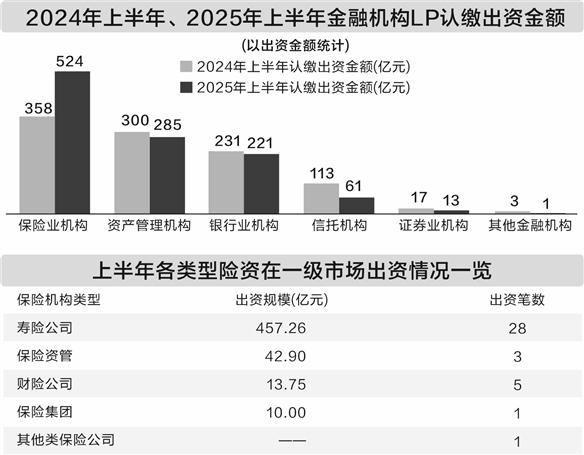
Core Viewpoint - The establishment of Tianjin Jiayu Equity Investment Fund and Suzhou Kuanyu Equity Investment Fund has attracted market attention, with significant participation from insurance capital, indicating a trend of increased investment in the primary market by insurance funds since 2025 [1] Group 1: Investment Trends - Insurance capital's subscribed investment amount in equity investment reached 52.4 billion yuan in the first half of 2025, representing a year-on-year increase of 46% [1] - The general partners (GPs) in this round of insurance capital cooperation include not only state-owned enterprises but also several leading dollar funds and market-oriented venture capital institutions [1] Group 2: Market Dynamics - The acceleration of insurance capital entering the primary market is driven by policy relaxation and the pursuit of diversified allocation paths due to declining interest rates [1] - The continuous entry of long-term funds like insurance capital is expected to transform previously anticipated long-term capital in the primary market into actual investments, injecting more vitality into the market [1]
险资LP“跑步”进入股权投资市场 挑选GP有三大考量
Zheng Quan Shi Bao· 2025-09-04 18:52
Core Insights - The establishment of Tianjin Jiayu Equity Investment Fund and Suzhou Kuanyu Equity Investment Fund has attracted market attention, with significant participation from insurance capital [2][3] - Insurance capital's investment in the primary market has accelerated, with a 46% year-on-year increase in subscribed capital in the first half of 2025, reaching 52.4 billion yuan [3][4] - The surge in insurance capital investment is driven by policy relaxation and the need for diversified asset allocation due to declining interest rates [5][6] Investment Scale and Trends - Tianjin Jiayu Equity Investment Fund has a total investment of 4.5 billion yuan, with insurance companies contributing approximately 4.497 billion yuan, highlighting their dominant role [3] - Suzhou Kuanyu Equity Investment Fund has a larger scale of about 22.429 billion yuan, with significant contributions from insurance companies [3] - In the first half of 2025, insurance capital's subscribed investment in equity reached 52.4 billion yuan, with life insurance companies accounting for nearly 90% of the total [4] Active Insurance Capital Players - Notable active insurance institutions include Ping An Life, Pacific Life, AIA, Sunshine Life, and others, with Ping An Life leading with an investment of 15 billion yuan across six funds [4] - Insurance capital is expanding its equity asset allocation through various methods, including equity investment plans and long-term equity investments [4] Policy and Market Drivers - The dual drivers of policy relaxation and market demand are facilitating the growth of insurance capital in equity investments [5] - Recent regulatory changes have increased the upper limit for equity asset allocation and simplified standards, allowing for greater flexibility in investments [5] Selection Criteria for General Partners (GPs) - Insurance capital prefers GPs with strong backgrounds, focusing on those with substantial registered capital and asset management [7] - The selection criteria emphasize matching investment stages, management capabilities, and performance metrics [7][8] - GPs with robust resources and proven performance in specific sectors are more likely to receive funding from insurance capital [8][9]