乳制品

Search documents
复原乳是「假牛奶」?哪些奶还能用?
36氪· 2025-09-17 10:15
Core Viewpoint - The new regulation prohibits the use of reconstituted milk in pure milk production, aiming to enhance the quality of liquid milk products in China and promote the consumption of fresh milk [8][11][12]. Summary by Sections Regulation Changes - The National Health Commission and the State Administration for Market Regulation issued a modification to the national food safety standard for sterilized milk, effective from September 16, which mandates that sterilized milk can only be made from fresh milk, banning the use of reconstituted milk [8][11]. Definition of Reconstituted Milk - Reconstituted milk, also known as reconstituted milk powder, is created by mixing dried dairy products with water, essentially rehydrating milk powder [9]. Reasons for the Ban - The ban on reconstituted milk in pure milk is based on three main considerations: 1. Implementation of the 2024 Central Document No. 1, which aims to improve liquid milk standards and promote fresh milk consumption. 2. Sterilized milk is a major product in China's liquid milk market, and limiting its raw materials to fresh milk meets consumer demand for high-quality dairy products. 3. The quality and safety of domestic fresh milk have significantly improved, with a 99.9% pass rate in inspections over the past 16 years [11][12]. Impact on the Dairy Industry - The modification is seen as a significant advancement for the dairy industry in China, ensuring the quality of pure milk and addressing the surplus of fresh milk [12]. - Major dairy companies like Yili and Mengniu have already shifted to using fresh milk for their products, minimizing the impact of the new regulation on their operations [21]. Types of Milk Affected - The regulation affects sterilized milk and pasteurized milk, while reconstituted milk can still be used in other categories like flavored milk and fermented milk, which are not subject to the same restrictions [15][21]. Nutritional Value of Reconstituted Milk - Concerns about the nutritional value of reconstituted milk have been addressed, indicating that while pasteurized milk has some advantages, reconstituted milk is not inherently inferior and can still provide essential nutrients [22][24].

“国际质量管理融合创新”案例征集结果公布
Zhong Guo Jing Ji Wang· 2025-09-17 10:01
9月16日,在中国质量(南京)大会全球产业链供应链质量发展与协作专题会议上,质量赋能新质生产 力典型案例方向(二)"国际质量管理融合创新"案例征集结果正式公布, 25个案例成为"国际质量管理 融合创新"典型案例。 据悉,市场监管总局办公厅6月27日印发《关于征集质量赋能新质生产力典型案例的通知》,面向全社 会征集案例,其中方向(二)为国际质量管理融合创新典型案例。在市场监管总局质量发展局指导下, 中国质量报刊社在全国范围内组织开展了"国际质量管理融合创新"案例征集活动。 此次征集共收到27个省(区、市)和新疆生产建设兵团组织152家企业(组织)报送的154个国际质量管 理融合创新案例。其中山东、河北、江苏、广东、浙江、四川等地申报的案例达10个及以上。经企业 (组织)自愿申报、省级市场监管部门初审推荐、中国质量报刊社初评、专家集中评价、社会公示等程 序,最终从征集到的154个案例中确认国际质量管理融合创新入选案例50个,其中典型案例25个,并在 本次专题会议上正式发布。 为保证典型案例征集程序严谨、结果公平,此次案例专家集中评价以案例规范性、实践性、实效性、可 复制性,注重理论探索和实践创新相结合为评价标准。 ...
蒙牛乳业9月17日斥资307.4万港元回购20万股
Zhi Tong Cai Jing· 2025-09-17 09:30
蒙牛乳业(02319)发布公告,于2025年9月17日斥资307.4万港元回购20万股股份。 ...

蒙牛乳业(02319)9月17日斥资307.4万港元回购20万股
智通财经网· 2025-09-17 09:23
Core Viewpoint - Mengniu Dairy (02319) announced a share buyback plan, intending to repurchase 200,000 shares at a cost of HKD 3.074 million, scheduled for September 17, 2025 [1] Company Summary - The company is set to spend HKD 3.074 million on the repurchase of shares [1] - The total number of shares to be repurchased is 200,000 [1]
天润乳业:一季度加速低产牛只的淘汰优化,目前为常规化淘汰
Cai Jing Wang· 2025-09-17 09:15
Core Viewpoint - The company is experiencing a prolonged decline in raw milk prices, which has lasted for 28 consecutive months, marking the longest downturn since 2010 [1] Group 1: Raw Milk Price Trends - As of August this year, the average purchase price of raw milk in major producing provinces is 3.02 yuan per kilogram, reflecting a year-on-year decrease of 5.6% [1] Group 2: Company Operations - The management indicated that the company has accelerated the elimination of low-yield cows in the first quarter, which is now a regular practice [1]

纯牛奶中禁止添加复原乳,有何影响?
Guan Cha Zhe Wang· 2025-09-17 08:49
Core Viewpoint - The revised national standard for sterilized milk, effective from September 16, 2025, prohibits the use of reconstituted milk, mandating that only fresh milk can be used as raw material, which is expected to enhance the quality of dairy products and support the domestic dairy industry [1][5][11]. Group 1: Regulatory Changes - The new standard clarifies that products made with reconstituted milk cannot be labeled as "pure cow (sheep) milk" and will be classified as processed milk [1][2]. - The prohibition of reconstituted milk in sterilized milk production aims to increase the demand for fresh milk, benefiting dairy farmers and improving their income [1][5][11]. Group 2: Nutritional and Quality Aspects - Fresh milk contains more active nutrients compared to reconstituted milk, leading to better taste and quality in products made from fresh milk [1][5]. - The nutritional value of reconstituted milk is inferior to that of fresh milk, as it undergoes significant nutrient loss during processing [2][3]. Group 3: Industry Impact - The ban on reconstituted milk is expected to alleviate the current oversupply of fresh milk in the market, as the demand for fresh milk will increase due to the new regulations [6][11]. - The domestic dairy industry has seen significant improvements in the quality and safety of fresh milk, with a 99.9% pass rate in inspections and a rise in production standards [4][11]. Group 4: Market Dynamics - The overall demand for fresh milk is around 50-55 million tons, while actual consumption is about 45 million tons, indicating a supply surplus [6]. - In 2024, the total production of raw milk in China was 40.79 million tons, a 2.8% decrease year-on-year, marking the first decline since 2018 [7]. Group 5: Price Stability - Experts indicate that the price of fresh milk is unlikely to rise due to the current oversupply situation and the low prices of raw milk, which have been below production costs for many farmers [12][13][14]. - The average retail price of fresh milk has remained stable, with minimal fluctuations observed in 2025, despite concerns about potential price increases due to the new regulations [19][20][21].


伊利股份(600887):营收增速保持回升 公司多个产品持续领跑市场
Xin Lang Cai Jing· 2025-09-17 08:33
Core Viewpoint - The company reported a revenue growth of 3.37% in the first half of 2025, with a revenue of 61.933 billion yuan, while net profit decreased by 4.39% to 7.200 billion yuan, indicating a mixed performance amid market challenges [1] Group 1: Financial Performance - The company achieved a revenue of 61.933 billion yuan in H1 2025, with a year-on-year growth of 3.37% [1] - The net profit for the same period was 7.200 billion yuan, reflecting a decline of 4.39% [1] - The gross profit margin improved to 36.05%, an increase of 1.26 percentage points year-on-year [1] - Operating costs were reported at 39.509 billion yuan, with a growth of 1.49% [1] - The company’s net profit margin was 11.71%, up by 0.97 percentage points year-on-year [1] Group 2: Market Position and Product Performance - The liquid milk business generated revenue of 36.126 billion yuan, accounting for 58.4% of total revenue, and maintained the leading market share in both offline and major e-commerce platforms [2] - The company’s milk powder and dairy products segment achieved revenue of 16.578 billion yuan, a growth of 14.26%, representing 26.77% of total revenue [3] - The company’s cold drink business reported revenue of 8.229 billion yuan, with a growth of 12.39%, and also held the leading market share [3] Group 3: Strategic Initiatives - The company has entered the Hong Kong market through a strategic partnership with a well-known health retail chain, marking a significant step in its internationalization efforts [4] - The company is advancing its "WISH 2030" sustainable development strategy, aiming to become the global leader in the dairy industry by 2030 [4] - The company has established 81 production bases globally, with products available in over 60 countries, enhancing its supply chain and consumer insights through digital transformation [4] Group 4: Future Projections - The company forecasts revenues of 119 billion yuan, 123.8 billion yuan, and 128.9 billion yuan for 2025, 2026, and 2027, respectively, with year-on-year growth rates of 3.1%, 4.1%, and 4.1% [5] - Expected net profits for the same years are projected at 11.4 billion yuan, 12.1 billion yuan, and 12.6 billion yuan, with corresponding EPS of 1.81 yuan, 1.92 yuan, and 2.00 yuan [5]
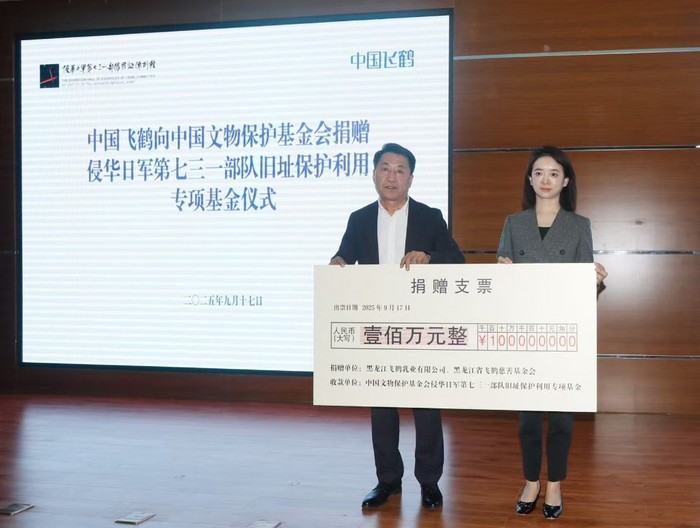
中国飞鹤向中国文物保护基金会捐赠侵华日军第七三一部队旧址保护利用专项基金
Xin Lang Cai Jing· 2025-09-17 08:07
Group 1 - China Feihe donated to the Special Fund for the Protection and Utilization of the Site of the Japanese Army's Unit 731, demonstrating its commitment to historical heritage protection [1][3] - The donation aims to support the application of the Unit 731 site for World Cultural Heritage status, showcasing the company's role in social responsibility and historical memory preservation [3] - Founded in 1962, China Feihe is one of the earliest milk powder companies in China, originating from Qiqihar, Heilongjiang [3] Group 2 - The donation serves as a high-standard practical example for social participation in historical heritage protection, emphasizing its historical, public, and educational value [3] - The financial support provided by China Feihe strengthens the foundation for the protection of the Unit 731 site [3] - The act reflects China Feihe's commitment as a national enterprise to uphold the memory of the nation and fulfill its social responsibilities [3]
食品饮料行业2025H1业绩综述报告:业绩增速明显放缓,只有啤酒、软饮料、调味品、肉制品营收利润双增长
Wanlian Securities· 2025-09-17 08:01
Investment Rating - The report maintains an "Outperform" rating for the food and beverage industry [5] Core Insights - The food and beverage sector is experiencing a significant slowdown in performance, with a year-on-year decline in net profit attributable to shareholders. The sector's revenue for H1 2025 reached 580.635 billion yuan, a year-on-year increase of 2.41%, while net profit attributable to shareholders was 127.508 billion yuan, reflecting a year-on-year decrease of 0.56% [2][16] - The report highlights that the growth rates of revenue and net profit have declined compared to H1 2024, with revenue growth down by 1.30 percentage points and net profit growth down by 14.52 percentage points. The sector's gross margin and net margin have also decreased year-on-year [2][16] Summary by Sections Overall Performance - The food and beverage sector's revenue growth has slowed significantly, ranking 14th among 31 sub-industries, while net profit growth ranked 20th [2][16] - The sector's gross margin and net margin have decreased year-on-year, although the expense ratio remains relatively stable [3][21] Sub-sector Performance - Snack foods, soft drinks, and fermented seasonings showed the highest revenue growth rates, with increases of 36.36%, 9.08%, and 4.66% respectively. In terms of net profit growth, beer, fermented seasonings, and soft drinks led with increases of 12.06%, 8.04%, and 4.89% respectively [2][25] - The beer sector achieved positive growth in both revenue and net profit, with revenue increasing by 2.75% and net profit by 12.06% in H1 2025. Major beer companies like Zhujiang Beer and Yanjing Beer performed well, with net profit growth exceeding 22% [8][41] Wine Sector - The wine sector experienced a slight decline in revenue and net profit, with H1 2025 revenue at 241.508 billion yuan, down 0.86% year-on-year, and net profit at 94.561 billion yuan, down 1.18% year-on-year. This marks the first negative growth since H1 2014 [4][28] - High-end wines showed resilience, with revenue growth of 6.17% and net profit growth of 5.49%. The market share of leading brands like Moutai and Wuliangye remained strong [34][35] Investment Recommendations - The report suggests structural investment opportunities in the food and beverage sector, particularly in the beverage, snack, and health food industries. It emphasizes the potential in energy drinks and innovative snack brands [10] - The beer, seasoning, and dairy sectors are identified as areas for marginal improvement, while the wine sector is viewed as being in a bottoming phase, with limited downside risk [10]




西安市未央区市场监督管理局食品抽检通告(2025年第25号)
Zhong Guo Zhi Liang Xin Wen Wang· 2025-09-17 06:56
Core Viewpoint - The Xi'an Weiyang District Market Supervision Administration conducted a food safety inspection, testing 51 batches of samples across 11 food categories, with all samples passing the safety standards, indicating a strong compliance with food safety regulations in the region [2][3]. Group 1: Inspection Results - A total of 51 batches of food samples were tested, covering categories such as condiments, bean products, honey products, canned goods, alcoholic beverages, grain products, dairy products, sugar, agricultural products, fruit products, and beverages [3]. - All 51 batches of samples were found to be compliant with national food safety standards, resulting in a 0% non-compliance rate [2][3]. Group 2: Categories of Food Tested - The inspection included a diverse range of food categories, specifically: - Condiments - Bean products - Honey products - Canned goods - Alcoholic beverages - Grain processing products - Dairy products - Sugar - Agricultural products - Fruit products - Beverages [3].