电子商务

Search documents
京东:超半数职场人在意中秋福利实用性
Bei Jing Shang Bao· 2025-08-18 12:47
Group 1 - The core viewpoint of the report indicates that corporate Mid-Autumn Festival procurement is characterized by "steady changes," with over 70% of purchasers seeking a balance between historical data and established plans [1] - There is a notable increase in the awareness of implicit cost management among purchasers, with over 70% preferring welfare forms that include electronic vouchers [1] - The trend in welfare distribution strategies is shifting towards "lightweighting," indicating a preference for simpler and more efficient options [1] Group 2 - More than half of the workforce prioritizes practicality in their welfare preferences, with staple foods and digital products being the most frequently chosen items [1] - 36.8% of employees are looking for "novelty" in products, expressing interest in cross-industry collaborations and creative designs [1] - 32.4% of employees value "quality" in products, desiring welfare that combines usability with emotional recognition [1] Group 3 - Health and wellness products, outdoor goods, and home service vouchers are also gaining popularity among employees [1]

京东发布中秋采购趋势报告:南礼卡北粮油 中秋福利采购呈现鲜明地域和行业特征
Zhi Tong Cai Jing· 2025-08-18 09:21
Core Insights - The report highlights the evolving nature of corporate Mid-Autumn Festival welfare procurement, moving from standardized offerings to more refined operations, with over 70% of procurement personnel seeking a balance between historical data and established plans [1][2] - The emotional connection of Mid-Autumn welfare is increasingly significant, with over 80% of employees believing that such benefits enhance their sense of belonging to the company [2][3] Procurement Trends - Over 55% of employees prioritize practical needs in welfare selection, while procurement personnel are introducing diverse categories such as health, digital, and household cleaning products [2][3] - 43% of procurement personnel express concerns about the homogenization of welfare offerings, and 42% face challenges in catering to diverse employee preferences [2][3] Regional Preferences - Regional cultural influences shape welfare preferences, with variations such as "southern gift cards and northern grains" and "eastern diversity versus western tradition" [3][4] - In Guangdong, gift cards are the preferred choice, while in Heilongjiang, traditional food items dominate, reflecting local customs [3][4] Cost Management - Cost control is a key consideration in welfare procurement, with 49% of procurement personnel focusing on direct purchase prices and 39% concerned about hidden costs from ineffective welfare [5][6] - The integration of digital tools by companies like JD.com enhances procurement efficiency and reduces costs, with 63% of procurement personnel indicating a need for multi-address ordering [5][6] Quality Concerns - Nearly 40% of procurement personnel report issues with product quality when sourcing from platforms other than JD.com, highlighting the importance of quality alongside price in procurement decisions [6][7] - JD.com emphasizes the selection of quality products, with over 10 million SKUs available, gaining trust from corporate clients [6][7] Platform Preference - JD.com has emerged as the preferred online platform for corporate welfare procurement, with its selection rate exceeding that of other platforms by more than double [7] - The company has served over 8 million active corporate clients, including over 90% of Fortune 500 companies in China, showcasing its extensive reach and reliability [7]
安徽财贸学院教授葛晓滨:平台经济“反内卷”的核心在于重构竞争逻辑
Sou Hu Cai Jing· 2025-08-18 03:37
Core Viewpoint - The platform economy is currently trapped in a "low-price competition" and "subsidy war," necessitating urgent solutions to break this cycle and promote healthy development [1][22]. Group 1: Current Situation of Platform Economy - The platform economy is experiencing systemic characteristics of "involution," with low-price subsidies leading to a cycle of "low price - low quality - further price reduction," degrading both product quality and pricing [11]. - Non-market methods such as "choose one from two," exclusive rebates, and forced traffic allocation are increasing costs for merchants and squeezing their survival space [11]. - Algorithmic recommendations and punitive mechanisms are transferring competitive pressure down the supply chain, exerting hidden pressure on small market players [11]. Group 2: Deep-rooted Causes - The market structure is imbalanced, with high concentration among leading platforms forcing smaller players into subsidy competitions, resulting in unhealthy competition [12]. - Capital logic dominates, with financing agreements emphasizing GMV as a core indicator, leading to short-term behaviors that suppress long-term value cultivation [12]. - There is a lack of innovation momentum, with limited competitive methods restricted to price wars and traffic battles, hindering sustainable competitiveness [12]. - Regulatory frameworks addressing emerging issues like algorithm pricing and data blocking are still underdeveloped, lacking a complete constraint mechanism [12]. Group 3: Core Contradictions - The fundamental conflict lies between "maximizing short-term traffic" and "sustaining long-term ecological viability," manifesting in several ways: - Homogeneous competition suppresses innovation incentives [13]. - The pursuit of capital profit conflicts with market fairness [13]. - Consumer preferences for short-term low prices clash with long-term quality rights [13]. - The need for global value chain competition contradicts domestic inefficient involution [13]. Group 4: Negative Impacts of Involution - On the platform level, profitability is weakened, with cash flow heavily reliant on external financing, reducing risk resistance [14]. - The industry faces compressed profit margins, with innovation investments yielding to marketing expenses, slowing technological iteration [15]. - Nationally, resource allocation issues arise as production factors tilt towards subsidies and traffic purchases, with insufficient investment in R&D and manufacturing upgrades [16]. Group 5: Transition Strategies - Transitioning from "traffic involution" to "value creation" involves: - Upgrading from "consumer algorithms" to "industry algorithms" to optimize capacity forecasting and inventory management, reducing operational costs [17]. - Shifting evaluation metrics from GMV to Total Value to Ecosystem (TVE), incorporating user retention, merchant profitability, and worker rights into a comprehensive evaluation system [18]. - The core of "anti-involution" in the platform economy is to reconstruct competitive logic, focusing on "value innovation" rather than "traffic arbitrage" [18].


阿里第一位程序员 “多隆”,离职了,靠写代码身价数十亿......
菜鸟教程· 2025-08-18 03:30
Core Viewpoint - The article highlights the remarkable journey and technical prowess of Cai Jingxian, also known as "Duolong," a legendary figure in Alibaba's history, emphasizing his contributions to the development of Taobao and his status as a revered technical expert within the company [2][3][4]. Group 1: Technical Expertise - Duolong is regarded as a unique talent at Alibaba, with unparalleled problem-solving abilities, often resolving issues that stumped entire teams [4][5]. - His technical contributions include the development and maintenance of Taobao's search engine, file systems, and various middleware, showcasing his capability to handle complex projects single-handedly [18][19]. - Duolong's approach to problem-solving involves deep dives into source code, demonstrating his passion for technology and commitment to finding solutions [4][21]. Group 2: Personal Background - Born in a rural family in Zhejiang Province, Duolong's early education was marked by a strong interest in mathematics and a fascination with computers, which laid the foundation for his future career [8][9]. - Despite not being formally trained in computer science, his curiosity and self-driven learning led him to excel in technology [7][8]. Group 3: Career Development - Duolong was one of the early programmers at Taobao, joining a secretive team tasked with developing the platform to compete with eBay [10][11]. - His commitment to coding and problem-solving earned him a reputation as a go-to person for technical challenges within the company [12][14]. Group 4: Recognition and Impact - Duolong's achievements led to his selection as an Alibaba partner, a prestigious position that reflects his influence and contributions to the company [25]. - His estimated wealth reached 2.6 billion RMB, highlighting the financial success that accompanied his technical expertise [26]. Group 5: Insights on Becoming a Technical Expert - Duolong emphasizes that becoming a top technical expert requires dedication, continuous learning, and a willingness to tackle challenges head-on [27]. - He advocates for the importance of problem-solving and refining one's skills through practice and experience [27][28].


京东这一仗,单季血亏超百亿
雷峰网· 2025-08-18 00:52
Core Viewpoint - JD's entry into the food delivery market has resulted in significant financial losses, impacting its overall profitability and stock performance, despite a record revenue growth in Q2 2025 [2][3][9]. Group 1: Financial Performance - In Q2 2025, JD reported a revenue of 356.66 billion yuan, a year-on-year increase of 22.4%, but net profit dropped by 50.8% to 6.2 billion yuan [2][7]. - The operating loss in the new business segment, which includes food delivery, surged from 700 million yuan to 14.8 billion yuan year-on-year, leading to an overall operating loss of 900 million yuan [8][9]. - Marketing expenses skyrocketed from 11.9 billion yuan to 27 billion yuan, a 127.6% increase, significantly outpacing revenue growth [8]. Group 2: Market Dynamics - JD's stock price fell over 33% from a peak of 179 HKD in March to 120.3 HKD by mid-August, reflecting investor concerns about its profitability [4][10]. - The food delivery business, which generated 13.9 billion yuan in revenue, is seen as a major focus for analysts, despite its substantial losses [5][8]. Group 3: Strategic Outlook - JD's CEO emphasized the long-term vision for food delivery and instant retail, aiming for sustainable business models rather than short-term profits [11]. - Despite the challenges, JD's core retail business remains strong, with a 20.6% revenue growth, contributing significantly to overall profits [7][12]. - Analysts express skepticism about JD's ability to maintain user growth and profitability in the food delivery sector, especially given the competitive landscape [11][14].

2025年亚马逊加拿大站点热卖趋势及机会选品报告-亚马逊全球开店
Sou Hu Cai Jing· 2025-08-17 16:32
Group 1: Consumer Electronics - The wireless electronics category is highly competitive, with opportunities in smart wearable devices and smart security equipment, requiring attention to technological innovation and compliance [1][10] - In the computer category, laptops and tablets show high opportunity scores, with a focus on compliance and patents, while providing quality after-sales service [1][11] - The electronic devices category is rapidly evolving, with significant opportunities in wearable devices and accessories, emphasizing quality and innovation [1][12] Group 2: Office Supplies - The demand for office supplies has increased due to remote work, with three peak sales periods each year, necessitating careful inventory and promotional planning [1][13] - Key products include ink/toner, desktop supplies, and classroom supplies, all showing good market potential [1][13] Group 3: Lifestyle Products - The home improvement category has a high composite score, suitable for sellers with supply chain advantages, focusing on design and after-sales service [2] - Furniture demand is growing, particularly for home office furniture, requiring a balance between functionality and cost [2] - The gardening and yard category has significant demand, with seasonal bestsellers needing attention to quality control and inventory planning [2] Group 4: Fashion Products - The apparel category shows broad growth, especially in women's fashion, requiring sellers to stay on trend and manage sizing effectively [2] - Footwear has many subcategories with growth opportunities, particularly in children's shoes, necessitating attention to size and quality [2] Group 5: Fast-Moving Consumer Goods - The beauty and personal care category is highly competitive, with a focus on natural and organic products, particularly for men's grooming [2] - The grocery category is sensitive to brand perception, with rising demand for health foods, requiring compliance and safety guarantees [2] Group 6: Sports and Outdoor Products - The sports category requires attention to functionality and professionalism, with precise targeting and seasonal marketing strategies [1][22] - Automotive products emphasize compatibility and durability, necessitating detailed information and compliance checks [1][23] Group 7: Industrial Products - Industrial products have strict compliance requirements, necessitating the display of certifications and provision of technical support [1][24] - Outdoor products focus on materials and safety, requiring seasonal promotions and eco-labeling [1][24]


跑到新加坡的Manus,可能白跑了;只剩两家店,优衣库“亲妹妹”败退中国丨Going Global
创业邦· 2025-08-17 11:12
Key Points - The article discusses significant events in the global market, focusing on companies expanding their operations and facing challenges in various regions [2][3]. Group 1: Major Events - TikTok Shop's launch in Japan has faced obstacles, with sellers expressing concerns about the platform's viability in a market that values traditional retail practices [5]. - SHEIN's sales in the UK reached £2.05 billion (approximately $2.77 billion) in 2024, marking a 32.3% increase from the previous year, with pre-tax profits rising from £2.44 million to £3.83 million [6]. - Temu has become the fastest-growing retail brand in Australia, attracting 1.35 million new users in the 2024/2025 fiscal year, with advertising spending doubling in recent months [7][8]. - AliExpress has launched an "overseas hosting" service in Mexico, allowing local merchants to stock products and benefit from various incentives [10][13]. Group 2: Company Developments - Manus is facing scrutiny from U.S. authorities regarding its funding round led by Benchmark, which may lead to the venture capital firm exiting its investment [15][17]. - SHEIN's beauty brand SHEGLAM is set to enter Germany's largest drugstore chain, DM, with plans to launch in up to 1,500 stores [18][20]. - JD.com has completed the acquisition of Hong Kong's Jia Bao supermarket chain, with the transaction reportedly valued at HK$4 billion [21][23]. - Didi's food delivery platform 99Food has launched in Brazil, implementing a strategy to reduce delivery costs and attract customers [24][26]. Group 3: Market Trends - Xiaomi is increasing its investment in the African market, appointing several executives to strengthen its presence [27][29][30]. - Uniqlo's sister brand GU will close its first store in China, although the company states it is not exiting the market [38][39][43]. - Intersport is considering shifting production to China to increase its procurement of private label products [35][37]. - Amazon is testing a low-cost platform in Australia to compete with Temu and SHEIN, reflecting the growing price sensitivity among consumers [44][46]. Group 4: Investment News - Grab plans to invest tens of millions of dollars in autonomous driving company WeRide, aiming to integrate its technology into Grab's fleet management [52]. - Ninja Van is negotiating a new funding round of approximately $80 million, but its valuation has been halved [54]. - Carlyle Group is set to acquire the UK online retailer Very Group, which has been experiencing declining sales [56][58]. - Dubai fintech company Alaan has raised $48 million in a Series A funding round, marking one of the largest A-round financings in the region [59][60].

京东2025Q2收入增速领跑行业 零售、外卖协同联动加码核心业务
Zhong Guo Jin Rong Xin Xi Wang· 2025-08-17 08:19
Core Insights - JD.com reported a significant revenue increase of 22.4% year-on-year for Q2 2025, reaching 356.7 billion yuan, exceeding market expectations by 6 percentage points [1] - The company's Non-GAAP net profit for the same period was 7.4 billion yuan, also surpassing consensus estimates [1] - The growth was driven by the success of the trade-in policy, particularly in the electronics and home appliance categories, which saw a revenue increase of 23.4% [2][6] Retail Business Performance - JD's core retail business generated 310.1 billion yuan in revenue for Q2 2025, reflecting a 20.6% year-on-year growth, exceeding market expectations by approximately 5 percentage points [2] - Operating profit for the retail segment was 13.9 billion yuan, up from 10.1 billion yuan in the same quarter last year, with an operating profit margin of 4.5%, an increase of 0.6 percentage points year-on-year [2] - The daily necessities category maintained double-digit growth for six consecutive quarters, with a 16.4% year-on-year revenue increase [2][3] User Engagement and Growth - JD.com experienced over 40% year-on-year growth in quarterly active users and shopping frequency, marking the seventh consecutive quarter of double-digit growth in active users [2][3] - The "618" shopping festival saw a more than 100% increase in the number of placing orders, with overall order volume exceeding 2.2 billion [3] New Business Developments - JD's new business, including food delivery, saw a remarkable revenue increase of 199% year-on-year in Q2 2025 [6] - The food delivery service achieved a daily order volume exceeding 25 million, covering 350 cities and involving over 150,000 quality dining establishments [6][7] - The launch of the "Seven Fresh Kitchen" platform aims to innovate the food delivery sector, with plans to establish 10,000 locations nationwide within three years [7] Supply Chain and Differentiation - JD's supply chain capabilities were highlighted as a key factor in achieving high-quality user experiences and operational efficiency, with retail gross margins increasing for 13 consecutive quarters [3][5] - The company is focusing on customized products and differentiated shopping experiences through its private label offerings and innovative packaging strategies [4][5]
下周重磅日程:杰克逊霍尔央行年会、美俄乌三方会谈,万众瞩目!
Hua Er Jie Jian Wen· 2025-08-17 07:28
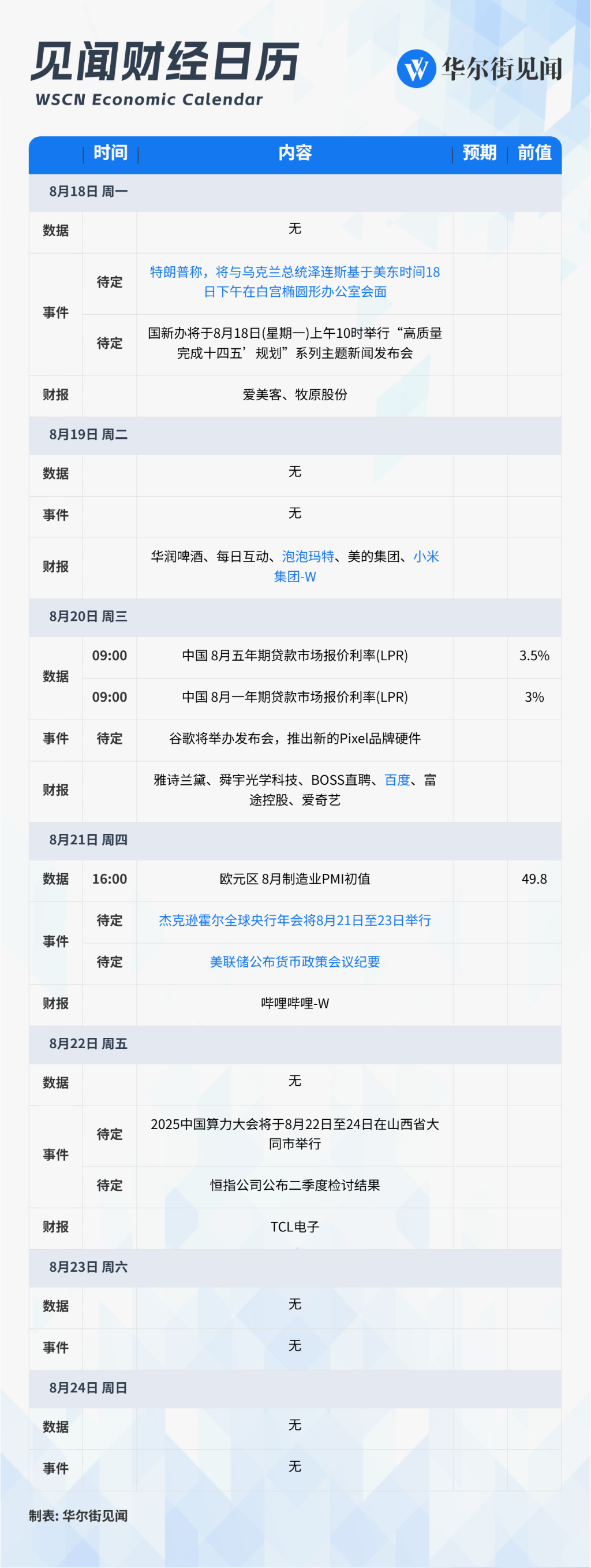
Group 1: Economic Events - The Jackson Hole Global Central Bank Conference will be held from August 21 to 23, with expectations that Powell will not reveal the September interest rate decision but will focus on the Fed's monetary policy framework assessment [5][9] - The market anticipates a 62.9% probability of a 25 basis point rate cut in September, with a 22.5% chance of a 50 basis point cut, influenced by recent economic data showing a moderate rise in CPI and a cooling job market [5][12] - The Eurozone's August manufacturing PMI preliminary value is reported at 49.8, indicating a potential recovery in manufacturing activity [2][16] Group 2: Company Earnings Reports - Xiaomi Group is expected to report Q2 earnings on August 19, with revenue projected to grow approximately 32% year-on-year, reaching around 117 billion yuan, and net profit expected to increase over 66% [17][18] - Baidu's Q2 revenue is forecasted to be between 32.693 billion and 34.521 billion yuan, with net profit expected to decline by 25.1% to 45.1% year-on-year [19][20] - Pop Mart anticipates a revenue increase of no less than 200% for the first half of 2025, with net profit expected to grow by at least 350% [21] - Midea Group is projected to achieve Q2 revenue between 135 billion and 140 billion yuan, reflecting a year-on-year growth of 15% to 20% [22][23] - Walmart's upcoming Q2 earnings report is expected to reinforce its bullish investment thesis, showcasing strong fundamentals despite economic headwinds [24]


世界500强,全球城市分布情况
首席商业评论· 2025-08-17 05:14
Core Insights - The 2025 Fortune Global 500 list shows that the revenue threshold for inclusion is $32.2 billion, a slight increase from the previous year [4] - The top three companies are Walmart, Amazon, and State Grid, with Apple and Nvidia ranking 8th and 66th respectively [4] - The United States leads with 138 companies, followed by China with 130, and Japan with 38 [5] Group 1: Global Company Distribution - The United States has 138 companies on the list, a decrease of one from last year, while China has 130, down by three [5] - Japan ranks third with 38 companies, also down by two [6] - Together, these three countries account for over 60% of the total number of companies, revenue, and profits on the list [5] Group 2: City Distribution - Beijing ranks first globally with 47 companies, although it has decreased by two from the previous year [7] - Tokyo follows with 26 companies, and New York has 14 [7] - Shanghai and London are tied for fourth with 12 companies each [7] Group 3: Chinese City Distribution - In China, Beijing leads with 47 companies, followed by Shanghai with 12, and Shenzhen and Hangzhou with 9 each [9] - The Greater Bay Area has a total of 23 companies, with Guangdong contributing 18 [15] - The top cities in the Greater Bay Area include Shenzhen, Guangzhou, and Hong Kong [15] Group 4: Company Performance - The total revenue of Chinese companies on the list is approximately $10.7 trillion, a year-on-year decrease of 3% [5] - Average sales revenue for Chinese companies is $82 billion, lower than the $105.8 billion average for U.S. companies [5] - The average profit for Chinese companies is $4.2 billion, about half of that of U.S. companies [5] Group 5: Notable Chinese Companies - Notable companies from China include State Grid, China National Petroleum, and Sinopec, with revenues of $54.84 billion, $41.26 billion, and $40.75 billion respectively [20][21] - The list includes three real estate companies: Vanke, Country Garden, and Greenland Holdings, with Country Garden making a return to the list [4][20]