农产品贸易

Search documents
南农晨读 | 粤桂协作 肇贺同心
Nan Fang Nong Cun Bao· 2025-11-23 03:02
南农晨读 | 粤桂 协作 肇贺同心_ 南方+_南方plus 【今日关注】 观察|南药食养 肇庆启航 当前,我国正处 在"健康中 国"与"乡村振 兴"两大战略的 历史交汇点。在 政策层面,"健 康声称"制度的 探索已提上日 程,诸如"杞具 有补肾、补肝作 用"等传统功效 合法出现在食品 标签指日可待, 这为南药药食养 文化与现代食品 产业融合开启了 无比广阔的天 地。 图集|"肇"亮湾 区,"贺"礼羊城 深秋的广州,寒 风掠过北京路骑 楼的廊檐,却吹 不散街头渐浓的 热情。11月21 日,"粤桂协作· 肇贺同心——媒 体+肇贺'土特 产'产销对接活 动"在广州北京 路举行,来自肇 庆与贺州的山水 风物惊艳亮相千 年商都,为湾区 市民带来一场融 合瑶乡风情的诗 意盛宴。 老校舍变致富车 间,旧操场成夜 游胜地丨驻在千 镇万村㉕ "以前界炮镇晚 上冷冷清清,看 不到人,现在每 天都能看到很多 运动和唱歌的群 众,非常热 闹。"驻湛江市 遂溪县界炮镇帮 近日,一场别开 生面的"粤桂协 作·肇庆同心 ——媒体+肇 贺'土特产'产销 对接活动"在广 州市北京路举 行。活动上,四 位来自粤桂协作 一线的代表,通 过真挚朴实 ...


共建“名厨+好食材”直通平台,“清城优选”飘香大湾区
Nan Fang Nong Cun Bao· 2025-11-22 11:30
Core Viewpoint - The Panyu District Chef Association and the Qingtian Supply and Marketing Cooperative have signed a strategic cooperation agreement to create a "Famous Chef + Quality Ingredients" direct platform, enhancing the agricultural product supply chain and promoting local products in the Greater Bay Area [6][11][10]. Group 1 - The strategic cooperation aims to enhance product and service value through resource sharing and complementary advantages, facilitating mutual empowerment between the catering industry and agricultural supply chain [8][9]. - The initiative includes the launch of the "Qingcheng Preferred" agricultural product exhibition, showcasing high-quality local products in multiple exhibition areas [12][16]. - The collaboration is a significant step in deepening cross-regional cooperation between Qingtian and Panyu, building on previous events that laid a solid foundation for this partnership [26][29]. Group 2 - The innovative model of "Supply and Marketing Cooperative + Catering Association + Restaurants" aims to boost the market competitiveness and brand influence of Qingtian's specialty agricultural products [31][32]. - The responsible person from Zhenlian Agricultural Trade expressed intentions to deepen cooperation with the Greater Bay Area catering industry and expand sales channels through community engagement and new retail strategies [34][35]. - The "Famous Chef Leading Freshness, Community Deep Cultivation" plan will be initiated to enhance consumer awareness of ingredient sources and quality stories, promoting "Qingcheng Preferred" products to more families in the Greater Bay Area [36][38].
800万吨大豆订单作废,中国重启美豆采购,巴西因涨价后悔莫及
Sou Hu Cai Jing· 2025-11-22 07:15
巴西的港口堆积着200万吨大豆,形成了如同黄金山般的景象,每天的滞港费用高达120万美元。而就在几个月前,这些大豆还被出口商视为稀缺宝贝,称之 为金豆子。 这场危机的根源在于巴西大豆价格的急剧上涨。从年初每吨360美元一路飙升至650美元,涨幅接近80%,创下七年来的新高。在桑托斯港,大 豆报价每蒲式耳比芝加哥期货交易所的基准价高出2.8到2.9美元,比美国大豆的溢价高出近1美元。 面对如此局面,中国的压榨企业感受到了巨大的成本压 力。每加工一吨巴西大豆就可能亏损200多元,山东部分企业的豆粕出厂价甚至低于原料成本,每吨倒挂高达80元。10月17日,中国大豆产业协会发布公 告,国内企业决定集体暂停采购今年12月和明年1月船期的巴西大豆,总量高达800万吨,相当于巴西对华月出口量的七成。 美国豆农对此感到欣慰。自中国暂停采购以来,美国大豆库存已积压至4200万吨,部分粮仓甚至因不堪重负而发生坍塌。北达科他州、伊利诺伊州等农业州 对华出口高度依赖,这些传统共和党铁票仓的农民压力倍增。尽管18万吨订单量不大,但象征意义重大。这一采购与中美吉隆坡经贸谈判顺利收官的时间相 吻合,美方在谈判中明确表示不再考虑加征100% ...
2025年10月中国大麦进口数量和进口金额分别为115万吨和2.97亿美元
Chan Ye Xin Xi Wang· 2025-11-22 03:08
Core Insights - The report by Zhiyan Consulting analyzes the operational landscape and future prospects of the oat industry in China from 2026 to 2032 [1] Import Data - In October 2025, China's barley imports reached 1.15 million tons, marking a year-on-year increase of 22% [1] - The import value for barley was $297 million, reflecting a year-on-year growth of 26% [1] Company Profile - Zhiyan Consulting is recognized as a leading industry consulting firm in China, specializing in in-depth industry research reports, business plans, feasibility studies, and customized services [1] - The company has over a decade of experience in the industry research field, providing comprehensive industry solutions to empower investment decisions [1]

保持首位!深圳前10月进出口总值3.74万亿元
Shen Zhen Shang Bao· 2025-11-21 07:03
Core Insights - Shenzhen's total import and export value reached 3.74 trillion yuan in the first ten months of 2025, maintaining its position as the leading city in mainland China [1] - Exports amounted to 2.27 trillion yuan, while imports were 1.47 trillion yuan, reflecting a year-on-year growth of 6.8% [1] Export Summary - The export of electromechanical products continued to dominate, totaling 1.72 trillion yuan, with a growth rate of 4%, accounting for 75.7% of total exports [1] - In the traditional electronics sector, exports of computers and their components reached 263.96 billion yuan and 75.59 billion yuan, growing by 9.6% and 6.5% respectively [1] - Emerging industries saw significant export growth, with lithium batteries, 3D printers, and medical devices exporting 70.06 billion yuan, 6.75 billion yuan, and 25.12 billion yuan, reflecting growth rates of 35.6%, 19.8%, and 5.5% respectively [1] Import Summary - Imports exhibited strong production demand and an upgrade in demand for food and aquatic products, with a total of 1.2 trillion yuan in electromechanical product imports, growing by 8.5% [2] - Integrated circuits accounted for 661.53 billion yuan in imports, with an 18.4% increase, while computer components, primarily graphics cards and servers, reached 242.7 billion yuan, growing by 12.3% [2] - Agricultural product imports totaled 82.26 billion yuan, increasing by 10%, with food grains and aquatic products seeing remarkable growth rates of 107.7% and 36.2% respectively [2]
中国周一至少采购了 14 船美国大豆!
Sou Hu Cai Jing· 2025-11-21 02:15
Core Insights - China has made a significant purchase of 14 vessels of U.S. soybeans, marking the largest procurement since January and the most important transaction following the October U.S.-China meeting [1] - COFCO Group has procured at least 840,000 tons of U.S. soybeans, scheduled for shipment between December and January, with a majority expected to be shipped from the Gulf Coast [3] - The U.S. government anticipates that China will purchase 12 million tons of U.S. soybeans this year, although only a small portion has been completed so far [3] Pricing and Market Dynamics - The price of soybeans shipped from the Gulf Coast is estimated to be $2.35-$2.40 per bushel higher than the January Chicago contract, while those from the Pacific Northwest are $2.15-$2.20 higher, significantly above Brazilian soybean prices [3] - U.S. soybean futures rose nearly 3% on Monday, reaching a 17-month high, driven by optimistic sentiment regarding U.S.-China trade relations [5] Historical Context - Previously, due to escalating U.S.-China trade tensions, China had largely ceased purchasing U.S. soybeans, opting instead for suppliers like Brazil and Argentina [5] - The absence of Chinese purchases led to a significant drop in U.S. soybean prices during the summer, exacerbating challenges for the agricultural sector already facing rising input costs [5]
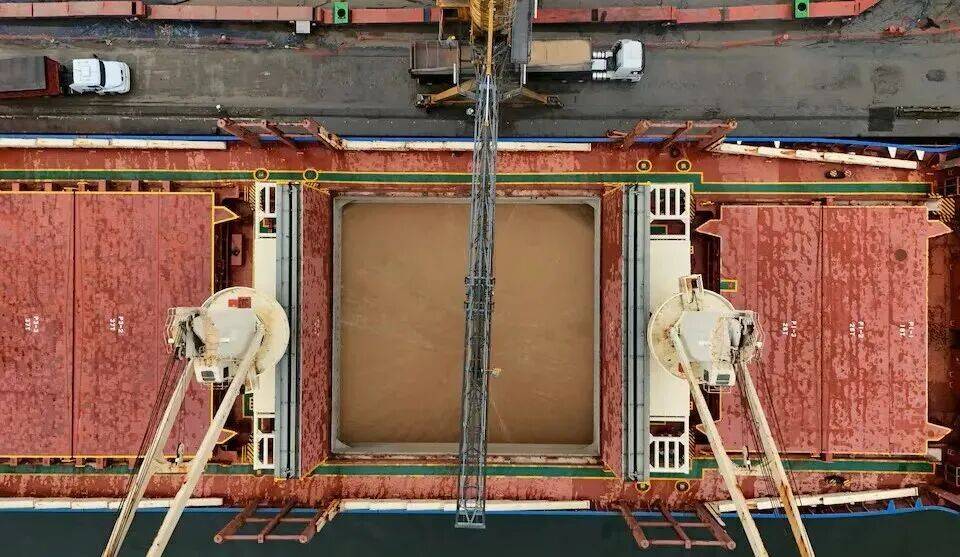
美总统特朗普修改对巴西商品关税范围
Yang Shi Xin Wen Ke Hu Duan· 2025-11-20 22:09
Group 1 - The core point of the article is the announcement by the White House regarding President Trump's executive order to modify the tariff range on goods imported from Brazil, aiming to balance national security concerns with the development of trade relations with Brazil [1] Group 2 - A 40% ad valorem tariff will remain unchanged on certain products, while specific Brazilian agricultural products will have the additional ad valorem tariff removed for those entering the U.S. after November 13 at midnight Eastern Time [1] - The White House stated that this decision reflects progress in negotiations between the U.S. and Brazil [1]
深圳市光启互联贸易有限公司成立 注册资本1万人民币
Sou Hu Cai Jing· 2025-11-20 08:45
Core Viewpoint - Shenzhen Guangqi Huilian Trading Co., Ltd. has been established with a registered capital of 10,000 RMB, focusing on various agricultural and food-related operations [1] Group 1: Company Overview - The legal representative of Shenzhen Guangqi Huilian Trading Co., Ltd. is Nie Huanghuang [1] - The company is engaged in a wide range of activities including the initial processing, wholesale, and retail of edible agricultural products [1] - The company also deals with non-edible agricultural product processing and sales of agricultural intelligent logistics equipment [1] Group 2: Business Scope - The general business scope includes food sales (limited to pre-packaged food), health food sales (pre-packaged), and various retail activities such as cosmetics, personal hygiene products, and daily household appliances [1] - The company is authorized to conduct licensed operations including food sales, internet food sales, and electronic cigarette retail [1] - The company is permitted to operate only after obtaining the necessary approvals from relevant authorities for specific projects [1]
中非共绘互利共赢新图景
Jing Ji Ri Bao· 2025-11-20 02:01
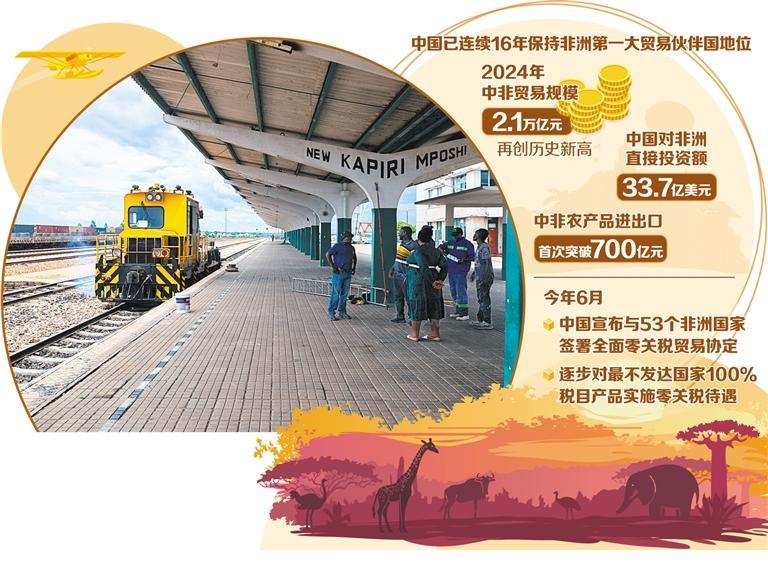
Group 1: Economic Partnership and Trade Agreements - China is actively signing economic partnership agreements to implement 100% zero-tariff measures on products for 53 African countries, with the Republic of Congo being the first beneficiary [1] - China has maintained its position as Africa's largest trading partner for 16 consecutive years, with trade volume expected to reach 2.1 trillion yuan in 2024, setting a new historical record [1] Group 2: Agricultural Trade Growth - The bilateral trade structure between China and Africa is diversifying, with African agricultural products becoming a significant highlight, as imports of agricultural products from Africa to China are projected to exceed 70 billion yuan in 2024 [2] - In the first five months of this year, China imported 15.83 billion yuan worth of agricultural products from Africa, with notable increases in coffee (145.7%), cocoa beans (88.6%), and frozen strawberries (82%) [2] Group 3: Investment and Infrastructure Development - In 2024, China's direct investment in Africa is expected to reach 3.37 billion USD, primarily concentrated in construction, mining, and manufacturing sectors [6] - Chinese enterprises have participated in the construction and renovation of over 10,000 kilometers of railways and nearly 100,000 kilometers of roads across Africa, significantly enhancing regional connectivity [9][10] Group 4: Clean Energy Initiatives - China plays a crucial role in Africa's energy transition, focusing on solar power projects that leverage Africa's abundant solar resources [7] - A solar energy storage project in Côte d'Ivoire, with an investment exceeding 50 million euros, aims to provide stable electricity to 30,000 households and reduce the electricity abandonment rate from 35% to below 5% [8] Group 5: Agricultural Cooperation and Food Security - Chinese agricultural technology has been instrumental in promoting rice cultivation in Guinea-Bissau, increasing the rice planting area from 60,000 hectares to 100,000 hectares [12] - The introduction of hybrid rice varieties has led to significant yield improvements, with some varieties achieving over 10 tons per hectare [12]

乱世出奇谋:嘉吉如何在津国通胀套利?
伍治坚证据主义· 2025-11-19 02:59
Core Insights - The article discusses the severe hyperinflation in Zimbabwe around 2003, where the Consumer Price Index increased by approximately 365% annually, primarily due to systemic governance failures, chaotic land reforms, and excessive government spending [2][4] - Cargill, a major multinational agricultural trader, faced significant challenges in Zimbabwe due to cash shortages caused by hyperinflation, which threatened its cotton procurement operations [5][6] Group 1: Cargill's Response to Hyperinflation - In response to the cash shortage, Cargill decided to issue its own currency, known as "Staley bucks," totaling 7.5 billion Zimbabwean dollars (approximately $2.2 million at the time), which were accepted as cash by the local population [6][7] - The issuance of Staley bucks allowed Cargill to pay cotton farmers, who then used the currency for immediate survival needs, thus preventing the currency from quickly returning to banks and allowing Cargill to benefit from the devaluation of the currency over time [7][11] Group 2: Financial Arbitrage and Profit Maximization - Cargill's strategy relied on the inability of farmers to immediately exchange Staley bucks for stable foreign currency, allowing Cargill to purchase cotton at a significantly reduced effective cost due to inflation eroding the value of the currency [11][12] - The operation was not a charitable act but a calculated financial arbitrage, where Cargill profited from the systemic crisis in Zimbabwe, effectively acting as a "shadow central bank" [12][14] Group 3: Long-term Implications and Lessons - Cargill's experience in Zimbabwe provided valuable insights for commodity traders on how to navigate high-risk markets, influencing their strategies in other volatile regions [12][13] - The article highlights the role of multinational corporations in filling governance vacuums in unstable countries, often gaining significant financial and political leverage while operating in morally ambiguous environments [13][14]