
卫星通信

Search documents
重大资产重组,或终止!
Zhong Guo Zheng Quan Bao· 2026-01-09 12:24
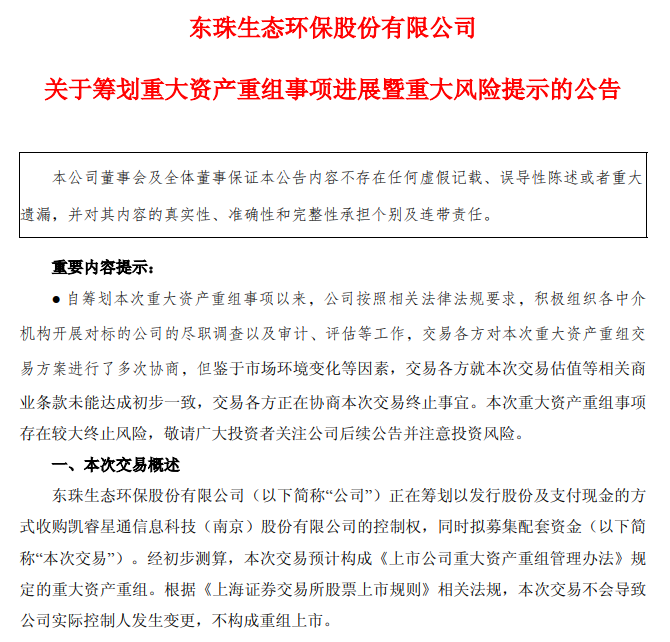
Core Viewpoint - Dongzhu Ecological's planned acquisition of Kairuixingtong Information Technology (Nanjing) Co., Ltd. has been halted due to failure to reach preliminary agreement on commercial terms, with parties negotiating termination of the transaction [1]. Group 1: Acquisition Details - The acquisition was initially seen as a strategic move for Dongzhu Ecological to enter the commercial aerospace and general aviation sectors [2]. - On August 26, 2025, Dongzhu Ecological announced a major asset restructuring plan, intending to acquire control of Kairuixingtong through a combination of share issuance and cash payment, along with raising supporting funds [2]. - The board of directors approved related proposals for the acquisition on September 9, 2025 [2]. Group 2: Stock Performance - Dongzhu Ecological's stock resumed trading on September 10, 2025, and experienced a three-day price increase [3]. - In 2025, the stock price of Dongzhu Ecological rose over 72% cumulatively [3]. Group 3: Company Overview - Dongzhu Ecological specializes in ecological restoration and governance, with operations in wetland protection, water environment management, municipal landscape, state-owned forest management, park development, mine restoration, and carbon management [5]. - Kairuixingtong, established in 2011, focuses on satellite mobile communication terminal manufacturing, sales, and related services, including smart unmanned aerial vehicle production [6]. Group 4: Financial Performance - In the first three quarters of 2025, Dongzhu Ecological reported revenue of 258 million yuan, a year-on-year decline of 29.78% [6]. - The company incurred a net loss of 30.24 million yuan and a non-recurring net loss of 30.11 million yuan, both transitioning from profit to loss compared to the previous year [6]. - Dongzhu Ecological is projected to continue facing losses in 2023 and 2024, with net losses of 315 million yuan and 630 million yuan, respectively [6].


低轨卫星行业研究系列之四:卫星星座组网加速,商业应用不断拓展
EBSCN· 2026-01-09 12:18
Investment Rating - The report maintains a "Buy" rating for the aerospace sector, particularly focusing on low Earth orbit (LEO) satellite communications and applications [5]. Core Insights - The construction of low Earth orbit satellite constellations is accelerating, with increasing competition for orbital and spectrum resources. LEO satellites are becoming a core direction for commercial space development due to their low latency and global coverage advantages [1][2]. - The industry is transitioning from traditional C and Ku frequency bands to higher frequency bands like Ka to support high-throughput data transmission. This shift is essential for meeting the growing demand for quality communication services in mobile applications and the Internet of Things (IoT) [1][2]. - The commercial application scenarios for satellites are expanding beyond traditional communication to include IoT, aviation, maritime, and emergency disaster reduction, indicating a significant market potential [3]. Summary by Sections 1. Industry Overview - LEO satellites are favored for real-time communication and global IoT connectivity due to their low transmission loss and delay. The competition for LEO orbital resources is intensifying as countries accelerate their satellite deployment efforts [1][19]. - The report highlights the importance of satellite platform and payload technology advancements, which are driving improvements in satellite performance and reductions in manufacturing costs [2][4]. 2. Commercial Applications - The report emphasizes the diversification of satellite applications, with examples like Starlink, which has developed a multi-faceted business model including home broadband, mobile services, and aviation maritime communication [3][66]. - The advancements in hyperspectral payload technology are opening new avenues for satellite applications in mineral exploration and agricultural monitoring [4][25]. 3. Investment Recommendations - The report suggests focusing on the mobile application and IoT markets, as well as the satellite navigation sector, particularly in areas like vehicle networking and wearable device navigation [4][27]. - It identifies key companies to watch in the satellite and rocket sectors, including Shaanxi Huada, Shanghai Port, and others, as they are positioned to benefit from the upcoming surge in satellite launches [4][66].
普天科技:卫星互联网是公司核心战略方向之一 积极参与承接卫星运营商相关技术服务
Xin Lang Cai Jing· 2026-01-09 09:49
Core Viewpoint - Puxin Technology (002544.SZ) identifies satellite internet as a core strategic direction, actively engaging in various initiatives to advance its capabilities in this sector [1] Group 1: Strategic Collaborations - The company has established a joint laboratory with Xi'an University of Electronic Science and Technology's ISN Laboratory to conduct research and academic exchanges in integrated terrestrial and satellite information networks [1] - A strategic cooperation agreement has been signed with Helios Starlink (Shenzhen) Co., Ltd. and Beijing Yixin Technology Co., Ltd. to participate in the national satellite internet strategy and promote breakthroughs in key technologies in the aerospace intelligence computing field [1] Group 2: Research and Development Initiatives - The company is involved in the research and standard-setting for multi-mode collaborative networking through organizations like the China Communications Standards Association (CCSA), while accelerating the development of low Earth orbit satellite communication products [1] - Continuous efforts are being made in the research and application of products related to the BeiDou satellite navigation system [1] - The company leverages its aerospace-grade intelligent manufacturing advantages to provide high-quality and reliable components such as PCB design and manufacturing for satellite-related equipment [1] Group 3: Technological Advancements - The joint research center focuses on breakthroughs in laser-microwave composite transmission technology to enhance inter-satellite and ground-satellite link transmission rates and stability, addressing the need for real-time interaction of massive data [1] - The exploration of new satellite architectures with on-orbit data processing capabilities is being pursued, integrating storage and transmission technologies [1] - The company aims to promote the market-oriented allocation of aerospace resources, providing innovative service models for government, industry, and commercial users [1]

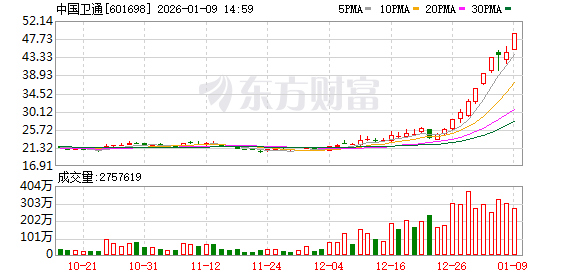
中国卫通走出9天5板续创历史新高 总市值突破2000亿元
Mei Ri Jing Ji Xin Wen· 2026-01-09 06:59
Group 1 - The core viewpoint of the article highlights that China Satellite Communications, a leading player in the commercial aerospace sector, has seen its stock price surge, achieving a limit-up on January 9, marking its fifth consecutive trading day of gains and setting a new historical high with a market capitalization exceeding 200 billion yuan [2] Group 2 - The stock has experienced a remarkable performance, with a total of five trading days of gains within a nine-day period, indicating strong investor interest and confidence in the company's prospects [2] - The market capitalization surpassing 200 billion yuan signifies a significant milestone for the company, reflecting its growing influence and position within the commercial aerospace industry [2]

中国卫通9天5板续创历史新高,市值突破2000亿
Ge Long Hui· 2026-01-09 06:58
Group 1 - The core viewpoint of the article highlights that China Satellite Communications, a leading player in the commercial aerospace sector, has seen its stock price hit a historical high, with a market capitalization exceeding 200 billion [1] Group 2 - The stock experienced a significant surge, achieving a limit-up on the last trading day, marking its fifth consecutive trading day of gains [1] - The company has demonstrated strong market performance, indicating robust investor confidence and interest in the commercial aerospace industry [1]
236只ETF获融资净买入 国泰中证全指证券公司ETF居首
Zheng Quan Shi Bao Wang· 2026-01-09 02:12
Core Viewpoint - As of January 8, the total margin balance for ETFs in the Shanghai and Shenzhen markets is 117.709 billion yuan, showing a decrease of 1.606 billion yuan from the previous trading day [1] Group 1: ETF Financing and Margin Data - The ETF financing balance stands at 110.06 billion yuan, down by 1.603 billion yuan from the previous trading day [1] - The ETF margin short balance is 7.649 billion yuan, which is a decrease of 0.03 billion yuan compared to the previous trading day [1] Group 2: Top Performing ETFs - On January 8, 236 ETFs experienced net financing inflows, with the Guotai CSI All-Share Securities Company ETF leading with a net inflow of 436 million yuan [1] - Other ETFs with significant net financing inflows include the E Fund ChiNext ETF, Yongying National Standard Commercial Satellite Communication Industry ETF, Huabao CSI All-Share Securities Company ETF, GF CSI Hong Kong Innovative Drug ETF, Huaxia SSE STAR 50 ETF, and Haitong Baichuan Hang Seng Technology ETF [1]
委内瑞拉变天后 作为最大的投资者和债权人-中国能否保障投资和债务主权?
Sou Hu Cai Jing· 2026-01-08 15:05
Core Insights - China's investment and loan scale in Venezuela is the largest in Latin America, with cumulative loans estimated between $60 billion to $67 billion, accounting for approximately 40%-50% of China's total loans to the region [2] - As of early 2026, Venezuela's outstanding debt to China is approximately $19 billion to $20 billion [3] Group 1: Energy and Oil Sector - Oil cooperation is a cornerstone of the relationship, with China National Petroleum Corporation (CNPC) as a key player [4] - The Sino-Venezuelan oil joint financing project has an initial amount of $4 billion, with subsequent extensions and expansions [4] - Chinese investments in the Orinoco heavy oil belt exceed $10 billion to enhance oil production and refining capacity [4] Group 2: Infrastructure and Housing Investment - The "Great Housing Mission" project involves significant participation from Chinese companies, constructing tens of thousands of social housing units [5] - The Tinaco-Anaco Railway, a flagship infrastructure project, has a contract amount of approximately $7.5 billion but has faced delays due to Venezuela's economic collapse [5] - Projects include modernization of Puerto Cabello and technical support for multiple thermal and hydroelectric plants [5] Group 3: High-Tech and Aerospace Cooperation - Venezuela is the Latin American country with the most in-depth space cooperation with China [6] - Satellite projects include the "Venezuela 1" communication satellite with an investment of about $400 million and two remote sensing satellites with investments of $140 million [7] Group 4: Mining and Agriculture Cooperation - Chinese enterprises have signed agreements to assist Venezuela in resource exploration in the Orinoco mining arc [8] - Agricultural development projects, such as irrigation and rice processing in Delta Amacuro state, have contract amounts around $3 billion [9] Group 5: Current Challenges and Risks - China's direct loans to Venezuela have become cautious, but bilateral cooperation has seen a resurgence after being elevated to an "all-weather strategic partnership" in 2023 [10] - The opening of direct flights from Caracas to Guangzhou in June 2024 has strengthened trade ties [11] - Some projects have faced significant issues, such as the Tinaco-Anaco Railway, which is only 30% complete due to payment issues since 2015 [12] Group 6: Debt and Asset Risks - China's "bad debt" in Venezuela is a dynamic and complex figure, with outstanding loans estimated at $19 billion to $20 billion, primarily owed to China Development Bank (CDB) [14] - The value of joint venture assets in the oil sector has incurred losses of approximately $10 billion to $15 billion [15] - The total financial risk exposure for China in Venezuela could exceed $100 billion when considering all financial aid and technical transfers [16] Group 7: Political Changes and Implications - The political upheaval in Venezuela poses high risks to China's investments and sovereign debt [22] - If a new regime does not recognize previous "oil-for-loan" agreements, China could face significant financial losses [23] - The potential for asset protection and the challenges of proving the legitimacy of debts in a new political landscape are critical concerns [23] Group 8: International Dynamics - The role of the IMF and the U.S. in Venezuela's economic reconstruction could complicate China's position, as the new government may prioritize debt sustainability analysis [27] - The U.S. may exert pressure on the new regime to reduce ties with China, potentially freezing Chinese energy assets in Venezuela [27] Group 9: Future Scenarios for Debt Management - The new regime's approach to inheriting Chinese debt could involve selective defaults or audits, potentially leading to significant debt reductions [30] - Possible scenarios include full debt inheritance, selective inheritance, or debt-to-equity swaps, depending on the new government's strategy [31][32]
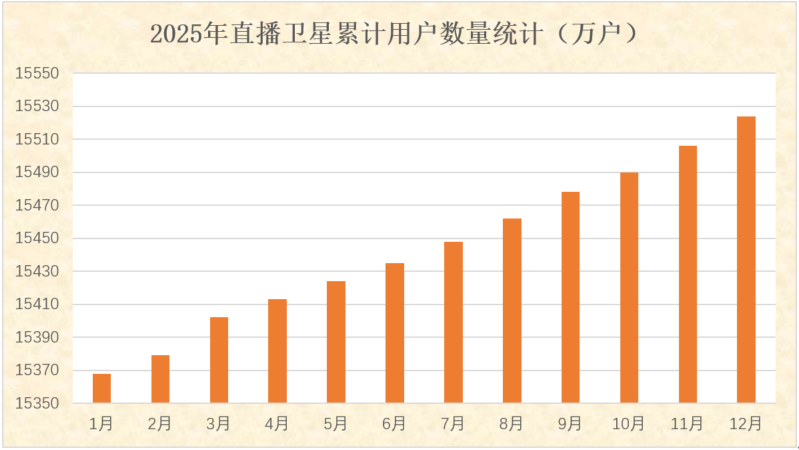
2025年直播卫星用户累计达15524万户
Xin Lang Cai Jing· 2026-01-08 11:43
Group 1 - The satellite broadcasting center has developed a total of 10.16 million HD users by December 31, 2025, with an addition of 1.76 million HD users in 2025 [2][7] - The satellite broadcasting center has accumulated a total of 155.24 million live satellite users by December 31, 2025 [3][8] - The competition among operators in the trillion-yuan satellite market is intensifying [9] Group 2 - The development of 6G technology is expanding smart new terminal applications [9] - Domestic institutions are actively laying out overseas FAST markets [9] - The video platform's financial report for Q3 2025 indicates significant developments in the broadcasting industry [10]
丰业银行对AST SpaceMobile(ASTS.US)给出“卖出”评级:目标价看跌近50%,称其难敌星链
智通财经网· 2026-01-08 07:15
Group 1 - AST SpaceMobile faces significant challenges in competition with Starlink, having no retail customers and experiencing stock price increases deemed unreasonable by analysts [1] - The stock is rated "sell" with a target price of $45.60, indicating a potential decline of 46.8% from the recent closing price [1] - Analysts warn that actual free cash flow may not materialize until 2028 or 2029, while Starlink is projected to have around 680 million users by the time AST SpaceMobile launches in selected markets [1] Group 2 - Starlink has successfully launched 3,169 satellites in 2025 alone, while AST SpaceMobile has faced challenges in launching seven satellites since 2017 [1] - Even a 48-hour delay for AST SpaceMobile could further hinder its progress against Starlink, which can complete launches every one to two days [2] - The integration of Starlink with SpaceX allows it to operate independently of third-party launch services, giving it a competitive edge [2] Group 3 - Following a 34% increase in stock price over three days, Canadian Imperial Bank of Commerce downgraded AST SpaceMobile's rating from "in line with industry" to "underperform," resulting in a 12.06% drop in stock price [3]

恒生指数早盘跌1.22% 三只新股上市首日逆市上涨
Zhi Tong Cai Jing· 2026-01-08 04:10
Market Overview - The Hang Seng Index fell by 1.22%, down 322 points, closing at 26,136 points; the Hang Seng Tech Index decreased by 1.13%, with early trading volume at 130.6 billion HKD [1] New Listings - Three new stocks listed, all showing gains: - Zhiyuan (02513) increased by 11.7%, announcing the upcoming launch of its next-generation model GLM-5 - Tianshu Zhixin (09903) rose by 11%, being the first domestic general-purpose GPU company - Jingfeng Medical-B (02675) surged by 29%, focusing on the laparoscopic surgical robot sector [1] Brain-Computer Interface Sector - Most stocks in the brain-computer interface sector rose, benefiting from the "14th Five-Year Plan" key layout, with significant catalysts emerging domestically and internationally: - Brainhole Aurora-B (06681) increased by 9% - Micron Brain Science (02172) rose by 5.3% - Nanjing Panda (600775) (00553) gained over 4% [1] Satellite Communication - Asia-Pacific Satellite (01045) surged by 12%, with its stock price doubling over the past three weeks, primarily engaged in satellite communication services [1] Shipping Sector - COSCO Shipping Energy (600026) (01138) rose over 5%, with geopolitical disturbances favoring the compliant tanker market; Morgan Stanley indicated its short-term valuation is attractive [2] Pharmaceutical Sector - Corning Jereh Pharmaceutical-B (09966) increased over 6% after the IND application for SKN033's Phase II clinical trial was accepted - Fuhong Hanlin (02696) rose over 4%, announcing its first PD-L1 ADC esophageal squamous cell carcinoma Phase II clinical data - Zhaoyan New Drug (603127) (06127) gained over 3%, with a growing supply-demand gap for experimental monkeys, possessing valuable scarce resources [3] Gaming Sector - Macau gaming stocks faced collective pressure, with Melco International Development (00200) and Sands China (01928) both declining over 2% [3] Company-Specific Issues - Polkan Vision Cloud-B (02592) plummeted over 18% due to a court-ordered judicial preservation of its subsidiary's bank account, coinciding with the recent unlocking of cornerstone shares [4]