智能驾驶

Search documents
千里科技:智驱未来,千里之行始于当下-20260119
Soochow Securities· 2026-01-19 10:24
Investment Rating - The report gives a "Buy" rating for Qianli Technology (601777) for the first time [1]. Core Insights - The company is undergoing a significant transformation from traditional manufacturing to smart mobility, with a focus on AI-driven technologies and strategic partnerships [12][15]. - Financial performance is gradually improving, with revenue expected to grow significantly in the coming years, driven by the automotive and AI sectors [6][27]. - The strategic partnership with Geely and the establishment of Qianli Smart Driving are key to enhancing the company's competitive edge in the smart driving market [70][75]. Summary by Sections 1. Business Transformation and Financial Analysis - Qianli Technology has shifted from a motorcycle-focused business to a smart mobility company, with a new name and strategic direction since 2025 [12][95]. - The company has shown signs of financial recovery, with revenue expected to reach 70.35 billion yuan in 2024, a 3.94% increase year-on-year [1][27]. - The automotive business is projected to contribute significantly to revenue, with a forecast of 42.17 billion yuan in 2024, reflecting a 12.9% increase [6][27]. 2. Strategic Partnerships and Ecosystem Development - The company has formed a stable three-way equity structure involving Geely, local government, and AI technology partners, enhancing its strategic capabilities [19][75]. - Qianli Technology aims to build an "AI Smart Mobility Open Platform" through partnerships with Geely and other industry players, focusing on smart driving solutions [70][75]. 3. Revenue and Profitability Forecast - Revenue forecasts for 2025, 2026, and 2027 are 89 billion yuan, 106 billion yuan, and 128 billion yuan respectively, with corresponding PS valuations of 5.86, 4.89, and 4.06 times [1][6]. - The company expects to achieve a net profit of 89.39 million yuan in 2025, with significant growth anticipated in subsequent years [1][27]. 4. Technology and Product Development - Qianli Technology is advancing its smart driving technology, with plans to launch L3 level solutions and Robotaxi technology by 2026 [80][89]. - The company is focusing on developing next-generation intelligent cockpit systems and enhancing its AI capabilities through strategic investments and partnerships [70][80].

千里科技(601777):智驱未来,千里之行始于当下
Soochow Securities· 2026-01-19 09:27
Investment Rating - The report gives a "Buy" rating for the company, marking its first coverage [1]. Core Insights - The company is undergoing a significant transformation from traditional manufacturing to smart mobility, with a focus on AI-driven technologies and strategic partnerships [12][15]. - Financial indicators are gradually improving, with a forecasted revenue increase and a positive cash flow outlook, indicating a recovery from previous financial difficulties [6][27]. - The strategic partnership with Geely and the introduction of new technologies are expected to enhance the company's competitive position in the smart driving sector [70][80]. Summary by Sections 1. Business Transformation and Financial Analysis - The company has shifted from a motorcycle-centric business to a focus on smart vehicles, with significant investments in AI technology and strategic partnerships [12][15]. - Revenue is projected to grow from 7.04 billion yuan in 2024 to 10.64 billion yuan in 2026, with a compound annual growth rate (CAGR) of approximately 19.8% [1]. - The net profit is expected to increase significantly, from 40 million yuan in 2024 to 160 million yuan in 2026, reflecting a strong recovery trajectory [1]. 2. Business Segments Performance - The motorcycle business remains stable, with a focus on high-displacement models and a gradual recovery in revenue and profitability [43][44]. - The automotive segment, particularly through the joint venture with Geely, is expected to contribute significantly to revenue, with a projected 59.96% share of total revenue by 2024 [53][54]. - The technology segment is expanding, with a focus on AI-driven solutions and smart driving technologies, aiming to establish a comprehensive ecosystem [70][80]. 3. Strategic Partnerships and Market Position - The company has formed a robust partnership with Geely and other tech firms, enhancing its capabilities in AI and smart driving [70][80]. - The introduction of the "千里浩瀚" smart driving solution is expected to position the company as a key player in the autonomous driving market [89]. - The company plans to leverage its partnerships to enhance its product offerings and expand its market reach, particularly in the smart mobility sector [70][80].
中科慧眼:与欧冶半导体达成战略合作 芯眼协同赋能智能驾驶
Zhong Guo Qi Che Bao Wang· 2026-01-19 08:01
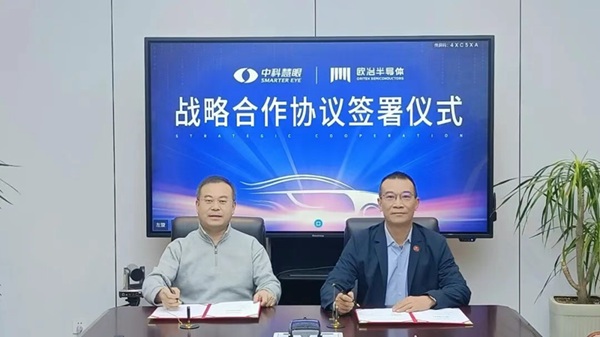
2026年1月13日,车载立体视觉领域领军企业中科慧眼,与专注于第三代 E/E 架构全车智能芯片研 发的欧冶半导体正式签署战略合作协议。双方将以 "智能芯片 + 视觉感知" 的深度协同模式,携手推动 汽车产业智能化升级进程。中科慧眼创始人兼CEO姜安、欧冶半导体创始人周涤非,携两家企业核心团 队共同出席签约仪式。 一体化方案打造:针对组合驾驶辅助系统场景,联合开发商用车一体机产品。该产品不仅满足《营 运客车安全技术条件》《轻型汽车自动紧急制动系统技术要求及试验方法》等行业标准,更是兼具高性 价比与快速量产能力的落地方案,目前已斩获多家主机厂多个车型的项目定点; 市场规模化推广:携手推进合作成果在乘用车、商用车全场景的规模化落地。 生态共建 助力国产部件系统突围 中科慧眼创始人兼CEO姜安表示:"'看得清'是智能驾驶的底层基石。中科慧眼在立体视觉领域的 技术积淀,与欧冶半导体芯片平台'算得快'的核心优势相结合,将实现'眼明心快'的协同效应。这不仅 能提升智能驾驶的安全性与高效性,更能有效降低车企研发成本与验证周期。" 欧冶半导体创始人周涤非指出:"此次'芯 - 眼'协同合作,是国产智能汽车核心部件从单点突破迈向 ...

智驾领域催化密集、板块资金交投火热!关注智能驾驶ETF(516520)配置机遇
Mei Ri Jing Ji Xin Wen· 2026-01-19 06:03
Group 1 - The smart driving sector is experiencing active performance due to multiple catalysts including policy support, technological advancements, and industry promotion [1] - The smart driving ETF (516520) has attracted a cumulative net inflow of 517 million yuan since 2026, with an average daily trading volume increasing to 225 million yuan, a significant growth of 650% compared to 2025 [1] - The fund's scale and shares have risen to 1.22 billion yuan and 880 million shares respectively, indicating strong liquidity and substantial size [1] Group 2 - Recent strategic collaborations, such as between Lantu and Yingwang, aim to enhance cooperation in smart driving and software services, accelerating marketization [1] - A well-known new energy vehicle company has formed a comprehensive strategic partnership with an autonomous driving technology company, focusing on the mass production and commercialization of L4-level Robotaxi technology [1] - Shanghai has set clear goals for autonomous driving development, with plans to achieve large-scale application of high-level autonomous driving by 2027, fostering a competitive smart connected vehicle industry cluster [1] Group 3 - The smart driving ETF (516520) closely tracks the CSI Smart Car Theme Index, which reflects the overall performance of companies in the smart car industry [2] - The top five secondary industries represented in the index are automotive parts (24.0%), semiconductors (19.6%), passenger vehicles (14.4%), software development (11.3%), and communication equipment (7.1%), covering multiple segments of the smart car industry chain [2] - The current PE ratio of the smart driving ETF is 34.33, which is at a low valuation level compared to the past decade, indicating a potentially important investment opportunity [2]
大行评级|浦银国际:首次覆盖佑驾创新并予“买入”评级,估值弹性有望进一步释放
Ge Long Hui· 2026-01-19 02:41
Core Viewpoint - Ping An International has initiated coverage on Youjia Innovation (2431.HK) with a "Buy" rating and a target price of HKD 19.3, indicating a potential upside of 30% based on a projected 2026 price-to-sales ratio of 4.2 [1] Group 1: Business Strategy and Growth - Youjia's strategic focus is on two business lines: intelligent driving and cockpit solutions, with progressive iterations through its iSafety and iPilot solutions in the intelligent driving domain [1] - The company's DMS products are evolving, and with the implementation of mandatory regulations, there is potential for an expanded customer base and increased order volume [1] - The introduction of the intelligent assistant BamBam, leveraging large model capabilities, is expected to enhance the value of the cockpit business [1] Group 2: Revenue Projections - Youjia's revenue from intelligent components and solutions is anticipated to maintain rapid growth through 2026 [1] Group 3: Autonomous Driving Innovations - The company is advancing its L4-level autonomous driving solution, iRobo, through innovative applications across diverse scenarios, supported by its self-developed capabilities and experience in large-scale production [1] - Youjia's unmanned minibus project, which completed its first deployment in February 2025, is expected to contribute significantly to revenue due to its accumulated project experience [1] - The company is also entering the unmanned delivery sector with the Xiaozhu unmanned vehicle, which is expected to leverage supply chain resources from its front-end production projects, enhancing its cost-performance advantage [1] - Since its launch, the Xiaozhu unmanned vehicle has received numerous orders, with expectations to reach a delivery scale of 10,000 units in 2026, becoming a significant revenue source for the company [1] - If the business model for unmanned vehicles continues to be validated, Youjia's valuation flexibility is likely to increase further [1]
晨会纪要-20260119
Guoxin Securities· 2026-01-19 01:35
Group 1: Outdoor Apparel Industry - The outdoor footwear and apparel industry has maintained rapid growth since 2021, with a CAGR of 25.3% for outdoor apparel and 18.4% for outdoor footwear, projected to grow by 24.5% and 16.3% year-on-year in 2025 respectively [24][26] - Online sales of outdoor footwear are growing faster than apparel, with outdoor footwear online sales growth maintaining over 40%, while certain apparel categories like jackets and sun-protective clothing are experiencing slower growth [24][26] - Key outdoor brands such as Kailas and Berghaus are showing strong momentum, while brands like The North Face are underperforming; the market is becoming more diversified with new brands emerging [25][26] Group 2: AI Application in Computing Industry - Major international companies are focusing on AI application in vertical scenarios, with OpenAI and Anthropic launching healthcare-focused AI models, enhancing compliance and professional services [28] - Domestic companies are also advancing in AI applications, with Alibaba upgrading health services and Tencent providing comprehensive support for mini-programs, indicating a strong push towards AI integration [28] - The market for AI applications is expected to see significant growth, with predictions indicating that the GEO market will reach $24 billion globally by 2026, driven by high consumer trust in AI applications in China [30][32] Group 3: Public Utilities Industry - The public utilities sector, including electricity, gas, and water, is characterized by its "essential" nature, with stable long-term growth prospects [32] - The transition to low-carbon energy sources is accelerating, with the share of clean energy consumption expected to reach 28.6% of total energy consumption by 2024, up 2.2 percentage points year-on-year [32][33] - There is a growing trend of overseas funds over-allocating to the public utilities sector, with significant increases in holdings by institutional investors in this industry [33]





国信证券:首次覆盖希迪智驾给予优于大市评级 无人驾驶矿卡领先企业
Zhi Tong Cai Jing· 2026-01-19 01:04
Group 1 - The core viewpoint of the report is that Xidi Intelligent Driving (03881) is a leading company in the commercial vehicle intelligent driving products and solutions sector, benefiting from the accelerated development of the Robo-X industry. The company is expected to achieve revenues of 1.006 billion, 1.867 billion, and 3.518 billion yuan in 2025, 2026, and 2027 respectively, with year-on-year growth rates of 145.3%, 85.7%, and 88.4% [1] - Xidi Intelligent Driving specializes in autonomous mining trucks and logistics vehicle solutions, V2X, and intelligent perception, positioning itself as an innovative supplier driven by products in the commercial vehicle intelligent driving sector [1][2] - In the first half of 2025, the company reported revenues of 408 million yuan, a year-on-year increase of 57.9%, with a net loss of 450 million yuan [1] Group 2 - The commercialization of autonomous mining trucks is accelerating due to technological advancements, safety demands in the mining industry, and policy support. The market for autonomous mining truck solutions in China is projected to grow from 1.9 billion yuan in 2024 to 39.6 billion yuan by 2030, with a CAGR of 65.3% [2] - The potential total market size for autonomous mining truck solutions in China is estimated at approximately 550 billion yuan in 2024, assuming a 100% penetration rate of intelligent driving [2] - Xidi Intelligent Driving holds about 12.9% market share in the domestic autonomous mining truck solutions market as of 2024 [2] Group 3 - The company has a strong focus on research and development, with over 50% of its workforce dedicated to R&D. Core R&D members have an average of over 15 years of engineering experience [3] - Xidi Intelligent Driving has been one of the earliest companies in China to commercialize intelligent driving technology for commercial vehicles in closed environments since 2018 [3] - The company's diverse client base includes mine owners and operators, government entities, universities, commercial vehicle manufacturers, and other enterprises, indicating a high-quality and expanding customer group [3]

国信证券:首次覆盖希迪智驾(03881)给予优于大市评级 无人驾驶矿卡领先企业
智通财经网· 2026-01-19 01:04
Core Viewpoint - Guosen Securities reports that Xidi Zhijia (03881) is a leading company in the field of intelligent driving products and solutions for commercial vehicles, benefiting from the accelerated development of the Robo-X industry [1] Group 1: Company Overview - Xidi Zhijia specializes in autonomous driving solutions for mining trucks and logistics vehicles, V2X, and intelligent perception, positioning itself as an innovative supplier driven by products in the commercial vehicle intelligent driving sector [2] - The company is expected to achieve revenues of 1.006 billion, 1.867 billion, and 3.518 billion yuan in 2025, 2026, and 2027 respectively, with year-on-year growth rates of 145.3%, 85.7%, and 88.4% [1] Group 2: Market Potential - The market for autonomous mining truck solutions in China is projected to grow from 1.9 billion yuan in 2024 to 39.6 billion yuan by 2030, with a CAGR of 65.3% [3] - The total potential market size for autonomous mining truck solutions in 2024 is estimated to be around 550 billion yuan, assuming a 100% penetration rate of intelligent driving [3] - The V2X and intelligent perception market in China is expected to grow from 2 billion yuan in 2024 to 23.8 billion yuan by 2030, with a CAGR of 51% [3] Group 3: Technological and R&D Strength - The company has a strong focus on R&D, with over 50% of its workforce dedicated to research and development, and core R&D members averaging over 15 years of engineering experience [4] - Xidi Zhijia has been one of the earliest companies in China to commercialize intelligent driving technology for commercial vehicles in closed environments since 2018 [4] - The client base includes diverse and high-quality customers such as mine owners, government entities, universities, commercial vehicle manufacturers, and other enterprises [4]
68页深度 | 希迪智驾:无人驾驶矿卡领先企业,技术叠加降本推进商业化【国信汽车】
车中旭霞· 2026-01-18 16:02
Core Viewpoint - Xidi Intelligent Driving (03881.HK) is a leading enterprise in the field of commercial vehicle intelligent driving products and solutions, focusing on autonomous mining trucks and logistics vehicle solutions, V2X, and intelligent perception [2][7]. Company Overview - Established in 2017, Xidi Intelligent Driving is a global leader in intelligent driving hard technology products, dedicated to innovation in hard technology and the application of autonomous driving and vehicle-road collaboration technology [7]. - The company reported a revenue of 408 million yuan in the first half of 2025, representing a year-on-year growth of 57.9%, with a net loss of 450 million yuan [2][6]. Business Segments Autonomous Driving - The autonomous driving segment includes solutions for autonomous mining trucks and logistics vehicles, with a revenue contribution of 92.7% in 2025H1 [14]. - The market for autonomous mining truck solutions in China is projected to grow from 1.9 billion yuan in 2024 to 39.6 billion yuan by 2030, with a CAGR of 65.3% [3]. - Xidi holds approximately 12.9% market share in the autonomous mining truck solutions market in China [3]. V2X - The V2X market in China is expected to grow from 2 billion yuan in 2024 to 23.8 billion yuan by 2030, with a CAGR of 51% [3]. - Xidi's V2X solutions integrate advanced perception technology and traffic optimization algorithms, enhancing road safety and traffic management [24][25]. Intelligent Perception - The intelligent perception segment includes the Train Autonomous Perception System (TAPS) and vehicle-mounted intelligent perception solutions, contributing 5.0% to the revenue in 2025H1 [14][30]. - TAPS is designed to enhance train safety through active perception capabilities, utilizing various detection technologies [30]. Financial Analysis - The company has shown rapid revenue growth, with a significant increase in the autonomous driving segment's revenue by 142.47% year-on-year in 2025H1 [16]. - The gross margin for the autonomous driving segment was 15.59%, reflecting a slight decrease of 0.52 percentage points year-on-year [16]. Research and Development - Xidi emphasizes strong R&D capabilities, with over 50% of its workforce dedicated to research, and core team members averaging over 15 years of engineering experience [4][39]. - The company has been one of the earliest in China to commercialize intelligent driving technology in closed environments since 2018 [4]. Customer Base - Xidi's diverse customer base includes mine owners, government entities, universities, commercial vehicle manufacturers, and other enterprises, continuously expanding its clientele [4][10].

华为靳玉志:ADS 4比旧版本安全多了,说“我们智驾靠堆代码”是胡扯
Jing Ji Guan Cha Wang· 2026-01-18 15:28
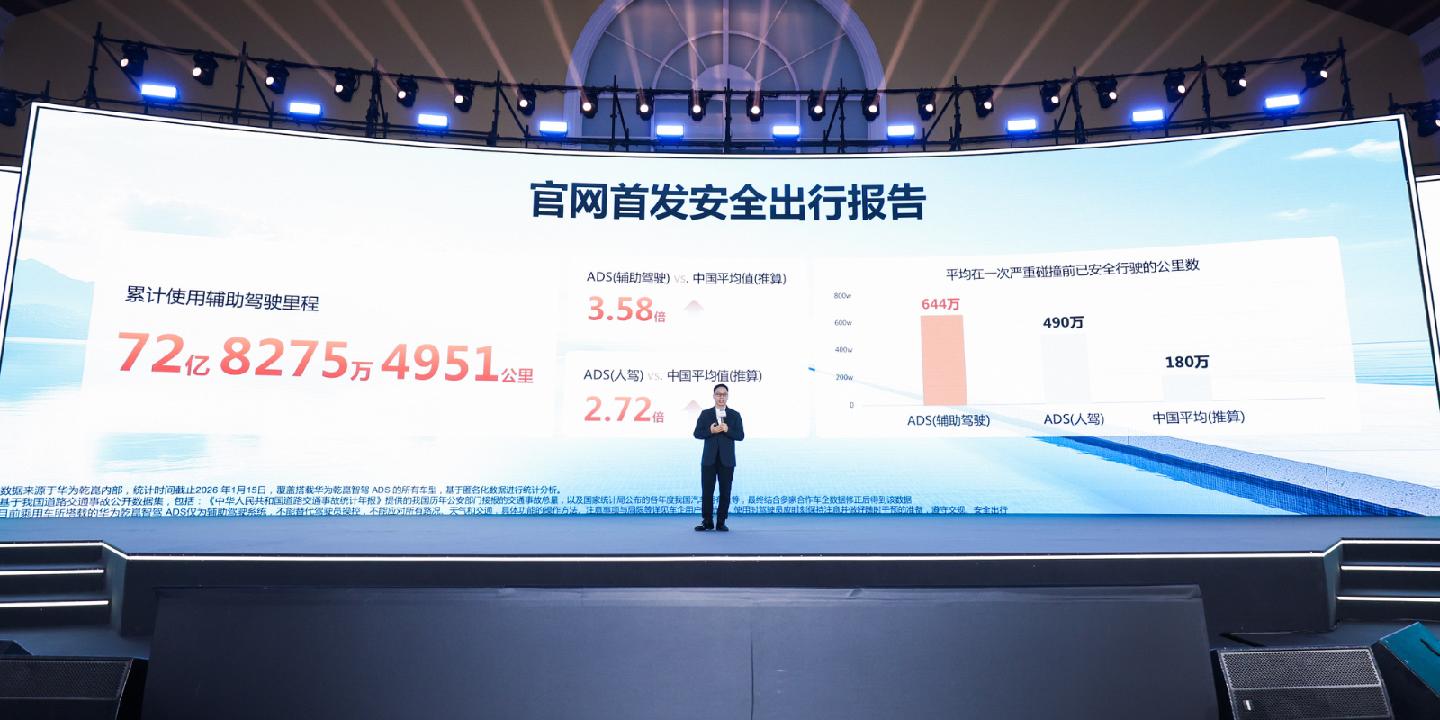
Core Insights - Huawei's CEO of Intelligent Automotive Solutions, Jin Yuzhi, addressed recent criticisms regarding Huawei's intelligent driving system, emphasizing that claims about the system being merely rule-based are unfounded [2] - The company plans to launch the next version of its intelligent driving system, ADS 5, by the end of 2026, with expectations of over 80 vehicle models equipped with the system and a total of 3 million units deployed [3] Group 1: Product Development and Performance - Huawei's intelligent driving system, QianKun ADS, is set to be released in April 2024, with version 4 expected in April 2025 [2] - In the last quarter of 2025, vehicles equipped with Huawei's QianKun ADS sold over 100,000 units for three consecutive months [2] - The safety of ADS 4 has improved by 50% compared to ADS 3.3, with user engagement in urban scenarios increasing [2] Group 2: User Engagement and Feedback - The QianKun app, launched at the 2025 Guangzhou Auto Show, has surpassed 1 million downloads and 660,000 users within two months [4] - Users have submitted 15,000 wish lists for future optimizations of the QianKun intelligent driving features through the app [4] Group 3: Industry Positioning and Technology - Huawei's QianKun ADS has accumulated over 7.2 billion kilometers of assisted driving mileage, demonstrating a safety record that is 3.58 times better than human drivers before a serious collision occurs [3] - The intelligent driving industry is diverging into two technical routes: VLA large models and "world models," with Huawei representing the "world model" approach [3] - Huawei supports the use of LiDAR in its multi-modal fusion hardware solutions, arguing that it enhances safety in extreme conditions where visual sensors may fail [3]