
通讯器材

Search documents
“五一”消费市场双引擎驱动:文旅餐饮火爆,“中国购”成新风尚
2 1 Shi Ji Jing Ji Bao Dao· 2025-05-06 12:46
21世纪经济报道记者周慧 北京报道 "五一"假期,以家电、家居为代表的商品消费增长势头良好,以餐饮文旅为代表的服务消费保持较高人 气。 "五一"假期,不少消费者选择了通过以旧换新政策补贴购买大件家居、家电商品。 "五一"期间,商务部重点监测零售企业家电、汽车、通讯器材销售额同比分别增长15.5%、13.7%和 10.5%。商务部重点监测电商平台智能家居产品销售额同比增长超20%。其中,以旧换新备受欢迎。从 2025年初至5月5日0时,汽车以旧换新补贴申请量突破300万份;消费者购买12大类家电以旧换新产品 5516万台,购买手机等数码产品4167万件。 除了商品消费,服务消费在假期持续升温,餐饮、文旅市场红火。据文化和旅游部数据中心测算,假期 5天全国国内出游3.14亿人次,同比增长6.4%;国内游客出游总花费1802.69亿元,同比增长8.0%。另据 商务大数据监测,假期全国重点监测餐饮企业销售额同比增长8.7%。 5月6日,在北京经营着6家餐厅的北平三兄弟涮肉联合创始人梁丽告诉21世纪经济报道记者,今年"五 一"假期餐厅的客流量都很高,销售额是平时的2倍,平时一天销售额5万元的店,"五一"期间一天销售 额 ...
2024年济南市社会消费品零售总额5213.2亿元
Qi Lu Wan Bao Wang· 2025-03-24 06:46
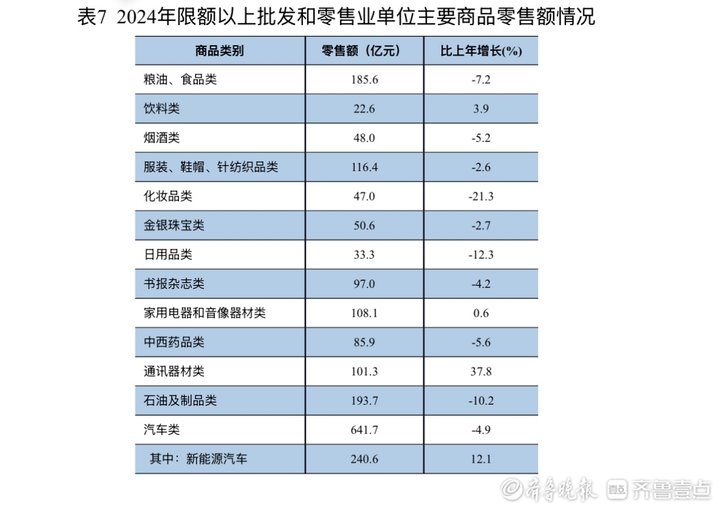
3月24日,济南市统计局公布2024年济南市国民经济和社会发展统计公报。 2024年济南市社会消费品零售总额5213.2亿元 齐鲁晚报.齐鲁壹点管悦 升级类消费需求不断释放。济南市限额以上单位新能源汽车实现零售额240.6亿元,比上年增长 12.1%,连续六年保持两位数增长,占全市限额以上单位汽车类商品零售额的比重为37.5%,较上年提 高5.6个百分点。通讯器材类商品零售额101.3亿元,增长37.8%;体育娱乐用品类商品零售额14.2亿元, 增长82.8%。 线上消费表现相对较好。济南市举办2024年网上年货节、618年中大促、2024济南电商季等专题活 动,新获评省级电商供应链基地、电商云仓等示范项目11个,全市限额以上批发和零售业单位通过公共 网络实现的商品零售额453.2亿元,增长3.1%,占全市限额以上单位消费品零售额的比重为23.2%,较上 年提高1.1个百分点。 齐鲁晚报.齐鲁壹点记者获悉,2024年,济南市社会消费品零售总额5213.2亿元,比上年增长 0.3%。按经营单位所在地分,全市城镇消费品零售额4577.8亿元,比上年增长0.4%;乡村消费品零售额 635.4亿元,下降0.3%。按消 ...

市场风格切换,哪些方向可以布局?丨智氪
36氪· 2025-03-23 09:33
Core Viewpoint - The article discusses the recent market corrections in A-shares and Hong Kong stocks, highlighting a shift in investment focus from high-valuation sectors like AI and robotics to undervalued dividend stocks, indicating a potential style switch in the market [2][3]. Market Performance - On March 21, A-shares and Hong Kong stocks experienced significant declines, with the Wind All A index dropping by 2% and the Hang Seng Technology Index falling over 3% [2]. - The AI and robotics sectors have seen a cumulative decline of nearly 10% and about 5%, respectively, since their peaks in late February, while the Hang Seng Technology Index has also retreated nearly 9% in March [4]. Market Sentiment - The decline in these sectors is attributed to a lack of new positive news and a retreat in market sentiment, as evidenced by a drop in weekly turnover rates for the AI and robotics indices from 35%-40% in February to 20%-25% currently [4][5]. - The "buy the expectation, sell the reality" investment logic is prevalent, with funds exiting positions after earnings reports, despite some companies like Xiaomi and Tencent reporting strong results [5]. Sector Rotation - The article notes a rotation of funds towards dividend stocks, as evidenced by the performance of the CSI Dividend Index, which has outperformed AI and robotics indices since the beginning of 2024 [5]. - As the earnings season approaches, the performance of quality stocks may gradually improve, while AI and robotics sectors may struggle without new catalysts [5][6]. Economic Indicators - In April, the market is expected to focus on the execution of fiscal policies and the effects of monetary policy, with a significant decrease in the likelihood of interest rate cuts due to the U.S. not lowering rates in March [9]. - The overall economic outlook for 2024 is relatively weak, with fewer companies expected to exceed earnings forecasts, leading to a potential consolidation phase for previously high-flying tech stocks [9]. Consumer and Investment Trends - From the demand side, consumer retail data shows that categories like communication equipment (26%) and sports and entertainment products (25%) have seen significant year-on-year growth, driven by policies encouraging upgrades [10][11]. - Fixed asset investment grew by 4.1% in January-February 2025, with notable increases in sectors such as water management (39.1%) and electrical machinery (37.3%) [12]. Industry Outlook - Companies in sectors with strong fundamentals, particularly in equipment manufacturing, are likely to perform well in the market, as these industries have shown robust growth and demand [13].

社零数据点评:1-2月社零同比+4%,服务消费市场稳健增长
CMS· 2025-03-18 02:41
Investment Rating - The report maintains a "Recommended" rating for the industry, indicating a positive outlook for the sector's fundamentals and expected performance exceeding the benchmark index [3]. Core Insights - The social retail sales total for January-February 2025 reached 83,731 billion yuan, with a year-on-year growth of 4%. The service consumption market is showing stable growth, particularly in dining and travel services, while e-commerce is recovering faster than the overall retail market [1][2][4]. - The report highlights the impact of the "Consumption Promotion Special Action Plan" policy, which is expected to drive positive trends in service consumption and the retail industry [1][2]. - In terms of category performance, essential goods such as grain, oil, and food saw a year-on-year increase of 11.5%, while discretionary categories like cosmetics and clothing showed improvements with growth rates of 3.3% and 4.4%, respectively [2][4]. Summary by Relevant Sections Industry Scale - The industry comprises 132 listed companies, with a total market capitalization of 1,158 billion yuan and a circulating market capitalization of 1,055.2 billion yuan [3]. Industry Index Performance - The absolute performance of the industry index over the past month is -10.8%, with a 6-month performance of 44.2% and a 12-month performance of 11.1%. Relative performance shows a decline of -7.9% over the past month, but a positive 35.6% over 6 months [4]. Retail Sales Breakdown - In January-February, the retail sales of essential goods grew by 11.5% for grain and oil, and 5.5% for daily necessities. The retail sales of household appliances increased by 10.9%, while the telecommunications equipment category, driven by new government subsidies for mobile phones, surged by 26.2% [2][19].
2025年1-2月经济数据点评:政策仍需接力
Haitong Securities· 2025-03-17 08:26
Investment Rating - The report indicates a stable outlook for the economy, with a focus on policy support and external demand as key drivers for growth [2][3]. Core Insights - The overall economic recovery is still reliant on policy measures and external demand, with internal dynamics such as consumer spending and private investment needing improvement [3][4]. - The production sector shows steady performance, with industrial value-added growth at 5.9% year-on-year for January-February 2025, slightly lower than December 2024's 6.2% [8][10]. - Consumer spending is recovering, with retail sales growth of 4.0% year-on-year in January-February 2025, up from 3.7% in December 2024 [17][21]. - Investment is showing marginal improvement, with fixed asset investment growth at 4.1% year-on-year for January-February 2025, compared to 3.2% for the entire previous year [24][25]. Summary by Sections 1. Production: Steady Performance - Industrial value-added growth for January-February 2025 is 5.9%, with a month-on-month increase of 0.51% in February [8][10]. - Export-oriented sectors like transportation equipment and automotive show the highest growth rates, while real estate-related sectors remain subdued due to slow downstream demand [10][12]. 2. Consumption: Bright Performance in Services - Social retail sales grew by 4.0% year-on-year in January-February 2025, higher than December 2024's 3.7% [17][21]. - Service retail sales increased by 4.9%, although this is a decline from December's 6.2% [17][21]. - Online consumption shows a significant recovery, with a year-on-year growth of 5.7% in January-February 2025, compared to 1.5% in December 2024 [21][22]. 3. Investment: Marginal Improvement - Fixed asset investment growth is at 4.1% year-on-year for January-February 2025, an increase from 3.2% in the previous year [24][25]. - Real estate investment shows a year-on-year decline of 9.8%, while manufacturing and broad infrastructure investments grow at 9.0% and 10.0%, respectively [25][26]. - The improvement in broad infrastructure investment is primarily driven by high growth in electricity and heat supply investments, which increased by 25.4% [26][27].