
饮料

Search documents
宗馥莉还没有输
3 6 Ke· 2025-08-06 03:21
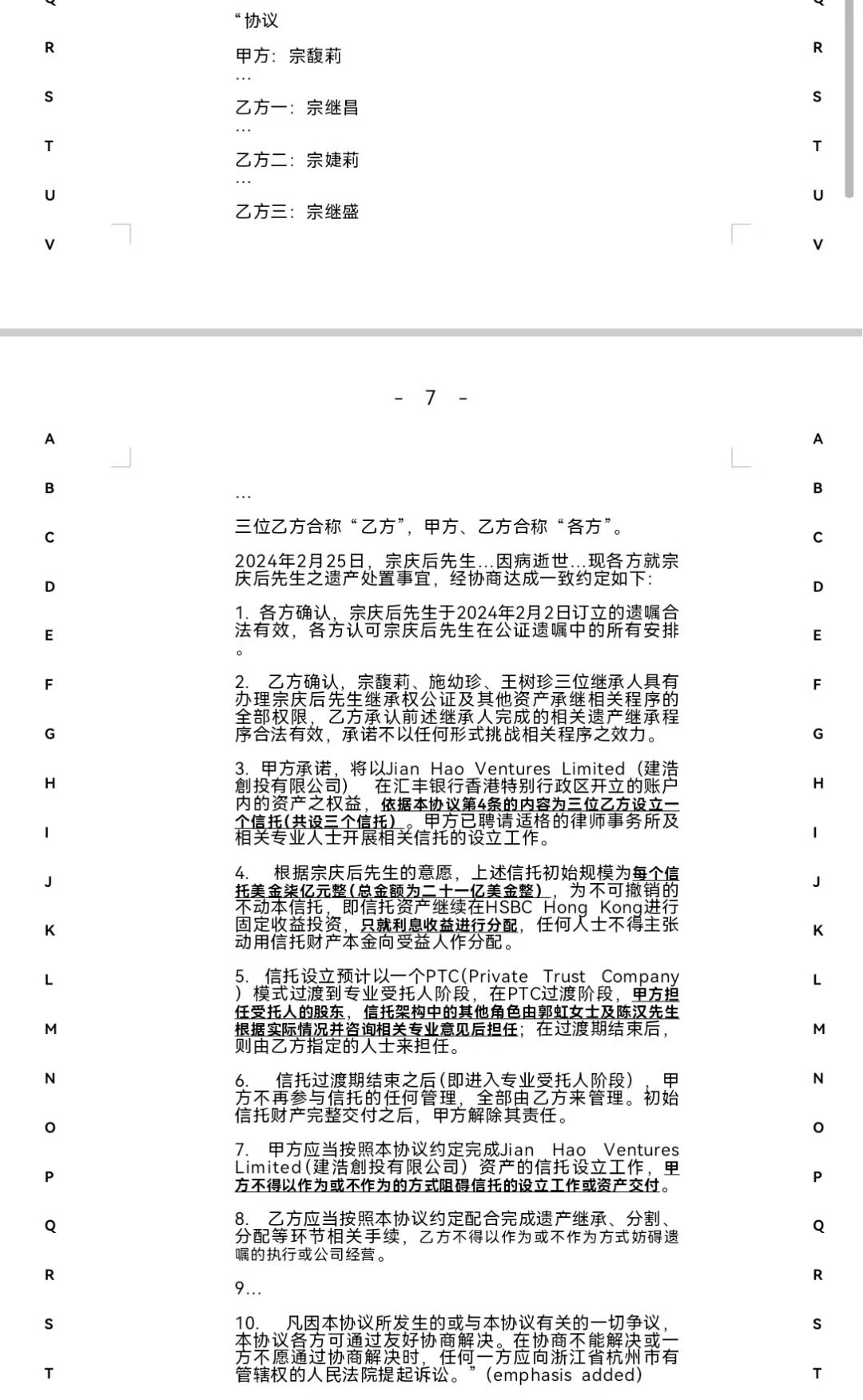
Core Viewpoint - The ongoing legal dispute over the trust established by the late Zong Qinghou has significant implications for the future of Wahaha Group, with the recent Hong Kong court ruling highlighting the complexities of family inheritance and business control [2][4][6]. Trust Dispute - The Hong Kong High Court confirmed that assets in Jian Hao Ventures Limited's HSBC account are trust properties benefiting Zong Qinghou's three children, prohibiting Zong Fuli from withdrawing or transferring funds until a final ruling is made in mainland courts [2][4]. - Zong Qinghou left behind a handwritten document establishing a $2.1 billion trust for his three children, acknowledging Zong Fuli's inheritance rights [4]. - The court ruling indicates that Zong Fuli claims the interest generated from the $2.1 billion trust is the trust asset, not the principal itself, which could allow her to influence the trust's duration and fund allocation [5][6]. Company Financials - Wahaha Group's revenue reached 50 billion yuan in 2023, down from a peak of 78.3 billion yuan in 2013, indicating a shrinking market despite the company's historical success [2]. - As of the end of 2022, Wahaha Group's total assets were 37.047 billion yuan, with a revenue of 51.202 billion yuan and a net profit of 4.767 billion yuan, while the main entity's assets accounted for only about 15% of the total [8]. Corporate Restructuring - Zong Fuli has initiated significant changes within Wahaha, including a management overhaul and the transfer of employee contracts to her new company, Hongsheng Group, leading to labor disputes [10][11]. - The restructuring has involved the closure of several factories previously managed by her siblings, with production capacity being shifted to Hongsheng Group's facilities [10]. - The company has also implemented a strict budget control system, requiring all expenditures to be approved by Zong Fuli, which has caused operational disruptions [11]. Market Position - Despite internal challenges, Wahaha's market share in packaged water increased from approximately 9.42% in Q1 2024 to 17.07% in Q1 2025, indicating a potential recovery in its competitive position [14]. - However, the company has struggled to develop new flagship products since the launch of its Nutritional Fast Line, with competitors like Nongfu Spring maintaining a strong market presence [14].
宗馥莉去哪了?
阿尔法工场研究院· 2025-08-06 00:07
Core Viewpoint - The article discusses the internal and external challenges faced by Wahaha under the leadership of Zong Fuli, particularly in light of the ongoing inheritance dispute and her management style, which has led to dissatisfaction among employees and distributors [5][9][10]. Group 1: Management Changes and Employee Dissatisfaction - Zong Fuli has not appeared at the company for over a month, leading to speculation about her whereabouts [5][6]. - Since taking over after the death of founder Zong Qinghou, Zong Fuli has implemented significant reforms, including layoffs and a management style that differs sharply from her father's [9][10][25]. - Employees and distributors have expressed dissatisfaction with Zong Fuli's management, citing issues such as unrealistic sales targets and a lack of support [12][13][16]. Group 2: Legal and Financial Issues - A lawsuit involving over a thousand employees regarding the 2018 employee stock buyback has intensified the conflict within the company [11]. - Distributors have reported financial losses and difficulties in reimbursement processes, leading to further frustration with the company's management [12][13][38]. Group 3: Strategic Direction and Market Position - Zong Fuli aims to modernize Wahaha's management structure, focusing on data and results, contrasting with the previous "people-oriented" approach [28][30]. - The company has not launched new products since Zong Fuli took over, indicating a pause in innovation while she focuses on restructuring the sales system [33][35]. - Wahaha is shifting towards a more controlled distribution model, which has faced resistance from distributors who feel their interests are threatened [39][40]. Group 4: Current Operations and Future Outlook - Despite the turmoil, Wahaha's production lines are reportedly operating normally, and the company continues to function internally [21][22]. - The article suggests that the effectiveness of Zong Fuli's reforms and the company's future performance remain uncertain, with ongoing challenges in sales and employee morale [42].


创新消费力 | 元气森林:“养生”也可以俘获年轻人
Bei Jing Shang Bao· 2025-08-05 15:00
Core Insights - The core competition in beverage innovation is not merely about taste or functional segmentation, but about returning to the product itself and ensuring quality [1][13] - The market for traditional Chinese health drinks, particularly the "Good Zizai" series, has seen significant growth, with market size increasing from 0.1 billion in 2018 to 4.5 billion in 2023 [1][2] - The rise of health-conscious consumers has led to a decline in sugary drinks, with the no-sugar beverage market experiencing rapid growth [2][3] Company Overview - Yuanqi Forest's "Good Zizai" series has quickly gained popularity, selling out within five days of its launch on Tmall and achieving top rankings on major e-commerce platforms [2][12] - The company emphasizes the importance of product quality and consumer feedback, aiming to create products that resonate with traditional tastes while meeting modern health demands [3][11] - The brand has established a red bean planting base in Heilongjiang to ensure the quality of its raw materials, reflecting a commitment to product integrity [10] Market Dynamics - The market for Chinese health drinks is becoming increasingly competitive, with a significant number of brands entering the space, leading to issues of homogenization and price wars [7][8] - The average price of mainstream health drinks has dropped significantly, with some brands offering promotions that reduce prices to as low as 2.9 yuan per bottle [8] - The market structure is evolving, with a bifurcation between low-sugar basic products and high-margin functional products, indicating a shift in consumer preferences [7][9] Consumer Trends - The target demographic for "Good Zizai" includes a substantial portion of young consumers, with those aged 18-36 making up nearly 70% of the market [6][8] - High repurchase rates indicate a strong demand for health drinks, with "Good Zizai" achieving a market share of 58.6% in 2024 [8][12] - The trend towards health-conscious consumption reflects a broader shift in consumer behavior, moving from novelty to daily necessity [12][13]
宗馥莉还没有输|氪金·大事件
3 6 Ke· 2025-08-05 11:34
Core Points - The recent court ruling in Hong Kong confirmed that Jian Hao Ventures Limited's assets in HSBC Hong Kong are trust properties benefiting three plaintiffs, prohibiting the defendant, Zong Fuli, from withdrawing or transferring funds until a final ruling is made in mainland courts [2][4] - The trust dispute involves a total of $2.1 billion (approximately 150.94 billion RMB), which is a small fraction of Wahaha's overall business, which had a peak revenue of 78.3 billion RMB in 2013 and 50 billion RMB in 2023 [2][4] - The court ruling indicates that Zong Qinghou left behind handwritten documents establishing a trust for his three children, acknowledging Zong Fuli's inheritance rights [4][5] Trust Dispute - The Hong Kong court's ruling highlights that Zong Qinghou had indeed left a trust of $2.1 billion for his three children [4] - The plaintiffs acknowledged Zong Fuli's inheritance rights, and Zong Fuli committed to establishing three trusts totaling $2.1 billion for her siblings [5] - The court noted that Zong Qinghou had two wills, one concerning overseas assets and another for domestic assets, neither of which named the plaintiffs as beneficiaries [5][6] Company Structure and Financials - The current ownership structure of Wahaha shows that the state-owned enterprise holds 46% of the shares, while Zong Qinghou and Zong Fuli hold 29.4% [9][11] - As of the end of 2022, Wahaha Group's total assets were 37.047 billion RMB, with a revenue of 51.202 billion RMB and a net profit of 4.767 billion RMB [12][13] - The state-owned shares represent only about 15% of the total assets of the Wahaha business empire, with net profits accounting for just 0.39% [13] Management Changes and Reforms - Zong Fuli has initiated significant management changes within Wahaha, including a complete overhaul of the core management team and the transfer of employee contracts to her new company, Hongsheng Group [15][16] - The company has been closing factories, including those where her siblings serve as directors, while the production capacity is being replaced by Hongsheng Group [16][17] - Recent changes have led to labor disputes and dissatisfaction among long-term employees, contrasting with Zong Qinghou's previous management style that emphasized employee loyalty and stability [18][19] Market Performance - Wahaha's market share in packaged water increased from approximately 9.42% in Q1 2024 to 17.07% in Q1 2025, despite ongoing internal disputes and management changes [21] - The company has not successfully launched new blockbuster products since its Nutritional Fast Line, with competitors like Nongfu Spring dominating the market [21]
新风口?多家A股公司推出助眠饮料
财联社· 2025-08-05 11:24
Core Viewpoint - The increasing consumer focus on emotional and sleep health presents new opportunities for beverages containing GABA, which is believed to help with emotional regulation and sleep improvement [1][2]. Industry Overview - Several beverage companies, including China Wangwang, Yangyuan Beverage, Mengniu Dairy, and Junyao Health, are entering the GABA market by launching products that highlight the benefits of GABA for sleep and emotional relief [1][2]. - The global GABA market is projected to grow from $100 million in 2024 to $170 million by 2033, with a compound annual growth rate (CAGR) of 6.4% during the forecast period [2]. Market Trends - The beverage industry is experiencing a shift from thirst-quenching products to health-oriented options, with GABA beverages expected to maintain an annual growth rate of over 30% [3]. - The rise in societal stress, poor sleep quality, and emotional anxiety creates significant strategic opportunities for beverage companies to develop sleep-aiding products and establish strong brands [3]. Company Strategies - Yangyuan Beverage is diversifying its product line beyond its core product, "Six Walnuts," by introducing GABA-infused products like "Dream Concentrated Walnut Milk" to cater to the high-pressure lifestyle market [4]. - Companies are leveraging GABA as a means to create new product categories and brands, helping to overcome the challenges posed by traditional brand perceptions [3][4]. Challenges in the GABA Beverage Market - The effectiveness of GABA beverages in alleviating insomnia and anxiety is debated, with some medical professionals noting that oral GABA may not effectively cross the blood-brain barrier [5]. - Marketing claims regarding the benefits of GABA beverages often include disclaimers, which may lead consumers to perceive these products as mere marketing gimmicks, potentially harming brand reputation [5][6]. - Limited consumer awareness of GABA as an ingredient poses a challenge for market growth, as evidenced by the small sales volume of Yangyuan's "Dream" series [6].





“北京老字号”汽水,被谁打败了?
Xin Lang Cai Jing· 2025-08-05 11:19
Core Viewpoint - The carbonated beverage market in China is experiencing a significant decline, with only carbonated drinks showing negative growth while other beverage categories are thriving [2][3]. Group 1: Market Trends - In 2020, carbonated beverages were the only category with growth among seven major beverage types, while others faced negative growth [1]. - By 2023, carbonated beverages are now the only category experiencing negative growth, with the other six categories, including ready-to-drink tea and functional drinks, seeing substantial increases [2][3]. - The overall beverage market in China is projected to grow by 6.2%, with ready-to-drink tea, functional drinks, and juices outperforming carbonated beverages [3]. Group 2: Company Challenges - The Beijing-based brand Beibingyang, known for its orange soda, is struggling to maintain its market position and is seeking new growth avenues through diversification into coffee, juice, and health drinks [2][4]. - Beibingyang's sales peaked at 800 million yuan, primarily from juice-flavored sodas, but its new product lines have not performed well in the market [10]. - The brand faces intense competition from other local brands like Dayao, which offers larger packaging at lower prices, appealing to price-sensitive consumers [21][23]. Group 3: Regional Limitations - Beibingyang's market presence is largely confined to the Beijing-Tianjin-Hebei region, limiting its national expansion and brand recognition in southern markets [12][19]. - The brand's historical reliance on regional identity has hindered its ability to penetrate broader markets, particularly in southern China where it is less known [17][19]. Group 4: Competitive Landscape - The carbonated beverage market is dominated by international giants like Coca-Cola and Pepsi, which hold 38.2% and 29.7% market shares respectively, while Beibingyang only accounts for 3.5% [24]. - The increasing number of competitors in the beverage space, including both local and international brands, poses a significant challenge for Beibingyang [24][27]. Group 5: Strategic Directions - Beibingyang aims to focus on three strategic areas: expanding its market presence in lower-tier cities, enhancing product innovation to align with health trends, and exploring international markets [27]. - The brand has begun testing markets in Southeast Asia and plans to enter North America and Europe by 2026 [27].
研报掘金丨长江证券:维持东鹏饮料“买入”评级,国内市场稳健增长,海外市场积极布局
Ge Long Hui A P P· 2025-08-05 08:02
Core Viewpoint - Dongpeng Beverage's net profit for the first half of 2025 reached 2.375 billion yuan, reflecting a growth of 37.22%, with Q2 net profit at 1.395 billion yuan, up by 30.75% [1] Group 1: Financial Performance - The company's rapid growth in the hydration segment is notable, while the growth in functional beverages has slowed [1] - The number of distributors increased to 3,279, covering over 4.2 million active outlets, a rise of approximately 5% since the beginning of the year [1] - The company plans to distribute a cash dividend of 1.3 billion yuan, enhancing shareholder returns [1] Group 2: Market Expansion - Dongpeng Beverage is actively exploring overseas market opportunities, particularly in Southeast Asia and the Middle East, which are key areas for domestic beverage brand expansion [1] - The company's Hainan base, which began construction in April this year, is expected to serve as a pivotal point for cross-border business, leveraging product strength and cost-effectiveness for market breakthroughs [1] Group 3: Future Projections - The expected EPS for 2025 and 2026 is projected to be 8.92 yuan and 11.47 yuan, respectively, with corresponding PE ratios of 33X and 26X [1] - The company maintains a "buy" rating based on its robust domestic growth and proactive overseas strategies [1]

郭新生:上市公司最缺的是“钱景”
Sou Hu Cai Jing· 2025-08-05 07:53
Core Viewpoint - The financial struggles of listed companies often stem from a lack of strategic vision rather than mere cash flow issues, indicating that a clear and innovative strategic direction is essential for attracting capital [2][3]. Group 1: Root Causes of Financial Issues - Many companies have impressive strategic plans that resemble ornamental bonsai rather than robust growth strategies, leading to a disconnect between planning and market realities [3]. - A notable example is a once-prominent new energy company that failed to adapt to technological changes after initially thriving on subsidies, resulting in significant financial distress [3][4]. - Companies that focus solely on current business without considering future innovations or market trends risk temporary financial relief without sustainable growth [3]. Group 2: Successful Companies and Strategic Innovation - Companies like Huawei and BYD have successfully navigated market challenges by investing heavily in research and development and maintaining a focus on innovation, which has created competitive advantages [4][5]. - Strategic innovation should focus on the company's unique capabilities and market needs rather than following trends blindly, ensuring that the strategy is grounded in the company's core strengths [5][6]. Group 3: Balancing Value Creation - A company's financial outlook is influenced by a balance of production value, market value, and reputation, which must work in harmony to create a sustainable "money landscape" [8][9]. - Companies that prioritize production value at the expense of profitability or reputation risk long-term viability, as capital markets will eventually recognize unsustainable practices [8]. Group 4: Leveraging Strategic Investments - The value of strategic investments is often exponential rather than linear, where small adjustments can unlock significant potential and create competitive advantages [10][11]. - New Oriental's pivot to live streaming during a downturn exemplifies how leveraging existing resources and capabilities can lead to substantial market value recovery [10][11]. Conclusion - The focus for companies should be on identifying and cultivating their "money landscape," which is essential for attracting capital and ensuring long-term success [12].


抄养生水作业,方便面也改打养生牌了
Di Yi Cai Jing· 2025-08-05 07:15
Core Viewpoint - The rise of health-oriented instant noodles is inspired by the success of traditional Chinese health drinks, indicating a shift in consumer preferences towards healthier food options [1][3][4] Group 1: Market Trends - A significant number of health-focused instant noodle products have emerged on e-commerce platforms, with nearly a hundred varieties available, including offerings from major brands like Unification and White Elephant [1][3] - The online sales price of health instant noodles ranges from a few yuan to over ten yuan per serving, with notable sales figures such as over 100,000 bags of a monkey mushroom yam noodle and over 410,000 boxes of a kale noodle [3] - The health drink market, particularly driven by brands like Yuanqi Forest, has seen a remarkable growth of over 182% year-on-year in sales for the health drink category in 2024 [3] Group 2: Industry Challenges - The demand for instant noodles in China is projected to reach approximately 43.8 billion servings in 2024, a slight increase from 42.21 billion servings in 2023, but still below the 45.07 billion servings in 2022 [3] - The instant noodle industry is facing pressure with a projected year-on-year sales decline of 8.9% by the second quarter of 2025, indicating challenges in pricing and sales dynamics [3][4] Group 3: Competitive Landscape - The instant noodle market is highly concentrated, with the top five brands holding 83% of the market share, creating significant barriers for new entrants [4] - The introduction of health-oriented instant noodles has led to a surge in new product SKUs, with over 1,500 new SKUs in the first quarter of 2025, significantly higher than the 300 to 500 range in previous years [4] Group 4: Consumer Demand and Product Development - The emergence of health-focused instant noodles reflects a response to changing consumer demands for healthier options, pushing companies to innovate through ingredient and process improvements [4][5] - However, the actual health benefits of these products remain unclear, as some brands do not specify the quantities of health ingredients used, making it difficult for consumers to assess their effectiveness [5]

东鹏饮料(605499):2025年半年报点评:渠道扩张、新品放量,冰柜费用阶段性增加
Changjiang Securities· 2025-08-05 04:44
Investment Rating - The investment rating for the company is "Buy" and is maintained [7] Core Views - In the first half of 2025, the company achieved total revenue of 10.737 billion yuan, an increase of 36.37%, and a net profit attributable to shareholders of 2.375 billion yuan, up 37.22% [2][4] - The company is expanding its distribution channels and launching new products, with significant growth in its electrolyte beverage segment [10] - The company is increasing its investment in ice-freezing equipment, which is expected to impact short-term profitability but is seen as a necessary step for long-term growth [10] Summary by Sections Financial Performance - In Q2 2025, the company reported total revenue of 5.889 billion yuan, a year-on-year increase of 34.1%, and a net profit of 1.395 billion yuan, up 30.75% [2][4] - The revenue structure for H1 2025 shows that the electrolyte beverage segment generated 1.493 billion yuan, a remarkable increase of 213.71% year-on-year [10] Market Expansion - The company has expanded its dealer network to 3,279, covering over 4.2 million active outlets, reaching more than 250 million consumers [10] - The company is actively exploring overseas markets, particularly in Southeast Asia and the Middle East, with plans for a new base in Hainan [10] Profitability - The net profit margin for H1 2025 improved by 0.14 percentage points to 22.12%, with a gross margin of 45.15% [10] - In Q2 2025, the net profit margin slightly declined to 23.69% due to increased promotional expenses, particularly for channel promotion [10] Future Outlook - The company expects continued growth in both domestic and international markets, with projected EPS of 8.92 yuan and 11.47 yuan for 2025 and 2026, respectively [10]