
创新药械

Search documents
医药-景气延续-持续重点推荐创新药械产业链
2026-01-07 03:05
Summary of Key Points from the Conference Call Industry Overview - The pharmaceutical industry is experiencing sustained growth, particularly in the innovative drug and device sectors, with leading companies such as WuXi AppTec, Tigermed, United Imaging, and Lepu Medical being highlighted as key players [1][2] - The consumer healthcare sector is expected to recover to positive growth by 2026 after a period of price stabilization, with a focus on underperforming segments like dental and ophthalmic products [1][5] - The brain-computer interface industry is at a critical juncture with technological breakthroughs and clinical validations, supported by policies and the production plans of companies like Neuralink, presenting significant investment opportunities [1][15] Company Recommendations - Recommended companies in the A-share market include: - Heng Rui Medicine - Kelun Pharmaceutical - East China Pharmaceutical - Enhua Pharmaceutical - Teva Biopharmaceuticals - Jingxin Pharmaceutical - Yifan Biopharmaceuticals - WuXi AppTec - Tigermed - Lepu Medical - United Imaging - In the Hong Kong market, recommended companies include: - Hansoh Pharmaceutical - 3SBio - Kelun Biotech - Kintor Pharmaceutical - Yifan Biopharmaceuticals - BeiGene [3] Market Trends and Performance Expectations - The overall strategy for the pharmaceutical sector remains unchanged, with a focus on innovative drugs and devices, expecting a positive shift in performance in Q1 2026 despite a downturn in 2025 [2] - The blood products sector faced significant pressure in 2024, but recovery is anticipated in 2025 due to new product launches [6] - The Chinese medical device market is expected to see optimistic revenue growth in 2026, driven by new product launches and successful bidding processes [11] - United Imaging is projected to have a strong market performance in 2026, benefiting from improved bidding data and expected overseas growth of over 30% [3][12] Specific Sector Insights - The innovative drug sector is actively evolving globally, with China significantly participating in the global R&D landscape, particularly in oncology and metabolic disease treatments [4] - The weight loss and metabolic drug sector is seeing numerous catalysts, with companies like Heng Rui and BoRui focusing on long-acting injection formulations and oral lipid formulations [1][17] - In the autoimmune sector, companies like Yifan, Haizhi, and Kangnuo are highlighted for their oral drugs and long-acting bispecific antibodies, with significant collaborations enhancing their market potential [1][19] Additional Considerations - The pharmacy sector is recommended to focus on leading companies like Yifeng, which is pursuing growth through mergers and acquisitions [7] - The microelectrophysiology market is expected to accelerate revenue growth in 2026 due to the launch of new products and successful bidding processes [10] - The impact of medical insurance negotiations on the GLP-1 market is crucial for increasing penetration rates, with positive policy support for innovative drug development [21]



HTI 医药 2026 年 1 月月报:景气延续,持续重点推荐创新药械产业链-20260105
Haitong Securities International· 2026-01-05 07:14
Investment Rating - The report maintains an "Outperform" rating for the following A-share targets: Jiangsu Heng Rui Medicine, Sichuan Kelun Pharmaceutical, Huadong Medicine, Jiangsu Nhwa Pharmaceutical, Xiamen Amoytop Biotech, Zhejiang Jingxin Pharmaceutical, Innovent Biologics, WuXi AppTec, Hangzhou Tigermed Consulting, Lepu Medical, MicroPort EP MedTech [5][36][8] - The report also maintains an "Outperform" rating for the following H-share targets: Hansoh Pharmaceutical Group, 3SBio, PATEO Biotech, Akeso, and related targets: Innovent Biologics, WuXi AppTec [8][36] Core Insights - The report continues to recommend the innovative drug and device industry and its supply chains, indicating a positive outlook for this sector [1][36] - In December 2025, the pharmaceutical sector underperformed the market, with the SW Pharmaceutical and Biological index falling by 4.1%, while the SHCOMP rose by 2.1%, ranking 26th among Shenwan primary industries [15][37] - The report highlights that the premium level of the pharmaceutical sector relative to all A-shares is currently at a normal level, with a relative premium rate of 63.2% as of the end of December 2025 [25][37] Summary by Sections A-Share Targets - The report includes a monthly portfolio of A-share targets that outperformed the pharmaceutical index, with a monthly average decline of 1.8% compared to the overall pharmaceutical index decline of 3.9% in December 2025 [11][36] - The top three stock gains in December 2025 were Luyan Pharma (+118.8%), CareRay Digital Medical Technology Co., Ltd. (+36.6%), and Hubei Hongyuan Pharmaceutical Technology Co., Ltd. (+34.0%) [24][37] H-Share Targets - The report notes that the Hong Kong stock pharmaceutical sector also underperformed the market, with the Hang Seng Healthcare index falling by 9.5% and the Hong Kong Biological Technology index falling by 10.6% in December 2025 [26][38] U.S. Market Performance - In December 2025, the U.S. pharmaceutical sector underperformed the market, with the S&P 500 Healthcare Select Sector declining by 1.5% while the S&P 500 fell by only 0.1% [26][39]


继续推荐创新药械产业链
Haitong Securities International· 2025-12-29 05:01
Investment Rating - The report maintains an "Outperform" rating for several companies in the pharmaceutical sector, including Jiangsu Heng Rui Medicine, Hansoh Pharmaceutical Group, 3SBio, Sichuan Kelun Pharmaceutical, and Jiangsu Nhwa Pharmaceutical [5][6]. Core Insights - The report emphasizes the high prosperity in innovative drugs and continues to recommend companies with promising pipelines and performance growth in the Biopharma/Biotech sector, maintaining an "Outperform" rating for Innovent Biologics, WuXi XDC Cayman, and others [5][23]. - It highlights the performance of the A-Shares pharmaceutical sector, which underperformed the market, with the SW Pharma & Bio index falling by 0.2% while the SHCOMP rose by 1.9% [7][18]. - The report notes that the premium level of the pharmaceutical sector relative to all A-Shares is currently at a normal level of 66.7% as of December 26, 2025 [13][17]. Summary by Sections 1. Continued Recommendation for Innovative Drugs and Industry Chain - The report continues to recommend innovative drugs and the associated industry chain, highlighting the high demand and potential for revaluation in the pharmaceutical sector [5][23]. - Specific companies recommended include Jiangsu Heng Rui Medicine, Hansoh Pharmaceutical Group, 3SBio, Sichuan Kelun Pharmaceutical, and Jiangsu Nhwa Pharmaceutical, all rated as "Outperform" [5][6]. 2. A-Shares Pharmaceutical Sector Performance - In the fourth week of December 2025, the A-Shares pharmaceutical sector underperformed the broader market, with a decline of 0.2% compared to a 1.9% increase in the SHCOMP index [7][18]. - The best-performing sub-sectors included chemical raw materials (+2.0%) and medical equipment (+0.1%), while biological products saw a slight decline of -0.1% [9][18]. 3. Hong Kong and U.S. Market Performance - The Hong Kong pharmaceutical sector also underperformed, with the Hang Seng Healthcare index down by 1.8% and the Hang Seng Biotechnology index down by 2.3% [18]. - In contrast, the U.S. pharmaceutical sector performed similarly to the market, with the S&P Healthcare Select Sector increasing by 1.0% [18].


海通证券晨报-20251204
Haitong Securities· 2025-12-04 00:45
Financial Engineering Research - The Q4 style rotation model indicates signals for small-cap and growth stocks, with recommended sectors including power equipment and renewable energy [2][4] - The dual-driven rotation strategy for Q4 yields a composite score of -1, predicting a preference for small-cap stocks [4] - The value-growth rotation strategy for Q4 shows a composite score of -3, indicating a preference for growth stocks [4] Biopharmaceutical Research - Continuous recommendation for innovative drugs and medical devices along the industry chain [5][6] - Maintain "overweight" ratings for A-share stocks such as Heng Rui Medicine, Ke Lun Pharmaceutical, and others, included in the December monthly portfolio [6][7] - The biopharmaceutical sector underperformed the broader market in November, with a decline of 3.6% compared to a 1.7% drop in the Shanghai Composite Index [7][8] Industry Rotation Insights - In November, the composite factor strategy yielded an excess return of -0.58%, while the single-factor strategy showed an excess return of -0.83% [4] - For December, recommended sectors for the single-factor strategy include banking, construction, non-bank financials, and power equipment [4] - The composite factor strategy recommends sectors such as telecommunications, comprehensive finance, and public utilities [4] Consumer Electronics - The launch of the AI phone assistant by Doubao signifies the upcoming era of AI smartphones, enhancing the hardware ecosystem [20][21] - Doubao's AI assistant can execute complex commands and integrate deeply with operating systems, providing a seamless user experience [21][22] - The assistant's capabilities include cross-application tasks, enhancing user interaction with various platforms [21][22] Medical Commercial Sector - The report maintains an "overweight" rating for leading chain pharmacies, anticipating recovery driven by supply-side clearing and demand-side recovery [15][16] - The retail scale of China's physical pharmacies is projected to reach 611.9 billion yuan in 2024, despite a decline of 1.8% year-on-year [16][17] - The report highlights a recovery trend in drug sales, particularly in essential medicines, amidst a challenging consumer environment [17][18] New Materials Sector - The company achieved a revenue growth of 2.31% year-on-year in the first three quarters of 2025, driven by new materials [27][28] - The company is actively expanding its new materials business, with significant projects underway [28] - The controlling shareholder plans to increase its stake in the company, reflecting confidence in future growth prospects [27][28]
上海22条新政赋能创新药械,入院周期、产品出海全面提速
Di Yi Cai Jing· 2025-11-26 12:29
Core Viewpoint - Shanghai is implementing a series of measures to enhance the efficiency of the approval and application processes for innovative drugs and medical devices, aiming to reduce the hospital admission process for critical new drugs from 30 days to 15 days [1][2]. Group 1: Policy Measures - The newly issued "Several Measures" includes six areas with a total of 22 items aimed at promoting the development of the pharmaceutical and medical device industry through regulatory reforms [1][2]. - Key areas of focus include supporting research and development innovation, enhancing review and approval efficiency, expanding high-level open cooperation, and constructing a full lifecycle regulatory framework [2][4]. Group 2: Innovation Acceleration - The measures emphasize accelerating the application of innovative products by optimizing the listing services for new drugs and exploring efficient mechanisms for the transition from research to application [2][3]. - Shanghai aims to become the first province to list new innovative drugs, which could serve as a reference for other regions [3]. Group 3: Internationalization and Standards - The measures propose to align with international standards to facilitate the export of domestic pharmaceutical and medical device products, including supporting international clinical trials and enhancing the recognition of domestic testing institutions [5][6]. - The importance of addressing regulatory challenges faced by companies during international expansion is highlighted, with a focus on improving service levels and introducing high-quality overseas resources [6].
外商独资公募富达基金注册资本增至2亿美元
Zheng Quan Ri Bao· 2025-11-12 16:15
Core Insights - The Chinese market has become increasingly attractive to foreign investment institutions, as evidenced by Fidelity Fund's recent capital increase from $1.82 billion to $2 billion, marking a nearly 10% increase [1] - Other foreign institutions, such as BlackRock and Invesco, have also increased their registered capital significantly, indicating a broader trend of foreign investment in China [2] - A consensus among foreign institutions is emerging regarding the investment value of Chinese assets, with over 96% of foreign-owned mutual fund products experiencing net value growth this year [2] Group 1: Fidelity Fund Developments - Fidelity Fund has increased its registered capital twice this year, first from $1.6 billion to $1.82 billion in February, and then to $2 billion recently [1] - As of November 12, Fidelity Fund manages a total of 10 fund products with a combined management scale of 3.571 billion yuan [1] - The company has launched three new funds this year, including Fidelity Renyuan Stable Three-Month Holding Mixed Fund [1] Group 2: Broader Foreign Investment Trends - BlackRock increased its registered capital from 1.25 billion yuan to 1.45 billion yuan, a 16% increase, while Invesco raised its capital from 300 million yuan to 500 million yuan, a 67% increase [2] - A total of 41 new funds have been established by nine foreign-owned mutual funds this year, reflecting active product development [2] - The long-term investment logic in the Chinese stock market is rooted in the evolution of the national economic growth model, focusing on innovation and capital efficiency [2] Group 3: Investment Focus Areas - Invesco recommends focusing on high-quality companies that offer both dividend and value attributes, which can provide protection against market volatility [3] - The technology and new consumption sectors are highlighted as areas with sustainable growth potential, benefiting from innovation-driven trends [3] - The Chinese innovative pharmaceutical and medical device industry is seen as promising, with leading companies transitioning from imitation to innovation [3] - The chemical industry is also viewed positively, with signs of capacity clearing and increased collaboration among leading companies [3]
摩根士丹利基金:“十五五”规划建议发布 创新药械发展值得期待
Zhi Tong Cai Jing· 2025-11-11 23:29
Group 1 - The overall development of the biopharmaceutical industry is expected to continue its positive momentum, supported by the "14th Five-Year Plan" which emphasizes health, biotechnology, and innovation [1][2] - The "14th Five-Year Plan" aims to accelerate high-level technological self-reliance, strengthen original innovation, and promote deep integration of technological and industrial innovation [2] - Key sectors such as quantum technology, biomanufacturing, hydrogen energy, and medical devices are identified as new economic growth points [2] Group 2 - In the context of U.S. interest rate cuts, demand from overseas pharmaceutical companies is showing signs of recovery, with a positive trend in orders for external CDMO services [3] - Leading companies are experiencing a good growth trend in orders, with expectations for continued improvement in 2025 as overseas biotech companies become more active [3] - The domestic CRO sector is stabilizing, with a recovery in R&D demand driven by supportive policies for innovative drugs and active business development transactions [3] Group 3 - The industry is expected to return to endogenous growth by 2025, with ongoing policy support for innovative medical devices and potential increases in commercial insurance coverage for innovative drugs [3] - The optimization of centralized procurement policies is anticipated to enhance sector valuations, with proposals for provincial-level coordination of basic medical insurance and improved drug procurement policies [3]
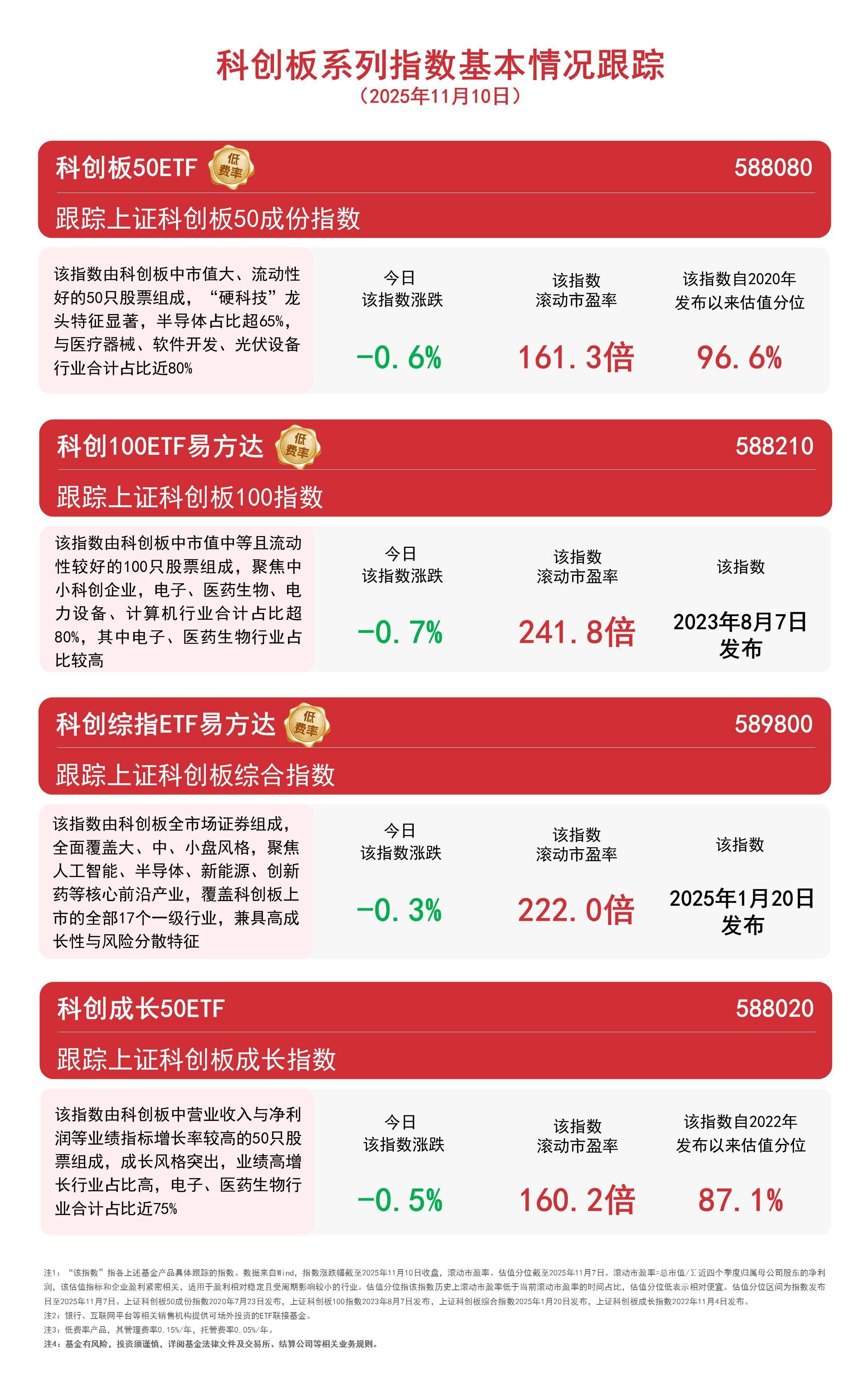
科创板系列指数今日震荡回调,关注科创板50ETF(588080)等产品投资机会
Sou Hu Cai Jing· 2025-11-10 11:00
Group 1 - The overall performance of the STAR Market indices showed a decline, with the STAR Composite Index down by 0.3%, STAR Growth Index down by 0.5%, STAR 50 Index down by 0.6%, and STAR 100 Index down by 0.7% [1] - The semiconductor sector exhibited localized strength, with notable stock performances including ShenGong Co. up by 20%, PuShen Co. up over 13%, JingYi Equipment up over 12%, and HuaHai ChengKe up over 8% [1] - The innovative pharmaceutical and medical device sectors were active, with JinDiKe reaching a 20% limit up [1] Group 2 - The STAR 50 ETF tracks the STAR 50 Index, which consists of 50 stocks with large market capitalization and good liquidity, prominently featuring "hard technology" companies, with over 65% in semiconductors and nearly 80% combined with medical devices, software development, and photovoltaic equipment [2] - The STAR 100 ETF follows the STAR 100 Index, which includes 100 stocks with medium market capitalization and good liquidity, focusing on mid-sized companies [2] - Small innovative enterprises in the sectors of electricity, medical devices, and computers account for over 80% of the index, with a high proportion in electronics and biopharmaceuticals [3] Group 3 - The STAR Composite Index ETF tracks the STAR Composite Index, which encompasses all securities in the STAR Market, covering large, medium, and small-cap styles, and focuses on core frontier industries such as artificial intelligence, semiconductors, new energy, and innovative pharmaceuticals [5] - The STAR Growth 50 ETF tracks the STAR Growth Index, which consists of 50 stocks with high growth rates in revenue and net profit, prominently featuring high-growth industries with a significant representation from electronics and biopharmaceuticals [5]

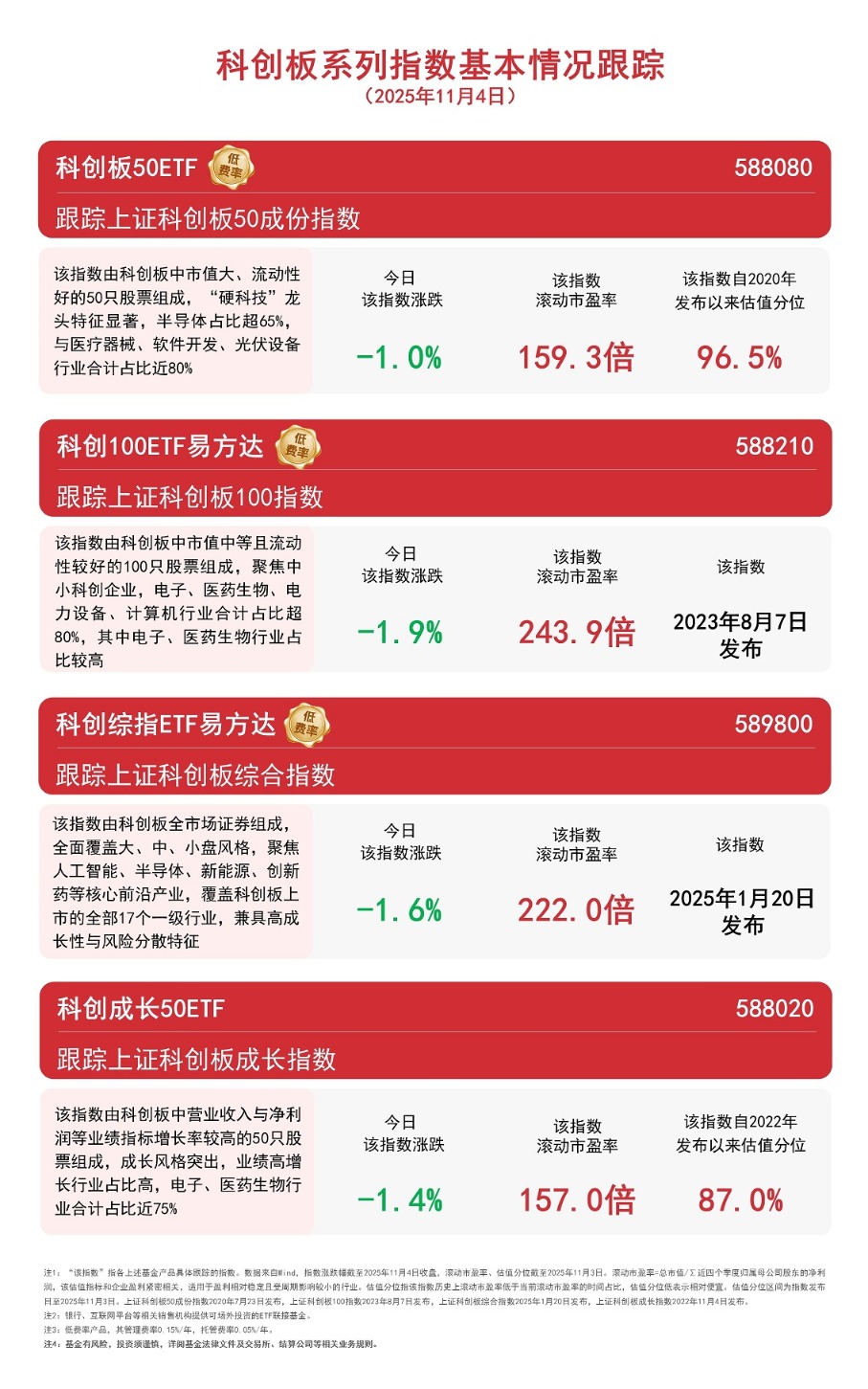
科技回调或迎布局机会,科创板50ETF(588080)连续4个交易日获资金净流入
Mei Ri Jing Ji Xin Wen· 2025-11-04 10:23
Group 1 - The technology sector experienced a volatile adjustment today, with the robotics sector leading the decline, and both computing hardware and innovative pharmaceutical and medical device stocks collectively falling [1] - As of the market close, the STAR Market 50 Index dropped by 1.0%, the STAR Growth Index fell by 1.4%, the STAR Composite Index decreased by 1.6%, and the STAR 100 Index declined by 1.9% [1] - According to Wind data, the STAR Market 50 ETF (588080) has seen a net inflow of funds for four consecutive trading days, totaling over 500 million yuan [1] Group 2 - The STAR Market 50 ETF tracks the STAR Market 50 Index, which consists of 50 stocks with large market capitalization and good liquidity, prominently featuring "hard technology" companies, with over 65% in semiconductors and nearly 80% in total across medical devices, software development, and photovoltaic equipment [3] - The STAR 100 ETF focuses on 100 medium-cap stocks with good liquidity, with over 80% in electronics, pharmaceuticals, and electrical equipment, and a significant portion in the electronics and pharmaceuticals sectors [3] - The STAR Composite Index ETF covers all securities in the STAR Market, focusing on core frontier industries such as artificial intelligence, semiconductors, new energy, and innovative pharmaceuticals, encompassing all 17 primary industries in the STAR Market [3]
从“十五五”规划看医药行业未来发展机会:支持创新药和医疗器械发展,加快健康中国建设
Bank of China Securities· 2025-10-29 10:13
Investment Rating - The industry investment rating is "Outperform the Market" [1] Core Viewpoints - The report highlights significant development opportunities for the pharmaceutical industry, particularly in innovative drugs and medical devices, as outlined in the "14th Five-Year Plan" [1][3] - The government has introduced various supportive policies for innovative drugs, including expedited approval processes and inclusion in medical insurance, which are expected to enhance the growth of the sector [3][5] - The report emphasizes the importance of improving the medical insurance system and the potential for commercial insurance to supplement coverage for innovative drugs, which could create a positive feedback loop for drug payments [3][5] Summary by Relevant Sections Investment Suggestions - The report recommends focusing on opportunities related to innovative drugs and medical devices, specifically mentioning companies such as Heng Rui Medicine, Innovent Biologics, BeiGene, Mindray Medical, and United Imaging Healthcare [3] - In the vaccine sector, it suggests paying attention to Zhifei Biological Products, Kangtai Biological Products, and CanSino Biologics [3] - For medical services, it highlights potential investments in Aier Eye Hospital and Tongce Medical [3] Policy Support and Market Trends - The report notes that the government is committed to supporting the development of innovative drugs and medical devices, which are crucial for public health and the independence of the biopharmaceutical industry [5] - It mentions that the time from drug approval to inclusion in the medical insurance directory has significantly decreased, with approximately 80% of innovative drugs being included within two years of market launch [5] - The report also discusses the optimization of fertility support policies and the response to aging populations, indicating that these factors could benefit related industries, including vaccines and long-term care services [5]