模拟芯片

Search documents
模拟芯片复苏 纳芯微A+H着陆
Bei Jing Shang Bao· 2025-12-28 16:11
Core Viewpoint - The semiconductor industry is experiencing a positive trend, particularly in the analog chip sector, highlighted by the recent listing of Naxin Micro on the Hong Kong Stock Exchange, making it one of the few companies in the domestic analog chip field to achieve dual listings in A+H markets [1] Group 1: Company Overview - Naxin Micro, established in 2013, focuses on chip design and sales, having previously listed on the Shanghai Stock Exchange's Sci-Tech Innovation Board in 2022 [1] - The company ranks fifth among Chinese analog chip manufacturers by revenue in 2024 and is the only major player in the top ten focusing on sensors, signal chain chips, and power management chips [3] Group 2: Market Dynamics - The domestic automotive analog chip market is projected to grow at a compound annual growth rate (CAGR) of 18% from 2025 to 2029, with expectations that the market size will surpass that of consumer electronics by 2029 [3] - Current domestic market penetration for analog chips is only 5%, indicating significant potential for domestic manufacturers to capture market share [3] Group 3: Pricing and Demand - Major industry players, such as Analog Devices and Texas Instruments, have announced price increases for their products, with some categories seeing price hikes of up to 30%, reflecting a recovery in downstream demand [3] - The demand for high-power and high-current analog chips is being driven by the recovery in industrial control and automotive sectors, as well as the growth in AI data centers [3] Group 4: Financial Performance - Naxin Micro reported a revenue of 1.524 billion yuan for the first half of 2025, a significant year-on-year increase of 79.49%, while the net loss narrowed to 78 million yuan, improving by 70.59% [5] - The company's gross margin for Q2 reached 35.97%, indicating a trend towards operational recovery, although profitability has not yet been achieved [5] Group 5: Strategic Initiatives - The funds raised from the recent listing will be used to enhance technical capabilities, expand product offerings, and develop international sales networks [4] - Naxin Micro's product range includes automotive electronics and AI-related components, with potential for growth in these sectors, although market cultivation will take time [5]


海外模拟芯片吹响涨价号角,国产厂商迎估值业绩修复曙光?
第一财经· 2025-12-25 03:30
Core Viewpoint - The recent surge in the semiconductor sector has shifted focus to analog chips, with leading stocks like Shengbang Co., Jihua Te, and Zhenlei Technology experiencing significant gains, indicating a potential recovery in the industry [3][4]. Group 1: Price Increases and Market Signals - Analog Devices (ADI) announced a price increase for its entire product line, effective February 1, 2026, with military-grade products seeing a rise of up to 30% [3][5]. - Texas Instruments (TI) initiated a price hike in August 2023, affecting over 60,000 models with increases ranging from 10% to 30% [3][5]. - The collective price increases from these industry giants are interpreted as strong signals of a cyclical reversal in the analog chip market, which has struggled with inventory and demand issues over the past two years [3][5][6]. Group 2: Demand Recovery and Market Dynamics - The demand for analog chips is closely tied to macroeconomic conditions, with signs of recovery in smartphone shipments, electric vehicle demand, and industrial automation driven by policy support [5][6]. - The current price increases differ fundamentally from the panic-driven hikes of 2020-2021, as they reflect strategic moves by leading companies to stabilize prices and restore profit margins rather than a response to supply chain disruptions [5][6]. Group 3: Implications for A-share Analog Chip Companies - A-share analog chip companies like Shengbang Co. and Jihua Te are expected to benefit from improved profit margins as a result of the price hikes initiated by global leaders [8][9]. - The average gross margin for the analog chip sector has declined from 42.2% in 2022 to 35.72% in 2024, with a slight recovery to 36.01% by Q3 2023, indicating the pressure faced by domestic manufacturers [9]. - If the price stability and potential increases lead to enhanced demand from downstream customers, A-share companies may experience a "volume-price rise" scenario, particularly in key areas like power management and automotive-grade chips [9].




海外模拟芯片吹响涨价号角,国产厂商迎估值业绩修复曙光?
Di Yi Cai Jing· 2025-12-25 03:13
Core Viewpoint - The recent price hikes by global semiconductor giants Analog Devices (ADI) and Texas Instruments (TI) signal a potential reversal in the semiconductor industry's cycle, particularly for the analog chip sector, which has been underperforming due to inventory digestion and weak demand over the past two years [1][2]. Group 1: Price Increases and Market Reactions - Analog Devices plans to increase prices across its entire product range by up to 30% for military-grade products starting February 1, 2026, following Texas Instruments' earlier price hikes of 10%-30% for over 60,000 models [1][2]. - The collective price increases from industry leaders are interpreted as a strong signal of a cyclical recovery, suggesting that the prolonged downturn may have reached its bottom [1][2][3]. - The market is shifting from a broad price war to a more structured "volume-price game," with high-end and automotive products showing stronger price rigidity compared to low-end general products [3]. Group 2: Demand Recovery and Industry Outlook - The demand for analog chips is closely tied to macroeconomic conditions, with signs of recovery in downstream markets, including a rebound in smartphone shipments and increased demand for electric and smart vehicles [2][4]. - The average gross margin for the analog chip sector has declined from 42.2% in 2022 to 35.72% in 2024, with a slight recovery to 36.01% by the end of Q3 this year, indicating the pressure domestic manufacturers faced during the downturn [4][5]. - The price stabilization initiated by leading companies could create a more favorable pricing environment for domestic firms, potentially aiding in gross margin recovery [5][6]. Group 3: Challenges and Future Prospects - Despite signs of recovery, domestic analog chip manufacturers face challenges, including reliance on international suppliers in consumer electronics and automotive sectors, and a need to observe the recovery strength in various fields [6]. - The potential for a "volume-price rise" scenario hinges on substantial recovery in downstream demand, particularly in key areas like power management and signal chain chips [6].
模拟IC走出谷底! ADI、TI接力涨价
半导体行业观察· 2025-12-21 03:58
Group 1 - The global analog chip market is showing clear signs of recovery, with major players like Analog Devices, Inc. (ADI) and Texas Instruments (TI) implementing price increases of approximately 15% and 10% to over 30% respectively, indicating a new cycle in the analog IC industry [1] - ADI's price adjustment is attributed to rising costs in raw materials, labor, energy, and logistics, as well as ongoing global inflation pressures [1] - The demand for high-power and high-current components is expected to increase significantly due to the construction of AI data centers, which is driving a structural reversal in the analog IC market [1] Group 2 - Silicon Labs remains confident in its long-term growth prospects, particularly in the automotive and data center sectors, with new products such as Power ICs for autonomous driving and mid-to-high-end MCUs set to enter mass production next year [2] - The company anticipates that revenue from data centers will account for 4% to 5% of its total revenue next year, driven by the introduction of many new products [2] - The overall market demand and outlook for next year remain uncertain, with concerns about storage prices potentially dampening end-user purchasing [2]



豪威集团:景气赛道叠加技术复用 多引擎驱动CIS产业
Zhi Tong Cai Jing· 2025-12-17 05:48
Core Viewpoint - Company is a leading Fabless semiconductor design firm focusing on CMOS image sensors (CIS) and expanding into display and analog solutions, aiming to strengthen its global competitiveness through an upcoming IPO [1] Group 1: Business Overview - Company operates in three main solution areas: image sensor solutions, display solutions, and analog solutions, continuously driving technological iteration and market expansion [2] - In the smartphone CIS sector, the company plans to launch the OV50X image sensor in April 2025, featuring LOFIC technology for HDR in various lighting conditions [2] - The automotive CIS sector has seen the introduction of several products, including the OX08D10 and OX05D10, designed to meet the requirements of next-generation ADAS and autonomous driving [2] - The medical CIS sector will see the release of the OCH2B30 camera module in June 2024, aimed at 3D dental scanning applications [2] Group 2: Financial Performance - Company reported revenues of approximately 20.04 billion RMB, 20.984 billion RMB, 25.707 billion RMB, and 13.944 billion RMB for the years 2022, 2023, 2024, and the first half of 2025 respectively, with a CAGR of about 13.3% from 2022 to 2024 [3] - The net profits for the same periods were 0.951 billion RMB, 0.544 billion RMB, 3.279 billion RMB, and 2.02 billion RMB, with a staggering 502% year-on-year profit increase in 2024 [3] Group 3: Market Position and Growth Drivers - In 2024, the company's revenue reached a historical high, driven by its strong market penetration in high-end smartphones and automotive applications, with CIS solutions revenue of 19.19 billion RMB, significantly higher than previous years [4] - The smartphone CIS product revenue was approximately 9.8 billion RMB in 2024, reflecting a 26.0% year-on-year growth [4] - The automotive CIS product revenue was around 5.91 billion RMB, showing a 30% year-on-year increase [4] Group 4: Industry Trends - The global CIS market is projected to grow from 17.9 billion USD in 2020 to 19.5 billion USD in 2024, with a CAGR of 2.2%, and is expected to reach 29.5 billion USD by 2029, with a CAGR of 8.6% from 2024 to 2029 [7] - The company is positioned to benefit from this growth, leveraging its technological advantages and expanding into new applications such as automotive intelligence, machine vision, and AR/VR [7][8] Group 5: Competitive Advantages - Company has developed a strong and transferable technology platform, with over 4,500 global patents, enabling rapid product development and market entry [3][8] - The company's technology reuse strategy allows it to maintain a competitive edge across various sectors, including smartphones, automotive, and emerging fields like industrial automation [8][9] - The company is not only a beneficiary of the semiconductor industry's recovery but also a proactive leader in the digital and intelligent transformation across multiple industries [9]

纳芯微港股敲钟,中国汽车芯片开讲“出海”新故事
Jing Ji Guan Cha Wang· 2025-12-11 06:33
Core Insights - Naxin Micro officially listed on the Hong Kong Stock Exchange on December 8, becoming one of the few companies in the analog chip industry to establish an "A+H" dual capital platform [2] - Naxin Micro ranks first among Chinese manufacturers in the automotive analog chip market based on projected revenue for 2024, positioning itself as a representative enterprise in China's analog chip sector [3] - The company aims to use Hong Kong as a strategic hub for global expansion, indicating that its listing is not solely for fundraising but also for building a high-standard platform for international operations [3] Company Strategy - Naxin Micro's co-founder and COO outlined a "three-step" strategy for international expansion: Local for Local, Local for Global, and Global for Global [4] - The current phase, "Local for Global," focuses on leveraging domestic market collaborations to gain trust and extend projects to international clients [4] - The ultimate goal, "Global for Global," involves building a global capital and operational platform through the Hong Kong listing [4] Market Position and Challenges - Despite achieving breakthroughs in various segments, Naxin Micro acknowledges the gap between itself and established international giants like Texas Instruments and Infineon, particularly in product portfolio scale and manufacturing capabilities [5] - The company has over 4,000 product SKUs, but this is still less comprehensive compared to competitors with tens of thousands of products [5] - Naxin Micro operates under a Fabless model, relying on foundries, which creates a gap in manufacturing capabilities compared to vertically integrated manufacturers [5] Operational Efficiency - Naxin Micro plans to establish an independent and efficient overseas supply chain centered in Hong Kong, enhancing operational efficiency and providing a buffer against complex trade environments [7] - The company aims to attract global R&D talent by leveraging Hong Kong's top universities and international environment [7] Financial Performance - Naxin Micro's revenue grew from approximately 250 million yuan to about 840 million yuan from Q2 2023 to Q3 2025, despite the overall industry facing challenges [8] - The company has shipped over 980 million automotive chips, with an average of over 20 chips per vehicle produced in China, and 40 to 50 chips per electric vehicle [9] - Naxin Micro is currently operating at a loss, attributed to increased market competition and ongoing investments in new products and directions [9] Future Goals - The company aims to surpass the $1 billion revenue mark by 2029, which is a significant challenge given that leading domestic firms typically hover around 3 billion yuan (approximately $400 to $500 million) [10] - Naxin Micro's growth strategy emphasizes organizational capability over product alone, with a focus on building a systematic organization that does not rely on individual leadership [10]

两起模拟芯片横向并购案“火速”终止,行业并购潮迎分化拐点
2 1 Shi Ji Jing Ji Bao Dao· 2025-12-10 13:09
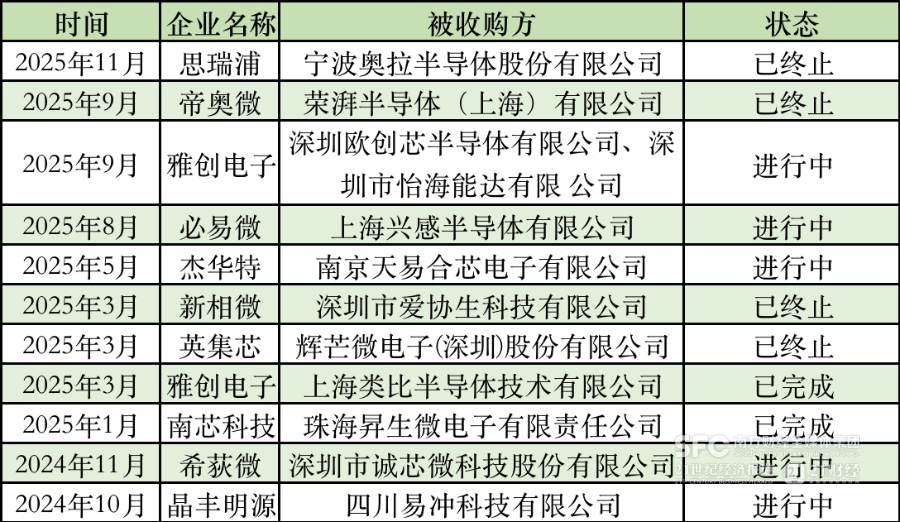
Core Viewpoint - The recent trend in the semiconductor industry, particularly in the analog chip sector, shows a surge in horizontal mergers and acquisitions (M&A), but several notable deals have been terminated due to disagreements on key terms and conditions [1][5][6]. Group 1: M&A Activity - SiRuPu (688536.SH) announced the termination of its major asset restructuring plan, leading to the resumption of its stock trading [1] - DiAoWei (688381.SH) held an investor briefing to announce the termination of its share purchase agreement for acquiring RongPai Semiconductor (Shanghai) Co., Ltd., due to a lack of consensus on the transaction terms [1] - A total of 9 horizontal M&A attempts have been initiated by 8 domestic analog chip manufacturers this year, including notable companies like SiRuPu, DiAoWei, and YaChuang Electronics [2][3]. Group 2: Reasons for M&A Termination - The primary reason for the termination of several M&A deals is the inability of the parties involved to reach an agreement on the transaction's core terms, such as pricing and performance commitments [5][6] - SiRuPu cited that the conditions for implementing a major asset restructuring were not fully mature as a reason for its deal's termination [5] - The semiconductor industry has experienced a significant influx of capital over the past decade, leading to inflated valuations, which, combined with economic adjustments, has made M&A transactions more challenging [5][6]. Group 3: Industry Characteristics and Trends - The analog chip industry is characterized by a long product lifecycle, a wide variety of chip types, and a low individual chip value, making it difficult for single companies to cover all product categories through self-research [4][7] - Horizontal M&A is seen as a key growth strategy for analog chip companies, allowing them to quickly acquire core technologies, R&D teams, and customer resources, thereby shortening development cycles and reducing market risks [3][4]. - The global analog chip market is dominated by companies like Texas Instruments (TI) and Analog Devices (ADI), which have successfully built comprehensive product lines through strategic acquisitions [6][7]. Group 4: Future Outlook - Despite the recent terminations, external M&A is still viewed as a crucial growth path for analog chip companies, with firms like Xinxiangwei indicating a commitment to combining organic growth with external development strategies [5][6]. - The Chinese analog chip sector has over 400 design companies, but there is a notable absence of domestically competitive large firms capable of global competition [6][7].


安永企业家奖2025获奖企业家介绍专辑(二)
Sou Hu Cai Jing· 2025-12-10 04:04
Group 1 - The "Ernst & Young Entrepreneur Award" 2025 has officially announced its winners, recognizing twelve outstanding entrepreneurs from mainland China and Hong Kong/Macau [2] - The award highlights significant contributions from the technology sector, showcasing innovative leaders in the industry [2] Group 2 - Dr. Zhang Shilong is a pioneer in China's analog chip industry and founded Shengbang Microelectronics in 2007, focusing on high-performance analog integrated circuits [4] - Shengbang Microelectronics became the first listed company in China's A-share market dedicated to analog chip design in 2017, earning the title of "leader in analog chips" [4] - The company emphasizes customer-centric innovation and aims to enhance its market share and profitability through technological advancements and international market expansion [4] Group 3 - Li Ping, co-founder and CEO of Chizi City Technology, has led the company to serve over 1 billion users across more than 150 countries, with a revenue exceeding 5 billion RMB and a market value over 18 billion RMB [7] - Under Li Ping's leadership, Chizi City Technology has developed a diverse product matrix, including global social platforms and niche social products, while establishing a strong presence in the Middle East and North Africa [7] - The company aims to continue its mission of creating valuable emotional experiences in the global social entertainment market [7]

纳芯微港股挂牌:以传感器、信号链、电源管理三大体系挺进全球市场
Sou Hu Cai Jing· 2025-12-08 10:42
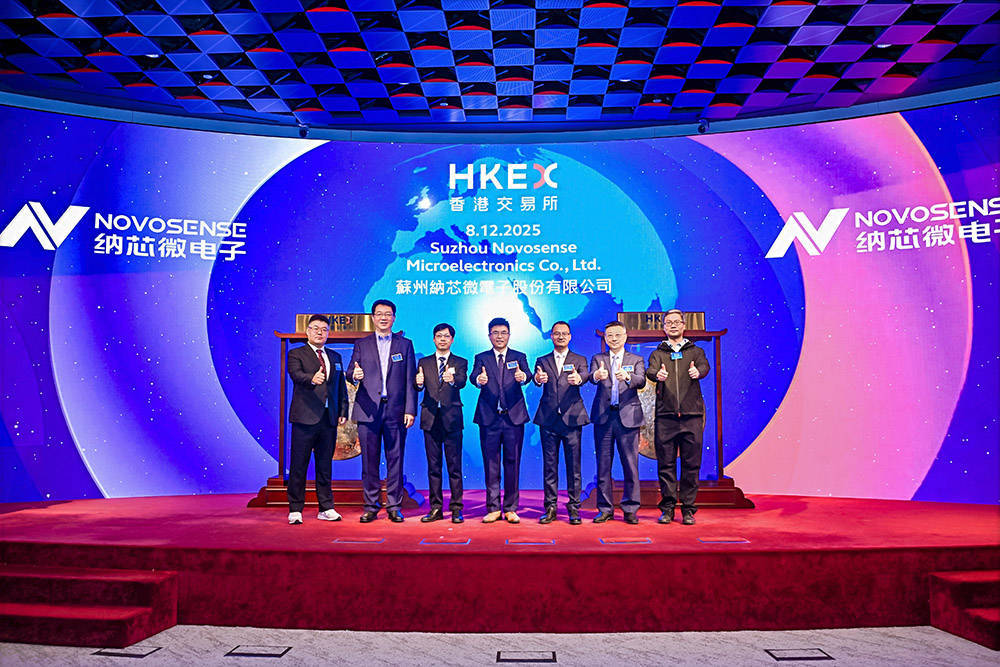
Core Viewpoint - Naxin Micro officially listed on the Hong Kong Stock Exchange on December 8, 2025, marking a new phase in the company's globalization strategy [1] Group 1: Global Strategy - Naxin Micro positions Hong Kong as its overseas headquarters, serving as a strategic hub for global customer service, supply chain collaboration, and ecosystem development [3] - The company aims to enhance its participation and influence in the international analog chip industry [3] Group 2: Market Position and Product Development - Naxin Micro is one of the few companies in China with deep layouts in three core areas: sensors, signal chains, and power management [3] - The company has established a leading advantage in key sectors such as automotive electronics, general energy sources, and smart terminals [3] Group 3: Future Plans - The CEO of Naxin Micro stated that the Hong Kong listing is not only a milestone for business development but also the starting point for the company's global narrative [3] - The company plans to increase investment in underlying technology, expand its product portfolio, improve overseas sales and market systems, and enhance global operational capabilities [3]
国产模拟芯片龙头纳芯微赴港上市:国家队领投、全球资本重磅集结
半导体行业观察· 2025-11-29 02:49
Core Viewpoint - Naxin Microelectronics is set to list its H-shares in Hong Kong, marking a significant milestone in its development and enhancing its global capital and industry cooperation opportunities [1][2]. Group 1: H-Share Issuance Characteristics - The H-share issuance features a strong cornerstone investor lineup, including national strategic funds and leading enterprises, indicating high recognition of Naxin's growth potential [2][3]. - The international placement accounts for 90% of the issuance structure, reflecting the company's strategy to embrace international capital markets [2][6]. - Naxin has established a solid technological and market leadership position in several key segments, providing a robust foundation for international expansion [2][9]. Group 2: Investor Composition - The cornerstone investor group includes major industry players like BYD and Xiaomi, highlighting Naxin's importance in key application areas with high demand for analog chips [4][5]. - Professional investment institutions also participate, reinforcing market confidence in Naxin's long-term growth [4][6]. - The combination of national strategic capital, industry leaders, and professional investors is rare in semiconductor financing, showcasing Naxin's broad recognition [4][16]. Group 3: Global Issuance Strategy - Naxin plans to issue approximately 19.07 million shares, with 10% for public offering in Hong Kong and 90% for international placement, aiming to attract long-term capital [6][7]. - The maximum issuance price is set at HKD 116 per share, with an option for additional shares, providing flexibility in the market [6][7]. - The choice of Hong Kong as a listing venue is strategic, allowing Naxin to connect with global institutional investors and enhance its visibility [6][15]. Group 4: Fund Utilization - The funds raised will be allocated to enhancing technical capabilities (18%), expanding product offerings (22%), overseas market promotion (25%), strategic investments (25%), and general corporate purposes (10%) [7][11]. - A significant portion of the funds will support global market development, indicating Naxin's commitment to international business [7][11]. Group 5: Market Position and Growth - Naxin ranks among the top five Chinese analog chip manufacturers, uniquely covering sensors, signal chains, and power management [9][10]. - In the automotive electronics sector, Naxin holds the top position among Chinese companies, demonstrating its reliability and scalability [9][10]. - The company has seen substantial growth in automotive electronics, with a compound annual growth rate of 67% in electronic shipments from 2022 to 2024 [10][11]. Group 6: Industry Trends and Challenges - The Chinese analog chip market is projected to grow from CNY 121.1 billion in 2020 to CNY 195.3 billion in 2024, with a compound annual growth rate of 12.7% [13][14]. - Naxin's growth reflects a broader trend of domestic companies gaining market share and moving up the value chain in the analog chip sector [13][14]. - Despite the competitive landscape, Naxin's strategic investments and product development position it well for future growth [16].