
燃气生产和供应业

Search documents
上月PPI环比涨幅扩大
Zhong Guo Hua Gong Bao· 2026-01-13 02:51
Core Viewpoint - The Producer Price Index (PPI) in December 2025 showed a year-on-year decline of 1.9%, with a narrowing decrease compared to the previous month, while a month-on-month increase of 0.2% was observed, indicating a mixed trend in industrial prices driven by supply-demand dynamics and external factors [1]. Group 1: PPI Trends - The year-on-year PPI decline of 1.9% reflects a narrowing of 0.3 percentage points from the previous month [1]. - The month-on-month PPI increased by 0.2%, which is an expansion of 0.1 percentage points compared to the prior month [1]. Group 2: Price Influences - Improvement in supply-demand structure led to price increases in certain sectors, such as a 1.0% rise in lithium-ion battery manufacturing prices for three consecutive months [1]. - Seasonal demand increases contributed to price rises in gas production and supply (1.2%) and electricity and heat production and supply (1.0%) [1]. - Input factors caused a divergence in prices for non-ferrous metals and oil-related industries, with international crude oil prices leading to declines of 2.3% in domestic oil extraction and 0.9% in refined oil product manufacturing [1]. Group 3: Policy Impact and Sector Performance - Continuous effectiveness of macro policies has resulted in positive price changes in certain industries, with the construction of a unified national market contributing to a narrowing of year-on-year price declines [1]. - The growth of new productive forces has led to price increases in related sectors, including a 9.0% rise in biomass liquid fuel prices, 5.5% in graphite and carbon product manufacturing, 2.4% in integrated circuit finished products, and 0.9% in waste resource recycling [1]. - The effective release of consumer potential has also driven year-on-year price increases in relevant industries [1].
12月通胀数据解读:2025年通胀回眸
Huachuang Securities· 2026-01-10 07:51
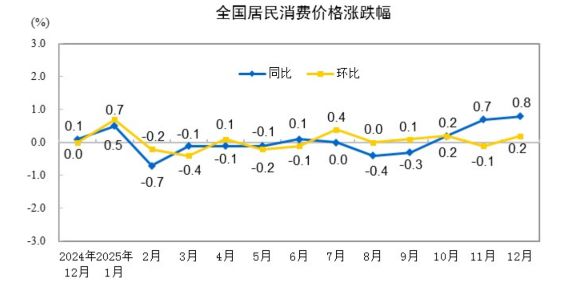
1. Report Industry Investment Rating No information about the industry investment rating is provided in the report. 2. Core Viewpoints of the Report - In 2025, CPI increased by 0.8% year - on - year, with core consumer goods, services, and fresh produce prices improving. PPI's year - on - year decline narrowed to - 1.9%, and prices gradually recovered from upstream to mid - downstream after the "anti - involution" policy [2][3]. - In December 2025, due to the decline in vegetable price growth and the seasonal recovery of consumer goods, CPI's year - on - year increase rebounded to 0.8% under the low - base effect. PPI's month - on - month increase rebounded to 0.2% due to the heating season and the impact of imported non - ferrous metals [29][45]. 3. Summary According to the Directory 2025 Inflation Review CPI - In 2025, CPI increased by 0.8% year - on - year. The factors contributing to the CPI increase from high to low were core consumer goods (0.63 pct), fresh produce (0.4 pct), services (0.25 pct), while livestock and meat (- 0.19 pct) and energy (- 0.3 pct) dragged it down [2][9]. - Core consumer goods: Gold prices contributed half of the increase, and prices of household appliances and daily necessities improved under consumption - promoting policies. Services: Service consumption scenarios mainly related to travel still supported prices, with significant price fluctuations between peak and off - peak seasons. Livestock and meat: Pig production capacity reduction was slow under "large - scale" farming, and terminal demand was weak, leading to a slow decline in prices. Fresh produce: Extreme weather affected production and transportation, tightening supply and driving up prices. Energy: Trade frictions led to weak demand and a downward price trend [2][14][15]. PPI - In 2025, the year - on - year decline of PPI narrowed to - 1.9%. After the "anti - involution" policy in July, mid - stream production materials industries showed positive signals, but the durable consumer goods manufacturing industry related to long - term income expectations and closer to terminal demand was still weak [24]. - Industries with continuous price increases included the imported non - ferrous metal industry chain, which had six consecutive months of price increases. Domestically, industries generally saw price recovery from upstream to mid - downstream, such as coal and black mining in the upstream, the paper - making industry, and then lithium - ion battery manufacturing and non - metallic mineral products industries [27]. December CPI Food Items - CPI food prices increased by 0.3% month - on - month, slightly weaker than the seasonal average, driving CPI up by about 0.05 percentage points. Pork prices decreased slightly due to oversupply, and fresh produce prices were weaker than the seasonal level, with fresh fruit prices rising seasonally and fresh vegetable prices rising less than expected [31]. Non - food Items - The non - food item of CPI increased by 0.1% month - on - month, stronger than the seasonal average, driving CPI up by about 0.12 percentage points. Energy prices decreased slightly, core consumer goods drove CPI up by about 0.16 percentage points (21% contributed by gold price increases), and service prices had limited impact on CPI during the off - travel season [32][37][38]. December PPI Overall - In December, PPI's month - on - month increase rebounded to 0.2% after 19 months, with price increases spreading from the mining industry to raw material and processing industries. Production material prices increased by 0.2%, while downstream living material prices remained flat [45]. By Industry - The number of industries with rising prices among industrial producers remained at 9. Supportive factors included the seasonal increase in demand and prices of coal, gas, and the non - ferrous metal industry chain, as well as the continuous price recovery of the paper - making industry. The drag factor was the imported crude oil industry chain [47][51][59].
固定收益点评:菜金主导物价,持续性待观察
GOLDEN SUN SECURITIES· 2026-01-09 09:16
1. Report Industry Investment Rating No relevant content provided 2. Core Viewpoints of the Report - The rise in prices is significantly influenced by short - term and single - commodity factors, and its impact on financing demand is limited due to the short - term and seasonal nature of food price increases and the limited ability of single - commodity price hikes to drive up financing demand [4][25][26] - Monetary policy mainly for demand adjustment may not effectively respond to the current price increases, and price increases have a limited impact on interest rates [4][26] - The bond market is expected to recover. It may remain volatile in January due to supply shocks and have a smoother recovery after late January [5][26] 3. Summary by Related Content CPI Analysis - In December, CPI year - on - year increase expanded by 0.1 percentage points to 0.8%, reaching the highest level since March 2023, and the month - on - month increase was seasonally higher than the average of the past three years [1][8] - The increase in CPI was mainly driven by the expansion of food price increases, especially fresh vegetables and fruits. However, vegetable prices started to decline in late December [1][4][9] - Core CPI increased by 1.2% year - on - year, remaining flat compared to the previous month, with a month - on - month increase of 0.2% turning from decline to rise. Gold prices still had a significant impact on CPI [2] - The other supplies and services sector in CPI increased by 17.4% year - on - year in December, with its growth rate rising by 3.2 percentage points compared to November, likely supported by the increase in gold prices [2][14] PPI Analysis - In December, PPI decreased by 1.9% year - on - year, with the decline narrowing by 0.3 percentage points, and increased by 0.2% month - on - month. The non - ferrous and coal industries still had a large pulling effect [3][22] - Input factors affected domestic non - ferrous metal - related industries, and prices in the coal industry increased for five consecutive months. Seasonal demand also drove up prices in the gas and power industries [3][22] - The prices of industries related to the construction of a unified national market saw their year - on - year declines continuously narrowing, and the prices of industries related to new - quality productivity increased year - on - year [3][22] - In December, the PPI of consumer goods decreased by 1.3% year - on - year, with the decline narrowing by 0.2 percentage points compared to the previous month [3] Impact on the Bond Market - The bond market is expected to recover. The mild implementation of the public fund fee - rate new regulations and the easing of banks' institutional indicator pressure may boost the allocation power and drive the bond market to warm up [5][26] - In January, supply shocks such as the large - scale supply of government bonds and the initial - stage credit shock may cause the bond market to remain volatile, but after late January, the recovery may be smoother [5][26]
中国PPI连续3个月环比上涨
Zhong Guo Xin Wen Wang· 2026-01-09 08:34
Group 1 - China's Producer Price Index (PPI) increased by 0.2% month-on-month in December 2025, marking the third consecutive month of growth, with the growth rate expanding by 0.1 percentage points compared to the previous month [1] - Key industries such as coal mining and washing, as well as coal processing, saw prices rise by 1.3% and 0.8% respectively, both continuing to increase for five consecutive months [1] - The price of new energy vehicle manufacturing shifted from a decrease of 0.2% in the previous month to an increase of 0.1% [1] Group 2 - Year-on-year, China's PPI decreased by 1.9% in December, but the decline narrowed by 0.3 percentage points compared to the previous month [1] - The optimization of market competition has led to a reduction in the year-on-year price decline for coal mining, lithium-ion battery manufacturing, and photovoltaic equipment manufacturing, with reductions narrowing for five, four, and nine consecutive months respectively [1] - The prices of external storage devices and components increased by 15.3%, while biomass liquid fuel prices rose by 9.0%, and integrated circuit product prices increased by 2.4% [2]
2025年12月物价数据点评:多重因素共振,年末物价数据全面回升
Dong Fang Jin Cheng· 2026-01-09 05:59
Group 1: CPI Analysis - In December 2025, the CPI increased by 0.8% year-on-year, up from 0.7% in the previous month, marking the highest increase since August 2023[2] - The cumulative CPI for January to December 2025 was 0.0%, indicating a stagnation in price growth over the year[1] - The main drivers for the December CPI increase included rising vegetable and fruit prices due to adverse weather, consumer promotion policies boosting appliance and vehicle prices, and an increase in international gold prices[3] Group 2: PPI Analysis - The PPI in December 2025 decreased by 1.9% year-on-year, a slight improvement from a 2.2% decline in November, with a cumulative decline of 2.6% for the year[1] - The December PPI saw a month-on-month increase of 0.2%, marking the third consecutive month of rising prices[6] - Key factors contributing to the PPI changes included improved supply-demand dynamics in certain industries and rising prices in the non-ferrous metals sector, with specific increases of 3.7% and 2.8% in mining and refining respectively[7][8] Group 3: Economic Outlook - The overall economic environment in 2025 was characterized by weak demand and a "strong supply, weak demand" scenario, leading to a continued decline in PPI[10] - Looking ahead to January 2026, the CPI is expected to drop to around 0.2% year-on-year due to a higher base effect from the previous year and seasonal price fluctuations[5] - The forecast for 2026 indicates a continued low inflation environment, with an expected annual CPI of approximately 0.4%[5]
国家统计局:PPI环比涨幅扩大 同比降幅收窄
Sou Hu Cai Jing· 2026-01-09 02:36
Group 1 - The Producer Price Index (PPI) for industrial producers increased by 0.2% month-on-month in December 2025, marking the third consecutive month of growth, with the year-on-year decline narrowing to 1.9% [1] - Key industries such as coal mining and lithium-ion battery manufacturing saw price increases, with coal mining prices rising by 1.3% and lithium-ion battery prices by 1.0%, both continuing their upward trend for three months [1][2] - Seasonal demand increases contributed to price rises in gas production and supply, as well as electricity and heat production, with respective increases of 1.2% and 1.0% [1] Group 2 - Domestic prices in the non-ferrous metals and petroleum sectors showed divergence due to external factors, with non-ferrous metal mining and smelting prices rising by 3.7% and 2.8% respectively, while oil extraction and refining prices fell by 2.3% and 0.9% [2] - The narrowing year-on-year decline in PPI reflects the effectiveness of macroeconomic policies, with certain industries experiencing positive price changes [2] - The construction of a unified national market is progressing, leading to a continuous reduction in year-on-year price declines across various industries [2] Group 3 - Consumer potential is being effectively released, driving price increases in related industries, with prices for arts and crafts manufacturing rising by 23.3% and sports ball manufacturing by 4.0% [3] - The implementation of special actions to boost consumption has led to rapid growth in cultural and quality-related consumption [3]
2025年CPI数据发布
Di Yi Cai Jing Zi Xun· 2026-01-09 02:08
Core Viewpoint - In December 2025, the Consumer Price Index (CPI) increased by 0.8% year-on-year, with urban areas rising by 0.9% and rural areas by 0.6%, indicating a steady increase in consumer prices driven by food and non-food price changes [1][4][6]. CPI Summary - The CPI rose by 0.2% month-on-month in December, reversing a previous decline of 0.1% [5]. - Core CPI, excluding food and energy, increased by 1.2% year-on-year, maintaining a growth rate above 1% for four consecutive months [6]. - Food prices rose by 1.1% year-on-year, with significant increases in fresh vegetables (18.2%) and fresh fruits (4.4%), contributing to the overall CPI increase [6][8]. - Energy prices decreased by 3.8% year-on-year, with gasoline prices dropping by 8.4% [6]. PPI Summary - The Producer Price Index (PPI) increased by 0.2% month-on-month, marking three consecutive months of growth [8]. - Year-on-year, the PPI decreased by 1.9%, but the decline was less severe than in previous months, indicating some stabilization in industrial prices [9]. - Key industries such as coal mining and lithium-ion battery manufacturing saw price increases, reflecting improved supply-demand dynamics [8][9]. - Input factors like international commodity prices influenced the price trends in domestic industries, with non-ferrous metal prices rising due to global market conditions [8][9].

南京海缘通新能源科技有限公司成立,注册资本1000万人民币
Sou Hu Cai Jing· 2026-01-07 14:16
Core Viewpoint - Nanjing Haiyuantong New Energy Technology Co., Ltd. has been established with a registered capital of 10 million RMB, fully owned by Nanjing Taiyan Trading Co., Ltd. [1] Company Summary - The legal representative of Nanjing Haiyuantong New Energy Technology Co., Ltd. is Wang Tongjun [1] - The company is classified under the electricity, heat, gas, and water production and supply industry, specifically in gas production and supply [1] - The registered address is Room 312, Building S02, No. 30 Guangyue Road, Qixia Street, Qixia District, Nanjing, Jiangsu Province [1] - The company type is a limited liability company (wholly owned by a natural person) [1] - The business term is from January 6, 2026, with no fixed expiration date [1] Business Scope - The business scope includes research and development of emerging energy technologies, sales of new energy power equipment, sales of electric accessories for new energy vehicles, sales of battery swap facilities for new energy vehicles, sales of petroleum products (excluding hazardous chemicals), sales of chemical products (excluding licensed chemical products), and sales of lubricants (operating activities conducted independently with a business license) [1] - Nanjing Taiyan Trading Co., Ltd. holds 100% of the shares in Nanjing Haiyuantong New Energy Technology Co., Ltd. [1]
2025年1-11月全国燃气生产和供应业出口货值为38.4亿元,累计增长22.1%
Chan Ye Xin Xi Wang· 2026-01-06 03:36
Core Viewpoint - The report highlights the growth and investment opportunities in China's gas production and supply industry, with significant increases in export value noted for 2025 [1] Industry Summary - The gas production and supply industry in China saw an export value of 300 million yuan in November 2025, representing a year-on-year increase of 17.9% [1] - Cumulatively, from January to November 2025, the total export value reached 3.84 billion yuan, with a year-on-year growth of 22.1% [1] - The report provides a comprehensive assessment and forecasts for the gas industry from 2026 to 2032, indicating a positive outlook for investment opportunities [1] Company Summary - Listed companies in the gas sector include Shengli Co., Ltd. (000407), Delong Huineng (000593), ST Jinhong (000669), Shengtong Energy (001331), ST Shengda (002259), Shanxi Natural Gas (002267), Xin'ao Co., Ltd. (600803), Guizhou Gas (600903), Chongqing Gas (600917), Shenzhen Gas (601139), and Chengdu Gas (603053) [1]

辽河石油勘探局取得储气库压力能发电系统并网控制专利
Sou Hu Cai Jing· 2026-01-03 01:21
国家知识产权局信息显示,辽河石油勘探局有限公司、中国石油天然气集团有限公司、辽河油田(盘 锦)储气库有限公司取得一项名为"一种储气库压力能发电系统及其并网控制方法"的专利,授权公告号 CN119944795B,申请日期为2024年10月。 天眼查资料显示,辽河石油勘探局有限公司,成立于1984年,位于盘锦市,是一家以从事燃气生产和供 应业为主的企业。企业注册资本326100万人民币。通过天眼查大数据分析,辽河石油勘探局有限公司共 对外投资了68家企业,参与招投标项目2210次,专利信息1152条,此外企业还拥有行政许可61个。 声明:市场有风险,投资需谨慎。本文为AI基于第三方数据生成,仅供参考,不构成个人投资建议。 来源:市场资讯 中国石油天然气集团有限公司,成立于1990年,位于北京市,是一家以从事石油和天然气开采业为主的 企业。企业注册资本48690000万人民币。通过天眼查大数据分析,中国石油天然气集团有限公司共对外 投资了107家企业,参与招投标项目5000次,财产线索方面有商标信息1447条,专利信息5000条,此外 企业还拥有行政许可28个。 辽河油田(盘锦)储气库有限公司,成立于2021年,位 ...
