
耐用消费品与服装

Search documents
中国股票利好不断,外资爆买
Zheng Quan Shi Bao· 2025-10-03 11:08
Group 1 - Foreign capital inflow into the Chinese stock market rebounded to $4.6 billion in September, the highest monthly figure since November 2024, driven primarily by passive funds [1][3] - Year-to-date, passive funds have cumulatively flowed into China amounting to $18 billion, surpassing last year's total of $7 billion [3] - Over 90% of investors surveyed by Morgan Stanley plan to increase their exposure to the Chinese market, marking a new high since 2021 [3] Group 2 - The semiconductor sector has seen significant investment, with active managers increasing their holdings in this area, while reducing positions in insurance and durable goods [6] - Semiconductor stocks, particularly SMIC and Hua Hong Semiconductor, have experienced substantial price increases, with SMIC rising over 12% on October 2 [6] - The semiconductor industry reported a revenue of 353.03 billion yuan in the first half of the year, reflecting a year-on-year growth of 13.34% [7] Group 3 - The AI chip sector is expected to thrive, with a complete integration of the domestic AI industry chain from upstream to downstream [7] - The second half of the year is typically a period of intensive technology releases and product iterations in the domestic tech sector, particularly in semiconductors and AI applications [7] - The market sentiment is optimistic, with expectations of policy support and potential interest rate cuts from the Federal Reserve benefiting the Hong Kong stock market [7]
大摩:外资9月净流入中国股市46亿美元 主动基金增持半导体最多
财联社· 2025-10-03 02:49
Core Insights - In September, foreign capital inflow into the Chinese stock market rebounded to $4.6 billion, the highest monthly figure since November 2024, primarily driven by $5.2 billion inflow from passive funds, while active funds saw a slight outflow of $0.6 billion [1][5] - As of September 30, the cumulative inflow of foreign passive funds for the year reached $18 billion, surpassing last year's total of $7 billion [1][5] Fund Flow Analysis - Active managers increased their holdings the most in capital goods and semiconductors, while they reduced their positions the most in insurance, durable consumer goods, and apparel [1][5] - The largest increases in holdings were seen in Alibaba, CATL (Contemporary Amperex Technology Co., Limited), and JD.com, whereas Tencent, Ping An Insurance, and Pop Mart experienced the largest reductions in holdings [1][5]


周期股将迎爆发?瑞银:经济过热预期正触发市场广度扩张 滞涨板块有望迎补涨行情
智通财经网· 2025-09-16 01:56
Group 1 - UBS analysts indicate that the market has begun to price in a 12% probability of economic overheating, which is on the rise [1] - This trend may drive cyclical stocks higher and expand market breadth across various sectors [1] - The sectors most sensitive to the "overheating probability" include automotive and parts, durable goods and apparel, and diversified financials [1] Group 2 - The best-performing sectors in the S&P 500 currently include software, media and entertainment, semiconductors, and equipment and banks, while household and personal care, chemicals, and packaging are underperforming [1] - The ranking of these sectors is based on the "R.E.V.S. scoring system," which considers economic cycles, corporate earnings, valuation levels, and market sentiment [1] - 26 out of 27 sectors show positive scores, indicating a signal of market breadth expansion and potential for lagging sectors to catch up [1] Group 3 - By 2026, the earnings gap between the "six tech giants" (NVIDIA, Microsoft, Apple, Google, Amazon, Meta) and other S&P 500 constituents is expected to normalize, reducing overall market earnings disparity [2] - The forward P/E ratio of the S&P 500 is currently above 22, while excluding the "tech+" sector, the valuation is at 18.6, which is considered overvalued [2] - Factors such as stock buybacks and stable inflows from global pension savings plans are supporting current valuations despite concerns [2] Group 4 - The "thematic heat map" from UBS shows that the market crowding around the "seven giants" and AI-related investment themes is at a high level, yet remains reasonable due to their resilience in earnings expectations [3] - The highest-scoring stocks in the "R.E.V.S. scoring system" include Hasbro, Dayforce, Qualys, Steris, and MongoDB [3]






潮宏基(002345):业绩增长亮眼,品牌势能强劲,海外积极布局
Guoyuan Securities· 2025-08-25 13:43
Investment Rating - The report maintains a "Buy" rating for the company [3][6]. Core Insights - The company reported a robust revenue growth of 19.54% year-on-year, reaching 4.102 billion yuan in H1 2025, with a significant net profit increase of 44.34% to 331 million yuan [1][2]. - The gross margin slightly decreased by 0.34 percentage points to 23.81%, while the net profit margin improved by 1.38 percentage points to 8.11% [1]. - The company has successfully expanded its brand presence with new product lines targeting younger consumers, including the introduction of IP series [1][2]. Financial Performance - In H1 2025, the fashion jewelry segment generated 1.99 billion yuan in revenue, up 20.33%, while traditional gold products saw a revenue increase of 23.95% to 1.83 billion yuan [1]. - The company achieved a sales expense ratio of 9.27%, a decrease of 2.09 percentage points, and a management expense ratio of 1.56%, down 0.36 percentage points [1]. - The company’s EPS is projected to be 0.59, 0.71, and 0.83 yuan per share for 2025, 2026, and 2027, respectively, with corresponding P/E ratios of 26, 22, and 18 times [3][5]. Market Expansion - The company’s franchise channel revenue grew by 36.24% to 2.244 billion yuan, while self-operated channels increased by 4.75% to 1.172 billion yuan [2]. - The total number of franchise stores reached 1,340, with a net increase of 68 stores compared to the end of 2024, while self-operated stores decreased by 37 to 202 [2]. - The company has made significant strides in Southeast Asia, opening two new stores in Cambodia during H1 2025 [2].

智能家居行业双周报:促消费政策再加码,贴息+以旧换新组合拳共促消费活力-20250825
Guoyuan Securities· 2025-08-25 11:44
Investment Rating - The report maintains a "Recommended" rating for the smart home industry [5][28][7] Core Insights - The report highlights the combination of subsidy policies and trade incentives aimed at boosting consumer spending in the smart home sector, particularly through the promotion of old-for-new exchange programs and interest subsidies [3][19][28] - The smart home index has shown significant growth, outperforming major indices, indicating a robust market performance [12][16] - The report emphasizes the ongoing technological advancements in IoT, AI, and big data, which are expected to enhance product offerings and meet diverse consumer needs [5][28] Summary by Sections Market Review - In the past two weeks (August 9-22, 2025), the Shanghai Composite Index rose by 5.24%, the Shenzhen Component Index by 9.32%, and the ChiNext Index by 14.94%. The smart home index (399996.SZ) increased by 14.16%, outperforming the Shanghai Composite by 8.92 percentage points [12][16] - Year-to-date performance shows the smart home index up by 27.75%, significantly ahead of the Shanghai Composite's 14.14% increase [12][15] - Within the smart home index, the electronic components and parts sector saw a 23.68% increase over the past two weeks, while year-to-date gains were 62.20% [16][17] Industry Policy Tracking - A national conference was held to advance the old-for-new exchange program for consumer goods, emphasizing the government's commitment to stimulating consumption through coordinated policy efforts [18] - The combination of interest subsidy policies with the old-for-new exchange program aims to enhance consumer spending and market vitality [19][21] Industry News Tracking - Sales of old-for-new related and upgraded products have performed well, with significant year-on-year growth in retail sales for home appliances and communication devices [24] - Aux Electric has passed the listing hearing for the Hong Kong Stock Exchange, marking a significant step towards its market entry [25][26] Investment Recommendations - The report suggests that the smart home industry will benefit from government policies aimed at expanding consumer spending, technological advancements, and increasing domestic demand driven by rising living standards and aging population [5][28]





港股市场速览:市场再度启动,风格转换显著
Guoxin Securities· 2025-08-24 08:49
Investment Rating - The report maintains an "Outperform" rating for the Hong Kong stock market [4] Core Viewpoints - The market has restarted with a significant style shift, with mid-cap stocks outperforming large-cap and small-cap stocks [1] - The overall valuation has slightly increased, with notable divergence across industries [2] - Earnings expectations have been revised upward, particularly in the automotive sector [3] Summary by Sections Market Performance - The Hang Seng Index increased by 0.3%, while the Hang Seng Composite Index rose by 1.9% [1] - Mid-cap stocks (Hang Seng Midcap Index) outperformed large-cap (Hang Seng Large Cap Index) and small-cap stocks (Hang Seng Small Cap Index) [1] - Strongest performing sectors included textiles and apparel (+5.9%), automotive (+5.5%), and light industry manufacturing (+5.1%) [1] Valuation Levels - The Hang Seng Index's valuation increased by 0.4% to 11.7x, and the Hang Seng Composite Index's valuation rose by 0.7% to 12.0x [2] - The Hang Seng Consumer Index saw a significant valuation increase of 2.8% to 16.7x [2] - 18 industries experienced valuation increases, with steel (+33.3%) and textiles and apparel (+5.8%) showing the largest gains [2] Earnings Expectations - The EPS for the Hang Seng Index was revised up by 0.2%, while the Hang Seng Composite Index's EPS increased by 0.3% [3] - The automotive sector saw a notable EPS increase of 2.4% [3] - 18 industries had upward revisions in EPS, with light industry manufacturing (+4.5%) and national defense (+3.8%) showing significant improvements [3]
多部门召开会议,定调下半年工作重点
Guoyuan Securities· 2025-08-11 14:34
Investment Rating - The report maintains a "Recommended" rating for the smart home industry [7][33]. Core Insights - The report highlights three main areas of focus for the second half of the year: expanding domestic demand, innovation integration, and capacity governance. It emphasizes the importance of financial support for new industrialization and the potential benefits of easing US-China trade tensions for Chinese home appliance companies [3][5][18]. Summary by Sections Market Review - In the past two weeks (July 26 - August 8, 2025), the Shanghai Composite Index rose by 1.15%, while the Shenzhen Component Index and the ChiNext Index fell by 0.35% and 0.26%, respectively. The smart home index (399996.SZ) increased by 1.46%, outperforming the Shanghai Composite by 0.31 percentage points [12][14]. - Year-to-date (January 1 - August 8, 2025), the Shanghai Composite Index increased by 8.45%, the Shenzhen Component Index by 6.86%, and the ChiNext Index by 8.98%. The smart home index rose by 11.90%, outperforming the Shanghai Composite by 3.45 percentage points [12][14]. Industry Policy Tracking - Multiple departments have clarified three key economic work priorities for the second half of the year: expanding domestic demand, innovation integration, and capacity governance. The National Development and Reform Commission and the Ministry of Industry and Information Technology are expected to implement policies to stimulate consumption in the home appliance and home sectors [16][18]. - The report notes that the contribution of domestic demand to economic growth reached 68.8% in the first half of the year, indicating its role as a primary growth driver [16]. Industry News Tracking - New Times has had its refinancing application accepted, aiming to raise 1.219 billion yuan through a private placement to its controlling shareholder [26]. - Hitachi is considering selling its domestic white goods business in Japan, with potential transaction values ranging from 100 billion to several hundred billion yen [27][28]. - The US has initiated a 337 investigation against companies including OnePlus, Lenovo, and TCL, related to specific mobile cellular communication devices [29][30]. Investment Recommendations - The report suggests that the smart home industry is poised for growth due to supportive policies, technological advancements in IoT, AI, and big data, and increasing consumer demand driven by rising living standards and aging populations. The entire smart home supply chain is expected to benefit, leading to a "Recommended" rating [5][33].
摩根士丹利:7月外资基金对中国股票流入进一步加速 增至27亿美元
Zhi Tong Cai Jing· 2025-08-06 23:58
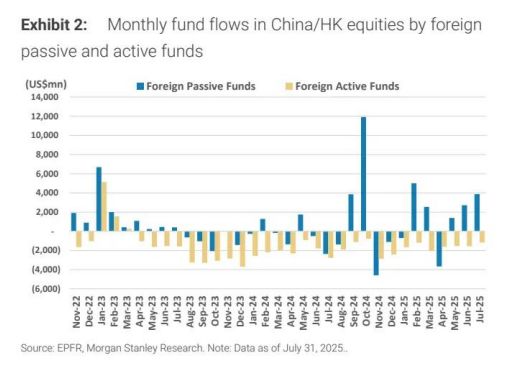
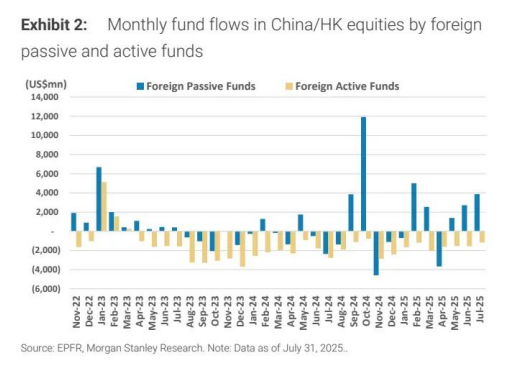
Group 1: Market Overview - In July, foreign capital inflow into Chinese stocks increased to $2.7 billion, up from $1.2 billion in June, with passive funds leading this trend by contributing $3.9 billion, while active funds saw an outflow of $1.2 billion, a significant reduction from June's outflow of $5 billion [1][2] - Southbound capital inflow through the Stock Connect reached $17 billion in July, compared to $10 billion in June, bringing the year-to-date total to $110 billion, surpassing the full-year forecast for 2024 [12][1] Group 2: Fund Flows - Year-to-date, foreign passive funds have accumulated inflows of $11 billion, exceeding the $7 billion level projected for 2024, while active funds have seen a cumulative outflow of $11 billion, which is a slowdown compared to the $24 billion outflow expected for 2024 [3][1] - Global and Asia-Pacific (excluding Japan) funds have slightly reduced their underweight positions in China by 1.4 percentage points and 0.3 percentage points, respectively, while emerging market funds have increased their underweight position by 3.2 percentage points [6] Group 3: Sector and Company Analysis - Active fund managers have increased their holdings in the media and entertainment, pharmaceuticals, and insurance sectors, while reducing their positions in consumer services and durable goods and apparel [7] - Among companies, Tencent, NetEase, Jiangsu Hengrui, and WuXi AppTec have seen the most significant increases in holdings, while Xiaomi has experienced the largest reduction [9]
外资主动、被动基金最新流向!大摩拆解 7 月中国股市关键数据
Zhi Tong Cai Jing· 2025-08-06 15:01
Group 1: Market Overview - In July, foreign capital inflow into Chinese stocks accelerated to $27 billion, up from $12 billion in June, with passive funds leading the trend by inflowing $39 billion [2][14] - Year-to-date, southbound capital inflow reached $110 billion, surpassing the total for the entire year of 2024 [14] Group 2: Fund Flows - Passive funds saw significant inflows, with a total of $110 billion year-to-date, exceeding the $70 billion level for 2024, while active funds experienced cumulative outflows of $11 billion, a slowdown compared to $24 billion in 2024 [4][12] - Global funds and Asia-Pacific funds (excluding Japan) slightly reduced their underweight positions in China, while emerging market funds increased their underweight positions by 3.2 percentage points [6] Group 3: Sector and Company Analysis - Active fund managers increased their holdings in media and entertainment, pharmaceuticals, and insurance sectors, while reducing their positions in consumer services and durable goods [9] - The most increased holdings among companies included Tencent, NetEase, Jiangsu Hengrui, and WuXi AppTec, while Meituan and Xiaomi saw the largest reductions [11] Group 4: Investment Trends - The inflow of foreign passive funds into China was notably concentrated at the end of July, coinciding with several antitrust announcements [4] - The overall short positions in A-shares and Hong Kong stocks increased primarily in the consumer staples, financial, and communication services sectors [21][22]
浦银国际:主动型外资出现回流港股迹象 南向资金净流入加速
智通财经网· 2025-08-06 07:33
Group 1 - The core viewpoint is that foreign capital is increasingly flowing into the Hong Kong and Chinese markets, driven by passive funds, indicating a shift in investor sentiment towards risk assets as geopolitical risks have eased [1][3][5] - In July, net inflows from southbound funds reached 1,356.5 billion HKD, with a daily trading volume share in Hong Kong stocks rising to 27.5% from 25.7% in June, reflecting increased investor activity [1][5] - The sectors attracting significant southbound fund inflows include financials (diversified finance, insurance, banking) and biopharmaceuticals, while sectors like automotive, telecommunications, and consumer durables saw net outflows [1][5] Group 2 - In the past month, foreign capital recorded a net inflow of approximately 33.8 billion USD into the Hong Kong market, with passive funds driving this trend and active foreign funds showing a slight net inflow of 0.8 million USD [1][5] - The report indicates that the interest of foreign investors in Chinese assets has significantly increased, with a total net inflow of 47.0 billion USD into the Chinese market, marking the largest monthly inflow since October of the previous year [3] - Domestic capital outflows from the Chinese stock market have notably slowed, with a total of 32.4 billion USD in outflows, indicating a shift in investment behavior as domestic funds have shown a tendency to increase holdings during market downturns [4]