智能手机

Search documents
未知机构:Counterpoint数据显示2026年1月中国智能手机销量同比-20260213
未知机构· 2026-02-13 02:00
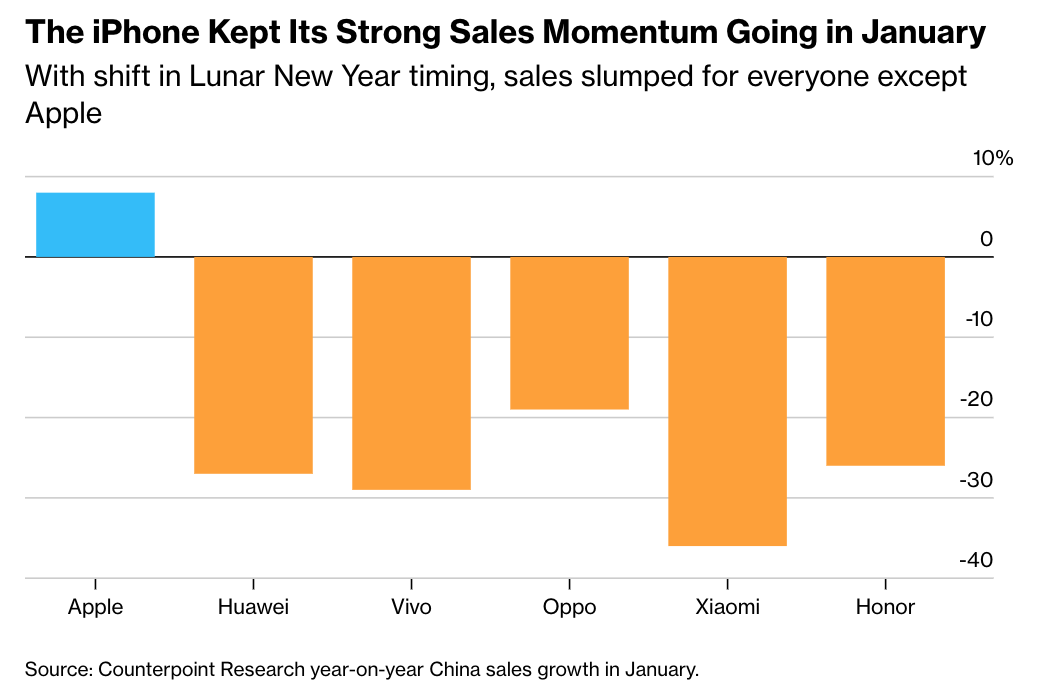
Summary of Key Points Industry Overview - The smartphone industry in China experienced a significant decline in sales, with a year-on-year decrease of 23% in January 2026, primarily due to the high base effect from last year's subsidies and the impact of the Lunar New Year timing [1][2] - Overall market demand remains weak, but an improvement in sales is expected in February due to seasonal purchasing during the Lunar New Year [1] Company Performance - **Huawei**: Despite a 27% decline in sales, Huawei maintained a leading market share of 19%, attributed to aggressive trade-in offers and subsidies [1] - **Apple**: Apple was the only major brand to achieve growth, with an 8% increase in sales, driven by the strong performance of the iPhone 17, which qualified for government subsidies. Its market share rose to a five-year high of 19% in January [2] - **OPPO**: Experienced a 19% decline in sales, holding a market share of 16% [2] - **Vivo**: Saw a significant decline of 29% in sales, with a market share of 16% [2] - **Xiaomi**: Faced a 36% drop in sales, resulting in a market share of 13% [2] - **Honor**: Reported a 26% decline in sales, with a market share of 13% [2] - **Other Brands**: Combined, other brands experienced a 24% decline, holding a market share of 13% [2] Market Share Comparison - January 2026 market shares: - Huawei: 19% - Apple: 19% - OPPO: 16% - Vivo: 16% - Xiaomi: 13% - Honor: 13% - Other brands: 13% [2] - January 2025 market shares for comparison: - Huawei: 20% - Apple: 14% - OPPO: 16% - Vivo: 17% - Xiaomi: 16% - Honor: 14% - Other brands: 3% [1] Additional Insights - The data indicates a challenging environment for most smartphone brands, with only Apple showing resilience and growth amidst a declining market [1][2] - The aggressive strategies employed by Huawei, such as trade-in offers, highlight the competitive nature of the market and the importance of subsidies in driving sales [1]

早报|影石CEO回应年会送房送车/12306新增「低人一等座」提醒/OpenAI发布新模型,用英伟达对手芯片
Sou Hu Cai Jing· 2026-02-13 01:43
Group 1 - The State Administration for Market Regulation opposes manufacturers engaging in "involution" and selling cars at a loss, aiming to promote healthy competition in the automotive market [3] - The newly released guidelines clarify the boundaries of pricing behavior in the automotive industry, encouraging compliance and fair competition among manufacturers and sellers [3] - The guidelines specify that automotive manufacturers must not engage in pricing behaviors that aim to eliminate competitors or monopolize the market, which poses significant legal risks [3] Group 2 - OpenAI announced the release of a new real-time programming model, GPT-5.3-Codex-Spark, which is a more compact version of GPT-5.3-Codex, optimized for low-latency hardware [5][7] - The Codex-Spark model can generate over 1000 tokens per second and is currently available as a research preview for ChatGPT Pro users [5][7] - The model operates on Cerebras' Wafer Scale Engine 3, which features 40 trillion transistors and 900,000 AI cores, providing extremely low latency [7] Group 3 - Multiple automotive companies, including Geely, Chery, and BYD, have disclosed their plans for solid-state battery technology, with Geely aiming for small-scale production by 2027 and a long-term goal of mass production by 2030 [18][19][20] - Chery plans to start pilot production of solid-state batteries by 2026 and aims to validate the technology in real vehicles by 2027 [20] - BYD is focusing on sulfide solid-state batteries, expecting to achieve small-scale production by 2027 [23] Group 4 - Meizu's smartphone business is reportedly facing dissolution, with the Meizu 23 project allegedly halted [25][26] - The company has not officially responded to the rumors, and customer service has stated that no notifications regarding the business's status have been received [26] Group 5 - ByteDance is set to release the upgraded Doubao model on February 14, 2026, which will include significant enhancements to its foundational model capabilities [34][35] - The Doubao 2.0 model is expected to be a multimodal model with 1 trillion parameters, marking a substantial advancement in the company's AI capabilities [35] Group 6 - Xiaomi has launched its first-generation robot VLA model, which features 4.7 billion parameters and excels in visual language understanding and real-time execution capabilities [39][42] - The model has achieved state-of-the-art results in various benchmarks and is designed for high efficiency in real-world tasks [42] Group 7 - Lenovo reported a 72% year-on-year increase in AI-related revenue, which now accounts for 32% of the company's total revenue, driven by growth in AI PCs, smartphones, and servers [32][36] - The company has successfully navigated challenges in the global AI supply chain, maintaining its commitment to double-digit revenue growth and profitability [32]







千元机的天塌了
虎嗅APP· 2026-02-13 00:37
Core Viewpoint - The article discusses the significant impact of rising storage chip prices on the mid-range smartphone market, highlighting how the demand for AI infrastructure has led to a supply crunch, adversely affecting lower-end mobile manufacturers like Transsion [6][7][9]. Group 1: Market Dynamics - Since the second half of last year, storage chips have experienced a dramatic price surge, with consumer-grade memory modules increasing by over 600% [6]. - Major storage chip manufacturers, including Samsung, Micron, and SK Hynix, have reported that their production capacities for DRAM, NAND Flash, and HBM products are fully booked until 2026 [7]. - The rising prices of storage chips have particularly harmed low-end smartphone manufacturers, with Transsion reporting a 22.6% revenue increase but an 11% drop in net profit in Q3 2025 [7][9]. Group 2: Impact on Smartphone Manufacturers - Many smartphone manufacturers are shifting their focus from low-cost models to higher-margin premium devices due to the cost pressures from rising storage prices [9][10]. - Companies like Meizu have canceled product launches, and several brands, including Xiaomi and OPPO, have reduced their 2026 order volumes by 10%-20%, particularly for mid-range models [10][11]. - The cost structure of low-end smartphones is heavily impacted by the rising prices of storage components, which are considered a rigid cost that cannot be easily adjusted [13][17]. Group 3: Pricing Strategies - The article notes that the cost of storage components represents about 10% of the total BOM cost for high-end devices like the iPhone Pro Max, and a 50% increase in storage prices could add approximately 150 yuan to the cost [18]. - For high-end smartphones, manufacturers have more flexibility to absorb cost increases without significantly affecting sales, while low-end models face greater risks of losing customers due to price sensitivity [18][25]. - The average selling price (ASP) of smartphones is projected to exceed $400 for the first time, indicating a shift towards higher-priced models as the low-end market continues to shrink [23][25].


音频 | 格隆汇2.13盘前要点—港A美股你需要关注的大事都在这
Xin Lang Cai Jing· 2026-02-12 23:15
Group 1 - US stock market experienced a significant decline, with the Nasdaq dropping over 2% and Cisco falling more than 12%, while the Chinese concept index decreased by 3% [2] - South Korean investors aggressively purchased Chinese stocks, notably MiniMax-WP and Lanke Technology [2] - The storage giant Kioxia's annual performance forecast exceeded expectations [2] Group 2 - The Ministry of Industry and Information Technology of China is soliciting opinions on five mandatory national standards related to intelligent connected vehicles and autonomous driving system safety requirements [2] - The Chinese smartphone sales in January saw a year-on-year decline of 23% [2] - Semiconductor company Hua Hong Semiconductor reported Q4 sales revenue of $660 million, marking a year-on-year increase of 22.4% and a quarter-on-quarter increase of 3.9% [2][3]
荣耀前CEO赵明官宣最新任职!
Sou Hu Cai Jing· 2026-02-12 15:24
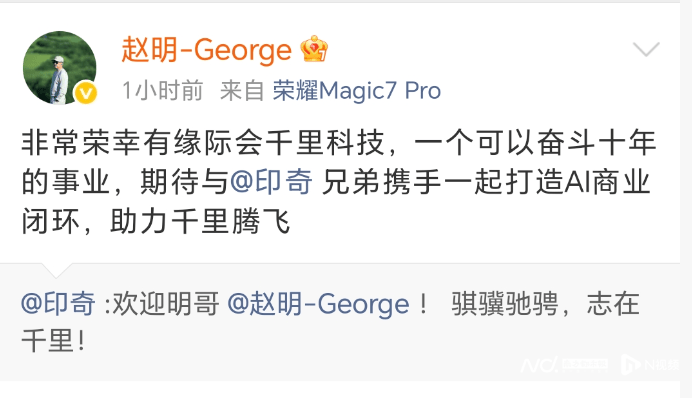
Core Insights - Zhao Ming, former CEO of Honor, has officially joined Qianli Technology as a non-independent director candidate for the sixth board of directors, aiming to advance the AI business model's closed-loop strategy [2][3][5] - Qianli Technology, previously known as Lifan Technology, has undergone significant leadership changes and strategic shifts towards an "AI + vehicle" approach under the current chairman, Yin Qi [5][7] Company Overview - Qianli Technology was rebranded from Lifan Technology and has embraced an "AI + vehicle" strategy since January 2025, with Yin Qi as chairman [5][7] - Zhao Ming brings over 25 years of global technology management experience, having held various leadership roles at Huawei and Honor, focusing on brand revitalization and market expansion [5][6] Strategic Focus - The combination of Yin Qi and Zhao Ming is seen as complementary, with Yin focusing on AI technology development and Zhao leveraging his consumer-facing experience in supply chain integration and brand management [6][7] - Qianli Technology is currently in a high-investment phase, having reported a revenue of 6.946 billion yuan for the first three quarters of 2025, but with a net loss of 176 million yuan after deductions [8] Industry Context - The automotive industry is increasingly attracting talent from the mobile phone sector, with notable figures like Zhao Ming and former Honor CMO Jiang Hairong transitioning to automotive roles [8] - The competition in the automotive sector is evolving, with a shift from mechanical performance to software ecosystems and user experience, positioning vehicles as the "next-generation smart terminal" [8]
内存涨价,千元机的天塌了
远川研究所· 2026-02-12 13:06
Core Viewpoint - The article discusses the significant impact of rising storage chip prices on the smartphone industry, particularly affecting mid-range and low-end models, as manufacturers shift focus to higher-margin products due to supply constraints driven by AI infrastructure demand [6][8][19]. Group 1: Market Dynamics - Since the second half of last year, storage chips have experienced a dramatic price surge, with consumer-grade memory modules increasing by over 600%, making them a highly valued investment product [6]. - Major storage chip manufacturers, including Samsung, Micron, and SK Hynix, have reported that their production capacities for DRAM, NAND Flash, and HBM products are fully booked until 2026 [6]. - The demand for HBM memory used in AI chips has led to prioritization in production, squeezing the supply of consumer-grade products and significantly impacting low-end smartphone manufacturers like Transsion [8][10]. Group 2: Financial Impact on Companies - Transsion, known for its cost-effective models, saw a 22.6% revenue increase in Q3 2025, but its net profit dropped by 11%, with a two-percentage-point decline in gross margin [8]. - Other smartphone manufacturers are also adjusting their strategies, with many opting to delay the launch of low-cost models and reducing overall order volumes by 10%-20% for 2026 [10]. - The rising costs of storage components have exposed the vulnerability of mid-range and low-end smartphones, which have less flexibility in pricing and profit margins compared to high-end models [13][14]. Group 3: Pricing Strategies and Market Trends - The average selling price (ASP) of smartphones is projected to exceed $400 for the first time, indicating a shift towards higher-priced models as manufacturers respond to rising component costs [19]. - Companies are likely to either increase prices to maintain margins or lower them to capture market share, particularly as the low-end market continues to shrink [19]. - The ongoing supply constraints and price increases in storage chips may signal the end of the "thousand-yuan phone era," pushing consumers towards higher-end devices [19].

传音控股:成本上涨净利砍半,股价下滑“套牢”多家接盘机构
Xin Lang Cai Jing· 2026-02-12 08:48
Group 1 - The core viewpoint of the article indicates that Transsion Holdings (688036.SH) is facing significant challenges, with a forecasted revenue decline and a more than 50% drop in net profit attributable to shareholders for 2025 [1][10] - The company reported a revenue of 655.68 billion yuan for 2025, a year-on-year decrease of 4.58%, and a net profit of 25.46 billion yuan, down 54.11% year-on-year [2][11] - The decline in performance is attributed to rising prices of core components like storage, which have significantly impacted the company's gross margin, alongside increased operating expenses [3][12] Group 2 - Transsion Holdings has seen a slowdown in growth in its primary market, Africa, where it has lost market share to competitors like Xiaomi and Honor, which have shown strong growth rates [4][13] - The company has dropped out of the top five global smartphone shipment rankings, with its market share in Africa declining, as evidenced by a 18.9% year-on-year drop in smartphone sales in the first half of 2025 [5][14] Group 3 - The company is attempting to diversify its business beyond smartphones, but this effort has not yet yielded significant results, as mobile phone sales still account for nearly 90% of total revenue [6][15] - Transsion Holdings is focusing on AI technology as a key area for future growth, planning to invest in AI research and development, but its current capabilities in foundational models and chip architecture are still lacking [7][16] Group 4 - The stock price of Transsion Holdings has fallen over 40% in the past four months, leading to significant losses for institutional investors who participated in a recent share transfer [8][17] - The share transfer involved 22.807 million shares at a price of 81.81 yuan per share, resulting in a total cash-out of 1.866 billion yuan for the controlling shareholder [9][18]
内存涨价,千元机的天塌了
3 6 Ke· 2026-02-12 08:43
Core Insights - The storage chip market has experienced a significant price surge since the second half of last year, with consumer-grade memory prices increasing by over 600%, making it a highly valuable investment product [1] - The demand for AI infrastructure has led to a depletion of production capacity among major storage chip manufacturers, including Samsung, Micron, and SK Hynix, with all their HBM production capacity booked until 2026 [1][11] - The rising prices of storage chips have disproportionately affected low-end smartphones, particularly brands like Transsion, which saw a 22.6% revenue increase but an 11% drop in net profit in Q3 last year [3][4] Market Dynamics - The high profit margins associated with HBM memory used in AI chips have prioritized its production over consumer-grade products, leading to supply constraints for low-end smartphones [3] - Various smartphone manufacturers are shifting focus from low-priced product lines to higher-margin high-end models due to the impact of rising storage costs [4][12] - Transsion's market share dropped from fourth to "others" category, indicating a significant decline in its competitive position [3][4] Pricing and Cost Structure - The cost structure of low-end smartphones is heavily impacted by the rising prices of storage chips, which are considered a rigid cost that cannot be easily adjusted [5][8] - The BOM (Bill of Materials) cost for a 12GB+256GB iPhone Pro Max indicates that storage costs account for approximately 10% of total costs, highlighting the sensitivity of low-end models to price increases [8][9] - The average selling price (ASP) of smartphones is projected to exceed $400 for the first time, reflecting a shift towards higher-priced models as low-end market segments shrink [13][16] Supply Chain Challenges - The demand for AI-related products has created a seller's market for storage chips, leading to unpredictable cost structures for smartphone manufacturers, especially in the low-end segment [12] - Major companies like Apple are facing significant supply pressures, with only partial agreements in place for NAND Flash and DRAM supplies for the upcoming quarters [11] - Samsung's internal conflicts regarding storage pricing have further complicated supply chain management, as the mobile division struggles to secure favorable terms from the semiconductor division [12]

存储芯片价格上涨 视频压缩技术替代效应明显
Xin Lang Cai Jing· 2026-02-12 07:22
Core Viewpoint - Companies are actively implementing various measures to mitigate the impact of rising storage chip prices, with predictions indicating a potential decline in smartphone shipments due to increased prices in 2026 [1] Group 1: Industry Response - Brands like Xiaomi and OPPO have raised the prices of new devices to offset cost pressures from rising storage chip prices [1] - The demand for storage in sectors such as coal mining and electricity is increasing due to new requirements for video image storage time and quality [1] Group 2: Technological Solutions - Companies are facing challenges with high-definition video storage due to rising storage chip prices, leading to increased inquiries and demand for video compression solutions [1] - Hangzhou Dahong Technology Co., Ltd. has developed a video compression technology that significantly reduces storage requirements, compressing 10TB of video to 1TB while maintaining quality and AI analysis capabilities, thus freeing up 90% of storage space [1]

逆势独涨!苹果(AAPL.US)iPhone 17在华1月销量涨8% 市场份额升至并列第一
智通财经网· 2026-02-12 06:23
该机构补充称,目前iPhone 17系列几乎没有折扣或降价,这为未来进一步调整价格或优化利润率留出了空间。不过,其他手机品牌尚未进入最密集 的促销阶段,本月的农历新年节日将成为季节性消费的核心。 Counterpoint Research指出:"苹果成为唯一实现同比增长的主要品牌,其市场份额达到过去五年来1月份的最高水平。""iPhone 17基础版本现已符合 补贴资格,提升了其性价比吸引力,并推动销量环比增长9%。" 智通财经APP获悉,根据Counterpoint Research的数据,苹果(AAPL.US)的iPhone是1月份唯一在中国市场实现销量增长的智能手机产品线。该机构 称,其他手机厂商的销量在整体下滑23%的市场环境中都出现大幅下降,主要是补贴减少以及农历新年时间变化所致。然而,iPhone 17系列帮助苹 果实现了8%的增长,使其市场份额提升至约五分之一,与华为并列领先。 自去年9月推出新款机型以来,苹果的旗舰产品实现了重大复苏。在全球最大智能手机市场,其假期期间出货量激增,帮助其实现了有史以来最佳的 iPhone季度业绩。苹果在上月底公布的财报显示,在截至2025年12月27日的第一财季 ...