手机

Search documents
【掘金板块牛熊】医药商业板块持续拉升 AI手机概念股延续活跃 有色金属板块回调
第一财经· 2025-12-02 04:58
②牛榜 - 医药商业板块暴涨原因找到了!受益标的还有哪些?医药商业板块还有多少上涨空间? ③熊榜- 有色金属板块意外回调,有色金属为何突然哑火?华锡有色跌超5%,是抄底机会还是风险 信号? 点击付费阅读,解密今日盘面热点的核心逻辑! 前言 市场迷雾重重,还在为抓不住市场热点而焦虑?《掘金板块牛熊》帮你精准把握风格切换信号,带领你 看懂热钱的情绪周期。 每个交易日午间解密当天盘面热点的核心逻辑,《掘金板块牛熊》让你踩准市 场节奏,财富增值不迷路! ①牛榜 - AI手机概念股热度不减,道明光学4连板领涨,福蓉科技2连板,下一只黑马是谁? ...

索尼手机刚撤,电视又爆危机,日本巨头为何在中国败退?
3 6 Ke· 2025-12-02 04:14
Core Viewpoint - Sony's television and mobile phone businesses are facing significant challenges in the Chinese market, with declining market share and increasing consumer complaints about product quality [1][12][17]. Group 1: Television Business Challenges - Sony's market share in the Chinese television market has dropped to below 5% in 2024, with each of the four major foreign brands averaging around 1.25% [1][8]. - Consumers have reported quality issues with Sony televisions, particularly models like XR-65X90J, which have experienced sound output failures shortly after the warranty period [2][4]. - Complaints about Sony televisions have surged on various platforms, indicating a widespread perception of quality problems [4][7]. Group 2: Consumer Sentiment and Brand Reputation - Users express dissatisfaction with Sony's customer service and warranty policies, feeling that the issues are not isolated incidents but indicative of broader quality concerns [7][12]. - Industry experts suggest that Sony should acknowledge these issues and improve customer service to regain consumer trust [7][12]. Group 3: Market Position and Competition - Sony's television sales have been outpaced by domestic brands like TCL and Hisense, which offer better technology and price-performance ratios [12][17]. - The company's television business is categorized under "other businesses" in financial reports, indicating a decline in visibility and profitability [16][17]. Group 4: Mobile Phone Business Exit - Sony has officially exited the Chinese mobile phone market, with the Xperia brand no longer launching new models since September 2023 [13][15]. - The decline of Sony's mobile phone business mirrors the challenges faced in the television sector, as domestic competitors have gained significant market share [13][15].

异动盘点1202 | 保险股集体回暖,手机产业链延续昨日上涨;美股加密货币概念股普跌,霸王茶姬涨超6%
贝塔投资智库· 2025-12-02 04:04
Group 1: Insurance Sector - Insurance stocks collectively rebounded, with China Pacific Insurance (02601) up 2.78%, China Property & Casualty Insurance (02328) up 2.27%, China Life Insurance (02628) up 0.37%, and China People’s Insurance (01339) up 1.95%. Reports indicate that several insurance companies have achieved or are close to achieving their sales targets for 2025, shifting focus towards preparations for 2026, with dividend-type life insurance products being the main offerings [1][2]. Group 2: Technology and AI - Bolekang Vision Cloud-B (02592) saw a rise of over 4%, with a cumulative increase of over 80% in the past week. The company announced successful patent applications in Japan and Europe for its core product CBT-009 [1]. - The mobile industry chain continued its upward trend, with AAC Technologies (02018) up 4.37%, BYD Electronics (00285) up 1.72%, and others. This growth is attributed to the collaboration between ByteDance's AI assistant "Doubao" and ZTE, marking a significant step in the integration of AI technology with mobile hardware [1]. Group 3: Gaming and Entertainment - Gaming stocks rose, with MGM China (02282) up 1.45%, Sands China (01928) up 1.4%, and Galaxy Entertainment (00027) up 1.91%. The Macau Gaming Inspection and Coordination Bureau reported that the gross gaming revenue for November was 21.09 billion MOP, a year-on-year increase of 14.4% [2]. Group 4: Automotive Sector - BYD Company (01211) increased by nearly 2%. The company reported sales of 480,186 vehicles in November, a record high for the year. Cumulatively, BYD's sales from January to November reached 4.18 million units, reflecting a year-on-year growth of 11.3% [2]. Group 5: Energy Sector - Oil stocks saw gains, with CNOOC (00883) up 2.05%, PetroChina (00857) up 1.25%, and Sinopec (00386) up 1.57%. OPEC+ countries announced they would maintain their production plans set in early November and suspend any production increases in the first quarter of 2026 to address global oil supply surplus and falling prices [2]. Group 6: Mining and Materials - Zhu Feng Gold (01815) surged over 10%, with a cumulative increase of over 30% in the past four trading days. The company plans to issue 248 million subscription shares at a price of 1.61 HKD per share, raising approximately 397.975 million HKD for exploration and operational funding [3]. - Longpan Technology (02465) rose nearly 4%, with a report from Huatai Securities indicating an expected increase in lithium battery production in December, leading to improved profitability across the lithium battery supply chain [4]. Group 7: Pharmaceuticals - Junsheng Tai Pharmaceutical-B (02511) increased by nearly 4% after announcing positive results from a Phase III trial of HTD1801 for Type 2 diabetes patients, outperforming the comparator drug [4]. - Weisheng Pharmaceutical-B (02561) rose over 3% following news of a strategic partnership with Anke Biological to promote the growth hormone in the Chinese market [4]. Group 8: US Market Highlights - Bawang Tea (CHA.US) rose 6.07%, reporting a global store count of 7,338 and significant growth in overseas GMV [5]. - NetEase (NTES.US) increased by 5% after winning a prestigious science and technology award for a project in collaboration with several institutions [5]. - New energy vehicle stocks in the US saw declines, with Li Auto (LI.US) down 2.45% and Xpeng Motors (XPEV.US) down 2.2%, as both companies reported lower-than-expected vehicle deliveries [6].

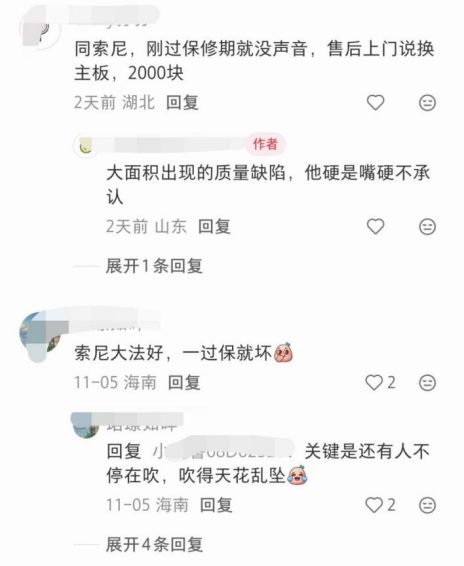
“都坏了” 索尼大法,突然在中国失灵了?
Xin Lang Ke Ji· 2025-12-02 02:23
Core Viewpoint - Sony's television and mobile phone businesses are facing significant challenges in the Chinese market, with declining market share and increasing customer complaints regarding product quality and service issues [1][9][10]. Television Business - Sony's market share in the Chinese television market has dropped to below 5% in 2024, with each of the four major foreign brands averaging around 1.25% [1][7]. - Customers have reported quality issues with several popular Sony TV models, including sound output failures shortly after the warranty period, leading to repair costs of several thousand yuan [2][4][6]. - The decline in Sony's television sales is attributed to the rise of domestic brands like Hisense and TCL, which offer better technology, features, and price-performance ratios [9][10]. - Sony's reputation has been further damaged by customer dissatisfaction with after-sales service and the perceived lack of responsiveness to quality complaints [6][9]. Mobile Phone Business - Sony has officially exited the Chinese mobile phone market, with the cancellation of its official WeChat account and the discontinuation of its website [10][12]. - The Xperia brand, once popular in China, has seen a significant decline in market presence due to competition from domestic brands like Huawei and Xiaomi [10][12]. - Sony's mobile phone business had been struggling for years, with no new models launched in China since the Xperia 5V in September 2023 [10][12]. Financial Performance - Sony's financial report for Q2 FY25 indicates that while other segments like music and gaming are performing well, the television and mobile phone divisions are in decline, contributing to a drop in overall profitability [13][14]. - The television and mobile phone businesses are categorized under "other businesses" in the financial report, reflecting their diminishing importance to the company's overall performance [14].

A股早评:三大指数小幅低开,创业板指低开0.04%,AI手机概念盘初活跃,黄金、有色金属板块低开
Ge Long Hui· 2025-12-02 01:59
格隆汇12月2日|A股开盘,三大指数小幅低开,沪指低开0.14%报3908.46点,深证成指低开0.13%,创 业板指低开0.04%。盘面上,AI手机概念盘初活跃,黄金、有色金属板块低开。 ...

“都坏了” 索尼大法 突然在中国失灵了:万元电视刚过保就坏
Xin Lang Ke Ji· 2025-12-02 00:59
Core Viewpoint - Sony's television market share in China has significantly declined, with foreign brands collectively holding less than 5% of the market in 2024, averaging around 1.25% per brand [1][8]. Group 1: Sales Decline and Quality Issues - The decline in sales is attributed to quality issues, with many users reporting that their high-priced Sony TVs malfunction shortly after the warranty period, leading to repair costs of several thousand yuan [2][4]. - Users have reported widespread issues with specific models, such as the XR-65X90J, which has experienced a failure in sound output, indicating potential design flaws [3][4]. - Complaints about Sony TVs have surged on various platforms, with thousands of users expressing dissatisfaction over similar problems, particularly after the warranty expires [4][6]. Group 2: Customer Service and Brand Perception - Sony's customer service has faced criticism for not adequately addressing the quality concerns raised by users, with many feeling that the issues are not isolated incidents but indicative of broader quality problems [5][6]. - Industry experts suggest that Sony should acknowledge the issues, apologize to customers, and consider extending warranties or offering discounted repairs to restore consumer trust [6][9]. Group 3: Market Position and Competition - Sony's television sales have plummeted, ranking last among the top ten global TV brands, with a significant drop in market share due to the rise of domestic competitors like TCL and Hisense [7][9]. - The company's failure to adapt to local market demands, particularly in smart systems and user experience, has further weakened its position against local brands [9][10]. Group 4: Broader Business Challenges - Beyond televisions, Sony's mobile division has also exited the Chinese market, marking a significant retreat from a once-prominent position in the smartphone sector [10][11]. - The company's overall financial performance shows that while some segments are growing, the television and mobile businesses are struggling, contributing to a decline in overall profitability [11][12].
“都坏了” 索尼大法,突然在中国失灵了? | BUG
Xin Lang Ke Ji· 2025-12-02 00:42
Core Viewpoint - Sony's television and mobile phone businesses are experiencing significant declines in the Chinese market, with quality issues and competition from domestic brands contributing to a loss of consumer trust and market share [2][10][11]. Group 1: Television Business - Sony's market share in the Chinese television market has dropped to below 5% in 2024, with each of the four major foreign brands averaging around 1.25% [2][8]. - Users have reported quality issues with Sony televisions, particularly models like XR-65X90J, which have experienced sound output failures shortly after the warranty period [3][6]. - Complaints about Sony televisions have surged on social media and consumer complaint platforms, indicating widespread dissatisfaction with product quality [4][6]. - Industry experts suggest that Sony needs to acknowledge these quality issues and improve customer service to regain consumer trust [6][10]. Group 2: Mobile Phone Business - Sony's mobile phone brand, Xperia, has officially exited the Chinese market, with the cancellation of its official WeChat account and the cessation of new product launches since September 2023 [11][14]. - The decline of Sony's mobile phone business mirrors that of its television segment, as it has struggled to compete with domestic brands like Huawei and Xiaomi [11][14]. - Sony's previous strong position in the mobile market has diminished significantly, leading to its classification as a niche brand [11][14]. Group 3: Financial Performance - Sony's financial report for Q2 FY2025 indicates that while other business segments like music and gaming are performing well, the television and mobile phone sectors are in decline, contributing to overall revenue drops in the "other businesses" category [15][16]. - The television and mobile phone businesses are not separately reported, but their poor performance is evident in the overall financial results, suggesting a need for strategic reevaluation [16].
字节手机,旧事重提
Bei Jing Shang Bao· 2025-12-01 13:44
Core Insights - ByteDance has reiterated its stance of not developing its own smartphones while launching the Doubao mobile assistant, which is a system-level AI assistant developed in collaboration with ZTE [1][2] - The Doubao mobile assistant is positioned as an engineering prototype, priced at 3499 yuan, and is currently available only to industry professionals for experience [1] - The launch has positively impacted ZTE's stock prices, with a significant increase observed in both A-share and Hong Kong markets [1] Group 1: Product Launch and Market Impact - The Doubao mobile assistant is based on the Doubao large model and aims to enhance user interaction and experience compared to previous mobile AI applications [1][5] - ZTE's stock reached a limit-up price of 46.3 yuan shortly after the announcement, reflecting strong market interest [1] - ByteDance has clarified that it will not pursue smartphone development but will instead integrate the Doubao assistant into various brands through ecological cooperation [1][2] Group 2: Strategic Positioning - ByteDance's approach to entering the mobile market is through AI technology rather than hardware, similar to Huawei's strategy in the automotive sector [2][4] - The Doubao assistant is designed to address practical usage pain points, emphasizing a collaborative development model with hardware manufacturers [5] - The collaboration between ByteDance and ZTE combines ByteDance's data processing capabilities with ZTE's hardware expertise, highlighting the trend towards integrated AI solutions in mobile devices [5] Group 3: Competitive Landscape - The AI mobile assistant market is becoming increasingly competitive, with major players like Huawei, Xiaomi, and others developing their own AI systems [4][10] - The shift towards AI integration in mobile devices is seen as a necessary evolution, with companies focusing on enhancing user experience through AI capabilities [10][11] - The industry is witnessing a collective move from conceptual discussions to tangible investments in AI technology, indicating a response to consumer demand and market potential [10][11]
非洲手机市场竞争升级,传音控股如何破解增长焦虑?
Guo Ji Jin Rong Bao· 2025-12-01 11:08
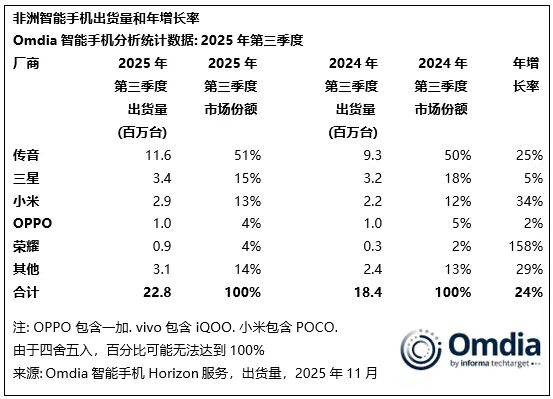
Core Viewpoint - Transsion Holdings, known as the "King of Mobile Phones in Africa," maintains a strong market presence in Africa despite increasing competition from other Chinese brands, focusing on enhancing its competitive advantages and brand differentiation strategies [1][3]. Group 1: Market Position and Performance - Since its listing in 2019, Transsion has seen an increase in its smartphone market share in Africa, remaining the market leader with over 40% share for five consecutive years [2][3]. - In the first nine months of 2023, the company reported a slight revenue decline of 3.3% year-on-year, totaling 49.54 billion yuan, while net profit dropped significantly by 44.97% to 2.15 billion yuan [2]. - The third quarter of 2023 showed a revenue rebound, achieving 20.466 billion yuan, a year-on-year increase of 22.6%, although net profit continued to decline by 11.06% to 0.935 billion yuan, indicating a "revenue growth without profit growth" scenario [2]. Group 2: Competitive Landscape - In Q3 2025, Transsion led the African smartphone market with a shipment of 11.6 million units, holding a 51% market share, while competitors like Xiaomi and Honor are rapidly increasing their market presence [3][4]. - Xiaomi's market share reached 13% with a 34% year-on-year growth, while Honor experienced a remarkable 158% growth, indicating a shift in competitive dynamics [3][4]. Group 3: Strategic Initiatives - Transsion plans to strengthen its competitive edge in Africa by focusing on refined operations, differentiated brand building, and establishing a robust "moat" through systematic capabilities [1][5]. - The company is also expanding its product categories beyond mobile phones, including digital accessories and home appliances, while implementing a multi-brand strategy to cater to emerging market demands [5].