
新能源产业链

Search documents
调查:近八成投资者看涨2026年行情 七成投资者配置了黄金
Shang Hai Zheng Quan Bao· 2026-02-01 23:31
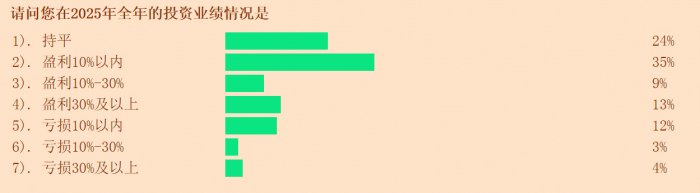
Core Viewpoint - The report indicates a significant improvement in investor sentiment, with nearly 80% of investors optimistic about the 2026 market, driven by a strong performance in 2025 and expectations for continued growth in technology sectors, particularly AI and chips [1][7][22]. Group 1: Market Performance and Investor Sentiment - In 2025, major stock indices in A-shares showed strong performance, with the Shanghai Composite Index rising nearly 20%, marking its best annual performance in six years [7][30]. - Approximately 57% of surveyed investors reported profits in 2025, a notable increase from previous years, with a 15 percentage point rise from 2024 [8][32]. - The average asset allocation in securities accounts increased to 41.68% by the end of 2025, reflecting a shift of funds from savings to equity investments [10][34]. Group 2: Sector Performance - The technology sector, particularly AI and chips, was identified as the primary source of investment returns, with 26% of investors citing it as their top-performing sector [3][42]. - Other notable sectors included the new energy industry at 24% and cyclical stocks at 18%, while traditional consumer sectors lagged behind [3][42]. Group 3: Future Expectations - Looking ahead to 2026, 78% of investors expect the market to rise, with 47% anticipating gains of over 5% [24][49]. - Investors are particularly optimistic about the technology sector, with 39% believing that tech stocks will continue to outperform [24][49]. - A significant 81% of investors are optimistic about the spring market in 2026, with a focus on technology growth [51]. Group 4: Investment Strategies - The report highlights a trend of increasing allocations to equity assets, with 42% of investors planning to increase their investments in stocks [48][35]. - There is a notable interest in gold investments, with 71% of investors having allocated funds to gold, reflecting its status as a safe haven amid market volatility [37][13]. - The preference for indirect investment methods, such as ETFs, is growing, particularly in the Hong Kong stock market, where 58% of investors chose this route [40][39]. Group 5: Economic Factors - The report notes that the decline in risk-free interest rates has prompted a shift in investment strategies, with more investors considering equities over traditional savings [11][36]. - Expectations for liquidity in the market remain high, with over 60% of investors anticipating a continued influx of capital into equities [48][22].

港股IPO发行活跃 生态优化提升国际竞争力
Zhong Guo Zheng Quan Bao· 2026-01-27 20:57
Core Viewpoint - The Hong Kong IPO market is experiencing a robust recovery in 2026, with a significant increase in both supply and demand, driven by enthusiasm from leading A-share companies to list in Hong Kong, including trends like spin-off listings and H-share returning to A-share markets [1][2]. Group 1: IPO Market Trends - As of January 27, 2026, 12 companies have listed on the Hong Kong Stock Exchange, with over 300 companies having submitted listing applications, marking a substantial increase compared to previous years [1]. - The number of active IPO applications from A-share companies has increased nearly fourfold in 2025 compared to 2024, with over 110 applicants from the A-share market [1][2]. - The quality and scale of A-share companies applying for Hong Kong listings have improved, with most companies having a market capitalization exceeding 10 billion yuan, such as 汇川技术 (over 200 billion yuan) and 德赛西威 (approximately 77 billion yuan) [2]. Group 2: Industry Distribution - The companies planning to list are primarily leaders in niche sectors, focusing on strategic emerging industries such as new energy, biomedicine, and advanced manufacturing [2]. - Notable companies in the new energy sector include 汇川技术, 正泰电器, and 鹏辉能源, while the biomedicine sector features leaders like 信立泰, 海特生物, and 仙乐健康 [2]. Group 3: Market Dynamics - The trend of spin-off listings has gained momentum, with over 10 A-share companies' subsidiaries listing in Hong Kong since 2025, and this trend is accelerating in 2026 [3]. - A dual listing trend is emerging, with several Hong Kong-listed companies initiating "return to A-share" plans, exploring new paths for "A+H" listings [4]. - The Hong Kong Stock Exchange has expanded its recognition of overseas exchanges, now including 20 foreign exchanges from 18 countries, enhancing the market's diversity [4]. Group 4: Market Outlook - UBS forecasts that the IPO financing scale in Hong Kong could exceed 300 billion HKD in 2026, with the number of new listings expected to reach between 150 and 200 [2]. - The Hong Kong IPO market is entering a positive cycle of supply and demand, with expectations for further growth in both the number and scale of IPOs in 2026 [4].
11月经济数据解读
2025-12-17 02:27
Summary of Economic Data and Industry Insights Industry Overview - The economic data for November indicates a GDP growth rate of approximately 4%, remaining stable but at a relatively low level, with a narrowing supply-demand gap and an improvement in the supply-strong, demand-weak scenario compared to October [1][2] - The manufacturing sector shows a clear trend towards high-end development, with production growth in high-tech industries such as equipment manufacturing and electronic communications rising against the trend [1][3] - Emerging industries, including low-altitude economy, industrial robots, and new energy supply chains, are performing well, suggesting potential investment opportunities in related stocks [1][3] Key Economic Indicators - Consumer goods consumption has rapidly declined due to a drop in demand for new products and preemptive demand effects, leading to a decrease in retail sales [1][5] - The service sector's production index has shown resilience, particularly in modern services like information transmission, leasing, and business services, despite an overall decline [4] Consumer Trends - The structure of consumer demand is primarily focused on three main lines: essential goods (e.g., food), new industries (e.g., home appliances), and some upgraded products (e.g., jewelry) [5] - The restaurant sector rebounded after a low point mid-year but saw a slight decline in November [5] - The 2026 outlook suggests that new policies will likely continue to support consumer demand, particularly in service consumption areas such as cultural tourism, elderly care, and healthcare [5] Employment and Unemployment - The unemployment rate has shown some improvement, but remains relatively high, putting pressure on employment and consumer confidence [6] - Policies aimed at improving the job market, income distribution, and social security systems are crucial for enhancing consumer spending and stock market performance [6] Investment Landscape - Fixed asset investment in November saw a year-on-year decline of over 10%, with real estate investment rapidly decreasing [7] - Infrastructure investment is expected to face challenges in 2026 due to local government debt pressures and weak real estate chains, although there is potential for stabilization with policy support [7][8] - High-end manufacturing shows signs of recovery, and industrial upgrades are seen as a long-term growth driver [7] Future Economic Policies - The macroeconomic policy for 2026 will focus more on supply-side reforms, optimizing supply, and expanding domestic demand [9] - The central economic work conference emphasizes the need to enhance supply-side priorities to improve economic efficiency and address long-term low inflation and supply-demand imbalances [9] - The anticipated economic environment for 2026 suggests a GDP growth rate of around 4.9%, close to 5%, despite ongoing economic fluctuations [8]
兴证策略:会有跨年行情吗?
智通财经网· 2025-11-30 11:22
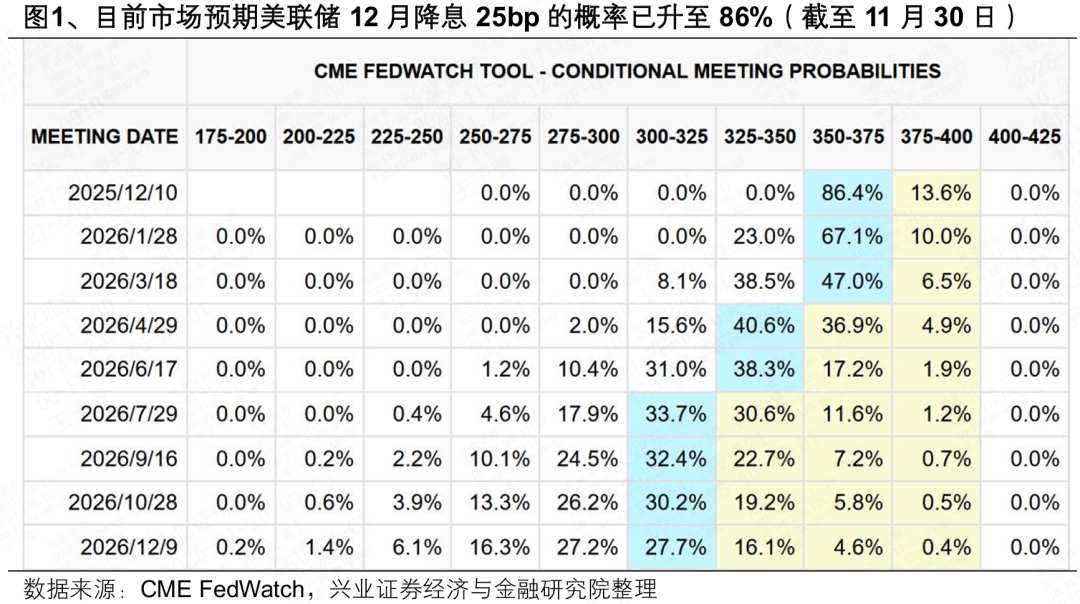
Core Viewpoint - Recent easing of various market disturbances is expected to lead to a recovery in Chinese assets, supported by the Federal Reserve's dovish signals and the alleviation of concerns regarding the "AI bubble" [1] Group 1: Market Conditions - The Federal Reserve's statements and economic data have increased expectations for a rate cut, with an 86% probability for a 25 basis point cut in December [2] - The global AI industry's progress is alleviating concerns about an "AI bubble," with Google's comprehensive approach to AI leading the narrative in the tech sector [1] Group 2: Year-End Market Dynamics - The year-end period is historically a significant window for market rallies, with previous years showing upward trends starting from November to early January [3] - Factors driving these rallies include a vacuum in fundamental data, upcoming important meetings, and expectations for policy easing [3] Group 3: Catalysts for Market Movements - Market rallies can be triggered by three main factors: 1. Economic improvement leading to a pro-cyclical style [4] 2. Unexpected macro policy changes benefiting high-elasticity sectors [4] 3. Easing of prior risks and liquidity expansion favoring sectors with favorable trends [4] Group 4: Investment Directions - Focus on sectors with high growth expectations, including AI, advantageous manufacturing, "anti-involution," and structural recovery in domestic demand [7] - Emphasis on cyclical sectors benefiting from stable growth policies and market expectations [10] Group 5: Policy and Economic Outlook - The year-end meetings are expected to provide clarity on policies aimed at enhancing service consumption and investment in human capital, which could benefit cyclical sectors [10] - The emphasis on technological self-reliance and new productivity in the context of national competition is likely to drive growth in tech sectors [13]
收评:沪指涨0.29% 有机硅概念领涨 海南板块领跌
Xin Hua Cai Jing· 2025-11-27 07:48
Market Performance - The Shanghai Composite Index opened slightly higher, while the Shenzhen Component and ChiNext Index opened slightly lower, with the Shanghai index closing at 3875.26 points, up 0.29% [1] - The Shenzhen Component reached a peak increase of nearly 1.36% and the ChiNext Index peaked at nearly 2.26% before both indices narrowed their gains and closed slightly down [1] - The total trading volume for the Shanghai market was approximately 698.5 billion yuan, while the Shenzhen market's trading volume was about 1.0113 trillion yuan [1] Sector Performance - The new energy industry chain stocks saw significant gains, particularly in the organic silicon sector, with notable increases in glass substrates, POE film, sodium batteries, solid-state batteries, and HJT batteries [1] - Other sectors that experienced significant gains included paper-making, newly listed stocks on the Sci-Tech Innovation Board, daily chemicals, EDA concepts, MicroLED, wireless earphones, and foldable screens [1] - Sectors that faced declines included Hainan Free Trade Zone, cultivated diamonds, and media entertainment [1] Institutional Insights - The market is currently in a phase of recovery after a sharp decline, with a focus on high-growth sectors such as semiconductors, consumer electronics, artificial intelligence, robotics, and low-altitude economy [2] - The lithium battery industry is expected to experience a boom in energy storage and solid-state battery industrialization by 2026, marking the beginning of a new capital expenditure cycle [2] Policy Developments - The Ministry of Industry and Information Technology indicated that by 2027, there is potential for the emergence of a new consumption market worth trillions of yuan in key sectors, driven by supply-side structural reforms and new technology applications [3] - Key consumption areas identified include elderly products, smart connected vehicles, and consumer electronics, with additional focus on various billion and hundred billion yuan sectors [3] Regulatory Actions - The State Administration for Market Regulation has initiated compliance guidance for the mobile phone industry to enhance awareness of fair competition and prevent unfair practices [4] - Companies in the mobile sector are urged to establish robust internal compliance management systems and adhere to legal and ethical standards to foster a healthy market environment [4]
市场回调释放压力,双创板块配置价值备受关注
Sou Hu Cai Jing· 2025-11-20 07:07
Group 1 - The market opened high but experienced a decline, with the Sci-Tech Innovation Board down 0.84% and the ChiNext Index down 0.60% as of 14:00 [1] - Volatility in the growth sector has increased since Q4, with high momentum reversal effects and core asset accumulation leading to significant fluctuations [1] - Despite the market volatility, the fundamentals of the dual innovation sector remain unchanged, particularly in AI-related areas where China's semiconductor upstream equipment, materials, and chip manufacturing still show attractive PEG levels compared to U.S. peers [1] Group 2 - From a mid-term perspective, growth stocks are stabilizing after previous emotional releases, while the ChiNext still holds high allocation value due to reasonable valuations and improving fundamentals [2] - As of November 19, the scale of the Sci-Tech Innovation Board 50 ETF (588080) is 69.34 billion yuan, and the ChiNext ETF (159915) is 100.69 billion yuan, both ranking among the top in their category [2] - The combined management and custody fee rate for these ETFs is only 20 basis points, making them excellent tools for investors to capture the investment value of the dual innovation sector [2]
战略数据研究|专题报告:红利择时看反弹的节奏和结构:AH红利资产的定价模式探索系列(III)
Changjiang Securities· 2025-11-19 14:45
Group 1: Market Trends and Conditions - The core drivers of the relative strength between dividend and growth styles are based on long-term expectations of asset fundamentals and short-term liquidity/macroeconomic credit environment changes[2] - Recent developments, including the conclusion of the US-China tariff negotiations and the release of Q3 earnings reports, have led to a correction in short-term risk preferences, transitioning into a medium to long-term economic outlook phase[6] - The current market environment shows a shift from growth towards a balanced dividend allocation due to changes in short-term market risk appetite and fund flow[22] Group 2: Performance and Investment Opportunities - As of November 14, 2025, a total of 845 A-share companies announced mid-term dividends, a significant increase from 704 in the previous year, indicating a growing trend in dividend distribution[51] - The total mid-term dividend amount for A-shares in 2025 is approximately CNY 6,846 billion, reflecting a year-on-year increase of nearly CNY 1,000 billion[54] - The performance of dividend indices has shown significant returns, with the Hang Seng High Dividend Index up 41.28% year-to-date, while growth indices like the ChiNext Index have seen a 45.29% increase[21] Group 3: Risks and Considerations - The analysis is based on historical data and does not guarantee future performance, highlighting the inherent risks in investment strategies[67] - The uncertainty surrounding dividend distributions remains, as the reported mid-term dividend figures may differ from actual payouts, introducing additional risk factors[68]
新能源与算力设施协同政策落地,科创板50ETF(588080)、创业板ETF(159915)受资金青睐
Mei Ri Jing Ji Xin Wen· 2025-11-11 07:07
Group 1 - The core viewpoint of the article emphasizes the promotion of the integration of new energy with strategic emerging industries, including information technology, high-end equipment manufacturing, and new materials [1] - The National Development and Reform Commission and the National Energy Administration released guidelines to enhance the consumption and regulation of new energy [1] - Despite short-term market fluctuations, the fundamental logic of technological advancement, computing power expansion, and deepening applications remains unchanged, indicating medium-term support for industry prosperity [1] Group 2 - The STAR Market 50 Index consists of 50 stocks with high market capitalization and liquidity, with over 65% of its composition from the semiconductor industry, including many leading AI computing power companies [1] - The ChiNext Index comprises 100 stocks with high market capitalization and liquidity, with over 90% from strategic emerging industries, where the combined weight of the new energy and AI hardware industry chains is approximately 60% [1] - Recent market volatility has not deterred investment in ETFs tracking these indices, with the STAR Market 50 ETF and ChiNext ETF receiving net inflows of 90 million and 900 million yuan, respectively [1]

新能源产业链持续获市场关注,储能电池ETF(159566)早盘净申购超7000万份
Mei Ri Jing Ji Xin Wen· 2025-11-10 07:21
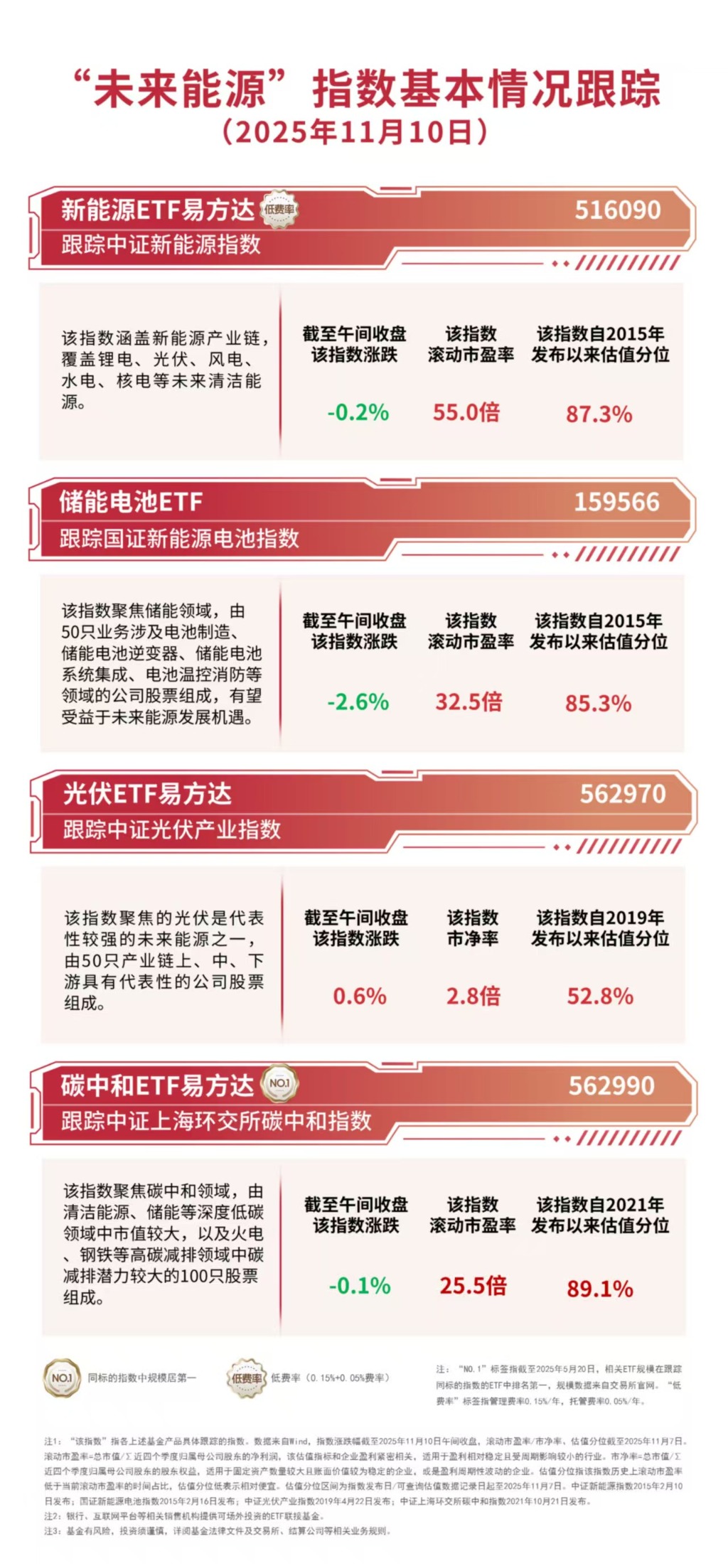
Core Insights - The market is experiencing increased attention towards the renewable energy sector, driven by China's firm stance on renewable energy strategies and adjustments in industry supply due to anti-competition measures [1] - New demands, particularly in energy storage, are exceeding expectations, leading to improved industry prosperity [1] - The overall market remains in a phase of oscillating upward movement, with renewable energy expected to become a new hotspot attracting widespread capital interest [1] Market Performance - As of midday closing, the CSI Photovoltaic Industry Index rose by 0.6% [1] - The CSI Shanghai Carbon Neutrality Index decreased by 0.1% [1] - The CSI New Energy Index fell by 0.2% [1] - The National New Energy Battery Index dropped by 2.6% [1] - The Energy Storage Battery ETF (159566) saw over 70 million net subscriptions in the morning session [1]
博时基金市场异动陪伴10月14日:A股三大指数调整,创业板跌近4%
Xin Lang Ji Jin· 2025-10-14 07:32
Market Performance - On October 14, the A-share market experienced a correction, with the ChiNext index falling nearly 4% [1][2]. Analysis of Market Movements - The recent escalation of China-U.S. trade tensions has raised concerns about the stability of global supply chains and the foreign trade environment, particularly in areas such as shipping costs, rare earth controls, and tariff threats [2]. - Technical adjustment pressures within the market have also contributed to the volatility, as the A-share market has accumulated significant gains since the beginning of the year, prompting some profit-taking amid external disturbances [2]. - The complex and changing international geopolitical landscape, including uncertainties in the policy directions of major economies like France and Japan, has led to a cautious market sentiment [2]. Impact of Trade Tensions - The recent escalation in China-U.S. trade tensions has implications beyond traditional trade, with China's export controls on rare earths and related technologies targeting the core supply chains of the global high-tech industry [2]. - The U.S. has threatened higher tariffs, which exacerbates tensions in the global trade system, creating uncertainty and risk aversion in the market, particularly affecting industries reliant on China-U.S. trade and those closely tied to globalization in high-tech and manufacturing sectors [2]. Market Outlook - Short-term volatility in the A-share market may increase, but there is no need for excessive pessimism in the medium term [3]. - The evolution of China-U.S. relations, especially with key events like the upcoming APEC summit, will be critical observation points for the market [3]. - The market focus is expected to shift towards internal drivers, particularly the policy dividends from the "14th Five-Year Plan" and the certainty of third-quarter earnings [3]. - In terms of asset allocation, a balanced strategy is recommended, focusing on sectors that highlight strategic value and benefit from domestic industrial policy support, such as technology and new energy [3]. - Additionally, sectors with relatively low valuations and improving fundamentals may also present investment opportunities [3]. - Continuous monitoring of incremental capital movements and changes in the external environment is advised for flexible portfolio adjustments [3].