
水泥

Search documents
掘金顺周期-多行业系列联合会议
2026-01-30 03:11
Summary of Key Points from Conference Call Records Industry Overview - **General Economic Outlook**: The Chinese economy shows signs of stabilization, with nominal GDP growth expected to enhance corporate profits. Supply contraction outpacing demand may improve industry prices and corporate earnings, highlighting opportunities in cyclical industries [1][2][3]. Real Estate Sector - **Investment Value**: The real estate sector is deemed to have high investment value, with significant growth in second-hand housing transaction volumes and a narrowing decline in listing prices. Major cities like Beijing and Shanghai have seen listing volumes drop by over 15% [1][3]. - **Policy Catalysts**: Continuous policy support for real estate investment trusts (REITs) and other measures are expected to catalyze the market. The valuation of real estate stocks is considered to have a sufficient margin of safety, with many leading companies trading at a price-to-book (PB) ratio significantly below 1 [1][3][11]. - **Market Dynamics**: The short-term data indicates positive changes in the real estate market, with a notable decrease in listings for older urban properties, as owners prefer renting or waiting for redevelopment rather than selling at lower prices [4][5]. Travel and Transportation Sector - **Positive Outlook**: The travel industry is expected to benefit from government policies promoting tourism, with signs of recovery in duty-free and hotel sectors. The airline industry anticipates strong growth in passenger traffic, with ticket prices expected to be higher than last year [1][8][9]. - **Airline Performance**: During the 2026 Spring Festival travel period, the airline industry is projected to see a 5-6% increase in passenger traffic, with improved ticket pricing compared to 2025. The industry is entering a positive development phase, with a supply growth rate of about 4% and demand growth of approximately 5.5% [9]. Home Appliance Sector - **Investment Opportunities**: The home appliance sector is currently undervalued, presenting good investment opportunities across various segments, including kitchen appliances and white goods. Leading companies are expected to maintain stable performance and high dividend payouts [1][10][11]. Coal Industry - **Market Conditions**: The coal industry is experiencing a marginal improvement in supply-demand dynamics, with a stable price recovery expected. Supply constraints are anticipated to reduce domestic coal supply by 70 million to 100 million tons in 2026, while demand remains resilient [2][19][20]. Chemical Industry - **Future Trends**: The chemical industry is gaining attention due to increased market liquidity and expectations of positive producer price index (PPI) trends. Supply-side constraints and improved demand from global markets are expected to drive price increases [17][18]. Consumer Healthcare Sector - **Recovery Signs**: The consumer healthcare sector is showing early signs of stabilization, particularly in ophthalmology and dental services. Key players in these segments are expected to benefit from a recovering market environment [16]. Food and Beverage Sector - **Market Performance**: The food and beverage sector has seen significant price increases, particularly for premium brands like Moutai. However, potential risks include the release of pent-up supply post-holiday, which could impact prices [21][22]. Construction and Building Materials - **Market Changes**: The construction materials sector is adapting to a shift in demand from new housing to renovations of existing properties. Recent data indicates a recovery in demand for glass and other materials, with expectations of price stabilization and potential increases [24][25]. Conclusion - **Investment Strategy**: Overall, the cyclical industries, particularly real estate, travel, and home appliances, present promising investment opportunities. The focus should be on companies with strong fundamentals and favorable market conditions as the economy stabilizes [1][3][8][11].
独董公开提名渐入“投服时刻”
Zhong Guo Zheng Quan Bao· 2026-01-29 21:02
Core Viewpoint - The independent director system for listed companies in China is undergoing a significant transformation, with new regulations aimed at enhancing shareholder representation and governance structures [1][2]. Group 1: Regulatory Changes - The "Management Measures for Independent Directors of Listed Companies" was officially introduced in August 2023, allowing investor protection agencies to publicly solicit shareholder rights and nominate independent directors [1][2]. - This regulatory change aims to amplify the voices of minority shareholders, particularly those who have historically been silent [1]. Group 2: Practical Implementation - The China Securities Investor Services Center has successfully transitioned the new system from concept to practice, with five successful independent director nominations planned from 2024 to 2026 across various companies and ownership structures [1][3]. - The nomination process has evolved to include "joint action" strategies, expanding the backgrounds of independent directors from industry experience to accounting expertise [1][4]. Group 3: Challenges and Participation - Despite a high approval rate of over 99% for the five nominations, actual participation from investors remains limited, with the highest number of participants in a single case being only 17 [2][9]. - The low engagement reflects a "free-rider" mentality among minority shareholders, indicating a need for improved investor education and participation mechanisms [2][9]. Group 4: Governance Impact - The involvement of the China Securities Investor Services Center is seen as a way to internalize external market supervision, enhancing the independence and representativeness of independent directors [5][6]. - The successful nominations have begun to demonstrate a potential shift in corporate governance, allowing for a more balanced representation of shareholder interests within company boards [4][6]. Group 5: Future Directions - The center aims to continue refining the independent director nomination process while addressing practical challenges such as the 1% shareholding requirement for proposal submissions [8][9]. - Experts suggest that regulatory adjustments may be necessary to facilitate the nomination process and encourage broader participation from minority shareholders [8][9].




Eagle Materials(EXP) - 2026 Q3 - Earnings Call Transcript
2026-01-29 14:32
Financial Data and Key Metrics Changes - Revenue for Q3 of fiscal 2026 was $556 million, down slightly from the prior year, reflecting lower wallboard and paperboard sales volume, partially offset by higher cement sales volume [11] - Earnings per share were $3.22, down 10% from Q3 of fiscal 2025, primarily due to lower net earnings from wallboard sales volume [11] - Gross profit margin was 28.9%, indicating a stable profitability level despite market challenges [3] Business Line Data and Key Metrics Changes - Heavy materials sector revenue increased by 11%, driven by a 9% increase in cement sales volume and a 22% increase in concrete and aggregates revenue [11] - Aggregate sales volume reached a record 1.6 million tons, up 81%, reflecting a 34% increase in organic aggregate sales volume [13] - Light materials sector revenue decreased by 16% to $203 million, primarily due to lower wallboard and recycled paperboard sales volume [11] Market Data and Key Metrics Changes - Cement and aggregate sales volumes grew last quarter, supported by federal, state, and local infrastructure spending [8] - Wallboard sales were challenged due to affordability issues in the housing market, with a 5% decline in wallboard sales prices [11][9] - The company announced price increases for cement in most markets for Q1 of calendar 2026, reflecting volume expectations [9] Company Strategy and Development Direction - The company aims to maintain operational flexibility and efficiency through investments in health and safety, cost control, and customer support [3][4] - Strategic projects include the modernization of the Mountain Cement plant and the Duke wallboard facility, expected to lower cost structures and enhance competitive positioning [7] - The company is focused on maintaining a strong balance sheet while pursuing growth opportunities through disciplined capital allocation [10] Management's Comments on Operating Environment and Future Outlook - Management expressed optimism about infrastructure and non-residential markets as they head into calendar 2026, despite mixed construction environments [19] - The company remains focused on operations rather than predicting demand, emphasizing their ability to manage costs effectively [9] - Management noted that while wallboard pricing has seen some downward trends, they expect stability in pricing due to structural changes in the industry [26] Other Important Information - Operating cash flow increased by 5% to $512 million, with capital spending rising to $295 million, primarily for modernization projects [14] - The company returned nearly $150 million to shareholders through dividends and share repurchases during Q3 [10] - The net debt-to-cap ratio was 48%, with a leverage ratio of 1.8x, providing significant financial flexibility [15] Q&A Session Summary Question: Is cement demand widespread across markets? - Management indicated that demand is broad-based across markets, with optimism for infrastructure and non-residential markets as they enter calendar 2026 [19] Question: What is driving the margins in cement? - Margins were impacted by slight increases in raw material costs, but maintenance and fuel costs remained largely in line [22] Question: How is wallboard pricing expected to trend? - Wallboard pricing has seen a downward trend, but management expects prices to remain range-bound due to structural changes in the industry [26] Question: What is the impact of winter storms on operations? - The company has prepared facilities for extreme cold temperatures, ensuring operations are ready for winter storms [41] Question: What portion of wallboard demand is from repair and remodel? - Repair and remodel account for about a third of wallboard demand, showing steady growth over the years [38] Question: How is the company managing capital allocation post-bond deal? - The company is focused on balancing growth through M&A and organic projects while maintaining a disciplined approach to capital allocation [51]

Eagle Materials(EXP) - 2026 Q3 - Earnings Call Transcript
2026-01-29 14:30
Financial Data and Key Metrics Changes - Revenue for Q3 2026 was $556 million, slightly down from the previous year, primarily due to lower wallboard and paperboard sales volume, partially offset by higher cement sales volume and contributions from the recently acquired aggregates business [10] - Earnings per share were $3.22, down 10% from Q3 2025, reflecting lower net earnings mainly due to decreased wallboard sales volume, despite a 5% reduction in fully diluted shares from the share buyback program [10] - Gross profit margin was reported at 28.9% [3] Business Line Data and Key Metrics Changes - Heavy materials sector revenue increased by 11%, driven by a 9% increase in cement sales volume and a 22% increase in concrete and aggregates revenue [10] - Aggregate sales volume reached a record 1.6 million tons, up 81%, reflecting a 34% increase in organic aggregate sales volume [11] - Light materials sector revenue decreased by 16% to $203 million, primarily due to lower wallboard and recycled paperboard sales volume, with operating earnings down 25% to $73 million [11] Market Data and Key Metrics Changes - Cement and aggregate sales volumes grew last quarter, supported by federal, state, and local infrastructure spending, as well as solid growth in key non-residential end markets [7] - Wallboard sales were challenged due to affordability issues in the housing market, with annual shipments for calendar 2025 returning to a 2018 pace [21] Company Strategy and Development Direction - The company aims to maintain operational flexibility and efficiency through economic cycles, focusing on health and safety, cost control, and customer support [3][4] - Strategic projects include the modernization of the Mountain Cement plant and the Duke wallboard facility, expected to lower cost structures and strengthen competitive positions [6] - The company is committed to maintaining a strong balance sheet while pursuing growth opportunities through both organic projects and potential acquisitions [9] Management's Comments on Operating Environment and Future Outlook - Management expressed optimism about infrastructure and non-residential markets as they head into calendar 2026, despite challenges in the residential construction sector [17] - The company anticipates that pricing for wallboard will remain range-bound, with potential for upward movement as housing construction recovers [23] - Management highlighted the importance of financial discipline and balance sheet strength, noting a leverage ratio of 1.8x, which allows for growth even in choppy market conditions [9] Other Important Information - The company returned nearly $150 million to shareholders through dividends and share repurchases during the fiscal third quarter [12] - A total of $750 million in 10-year senior notes was issued to enhance liquidity and align capital structure with long-term investments [13] Q&A Session Summary Question: Is cement demand widespread across markets? - Management indicated that demand is broad-based across markets, with optimism for infrastructure and non-residential markets as they enter 2026 [17] Question: What is driving the margins in cement? - Margins were impacted by increased raw material costs, but maintenance and fuel costs remained largely in line [19] Question: What is the outlook for wallboard pricing? - Management noted a downward trend in wallboard pricing due to a challenging residential market, but prices are expected to stabilize [21][23] Question: How is the company addressing wallboard shipment declines? - Shipments were consistent across regions, with a noted decline in line with regional performance [26] Question: What is the impact of natural gas costs on wallboard and cement? - Wallboard is more affected by natural gas prices, but the company has a hedging program in place to mitigate risks [32] Question: How is the company managing capital allocation post-bond deal? - The company is focused on balancing growth through organic projects and potential acquisitions while maintaining a disciplined approach to capital allocation [47]
二月策略及十大金股:实物资产与中国资产
SINOLINK SECURITIES· 2026-01-29 14:16
Group 1: Strategy Overview - The report emphasizes the resilience of the A-share market amidst multiple overseas risks and signals of regulatory easing in China, suggesting that the relationship between market performance and regulatory changes warrants further consideration [5][12] - It highlights the significant outperformance of the A-share market compared to other major indices, particularly the CSI 300, which has faced substantial redemption pressure [5][12] - The report suggests that investors should not overly worry about the CSI 300's performance, as it has already aligned with regulatory easing requirements, reducing the necessity for further pressure [5][12] Group 2: Economic Insights - China's exports continued to show strong performance in December, driven by overseas investment during a global easing cycle, positively impacting sectors like electrical and mechanical equipment [6][13] - Domestic consumption is recovering, with a rebound in per capita consumer spending in the fourth quarter, aligning with the report's annual strategy predictions [6][13] - The report notes that recent government policies aimed at boosting domestic demand and stabilizing real estate are expected to support synchronized recovery in both domestic and external demand [6][13] Group 3: Asset Allocation and Investment Recommendations - The report identifies a dual focus for 2026 on physical assets and Chinese assets, with thematic investments being essential [7][16] - Recommended sectors include physical assets such as copper, aluminum, tin, gold, lithium, and oil, alongside Chinese equipment export chains like electrical grid equipment and renewable energy [7][16] - The report also highlights sectors benefiting from capital market expansion and improving long-term asset returns, such as non-bank financials and consumer sectors like aviation and duty-free retail [7][16] Group 4: Company-Specific Insights - **Yunnan Aluminum Co. (000807.SZ)**: The report recommends a long-term investment due to favorable conditions for aluminum exports and a strong balance sheet, with potential for increased dividends [18] - **Hua Aluminum (600301.SH)**: The company is seen as a strong growth candidate due to rising tin and antimony prices and its position as a key beneficiary of metal consolidation in Guangxi [19] - **Yingliu Co. (603308.SH)**: The report anticipates a surge in global gas turbine demand, positioning the company to increase its market share in turbine blades [20] - **Shangfeng Cement (000672.SZ)**: The company is recognized for its strong cash flow from cement operations and potential for significant dividends [21] - **Pop Mart (9992.HK)**: The company is expected to maintain rapid growth in the entertainment market through IP incubation and diverse monetization strategies [22] - **China Duty Free Group (601888.SH)**: The company is projected to strengthen its market position in the duty-free sector, benefiting from increased inbound tourism and overseas expansion [24] - **China Southern Airlines (1055.HK)**: The airline is expected to benefit from improved industry supply-demand dynamics and a large fleet size [25] - **Li Auto (2015.HK)**: The company is focusing on advancements in AI and smart driving technology, with expectations for increased vehicle sales [26] - **Lante Optics (688127.SH)**: The company is positioned to benefit from strong demand in automotive and smart imaging sectors [27] - **InnoCare Pharma (9606.HK)**: The company is advancing in the ADC field with a robust pipeline and partnerships, with several products nearing clinical registration [29]




金隅集团:公司所属金隅冀东水泥旗下6家公司具备核电工程用硅酸盐水泥生产资质
Zheng Quan Ri Bao Zhi Sheng· 2026-01-29 13:10
Group 1 - The core viewpoint of the article is that Jinju Group's subsidiary, Jidong Cement, has the production qualification for silicate cement used in nuclear power engineering, and its products have been utilized in some nuclear power projects [1] - The gross profit performance of the silicate cement products is reported to be good, although their revenue contribution is relatively low [1]
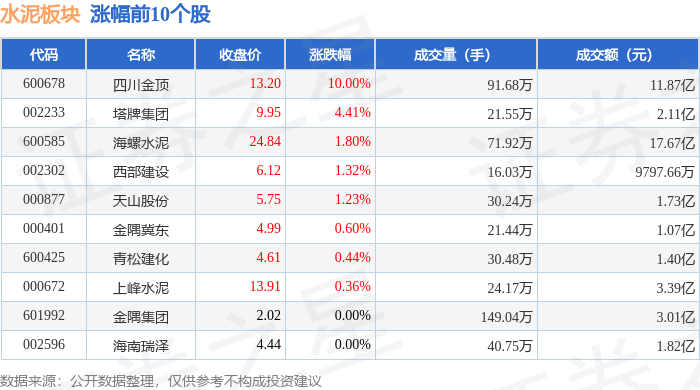
水泥板块1月29日涨0.64%,四川金顶领涨,主力资金净流入2.49亿元
Zheng Xing Xing Ye Ri Bao· 2026-01-29 09:03
Group 1 - The cement sector experienced a 0.64% increase on January 29, with Sichuan Jinding leading the gains [1] - The Shanghai Composite Index closed at 4157.98, up 0.16%, while the Shenzhen Component Index closed at 14300.08, down 0.3% [1] - Key stocks in the cement sector showed varied performance, with Sichuan Jinding rising by 10% to a closing price of 13.20 [1] Group 2 - The cement sector saw a net inflow of 249 million yuan from main funds, while retail funds experienced a net outflow of 94.96 million yuan [2] - Major stocks like Sichuan Jinding had a significant net inflow of 459 million yuan, accounting for 38.65% of the main fund's net [3] - Other stocks such as Huaxin Cement and Tapa Group also showed mixed fund flows, with Huaxin Cement experiencing a net inflow of 79.63 million yuan [3]



策略专题研究:2026年牛市展望系列3:些领域“反内卷”更值得期待?
Guoxin Securities· 2026-01-29 08:13
证券研究报告 | 2026年01月29日 策略专题研究 哪些领域"反内卷"更值得期待?——2026 年牛市展望系列 3 核心结论:①本次反内卷较 16 年供改背景更复杂,需求端内弱外强,供给 端受制造实力与地方非经济决策驱动。②26 年反内卷仍是经济工作重点,参 考 25 年及 16 年行情经验,反内卷行情或仍有可观上行空间。③政策干预角 度看,关注企业配合度高、地方、落地动力强的行业(如钢铁、油服工程、 水泥等)。④从行业自身周期看,关注供需两旺的景气行业(贵金属、化学 原料等),以及供需格局优化领域(养殖业、能源金属等)。 本轮反内卷背景更复杂,行情节奏相对波折。相较于供改,本轮反内卷再供 需背景上更复杂:需求端看,不同于供给侧结构性改革时期,棚改货币化等 强政策刺激快速拉动总需求,本次内需不足的特征更为突出,但外需支撑或 相对有韧性;供给端看,本次供给扩张与我国制造业实力提升有关,地方政 府"非经济"决策进一步加剧产能过剩。在此背景下,从行业结构看,本轮 呈"涉及面广、新兴行业多、民营企业多"的特点。对应行情节奏看,反内 卷行情相对波折,25 年以来"反内卷"行情呈现"预期发酵-分化降温-二次 升温-震 ...
福建水泥:预计2025年年度净利润为-1.2亿元到-8000万元
Mei Ri Jing Ji Xin Wen· 2026-01-29 08:11
Core Viewpoint - Fujian Cement expects to achieve a net profit attributable to shareholders of the parent company between -120 million and -80 million yuan for the fiscal year 2025, indicating a reduction in losses compared to the previous year due to ongoing challenges in the cement market [1] Group 1: Financial Performance - The company anticipates a decrease in both sales volume and operating revenue year-on-year, despite a slight increase in the average selling price and a significant reduction in sales costs, leading to an increase in gross profit margin [1] - The main reason for the performance change is the continuous decline in market demand for cement, exacerbating supply-demand conflicts [1] Group 2: Operational Strategies - The company is actively implementing staggered production to lead and promote regional "anti-involution" collaboration, enhancing precise marketing, and continuously advancing lean operations, productivity improvements, and cost control measures [1] - The company has made provisions for asset impairment related to two production lines with a daily capacity of 2,500 tons each, which are being used to supplement the capacity replacement of three production lines with a daily capacity of 4,500 tons [1] Group 3: Asset Management - The company plans to conduct impairment testing and assessment for its subsidiaries, including Haixia Cement and Ningde Jianfu, and will make provisions for asset impairment accordingly [1]

福建水泥:2025年预亏8000万元~1.2亿元 同比减亏
Mei Ri Jing Ji Xin Wen· 2026-01-29 07:59
Core Viewpoint - Fujian Cement (600802) expects to reduce its net profit loss to between 80 million and 120 million yuan in 2025, compared to a loss of 167 million yuan in the same period last year, indicating a year-on-year improvement in loss reduction [1] Group 1: Financial Performance - The company anticipates a net profit loss of 80 million to 120 million yuan for 2025, which represents a reduction in losses compared to the previous year's loss of 167 million yuan [1] - Despite a decrease in overall sales volume and operating revenue year-on-year, the average selling price of products has slightly increased, and sales costs have significantly decreased [1] - The gross profit margin for product sales has improved year-on-year, contributing to the company's goal of reducing losses [1] Group 2: Market Conditions and Strategies - The cement market demand continues to decline, exacerbating supply-demand conflicts [1] - The company is actively implementing staggered production to lead and promote regional "anti-involution" collaboration [1] - Fujian Cement is enhancing precision marketing and continuously advancing lean operations, improving labor efficiency, and controlling expenses as part of its cost reduction and efficiency enhancement measures [1]