
石化

Search documents
【1+13联动发布】晒答卷 话开局——我是连云港,向您报告!
Xin Lang Cai Jing· 2026-01-21 12:21
转自:微讯江苏 编者按:时序更替,华章日新。随着省两会脚步临近,全省各地两会正相继召开。在此节点,"微讯江苏"联动13个设区市官方发布平台,特别推出"晒答 卷 话开局——1+13省市政府工作报告联动发布"系列,生动呈现全省各地奋力扛起"经济大省挑大梁"的光荣使命,奋力谱写"强富美高"新江苏现代化建设 新篇章,奋力在推进中国式现代化中走在前、做示范的壮丽图景。让我们透过这些图解触摸发展脉动,从"答卷"中汲取信心,于"开局"里明确方向,共同 见证江苏高质量发展的铿锵步伐。 1月21日上午 连云港市第十五届人民代表大会 第六次会议开幕 周进代表市人民政府 向大会报告工作 2025年 连云港交出了怎样的成绩单? 2026年 政府工作有哪些重点目标任务? 带你快速了解 了了一次"时期工作回顾 "十四五"时期是极不寻常、极 不平凡的五年。面对错综复杂的宏观 环境、艰巨繁重的改革发展稳定任 务,全市上下坚持以习近平新时代中 国特色社会主义思想为指导,认真落 实习近平总书记对江苏、对连云港工 作重要讲话重要指示精神,有效应对 取得 Citir 世纪疫情严重冲击和一系列重大风险 挑战,较好完成"十四五"目标任 "强富美高"新港 ...


“金丝雀”报喜!韩国1月出口初步增长14.9%,芯片出口激增70%
Hua Er Jie Jian Wen· 2026-01-21 10:31
Core Insights - South Korea's exports saw a significant increase of 14.9% year-on-year in the first 20 days of January, primarily driven by a surge in semiconductor demand due to the global AI boom [1][2] - Semiconductor exports skyrocketed by 70.2%, continuing the growth trend fueled by strong investments in AI and data centers, which helped offset declines in traditional sectors like automotive and shipbuilding [1][2] - Despite structural pressures from U.S. tariffs and a slowdown in global demand, the robust performance of high-tech exports has narrowed the trade deficit to $626 million [1] Semiconductor Sector - The semiconductor sector remains the core engine of South Korea's export growth, with a notable 70.2% increase in chip exports in January, driven by AI-related demand [2] - South Korea's position in the global semiconductor supply chain is further emphasized, with projected exports reaching a record $709.4 billion in 2025, a 3.8% year-on-year increase, and a 22% rise in semiconductor shipments [2] - The U.S. has imposed a 25% import tariff on certain semiconductors and related equipment, which could impact South Korean manufacturers if they do not increase production in the U.S. [2] Regional Export Performance - Exports to China increased by 30.2%, and exports to the U.S. rose by 19.3%, indicating stable demand in major markets [3] - However, exports to the EU and Japan fell by approximately 15% and 13%, respectively, highlighting structural market disparities amid global economic and policy differences [3] Automotive Sector Challenges - The automotive sector faced significant challenges, with exports declining nearly 11% due to U.S. tariff policies and a slowdown in global demand [4] - Shipbuilding exports also dropped by 18%, reflecting the headwinds faced by traditional manufacturing industries [4] - Despite a trade agreement that set a 15% cap on import tariffs, the current rates remain higher than previous free trade arrangements, continuing to pressure the automotive sector [4] Currency Effects - The weakening of the Korean won has provided crucial support for exports, with the currency depreciating over 8% against the dollar since June [6] - While currency depreciation enhances the price competitiveness of export products, it also raises import costs, contributing to inflationary pressures [6] - The Bank of Korea has maintained the benchmark interest rate at 2.5% for the fifth consecutive time, indicating a neutral policy stance amid mixed economic outlooks [6]
为“中国智造”持续注入新动能 一批领航级智能工厂将亮相
Bei Jing Shang Bao· 2026-01-21 10:21
Core Viewpoint - The Ministry of Industry and Information Technology (MIIT) of China is promoting the development of leading smart factories to enhance the country's manufacturing competitiveness and support the digital transformation of the global manufacturing industry [1][6]. Group 1: Development of Smart Factories - Over 35,000 basic-level, more than 8,200 advanced-level, and over 500 excellent-level smart factories have been established, along with 15 leading smart factories [4]. - The first batch of 15 leading smart factories showcased their advancements at the 2025 World Intelligent Manufacturing Conference, achieving an average production efficiency increase of 29% and a reduction in product defect rates by 47% [5]. - The leading smart factories have integrated artificial intelligence into over 70% of their business scenarios, creating over 6,000 vertical domain models and facilitating the large-scale application of more than 1,700 key intelligent manufacturing equipment and industrial software [5]. Group 2: Strategic Initiatives - The MIIT, in collaboration with several government departments, aims to cultivate a batch of leading smart factories that represent the highest level of global intelligent manufacturing, serving as a model for the overall upgrade of China's manufacturing industry [6]. - A four-tier system for smart factory cultivation has been initiated, focusing on basic, advanced, excellent, and leading levels, with specific requirements for AI application scenarios [7]. - The MIIT plans to continue implementing intelligent manufacturing projects and support leading enterprises in exploring future manufacturing models, which will help overcome bottlenecks in high-end and intelligent development in the manufacturing sector [8].

印度最大LNG进口商布局石化项目
Zhong Guo Hua Gong Bao· 2026-01-21 06:52
Core Viewpoint - Larsen & Toubro (L&T) has secured a significant EPC contract from Petronet LNG to construct advanced storage and handling facilities at the Dahej petrochemical complex in Gujarat, marking a strategic move to address the domestic polypropylene supply-demand gap [1] Group 1: Project Details - The project includes the construction of a 170,000 cubic meter LNG/ethane double-wall tank and a 140,000 cubic meter propane double-wall tank [1] - L&T will also provide processing and delivery facilities for ethane and propane to support the propane dehydrogenation (PDH) and polypropylene units within the complex [1] Group 2: Company Strategy - Petronet LNG, India's largest LNG importer, is diversifying its business strategy since 2021, with this investment of 206.8 billion rupees (approximately 2.2 billion USD) being a crucial step in extending its value chain downstream [1] - The Dahej petrochemical complex is planned to have an annual production capacity of 750,000 tons of PDH and 500,000 tons of polypropylene [1]
山东:2025年机电产品出口1.06万亿元 ,首次迈上万亿台阶
Zhong Guo Fa Zhan Wang· 2026-01-21 06:17
Core Insights - Shandong province is focusing on industrial economic development, aiming for a significant increase in industrial product exports by 2025, targeting 1.97 trillion yuan, a growth of 4.4% [1] - The province's machinery and electrical products exports are projected to reach 1.06 trillion yuan, marking an 8.7% increase, surpassing the overall provincial export growth rate [1] - The shift towards high-end, intelligent, and digital manufacturing is evident, with substantial growth expected in high-end equipment and electronic information exports [1] Industrial Performance - Key industries such as steel, non-ferrous metals, and petrochemicals are expected to see quality improvements and efficiency gains, with steel, aluminum, and refined oil exports projected to grow by 3.3%, 7%, and 29.5% respectively by 2025 [2] - Shandong has 105 categories of machinery and electrical products that rank first in national export value, with certain products dominating global markets [2] Green Trade Initiatives - The export of "new three types" products is anticipated to grow by 37% by 2025, with electric vehicle exports expected to surge by 126% [2] - Customs is enhancing responses to green trade barriers and is developing a green cross-border trade service platform to assist companies in carbon accounting and compliance [2]
工信部:支持领军企业探索未来制造模式,持续培育“领航工厂”
Xin Jing Bao· 2026-01-21 05:50
Core Viewpoint - The establishment of leading smart factories is a strategic initiative by China to seize opportunities in industrial intelligence development and build future manufacturing competitive advantages [1][2] Group 1: Development of Leading Smart Factories - The Ministry of Industry and Information Technology (MIIT) will collaborate with multiple departments to promote the development of leading smart factories starting in 2025, with the first batch of 15 factories showcased at the 2025 World Intelligent Manufacturing Conference [1] - Leading smart factories meet high efficiency, precision, flexibility, and quality production requirements, setting transformation benchmarks for their respective industries [1] - Average production efficiency has increased by 29%, and product defect rates have decreased by 47% due to the transformations in these factories [1] Group 2: Integration of Artificial Intelligence - Over 70% of business scenarios in leading smart factories have integrated artificial intelligence, resulting in the accumulation of over 6,000 vertical domain models [1] - The application of more than 1,700 key intelligent manufacturing equipment and industrial software has led to the formation of industrial intelligent entities capable of perception, decision-making, and execution [1] Group 3: Value Creation and Industry Collaboration - Leading smart factories not only provide high-end products but also extend to scalable customization, industry chain collaboration, and predictive maintenance, transforming from "product manufacturers" to comprehensive providers of "products + services + solutions" [2] - These factories have facilitated the collaborative upgrade of over 1,300 upstream and downstream enterprises, promoting an overall upgrade of the industry chain towards high-end [2] Group 4: Future Plans and Global Impact - The MIIT will continue to cultivate smart factories in a gradient manner, supporting leading enterprises to explore future manufacturing models and nurturing more leading smart factories to drive overall industry transformation [2] - The aim is to summarize best practices and create replicable technical guidelines, standards, and solutions to share across the industry, positioning leading smart factories as sources of technology, standards, and rules, and accelerating their promotion overseas [2]
山东:2025年机电产品出口1.06万亿元,首次迈上万亿台阶
Zhong Guo Fa Zhan Wang· 2026-01-21 03:12
Core Insights - Shandong province is focusing on industrial economic development as a key strategy, aiming for a significant increase in industrial product exports by 2025, targeting 1.97 trillion yuan with a growth rate of 4.4% [1] - The province is emphasizing high-end, intelligent, and digital transformation in manufacturing, with notable growth projections for various sectors, including a 47% increase in high-end equipment exports [1] - Key industrial clusters such as steel, non-ferrous metals, and petrochemicals are expected to see substantial improvements, with specific export growth rates projected for steel, aluminum, and refined oil products [2] Industrial Development - By 2025, Shandong aims to export industrial products worth 1.97 trillion yuan, with machinery and electrical products expected to reach 1.06 trillion yuan, marking an 8.7% growth [1] - High-end equipment exports are projected to reach 108.96 billion yuan, growing by 47%, while electronic information exports are expected to grow by 30% [1] - The province is implementing policies to enhance production capabilities and streamline customs processes for biopharmaceuticals and medical instruments [1] Key Industry Clusters - Major industries such as steel, non-ferrous metals, and petrochemicals are set to improve quality and efficiency, with steel, aluminum, and refined oil exports projected to grow by 3.3%, 7%, and 29.5% respectively by 2025 [2] - Shandong has 105 categories of electromechanical products that rank first in national export value, with certain products like diesel trucks and concrete mixers accounting for over 10% of global exports [2] - The province's strategy is shifting towards a comprehensive competitive advantage in technology, brand, quality, and service, with over one-third of electromechanical product exports being self-branded [2] Green Trade Initiatives - Shandong's "new three samples" products are expected to see a 37% increase in exports by 2025, with electric vehicle exports projected to grow by 126% [2] - Customs is enhancing responses to green trade barriers and integrating various data sources to support carbon emission calculations and facilitate green cross-border trade [2]
聚焦进口替代、纯内需、高股息等方向,石化ETF(159731)连续10天净流入
Xin Lang Cai Jing· 2026-01-21 02:17
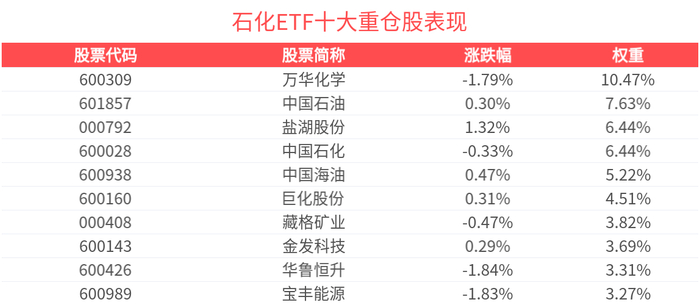
Group 1 - The China Petroleum and Chemical Industry Index decreased by 0.57% as of January 21, 2026, with mixed performance among constituent stocks, including Zhejiang Longsheng and Yara International leading gains, while Luxi Chemical and Hengyi Petrochemical faced declines [1] - The Petrochemical ETF (159731) fell by 0.50%, with a latest price of 1 yuan and a record high scale of 625 million yuan, having attracted a total net inflow of 344 million yuan over the past 10 days [1] - The Petrochemical ETF has seen a net value increase of 64.29% over the past two years, with the highest single-month return reaching 15.86% and the longest consecutive monthly gain lasting for 8 months, with an average monthly return of 5.25% [1] Group 2 - The top ten weighted stocks in the China Petroleum and Chemical Industry Index as of December 31, 2025, include Wanhua Chemical, China Petroleum, and China Petrochemical, collectively accounting for 56.73% of the index [2] - The performance of key stocks includes Wanhua Chemical down by 1.79%, China Petroleum up by 0.30%, and China Petrochemical down by 0.33%, among others [4] - The Petrochemical ETF closely tracks the China Petroleum and Chemical Industry Index, with various linked products available for investment [4] Group 3 - Huaxin Securities remains optimistic about the three major oil companies, particularly China Petrochemical, which benefits from lower raw material costs due to declining international oil prices [1] - Private refining companies are also expected to gain from the current downturn in oil prices due to their higher chemical yield and production efficiency [1]
东方证券:聚焦化工行业景气修复 主要看好MDI、石化、磷化工、PVC和聚酯瓶片
Zhi Tong Cai Jing· 2026-01-21 01:49
Core Viewpoint - The chemical industry is experiencing a collective shift in business strategies driven by multiple factors, leading to a recovery in industry prosperity [1] Group 1: Industry Trends - The long-standing focus on market share in China's chemical industry is being transformed, with companies now facing increased barriers to entry due to supply-side reforms, environmental checks, and dual carbon goals [1] - Internal policy adjustments and external anti-dumping investigations are signaling a necessary change in the expectations surrounding market share [2] Group 2: Business Strategy Shifts - Companies are moving towards sacrificing existing market share to enhance short-term return rates, as merely halting expansion is no longer sufficient to address inventory and excess capacity [2] - The change in business strategies is primarily driven by shifts in the mindset of entrepreneurs and management, marking a significant departure from previous industry recovery patterns [2] Group 3: Selection Criteria for Investment - The preferred selection criteria for the industry include the strength of expansion constraints and the depth of leading companies' advantages, with stronger constraints leading to lower expectations for market share-driven growth [3] - The depth of leading companies' advantages not only constrains industry expansion but also determines the potential recovery in industry return rates [3] Group 4: Investment Recommendations - Recommended investment opportunities include: - MDI: Wanhua Chemical (600309) - Petrochemicals: Sinopec (600028), Rongsheng Petrochemical (002493), Hengli Petrochemical (600346) - Phosphate Chemicals: Chuanheng Shares (002895), Yuntianhua (600096), Xingfa Group (600141) - PVC: Zhongtai Chemical (002092), Xinjiang Tianye (600075), Chlor-alkali Chemical (600618), Tianyuan Shares (002386) - Polyester Bottle Chips: Wankai New Materials (301216) [4]





增速5.8%!甘肃经济稳中向好韧性凸显质效双升——2025年甘肃省经济运行成绩单透视
Xin Lang Cai Jing· 2026-01-21 01:00
Core Viewpoint - Gansu Province's economy demonstrated resilience and positive growth in 2025, with a GDP of 1.36975 trillion yuan, reflecting a year-on-year increase of 5.8%, surpassing the national average by 0.8 percentage points [1]. Economic Growth Indicators - Gansu's economic performance in 2025 showed "five positive trends": stable growth outpacing the national average, improved supply across all three industries, resilient investment and consumption, strong foreign trade growth, and enhanced quality and efficiency [2]. - Key indicators included industrial added value growth exceeding the national average by 3.6 percentage points, import and export growth surpassing the national average by 12.4 percentage points, and per capita disposable income growth exceeding the national average by 0.6 and 0.5 percentage points respectively [2]. Industry Performance - The agricultural sector achieved a record grain output of over 13 million tons, with significant growth in specialty products like vegetables and medicinal herbs, establishing Gansu as a major seed production base [3]. - The industrial sector saw a 0.5 percentage point acceleration in industrial added value growth, with key industries like non-ferrous metals and electricity contributing significantly to economic stability [3]. - The service sector emerged as a primary growth driver, contributing 51.4% to GDP growth, with tourism seeing over 500 million visitors and generating 403.6 billion yuan in spending [3]. Domestic and Foreign Trade - Gansu implemented measures to boost domestic demand and stabilize foreign trade, resulting in a 2.7% increase in project investment despite a downturn in the real estate market [4]. - The province's total import and export value exceeded 70 billion yuan, with a growth rate 12.4 percentage points higher than the national average, and a notable increase in high-tech product exports [4]. Development Momentum and Quality Improvement - New industries and private sector growth contributed to Gansu's economic transformation, with significant increases in strategic emerging industries and private enterprise performance [5][6]. - In 2025, Gansu added 16.05 million kilowatts of new power generation capacity, with a total capacity exceeding 80 million kilowatts and a year-on-year increase in power generation of 11.4% [6]. - The province saw a 22.6% increase in funds for newly established and ongoing investment projects, with a notable rise in the contribution of private enterprises to both industrial output and foreign trade [6].