TMT

Search documents
本期缩量下跌的科技板块还能迎来大B浪反弹么
Guotou Securities· 2025-11-16 09:10
- The technology sector has experienced a significant decline in trading volume, with the TMT sector's trading volume shrinking by approximately 65% from its peak[7][12] - The TMT sector has undergone two clear rounds of adjustments and may have certain technical repair conditions[7] - The market's current focus and profit-making effects are still concentrated in other directions, and the TMT sector may need new catalysts to initiate a significant B-wave rebound[7]
宇树科技,IPO辅导完成
财联社· 2025-11-15 01:27
据证监会官网,宇树科技已发布IPO辅导工作完成报告。 CN WILK CENTER 4个 i角 ifl 下 2025-11-15 09:16:34 星期六 长按右侧二维码阅读原文 准确 快速 权威 专业 【宇树科技IPO辅导完成】 财联社11月15日电,据证监会官网,宇树科技已发 布IPO辅导工作完成报告。 TMT行业观察 下载财联社APP获取更多资讯 准确 快速 权威 专业 7x24h电报 头条新闻 VIP资讯 实时盯盘 C □ S 为速度和交易而生 机构和私募都在使用 ...


价值投资老将,业绩确实能打
Xin Lang Ji Jin· 2025-11-14 09:45
Core Viewpoint - The article emphasizes the importance of experienced fund managers who can navigate through bull and bear cycles to create long-term returns for investors [1][2]. Group 1: Fund Manager Profile - Hu Song, a veteran fund manager with over 20 years in finance and 14 years of investment experience, is highlighted as a rare example of a value investor in the current A-share market [2]. - Under Hu Song's management, the Guotai Jinpeng Blue Chip Fund has achieved a return of 75.63% since September 25, 2020, with an annualized return of 11.87%, outperforming its benchmark and peer average [2][3]. Group 2: Fund Performance - The Guotai Jinsheng Fund, launched at a market low in February 2024, has seen a performance increase of 50.73% this year, surpassing the CSI 300 Index and its benchmark [2][3]. - The Guotai Jinpeng Blue Chip Fund has delivered nearly 60% positive returns over the past three years, ranking in the top 10% among peers, with a maximum drawdown significantly lower than the average [6][7]. Group 3: Investment Philosophy - Hu Song's investment strategy focuses on fundamental analysis, emphasizing the importance of a company's competitive advantages and reasonable valuations [4][5]. - The principle of "margin of safety" guides Hu Song's investment decisions, favoring growth stocks that can create long-term value [5][6]. Group 4: Risk Management - Hu Song employs a balanced approach to risk and return, actively managing drawdowns and diversifying across industries to mitigate market volatility [6][9]. - The investment portfolio is dynamically adjusted based on macroeconomic conditions and individual stock performance, ensuring a robust response to market changes [4][9]. Group 5: Market Outlook - Hu Song remains optimistic about sectors such as AI, new energy, industrial metals, and technology, citing favorable domestic and international economic conditions [8][9]. - The article notes that despite challenges in the real estate and consumer sectors, there are structural highlights in emerging industries that could present investment opportunities [8][9].

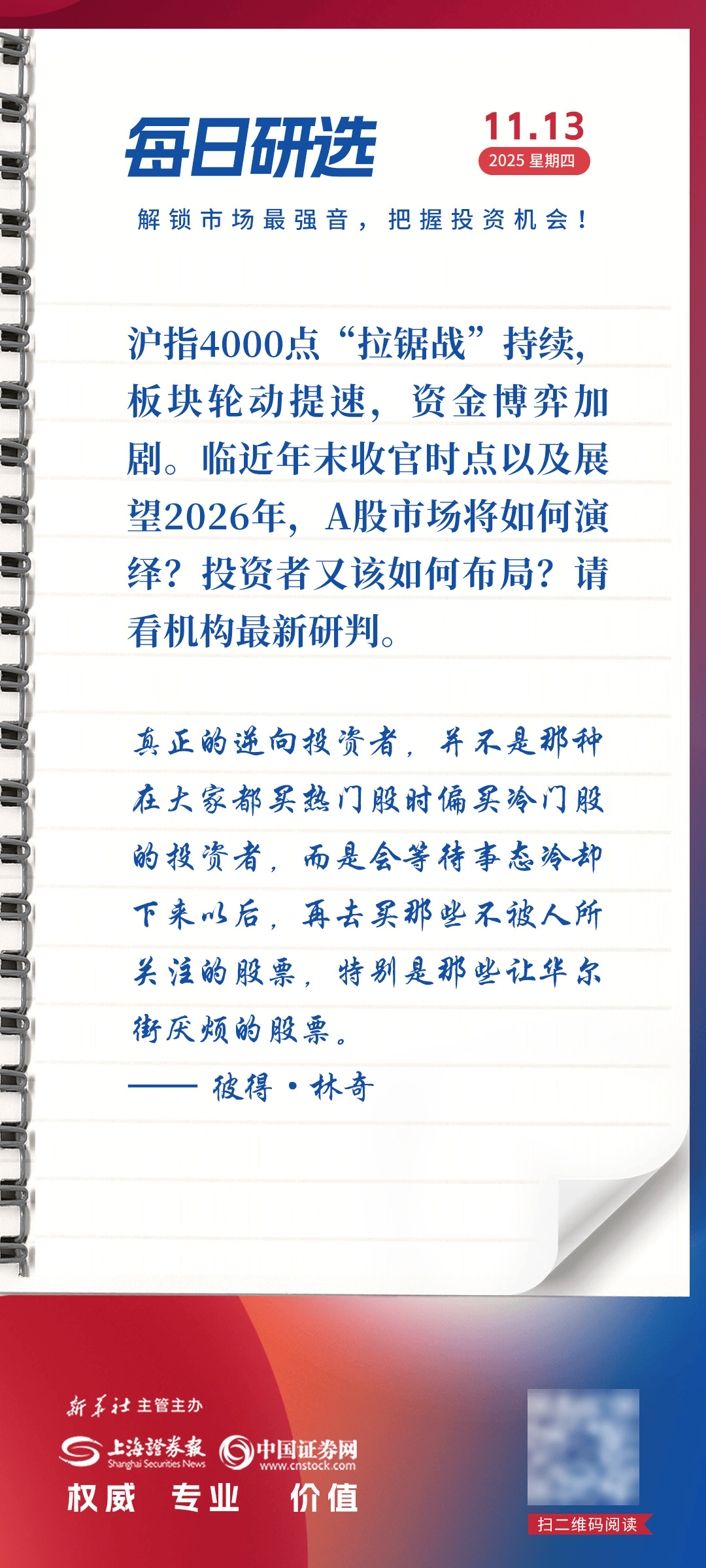
如何应对“电风扇”行情,机构建议这样布局丨每日研选
Shang Hai Zheng Quan Bao· 2025-11-13 01:37
Core Viewpoint - The A-share market is currently experiencing a "tug-of-war" around the 4000-point level, with accelerated sector rotation and intensified capital competition as the year-end approaches and outlook for 2026 is considered [1] Market Overview - The Shanghai Composite Index is in a phase of consolidation, with a lack of strong catalysts leading to a relatively stable market momentum, characterized by oscillation and accumulation [1] - The internal market dynamics show a significant increase in the speed of style and sector rotation, with profit opportunities concentrating in specific sub-sectors [1] - A "wait-and-see" strategy is recommended to avoid risks associated with chasing trends [1] Mid-term Market Outlook - The core support logic for the market is becoming clearer, with similarities drawn to the market conditions of 2020-2021, driven by policy guidance, industrial upgrades, and capital resonance [1] - The market is currently in the early stages of a new policy-driven and industry trend-driven cycle [1] - The fourth quarter is expected to be more stable, with November entering an earnings vacuum period, while the "14th Five-Year Plan" provides new hotspots for the market [1] Strategic Outlook for 2026 - The performance of RMB-denominated equity assets is strategically favored for three reasons: 1. The rise of new economic drivers in China, such as advanced manufacturing and technological innovation, is expected to drive a re-evaluation of China's growth model by overseas capital [1] 2. A marginal easing of Sino-US relations is anticipated to enhance risk appetite [1] 3. Increasing certainty of global liquidity easing is expected to support the RMB and equity markets [1] - Incremental capital sources for the market in 2026 are likely to come from foreign investment and public funds, with a gradual appreciation of the RMB against the USD expected [1] Asset Allocation Strategy - A balanced asset allocation strategy is recommended for the fourth quarter, with an emphasis on defensive and recovery opportunities [2] - High-dividend sectors are highlighted as valuable alternatives to deposits and real estate in a low-interest-rate environment [2] - The mid-term focus remains on technology growth and advanced manufacturing, with an emphasis on domestic production processes and new productive forces [2] - Key sectors for investment include new energy, new materials, aerospace, and strategic emerging industries as outlined in the "14th Five-Year Plan" [2]
11月13日每日研选|如何应对“电风扇”行情,机构建议这样布局
Sou Hu Cai Jing· 2025-11-13 00:34
Core Viewpoint - The A-share market is experiencing a tug-of-war around the 4000-point level, with accelerated sector rotation and intensified capital competition as the year-end approaches and looking ahead to 2026 [3] Market Overview - The Shanghai Composite Index is currently in a phase of consolidation, with a lack of strong catalysts leading to relatively stable market momentum. The market is expected to exhibit a pattern of oscillation and accumulation [3] - Internal market dynamics show a significant increase in the speed of style and sector rotation, with profit opportunities concentrating in specific sub-sectors [3] Short-term Strategy - A "watch and wait" strategy is recommended to avoid the risks of chasing highs and cutting losses, as investors adopt a more cautious approach near year-end [3] Mid-term Outlook - The core support logic for the market is becoming clearer, with similarities to the 2020-2021 market conditions. The current market is in the early stages of a new policy-driven and industry trend-driven cycle [3] - The "14th Five-Year Plan" is expected to provide new hotspots for the market, leading to a stable A-share market towards the end of the year [3] Long-term Perspective (2026) - The outlook for RMB-denominated equity assets is strategically optimistic due to three main reasons: 1. The rise of new economic drivers in China, such as advanced manufacturing and technological innovation, is expected to drive a re-evaluation of China's growth model by overseas funds [3] 2. A marginal easing of Sino-U.S. relations is likely to enhance risk appetite [3] 3. Increasing certainty of global liquidity easing will support the RMB and equity markets [3] - Incremental capital sources for the market in 2026 are likely to come from foreign investment and public funds, with a gradual appreciation of the RMB against the USD anticipated [3] Asset Allocation Strategy - A balanced asset allocation strategy is recommended for the fourth quarter, with an emphasis on defensive and recovery opportunities in the short term [4] - High-dividend sectors are highlighted as important alternatives to deposits and real estate, while sectors such as finance, energy resources, public utilities, consumption, operators, and transportation are noted for their specific focus areas [4] - In the mid-term, the focus remains on technology growth and advanced manufacturing, with an emphasis on domestic production processes and new productive forces [4]
股市哑铃配置,债市震荡持平
Zhong Xin Qi Huo· 2025-11-12 03:50
1. Report Industry Investment Rating - The trend of the stock index futures market is expected to be moderately bullish; the stock index options market is expected to be volatile; the Treasury bond futures market is expected to be volatile in the short - term and moderately bullish in the long - term [7][8][9] 2. Core View of the Report - In the stock index futures market, under the condition of shrinking trading volume, the market risk preference continues to converge. It is recommended to transfer technology funds to the price - rising chain and continue the dumbbell - style asset allocation. In the stock index options market, as the market style rotates and no clear capital main line has been formed, it is recommended to continue to hold covered options to increase returns. In the Treasury bond futures market, the market lacks a clear direction in the short - term and is in a volatile consolidation phase, but is expected to be moderately bullish in the long - term [7][8][9] 3. Summary by Relevant Catalogs 3.1 Market Outlook 3.1.1 Stock Index Futures - On Tuesday, the Shanghai Composite Index opened high and closed low, barely holding above 4000 points, with trading volume shrinking to 2 trillion yuan. The ChiNext and STAR Market indices retreated, and the TMT sectors led the decline. The coal sector also led the decline due to concerns about a potential reduction in pit - mouth coal prices. Low - position sectors such as commerce and retail, real estate, and steel led the gains. The central bank's Q3 2025 monetary policy report may support the fundamentals of bank stocks and increase the expectation of counter - cyclical monetary policy adjustment. It is recommended to transfer technology funds to the price - rising chain and continue the dumbbell - style allocation. The operation suggestion is to hold dividend ETFs and long positions in IM contracts [7] 3.1.2 Stock Index Options - The trading volume of each option variety showed a slight weakening trend, and the option sentiment index was weak. The PCR of technology - sector options decreased significantly on Monday, and the PCR of option positions of all varieties declined on Tuesday, indicating a cold market sentiment. The implied volatility of options showed mixed trends. It is recommended to continue to hold covered options to increase returns [8] 3.1.3 Treasury Bond Futures - On Tuesday, the prices of Treasury bond futures were volatile and unchanged. The yields of most interest - rate bonds declined, and the 5 - year and 7 - year China Development Bank bonds performed well. The central bank significantly increased net investment in the open market, and the supply and demand of funds in the inter - bank market tended to balance, but interest rates remained firm. In the short - term, the bond market lacks a clear direction and is in a volatile consolidation phase, but is expected to be moderately bullish in the long - term. Operation suggestions include maintaining caution in trend strategies, paying attention to short - hedging at low basis levels in hedging strategies, appropriately paying attention to basis widening in basis strategies, and appropriately paying attention to curve steepening in curve strategies [8][9] 3.2 Economic Calendar - The economic data to be released this week include China's new RMB loans, social financing scale, M2 money supply growth rate in October, the US CPI annual rate in October, China's year - on - year growth rate of total retail sales of consumer goods in October, and the year - on - year growth rate of industrial added value above designated size in October [10] 3.3 Important Information and News Tracking - The central bank released the Q3 2025 China Monetary Policy Implementation Report, proposing to deepen financial reform and opening - up, and improve the macro - economic governance effectiveness. The US has suspended the implementation of the export - control penetration rule, and the two sides will continue to discuss the arrangement after one - year suspension. As of now, the National Development and Reform Commission has recommended 105 infrastructure REITs projects to the CSRC, of which 83 have been issued and listed, with a total issuance fund of 207 billion yuan, expected to drive new project investment of over 1 trillion yuan [11][12] 3.4 Derivatives Market Monitoring - The report mentions the need to monitor data in the stock index futures, stock index options, and Treasury bond futures markets, but specific data are not detailed [13][17][29]
“非赛道选手”的易方达蔡荣成:理解科技创新,找到那些真正能够创造时代价值的企业
聪明投资者· 2025-11-12 03:33
Core Insights - The article emphasizes the importance of avoiding arrogance in technology investments, advocating for a deep understanding of technological innovations and their value creation potential [4][3]. - It highlights the investment philosophy of Cai Rongcheng from E Fund, focusing on identifying companies with strong value creation capabilities and significant revaluation potential within major industry trends [4][5]. Investment Philosophy - Cai Rongcheng believes that successful investment in the technology sector requires a return to fundamentals, understanding the true value of technological innovations, and developing sustainable investment strategies [4][5]. - His approach involves identifying high-quality growth companies with scarcity or shortage in supply, high competitive barriers, and excellent management [7]. Performance Metrics - As of November 7, 2025, Cai Rongcheng manages five funds with a total scale of 66.73 billion, achieving a return of 111.07% since taking over the E Fund Technology Innovation fund on April 21, 2022, with an annualized return of 23.54% and a year-to-date return of 74.46% [5][6]. - The performance of his funds significantly outperformed the market, with the CSI 300 index returning 17.94% and the electronics sector returning 47.96% during the same period [5]. Investment Strategy - Cai Rongcheng employs a cyclical thinking framework to understand industry undervaluation and overvaluation, focusing on supply and demand elasticity to identify investment opportunities and mitigate market risks [7]. - He emphasizes the importance of drawdown control and avoids zero-sum games, seeking elastic returns within a framework that minimizes significant losses [7]. Case Studies - The article discusses successful investments in companies like Baoxin Software and Tonghuashun, which benefited from the AI wave, showcasing Cai's ability to identify and capitalize on growth opportunities [13][15]. - Cai's investment in Huadian Co., which saw an 82.06% increase in stock price, exemplifies his strategy of buying at market bottoms and making timely exits to secure profits [15]. Future Outlook - Cai Rongcheng anticipates that 2025 will mark the beginning of a significant AI revolution, with increasing demand for computing power and the rapid adoption of AI technologies across various industries [26][27]. - He identifies three main sources of alpha assets: companies with core competitiveness in overseas markets, assets that provide stable returns, and industry leaders with strong risk resilience [30][31].

The Mold Of Rocket Lab Magic: Neutron
Seeking Alpha· 2025-11-11 02:17
Core Insights - The article emphasizes the importance of momentum in navigating the technology landscape, particularly in the context of past market events such as the dot com bubble, the credit default crisis of 2008, and the recent AI boom [1] Group 1: Market Context - The author has over two decades of experience in the market, focusing on the technology, media, and telecommunications (TMT) sectors [1] - The article highlights the significance of risk mitigation strategies employed during various market cycles [1] Group 2: Investment Focus - The primary focus of the service is on momentum, suggesting that it plays a crucial role in investment decisions within the technology sector [1]


对话安永吕晨:中企国际化进入“扎根”阶段,进博会是双向互动的战略枢纽 | 进博专访
Sou Hu Cai Jing· 2025-11-10 13:16
Core Insights - The eighth China International Import Expo (CIIE) highlighted the shift of Chinese enterprises from "product export" to "model export" in their internationalization efforts [1][4] - The transformation signifies a new phase of deep integration into local economies, moving from "going out" to "rooting in" [4][5] - The main driving forces behind this transition include technology-driven innovation, new business models, and upgrades in the industrial chain [5][6] Group 1: Trends in Chinese Enterprises Going Global - Chinese enterprises are increasingly focusing on greenfield investments rather than mergers and acquisitions, allowing them to build supply chains and enhance market proximity [4][5] - The primary sectors for outbound investment have shifted from traditional manufacturing to high-value industries such as TMT (Technology, Media, and Telecommunications), advanced manufacturing, and life sciences [4][5] - High-tech companies face unique challenges compared to traditional industries, including stringent compliance with data security and privacy regulations, as well as complex intellectual property competition [5][6] Group 2: Supply Chain Resilience and Market Selection - Establishing resilient supply chains (China + N) has become a key driver for enterprises, necessitating a comprehensive evaluation framework that balances efficiency and risk [6][7] - Companies should assess geopolitical stability, labor force, infrastructure, and local regulations to prepare for deep localization [6][7] - ASEAN and Middle Eastern countries are emerging as attractive destinations for Chinese enterprises due to their market potential and supportive policies [7][8] Group 3: Role of CIIE in Facilitating Global Expansion - The CIIE has evolved into a strategic hub for both "bringing in" and "going out," facilitating cross-border financial services and global resource connections [8][9] - The expo enables enterprises to showcase innovative technologies and expand international partnerships, thereby linking them to global industry networks [8][9] - Successful internationalization requires companies to assess market compatibility, understand local laws, and establish a global compliance management system [9]

年末怎么投?未来重要事件前瞻!
摩尔投研精选· 2025-11-10 10:41
Market Overview - The A-share market shows a divergence with the main board strengthening while the ChiNext board remains under pressure, with the Shanghai Composite Index successfully reclaiming the 4000-point mark [2] - Market sentiment is fluctuating, with over 3300 stocks closing in the green, and the total trading volume in the Shanghai and Shenzhen markets reaching 2.17 trillion, an increase of 175.4 billion from the previous trading day [3] Economic Indicators - The strong performance of consumer sectors such as food and beverage, liquor, and tourism is attributed to the rebound in October's CPI and core CPI data, signaling a recovery in domestic demand and boosting confidence in economic stabilization [3][4] - The Ministry of Finance has reiterated its commitment to continue implementing special actions to boost consumption, providing policy support to these sectors [4] Policy Outlook - The release of the "14th Five-Year Plan" marks the beginning of a new five-year economic and industrial development framework, which will serve as a foundation for future policies and provide a starting point for the policy tone leading up to 2026 [5][7] - Key areas of focus include industrial structure upgrades, technological self-reliance, and boosting domestic consumption [8][10] Sector Focus - For industrial structure upgrades, attention should be directed towards sectors such as mining, chemicals, machinery, and shipbuilding [11] - In terms of technological self-reliance, sectors like new energy, new materials, low-altitude economy, artificial intelligence, integrated circuits, and industrial mother machines are highlighted [11] - The domestic consumption boost should focus on retail, social services, food and beverage, and certain new consumption areas [11] Market Trends - The TMT (Technology, Media, and Telecommunications) and advanced manufacturing sectors are expected to remain the main themes of the bull market [12] - Historical trends indicate that the current market may be in the second phase of a multi-stage rally, with significant potential for growth [14] Investment Opportunities - In the TMT sector, key areas of interest include AI and storage, with AI driving technological innovation and industry transformation, while storage is expected to benefit from sustained demand due to AI [15][16] - In advanced manufacturing, focus areas include humanoid robots, liquid cooling, solid-state batteries, and PCB, with significant developments anticipated in 2026 [17][18] Future Market Dynamics - The market is expected to enter a phase of intense policy expectation, with domestic policies centered around the "14th Five-Year Plan" and the upcoming Central Economic Work Conference, while international policies will be influenced by U.S.-China relations and potential policy shifts from the U.S. midterm elections [21] - Key upcoming events include annual performance forecasts and quarterly reports, which will further validate industry conditions [22]