
半导体

Search documents
三星,推迟1.4nm
半导体芯闻· 2026-03-26 10:51
Core Viewpoint - Samsung Electronics is set to complete the design of its next-generation mobile application processor (AP) "Exynos 2800" by the end of this year, utilizing a 2nm process technology to ensure stability in development and yield [1][2]. Group 1: Exynos 2800 Development - The Exynos 2800, codenamed "Vanguard," is being developed with a target for tape-out by the end of this year, which marks the completion of the chip design and the handover for manufacturing [1]. - The design of Exynos 2800 will follow the naming convention based on existing mountain names, continuing from previous models like Exynos 2500 to 2700 [1]. Group 2: Process Technology - Exynos 2800 will utilize Samsung's most advanced 2nm process technology, specifically an improved version of the second-generation 2nm process (SF2P+) [2]. - The SF2P process offers a 12% performance increase, a 25% reduction in power consumption, and an 8% decrease in area compared to the first-generation 2nm process (SF2) [2]. - The decision to focus on the SF2P+ process instead of aggressively pursuing the 1.4nm process (SF1.4), which has been delayed by about two years, reflects a strategic shift towards optimizing yield stability [2]. Group 3: Industry Insights - Industry insiders indicate that it is no longer realistic for Samsung to continue annual advancements in process technology for mobile APs, leading to a focus on Design Technology Co-Optimization (DTCO) as a viable alternative [3].

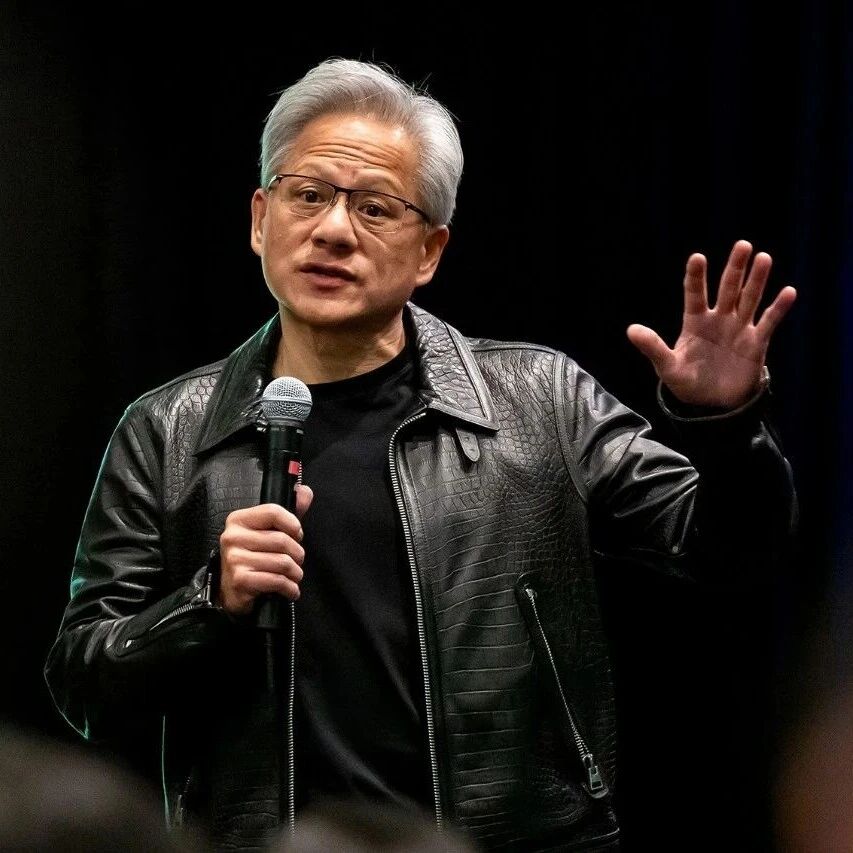
黄仁勋的“死亡观”:一个 AI 帝国掌控者的终极焦虑与权力边界
美股研究社· 2026-03-26 10:36
Core Viewpoint - The article discusses the evolving perception of leadership and risk in companies like NVIDIA, particularly focusing on the founder's role and the implications of their personal circumstances on corporate stability and valuation [1][13]. Group 1: Founder’s Perspective and Company Dynamics - The founder's time perspective has shifted from quarterly reports to existential concerns, indicating that the company has become a central nervous system of an era [2][3]. - Jensen Huang's remarks about death and work reflect a deep-seated anxiety about control and sustainability within a rapidly evolving AI landscape [4][5]. - NVIDIA's dominance in AI infrastructure, with over 70% of global AI training computing power relying on its architecture, positions it not just as a competitor but as a rule-definer in the industry [5][6]. Group 2: Risks and Market Implications - The core risk for NVIDIA has transitioned from technological competition to the irreplaceability of its founder, raising concerns about the company's future without Huang's leadership [6][8]. - Huang's rejection of a succession plan signals a significant disconnect with traditional corporate governance, emphasizing knowledge transfer over formal succession [7][8]. - The market's willingness to assign high valuations to NVIDIA is now challenged by the realization that its success is heavily tied to Huang's personal capabilities and health, introducing a "key person risk" into financial models [8][11]. Group 3: Broader Context and Structural Tensions - Huang's identity as a Chinese entrepreneur in a U.S. capital framework creates structural tensions, necessitating a balance between proving NVIDIA's indispensability and managing external uncertainties [10][11]. - The geopolitical landscape and increasing regulatory scrutiny on tech companies add layers of complexity to Huang's leadership and the company's stability [10][11]. - Huang's desire to "die at work" is interpreted as a rational response to the uncontrollable future, highlighting the emotional and strategic weight of his position [11][12]. Group 4: Investment Considerations - The article suggests that NVIDIA is transitioning from a technology-driven company to one defined by its power structure, with Huang becoming the most critical variable [13]. - Investors are urged to incorporate founder risk into valuation models, recognizing that the health and intentions of the founder are now essential factors in assessing the company's future [13].

伊朗局势,引爆!市场集体跳水,发生了什么?
券商中国· 2026-03-26 10:15
Core Viewpoint - The ongoing tensions in the Middle East, particularly between the U.S. and Iran, have led to significant volatility in financial markets, with analysts warning of a potential "war while negotiating" phase that could further impact economic stability [1][4]. Market Reactions - As of March 26, U.S. stock index futures showed declines, with the Nasdaq futures down by 0.97%, Dow futures down by 0.76%, and S&P 500 futures down by 0.80% [3]. - European markets also experienced collective downturns, with Germany's DAX30 index falling by 1.60%, the Euro Stoxx 50 index down by 1.51%, the UK's FTSE 100 down by 1.13%, and France's CAC40 down by 1.07% [3]. - Precious metals saw significant drops, with spot gold decreasing by nearly 2% and spot silver falling over 4% [4]. Geopolitical Developments - Reports indicate that Iranian military actions have escalated, with the Iranian Revolutionary Guard Corps claiming to have conducted drone strikes on various military bases in the region, including targets in Kuwait and Saudi Arabia [5][6]. - The Iranian military has stated that it has targeted critical infrastructure, including radar systems and military command centers, as part of its ongoing operations [7]. - Since the beginning of U.S. and Israeli military actions against Iran, the Iranian forces claim to have hit or downed 202 various military aircraft, including advanced models like the F-35 and MQ-9 drones [7].

芯动联科(688582):2025年业绩符合预期,多产品及领域持续拓展
Shenwan Hongyuan Securities· 2026-03-26 09:45
Investment Rating - The report maintains a "Buy" rating for the company, indicating expected performance to exceed the market by over 20% within the next six months [6][13]. Core Insights - The company reported a revenue of 520 million yuan for 2025, reflecting a year-over-year growth of 29.48%, and a net profit of 300 million yuan, up 36.56% year-over-year [3][6]. - The revenue for Q4 2025 was 120 million yuan, showing a decline of 7.77% year-over-year, with a net profit of 70 million yuan, down 23.11% year-over-year [3][6]. - The company is experiencing strong demand, particularly in its MEMS gyroscope and accelerometer product lines, with the latter showing a significant growth of 167.31% year-over-year [6]. - The report highlights a reduction in operating expenses, leading to improved profitability, with a net profit margin increase to 57.93% [6]. Financial Data and Profit Forecast - The company is projected to achieve total revenue of 719 million yuan in 2026, with a year-over-year growth rate of 37.2% [5][8]. - The net profit for 2026 is estimated at 428 million yuan, reflecting a growth rate of 41.2% [5][8]. - The earnings per share (EPS) is expected to reach 1.07 yuan in 2026, with a projected price-to-earnings (PE) ratio of 55 [5][8]. - The gross margin is forecasted to be 85.4% in 2026, slightly decreasing from 85.8% in 2025 [5][8].
泡泡玛特,拿到英伟达的剧本
3 6 Ke· 2026-03-26 09:32
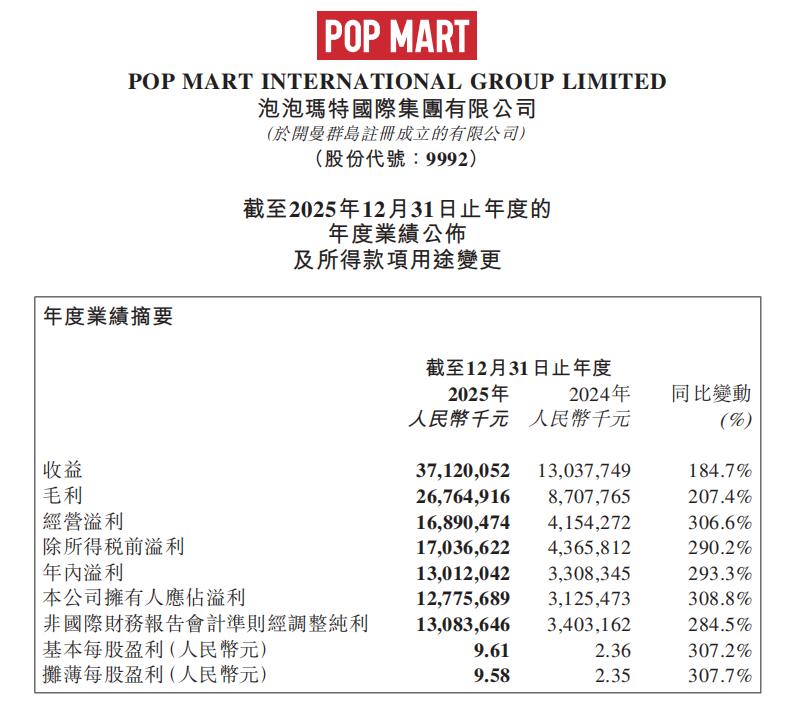
Core Viewpoint - Both Nvidia and Pop Mart experienced outstanding performance in 2025, yet their stock prices faced significant volatility, highlighting a disconnect between market expectations and actual results [1][2]. Group 1: Financial Performance - In 2025, Pop Mart achieved a revenue of 37.12 billion RMB, a year-on-year increase of 184.7% compared to 2024 [3][5]. - The net profit for Pop Mart reached 13.01 billion RMB, reflecting a 293.3% year-on-year growth [3][5]. - The adjusted net profit was 13.08 billion RMB, with a 284.5% increase year-on-year, and an adjusted net profit margin of 35.2% [3][5]. Group 2: Market Reaction and Expectations - Despite strong financial results, Pop Mart's stock price dropped by 22.51% on the day of its earnings announcement, indicating that market expectations had already factored in high performance [2][3]. - Investors are increasingly concerned about the company's reliance on a few key IPs, leading to a reassessment of valuation and growth expectations [7][10]. Group 3: Business Model and Growth Potential - Pop Mart's core competency lies in its platform operation capabilities, which allow it to continuously attract high-quality resources and maintain growth without solely depending on any single IP [16][19]. - The company has expanded its international presence, with nearly 50% of its revenue coming from overseas markets, indicating potential for sustained high growth [22][26]. - Pop Mart aims for a growth rate of no less than 20% in the coming year, reflecting a strategic shift towards healthier growth amidst high expectations [26].

港股AI应用、半导体股大跌,智谱重挫10%,中芯国际跌近6%,泡泡玛特两日跌超30%
21世纪经济报道· 2026-03-26 08:55
Market Overview - The Hong Kong stock market experienced a decline, with the Hang Seng Index falling by 1.89% to 24,856.43 points and the Hang Seng Tech Index dropping by 3.28% to 4,761.54 points [1][2]. Company Performance - Kuaishou's stock plummeted by over 14% after the release of its Q4 2025 financial report, which showed a total revenue increase of 12.5% year-on-year to RMB 142.8 billion and an adjusted net profit of RMB 20.6 billion, up 16.5% year-on-year, with a net profit margin of 14.5% [2]. - Pop Mart continued its downward trend, with a stock price drop exceeding 10%, following a previous decline of over 22%, resulting in a total two-day drop of over 30%. The company's 2025 revenue reached RMB 37.12 billion, a year-on-year increase of 184.7%, and an adjusted net profit of RMB 13.08 billion, up 284.5% [3]. Sector Performance - The technology sector saw significant declines, with major companies like Kuaishou, Alibaba, and JD Health all experiencing stock price drops of over 4% [2]. - In contrast, the oil and gas sector showed resilience, with companies like Baqian Oil Services rising over 8% and China Gas up over 5% [3].

美国成立AI梦之队!
国芯网· 2026-03-26 08:48
Core Viewpoint - The establishment of the President's Council of Advisors on Science and Technology (PCAST) aims to provide strategic guidance on artificial intelligence (AI) policies and emerging technologies to the White House, amidst ongoing debates regarding AI governance and its implications for the labor market [2][4]. Group 1: PCAST Formation and Members - The PCAST is co-chaired by David Sachs and Michael Kratsios, featuring prominent figures from the tech industry, including CEOs from Meta, Oracle, NVIDIA, Google, Dell, and AMD [4]. - The initial member count is 13, with a planned maximum of 24 members, indicating potential future additions to the council [4][5]. Group 2: Focus Areas and Challenges - PCAST's primary focus is to assess the opportunities and challenges posed by AI and other emerging technologies for the U.S. labor market, ensuring that citizens benefit during the "innovation golden age" [4]. - Current challenges in AI governance include regulatory issues, data center construction, energy consumption, and the allocation of national computing resources [4]. Group 3: Industry Implications - The inclusion of only NVIDIA and AMD executives in the PCAST highlights the significant role of these companies in the semiconductor sector, while Intel and other notable figures like Elon Musk and Sam Altman were not included [5]. - The decisions made by this elite group of tech leaders are expected to significantly influence the direction of U.S. AI strategy, drawing global attention from the tech industry [5].


泡泡玛特、快手、中芯国际、华虹半导体,集体大跌
第一财经· 2026-03-26 08:38
Market Overview - The Hang Seng Index closed at 24,856.43, down 479.52 points or 1.89% [1] - The Hang Seng Tech Index fell to 4,761.54, decreasing by 161.40 points or 3.28% [1] - The Hang Seng Biotech Index dropped to 13,819.14, down 257.41 points or 1.83% [1] - The Hang Seng China Enterprises Index ended at 8,389.93, down 192.81 points or 2.25% [1] - The Hang Seng Composite Index closed at 3,745.27, decreasing by 79.39 points or 2.08% [1] Precious Metals Sector - The precious metals sector experienced a widespread decline, with Zijin Mining International and China Silver Group both dropping over 7% [2] - Shandong Gold fell more than 6%, while Zhu Feng Gold and Datang Gold decreased over 5% [2] - Notable declines included: - Zijin Mining International: -7.57% to 168.500 [3] - China Silver Group: -7.29% to 0.445 [3] - Shandong Gold: -6.55% to 30.240 [3] - Zhu Feng Gold: -5.60% to 1.180 [3] - Datang Gold: -5.56% to 0.510 [3] Technology Sector - The tech sector saw collective declines, with Kuaishou dropping over 14% [4] - Other significant declines included: - Huahong Semiconductor: -6.20% to 83.150 [5] - SMIC: -5.93% to 53.150 [5] - Alibaba: -4.58% to 123.000 [5] - Meituan: -3.67% to 86.700 [5]

A股芯片股走势分化:海光信息、闻泰科技等上涨,存储板块承压
第一财经· 2026-03-26 07:44
Core Viewpoint - The article discusses the recent performance of semiconductor stocks in the A-share market, highlighting the impact of AI demand on the semiconductor industry and the differentiation in the storage chip sector [3][5][6]. Group 1: Semiconductor Stock Performance - Multiple semiconductor stocks in the A-share market saw gains, with Jin Hai Tong (603061.SH) rising over 4%, and other companies like SiDa Semiconductor (603290.SH) and HaiGuang Information (688041.SH) also experiencing increases [3]. - The Philadelphia Semiconductor Index in the U.S. rose by 1.21%, with Arm's stock surging by 16.38% after announcing its first self-developed AGI CPU, projected to generate $15 billion in revenue per product by 2031 [4]. Group 2: AI Demand and Market Dynamics - Intel and AMD have informed customers of upcoming price increases for CPUs in March and April, indicating a growing demand for AI computing power and an expanding market space [5]. - Google introduced a new AI memory compression technology, TurboQuant, which can reduce memory usage for large language models by at least six times without sacrificing accuracy, raising concerns about future storage demand [5]. Group 3: Storage Chip Sector Analysis - The growth in the storage chip sector is entering a phase of differentiation, with AI demand expected to provide long-term market growth momentum [6][7]. - TrendForce data indicates that the global supply-demand imbalance for memory will continue into 2026, with major DRAM manufacturers expected to increase production by approximately 26% and NAND production by about 24% [7]. - Despite the anticipated production increases, the actual expansion of supply from domestic manufacturers may take time, leading to a potential shift from broad sector growth to structural differentiation, particularly favoring high-end markets like HBM [7].



(2026-03-25):麦高视野--ETF观察日志
Mai Gao Zheng Quan· 2026-03-26 07:38
- The report introduces the **RSI (Relative Strength Index)** as a factor, which is calculated using the formula: $ RSI = 100 - \frac{100}{1 + RS} $ where RS represents the ratio of the average gain to the average loss over a 12-day period. RSI values above 70 indicate an overbought market, while values below 30 indicate an oversold market[2] - The report also calculates **Net Purchase (NETBUY)** as a factor, using the formula: $ NETBUY(T) = NAV(T) - NAV(T-1) \times (1 + R(T)) $ where NETBUY(T) is the net purchase amount, NAV(T-1) is the ETF's net asset value from the previous trading day, and R(T) is the return on the current day[2] - The report tracks **ETF performance metrics** such as daily price changes, RSI values, net purchases, and trading volumes for various ETFs, categorized into "broad-based" and "thematic" indices. Examples include ETFs tracking indices like CSI 300, CSI 500, and sector-specific indices such as non-bank financials and dividends[2][4] - The report provides detailed **RSI values** for various ETFs, such as: - CSI 300 ETFs: RSI values range from 40.03 to 41.72 - CSI 500 ETFs: RSI values range from 38.32 to 40.20 - CSI 1000 ETFs: RSI values range from 39.63 to 40.21 - Thematic ETFs (e.g., Semiconductor, Renewable Energy): RSI values range from 30.34 to 52.96[4][6] - The report evaluates **net purchase amounts** for ETFs, with examples including: - CSI 300 ETFs: Net purchases range from -20.87 billion to 1.15 billion - CSI 500 ETFs: Net purchases range from -4.85 billion to 1.01 billion - CSI 1000 ETFs: Net purchases range from -12.83 billion to 0.02 billion - Thematic ETFs: Net purchases range from -16.49 billion to 62.07 billion[4][6] - The report highlights **trading volumes** for ETFs, with examples including: - CSI 300 ETFs: Trading volumes range from 0.29 billion to 39.32 billion - CSI 500 ETFs: Trading volumes range from 1.03 billion to 45.84 billion - CSI 1000 ETFs: Trading volumes range from 0.35 billion to 35.07 billion - Thematic ETFs: Trading volumes range from 0.04 billion to 75.07 billion[4][6] - The report provides **qualitative evaluations** of the RSI and NETBUY factors, noting their utility in identifying overbought/oversold conditions and tracking fund flows, respectively[2]