军工

Search documents
军工ETF(512660)盘中涨超1%,关注军工板块行情
Mei Ri Jing Ji Xin Wen· 2026-02-04 07:08
Group 1 - The core viewpoint of the article highlights the positive outlook for the military industry, driven by the "14th Five-Year Plan" and the centenary goal of military development in China [1] - The military equipment construction efforts in China are expected to strengthen further, with a clear upward trend in military trade over the next 5 to 10 years [1] - Specific areas of focus include the "two aircraft" industry chain, where demand for military aviation engines remains robust, and the supply chain replenishment trend has begun [1] Group 2 - The commercial aerospace sector is experiencing accelerated industrial progress, presenting investment opportunities in satellites, rockets, and ground terminal segments due to the acceleration of industrialization [1] - The military ETF (512660) tracks the CSI Military Industry Index (399967), which selects listed companies related to the military industry from the Chinese A-share market, covering sectors such as aerospace, weaponry, and electronics [1]
杨德龙:近期国际金价大幅波动的原因与启示
Xin Lang Cai Jing· 2026-02-04 01:51
Core Viewpoint - Recent fluctuations in international gold prices have raised concerns among investors, with gold reaching $5600 per ounce before a significant drop, particularly in silver, which saw a 30% decline in a single day [1][2][6] Group 1: Market Dynamics - The recent drop in gold prices is attributed to a hawkish stance from the new Federal Reserve Chairman, leading to fears of tightening liquidity and balance sheet reduction [1][2] - The rapid increase in gold prices, exceeding $1000 in just a couple of weeks, was unsustainable, indicating that such sharp rises often precede significant corrections [1][2][6] - The current rebound in gold prices, now above $4800 per ounce, suggests that many investors are taking advantage of the dip, presenting a re-entry opportunity for those who missed earlier gains [2][7] Group 2: Investment Strategy - Investors are advised to view gold and silver as part of a long-term asset allocation strategy rather than short-term trading opportunities, with a recommendation to allocate about 20% of their portfolio to gold-related assets [2][7] - The volatility in gold and silver prices serves as a reminder that no asset is immune to fluctuations, emphasizing the importance of a rational investment approach [2][7] Group 3: Long-term Outlook - Looking ahead to 2026, gold and silver are expected to remain attractive assets, although the likelihood of a one-sided price surge like in 2025 is low, with increased volatility anticipated [3][8] - Factors such as rising U.S. national debt, which has surpassed $38 trillion, and concerns over fiscal sustainability are likely to support the long-term upward trend in gold prices [3][9] - The ongoing trend of "de-dollarization" is expected to gradually reduce the dollar's dominance in global payments and reserves, enhancing the appeal of gold and other hard currencies [4][9] Group 4: Economic Context - Domestic investors are facing a pivotal moment in asset allocation, with a significant amount of fixed-term deposits maturing and interest rates declining, prompting a search for new investment avenues [10] - The A-share market is showing signs of a slow bull market, with historical patterns suggesting potential for a spring rally, which could lead to increased investment in equities [10][11] - The focus for 2025 will be on technology stocks, while 2026 is expected to highlight innovations in various sectors, indicating a potential shift in capital market dynamics [10][11]
红相股份三年亏8亿历史问题待解 1.2亿出售减值收款权回笼资金减压
Chang Jiang Shang Bao· 2026-02-03 23:57
Core Viewpoint - Hongxiang Co., Ltd. is attempting to alleviate its operational pressures and historical burdens through asset disposals, specifically by selling a receivable related to a photovoltaic project for 120 million yuan, despite the asset having a book value of approximately 205 million yuan and accumulated impairment provisions exceeding 100 million yuan [1][2]. Group 1: Asset Disposal and Financial Performance - The company plans to sell a receivable with a book value of 205 million yuan, which has already incurred over 100 million yuan in impairment provisions, to recover funds and optimize its asset structure [1][3]. - The sale is linked to a previous asset divestiture from two years ago, where the company sold its subsidiary, Yilong Electric, to improve its business and financial structure [2][5]. - The company has reported continuous losses for three consecutive years, with cumulative losses exceeding 800 million yuan, highlighting the urgency of optimizing assets and recovering funds [7]. Group 2: Revenue and Profit Forecast - For 2025, the company expects to achieve revenue between 700 million and 750 million yuan, representing a year-on-year growth of 10.25% to 18.13%, driven by market expansion efforts [6][7]. - Despite the anticipated revenue growth, the company forecasts a net loss attributable to shareholders between 13 million and 26 million yuan, and a net loss after excluding non-recurring items between 49 million and 62 million yuan [6][7]. - The company has experienced significant revenue declines in 2023 and 2024, with revenues of 1.154 billion yuan and 635 million yuan, reflecting year-on-year decreases of 28.74% and 44.97% respectively [6].

高市赌赢了?日本汇率大跌,引火中国反制,却意外捅了美元一刀
Sou Hu Cai Jing· 2026-02-03 15:44
Core Viewpoint - The article discusses the negative impact of Japanese Prime Minister Kishi Sanae's policies, particularly the accelerated depreciation of the yen, which has led to a significant decline in the purchasing power of ordinary citizens while benefiting large export companies [1][3][6]. Economic Impact - The depreciation of the yen has resulted in a 40% increase in the price of eggs and rising costs for staple foods, creating a stark contrast between the stock market's performance and the struggles of everyday citizens [3][5]. - Japan's actual wages have been shrinking for 28 consecutive months, indicating a continuous erosion of purchasing power for the workforce [6][8]. Government Policies - Kishi's administration has implemented aggressive fiscal stimulus measures amounting to 21.3 trillion yen, aiming to inject funds into semiconductor and military industries, reminiscent of the "Abenomics" approach [8][10]. - The government has attempted to frame domestic issues as part of a broader "China threat," diverting attention from internal economic challenges [10][12]. International Relations - Japan's reliance on currency depreciation has inadvertently weakened its economic position, making it vulnerable to external pressures, particularly from China, which has imposed trade restrictions that have cost Japan nearly $40 billion [10][12]. - The article highlights the potential consequences of Japan's economic strategies on its relationship with the United States and the global monetary system, suggesting a shift in the traditional currency dynamics [15][17]. Market Reactions - The depreciation of the yen has attracted foreign capital, with American firms capitalizing on Japan's weakened economic state to acquire valuable assets, exemplified by Bain Capital's acquisition of Hitachi Metals [12][18]. - The article warns that the disconnect between macroeconomic data and individual experiences could lead to a significant economic downturn, as the benefits of government policies do not reach the average citizen [18][20].


A股流动性与风格跟踪月报(202602):成长占优,大小盘表现差异收敛-20260203
CMS· 2026-02-03 14:32
Market Style Outlook - The report continues to recommend a growth style as the market is still in the spring rally phase, with the performance gap between large and small caps expected to narrow, favoring large caps first and then small caps. Recommended indices include CSI 1000, ChiNext 50, CSI 300 Quality, and CSI 800 Information [1][4][11] - Historical data from 2016 to 2025 indicates that small-cap and growth styles have a higher winning probability in February, particularly due to the upcoming Two Sessions, which historically boosts small-cap performance due to increased market risk appetite [4][11][12] Liquidity and Capital Supply-Demand - In February, incremental capital is expected to continue net inflow, with foreign capital likely to remain net inflow before the holiday and financing expected to return post-holiday. The macro liquidity environment is anticipated to remain stable and ample [2][4][26] - The stock market saw a net outflow of tracked funds in January, with financing becoming the main source of incremental capital, while ETF experienced significant net redemptions. However, new equity fund issuance has rebounded, indicating a potential recovery in risk appetite for financing funds [2][4][26] Market Sentiment and Capital Preference - In January, the overall A-share risk premium initially decreased and then increased, with technology style being relatively dominant. Small-cap growth and Sci-Tech 50 indices saw significant trading activity, while large-cap growth style remained less concentrated [3][4][11] - The report highlights that the market's risk appetite is expected to remain high leading up to the Two Sessions, which typically favors small-cap stocks due to their greater elasticity [4][11][15] Fundamental Analysis - The manufacturing PMI for January recorded at 49.3, indicating a return to contraction territory, with both production and demand showing signs of cooling. The report emphasizes the ongoing structural contradiction of insufficient domestic demand, which will continue to be a focus for policy efforts [16][17][18] - The report notes that while the price index has strengthened, the demand side has weakened more significantly, suggesting a need for policies aimed at expanding domestic demand [16][17][18] External Liquidity - The report discusses the potential impact of the newly nominated Federal Reserve Chairman's policies, which may lead to a stronger dollar in the short term, putting pressure on A-share cyclical styles. However, sectors like technology and AI, which are driven by industrial trends, are expected to be less affected [20][23][24] Capital Market Dynamics - The report indicates that foreign capital tends to significantly increase holdings before the holiday, with a tendency to slow or reverse net inflows post-holiday. This pattern is attributed to new capital allocation and rebalancing strategies by foreign investors at the beginning of the year [26][27]
A股迅速修复!周期股猛烈反击,有色ETF(159876)回血6.4%,化工ETF摸高4.3%! SpaceX大动作引爆航天军工
Xin Lang Ji Jin· 2026-02-03 12:43
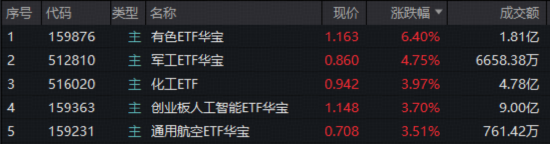
Market Overview - A-shares experienced a rapid recovery on February 3, with over 4,800 stocks rising and the three major indices rebounding collectively. The Shanghai Composite Index rose by 1.29% to 4,067.74 points, while the ChiNext Index increased by 1.86%. The total market turnover was 2.57 trillion yuan, compared to 2.61 trillion yuan the previous day [1]. Sector Performance - The precious metals market saw a strong rebound, with the Color ETF (159876) recovering 6.4% and the Chemical ETF (516020) rising by 3.97%. Spot gold regained its previous day's losses, surpassing $4,900 per ounce, with multiple foreign institutions asserting that the logic behind the gold bull market remains intact [2][5]. - The military and aerospace sectors surged following the announcement of SpaceX's merger with xAI, with the Military ETF (512810) increasing by 4.75% and the General Aviation ETF (159231) rising by 3.51%. Both ETFs have over 65% exposure to commercial aerospace [3][11]. Chemical Sector Insights - The chemical sector experienced a broad-based rally, with the Chemical ETF (516020) reaching a peak increase of 4.3% during the day. Key stocks in the sector, such as Hongda Co. and Cangge Mining, saw significant gains, with some stocks rising over 9% [9]. - Analysts suggest that the recent price increases in the chemical sector are driven by a combination of supply-demand mismatches, macroeconomic easing, and industrial upgrades. The sector is expected to maintain high profitability for the next 3-5 years [7][9]. Military Sector Developments - The military sector saw a significant influx of capital, with net purchases exceeding 171 billion yuan in defense and military stocks, ranking second among 31 primary industries. The Military ETF (512810) ended a four-day decline with a strong performance, with all 80 constituent stocks rising [11][12]. - The merger of SpaceX and xAI is anticipated to enhance the valuation of domestic military enterprises involved in satellite communication and related technologies, as the market expects accelerated advancements in these areas [14]. Gold Market Analysis - Analysts from Deutsche Bank and UBS maintain a bullish outlook on gold, with predictions of prices reaching $6,000 and $4,500 as a strong support level, respectively. The demand from Chinese buyers is noted to be significantly high, potentially tripling from the previous year [6][7]. Investment Recommendations - Companies and analysts recommend maintaining a balanced exposure to the color metal sector, suggesting a portfolio allocation of 10-20% to capitalize on potential gains while mitigating risks [7]. - The chemical sector is also highlighted as a promising investment opportunity, with a focus on leading companies and those benefiting from price increases due to recent policy changes [9].
特朗普急了,发文称“从未见过这样的情况”,他想从中国大赚一笔
Sou Hu Cai Jing· 2026-02-03 09:11
Group 1 - The article discusses Trump's claims about the economic situation with China, suggesting he is trying to portray a narrative of victory while facing significant domestic fiscal issues [1][3][5] - Trump's assertion that China's share of U.S. imports is at its lowest since 2001 is countered by the prediction of a $1.2 trillion trade surplus for China in 2025, while the U.S. is expected to face a similar trade deficit [3][5] - The article highlights that the decline in Chinese exports does not indicate a defeat for China but rather a restructuring of global supply chains, with orders shifting towards Southeast Asia, Africa, and Latin America [7][9] Group 2 - Trump's urgency to communicate may be linked to ongoing Supreme Court deliberations regarding the constitutionality of tariffs, which could result in the U.S. needing to retract approximately $300 billion in tariffs [5][11] - The impact of tariffs on U.S. small businesses is noted, with import costs rising by 30%, leading to inflation rates around 5.3% [5][11] - The article mentions the U.S. Treasury's report claiming the yuan is undervalued by 15%, aiming to pressure China into allowing more currency fluctuation, while China's reliance on the dollar is decreasing [11][13] Group 3 - The article discusses Trump's potential nomination of former Fed governor Walsh, who advocates for coordinated interest rate cuts to alleviate U.S. debt pressure, amidst concerns about a return to fiscal and monetary collusion [9][13] - The geopolitical implications of U.S. actions in Panama and Venezuela are examined, indicating a strategy to disrupt Chinese influence in Latin America and control critical resources [15][17] - The narrative suggests that China's response to U.S. pressure is more strategic and subtle, focusing on building its own influence rather than direct confrontation [20][22]
中加基金固收周报|银行配置行情推动债市震荡走强
Xin Lang Cai Jing· 2026-02-03 07:41
Market Overview and Analysis - The issuance scale of government bonds, local bonds, and policy financial bonds in the primary market last week was 0 billion, 439.3 billion, and 185 billion respectively, with net financing amounts of -113.3 billion, 310.9 billion, and 183 billion [1] - Financial bonds (excluding policy financial bonds) had a total issuance scale of 71.8 billion, with a net financing amount of 52.6 billion. Non-financial credit bonds had a total issuance scale of 294.5 billion, with a net financing amount of 149.8 billion [1] Secondary Market Review - The sentiment in the bond market continues to recover, with the yield on 10-year government bonds approaching 1.8%. Key influencing factors include institutional behavior, real estate policies, and stock market volatility [2] - The liquidity situation is tightening due to accelerated local bond issuance and month-end disturbances, with R001 and R007 rising by 4.3 basis points and 10.4 basis points respectively compared to the previous week [2][8] Policy and Fundamentals - The manufacturing PMI for January recorded 49.3, indicating a further decline in economic sentiment. High-frequency data shows stable performance on the production side at the beginning of the year, slight improvement in real estate demand, and price differentiation in food and a pullback in the prices of non-ferrous metals [3][9] Overseas Market - President Trump announced the nomination of hawkish member Kevin Walsh for the next Federal Reserve Chair. The yield on 10-year U.S. Treasury bonds closed at 4.26%, up 2 basis points from the previous week [4][10] Equity Market - Last week, A-shares experienced a pullback after reaching a peak, with the total A-share index down by 1.59%. There was sector divergence, with military, automotive, and computer sectors leading the decline, while the non-ferrous sector fell sharply after extreme trading conditions. The average daily trading volume increased to 3.06 trillion, up by 264.3 billion from the previous week. As of January 29, 2026, the total financing balance for all A-shares was 27,221.87 billion, an increase of 14.679 billion from January 22 [5][11] Bond Market Strategy Outlook - In February, the short-term downward space for bond market yields may be limited as the 10-year government bond approaches the lower range of 1.8-1.9%. There is expected to be an increase in profit-taking demand. The supply-demand dynamics in the bond market are anticipated to change, with local bond issuance accelerating again. Seasonal tightening pressure on liquidity before the Spring Festival remains a concern. Overall, the bond market's supply-demand performance at the beginning of 2026 is better than previously expected, with insufficient social credit demand and a slowdown in government bond supply growth. The banking sector's stabilization supports high demand for bond allocation, particularly in the long end, which is under less pressure than previously judged at the end of last year. The bond market is expected to show high certainty in the short and medium term, with long-end fluctuations. Potential directional changes should focus on external inflation transmission and real estate stabilization. There are slightly positive signals in real estate in January, but sustainability remains to be observed in the spring. The PPI for non-ferrous and energy prices shows a trend of rapid recovery [6][12]
2026年A股年度策略报告:AI兴,再通胀,驭慢牛
AVIC Securities· 2026-02-03 05:50
Global Economic Trends - The global economy is experiencing two major trends: de-globalization and the AI technology revolution, expected to last at least 5-10 years[34] - The US dollar may have entered a long-term depreciation cycle, with global commodities likely entering a new "super cycle," leading to sustained price increases for gold, copper, and certain minor metals[34] A-Share Market Outlook - The A-share market is anticipated to enter a long-term slow bull trend, driven by the AI technology revolution and re-inflation, contingent on stable US-China relations[34] - The overall market is expected to show an upward trend in Q1, followed by fluctuations in Q2 and Q3, and a recovery in Q4[3] Investment Recommendations - Focus on sectors related to AI, copper, rare earths, and gold, as well as military trade exports and domestic demand upgrades[3] - Anticipate a shift in market sentiment towards consumption in the second and third quarters, as the market narrative evolves towards "low inflation"[3] Market Dynamics - The current economic transition in China is marked by a shift in the real estate cycle and the transformation of old and new growth drivers[35] - A stable economic cycle in China is expected to lead to reduced volatility in the A-share market, supporting the long-term slow bull trend[35]
CA Markets:美印贸易协议,5000亿美元大单背后的金融博弈
Sou Hu Cai Jing· 2026-02-03 05:18
Core Points - The US-India trade agreement is described as "historic," with India committing to purchase over $500 billion of US products in the next five years, while the US will reduce tariffs on Indian imports from 25% to 18% [1][3] - The agreement is seen as a strategic exchange between the two nations amid a backdrop of global geopolitical shifts and financial market restructuring [1][3] Agreement Core Content - The trade agreement is structured around three dimensions: trade concessions, financial openness, and geopolitical binding, addressing both countries' core demands [3] - India will significantly increase imports from the US, particularly in energy, defense equipment, and agricultural products, while the US will eliminate certain tariffs on Indian steel and aluminum [3][4] - The agreement does not address India's concerns regarding US agricultural tariffs or IT service market access, indicating areas of compromise [3] Financial Cooperation - The agreement allows US financial institutions to establish wholly-owned subsidiaries in India, breaking previous foreign ownership limits in banking, insurance, and asset management [4][5] - A regular financial regulatory dialogue will be established to discuss cross-border capital flows and financial risk management [4] Geopolitical Commitments - India will gradually stop purchasing Russian oil, shifting to increased imports from the US and Middle Eastern countries, which could create a significant energy import gap [5] - In exchange, the US will support India's bid for a permanent seat on the UN Security Council and enhance military technology transfers to India [5] Impact on Global Financial Markets - The trade agreement has triggered immediate reactions in global financial markets, affecting currencies, commodities, and stock markets [6] - The US dollar initially strengthened, while the Indian rupee faced depreciation due to increased demand for dollars and reduced access to cheaper Russian oil [7] - Energy markets are expected to experience volatility, with India's shift in energy sourcing impacting global oil and gas prices [8] Stock Market Reactions - Indian stock markets faced selling pressure, with the SENSEX index dropping 2.1%, while US markets showed slight gains, particularly in energy and defense sectors [9] Strategic Considerations - The agreement reflects the strategic needs of both countries, with the US aiming to weaken Russia and counter China's influence, while India seeks to enhance its military capabilities and attract US investment [10][11] - The US aims to create a geopolitical and financial alliance centered around itself, while India seeks to leverage US support for its rise as a major power [12][13] Future Outlook - The agreement's execution is uncertain, with potential challenges in meeting the $500 billion procurement commitment and geopolitical tensions affecting energy supply [15][16] - Financial market volatility is anticipated, with fluctuations in currency and commodity prices depending on the agreement's implementation and geopolitical developments [18]