工业

Search documents
杠铃策略占优,电子板块优选组合超额显著
Changjiang Securities· 2025-12-23 23:30
Core Insights - The report highlights that the barbell strategy is superior, with a significant excess return from the selected electronic sector combination [1][5] - The A-share market experienced fluctuations, with micro-cap stocks leading gains and the CSI Dividend Index performing strongly, while the ChiNext index showed a notable decline [1][6] Strategy Tracking Dividend Strategy - The A-share market showed volatility, with micro-cap stocks leading the gains and the CSI Dividend Index performing well, while the ChiNext index faced a significant pullback [6][13] - Within the dividend sub-sectors, the dividend value category outperformed pure dividend assets [6][13] - The Central State-Owned Enterprises High Dividend 30 combination and the Balanced Dividend 50 combination slightly underperformed against the CSI Dividend Total Return Index this week [6][19] Electronic Sector - The A-share market displayed clear differentiation in returns among sectors, with essential consumer and financial sectors rebounding significantly, achieving over 2% excess returns relative to the entire A-share market [6][22] - The electronic sector's internal performance showed that display panels outperformed other sub-sectors [6][22] - The selected electronic sector enhancement combination outperformed the electronic total return index, with a weekly excess return of approximately 1.57%, placing it in the top 33% of active technology products [6][29]

欧盟服务业持续增长,显著高于其他主要行业
Shang Wu Bu Wang Zhan· 2025-12-23 16:39
Core Insights - The EU service sector has shown a significant recovery, with production levels increasing by 16.4% compared to February 2020, outperforming industrial production growth of only 2.3% [1] - Trade (+0.1%) and construction (+0.2%) have nearly returned to pre-pandemic levels, but their growth remains weak [1] Economic Impact - The EU economy faced severe disruptions during the COVID-19 pandemic, with historical declines in various sectors: industrial production fell by 27.3%, construction by 26.7%, trade by 22.3%, and services by 17.0% from February to April 2020 [1] - Following the initial downturn, the EU economy entered a recovery phase, with major economic sectors generally returning to pre-pandemic production levels about a year later [1] Sectoral Divergence - Since early 2022, a trend of divergence among sectors has emerged, with industrial, construction, and trade sectors stagnating or slightly declining, while the service sector continues to grow, becoming the main support for the EU's economic recovery [1]
巴西工业联合会公告:巴西多数工业部门缺乏信心
Shang Wu Bu Wang Zhan· 2025-12-23 16:39
巴西全国工业联合会(CNI)于12月18日发布的统计数据显示,巴西29个工业部门中有22个在2025 年年底处于"缺乏信心"状态,数量是保持乐观态度行业的三倍以上。该指标显示,与2024年12月相比, 工业领域的悲观情绪进一步加重。CNI指出,企业对巴西工业表现及其增长能力的预期明显恶化,这表 明企业在2026年对投资、招聘和扩大生产的意愿可能进一步下降,并将对经济活动、财政收入和就业产 生直接影响。 ...
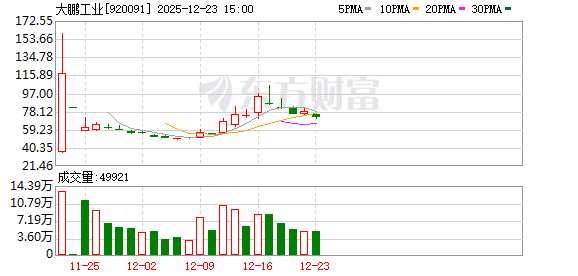
大鹏工业换手率36.73%,龙虎榜上机构买入599.10万元,卖出366.75万元
Zheng Quan Shi Bao Wang· 2025-12-23 12:31
Core Viewpoint - Dapeng Industrial (920091) experienced a significant decline of 7.85% in its stock price, with a trading volume turnover rate of 36.73% and a total transaction value of 363 million yuan on the day of reporting [2] Trading Activity - The stock was listed on the龙虎榜 due to its high turnover rate, with institutional investors net buying 2.32 million yuan [2] - The top five trading departments recorded a total transaction value of 102 million yuan, with a net buying amount of 24.6 million yuan, as buying transactions amounted to 63.19 million yuan and selling transactions totaled 38.59 million yuan [2] - Among the trading departments, one institutional seat was noted, which had a net buying amount of 2.32 million yuan, with buying and selling amounts of 5.99 million yuan and 3.67 million yuan respectively [2] Historical Performance - Over the past six months, Dapeng Industrial has appeared on the龙虎榜 22 times, with an average price drop of 0.06% the day after being listed and an average increase of 5.82% over the following five days [2]

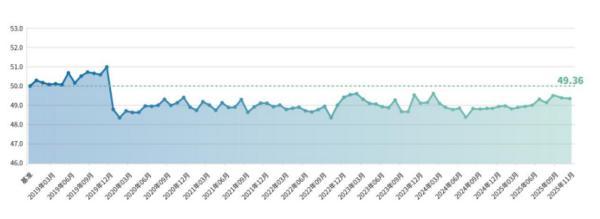
新华指数|11月普惠金融-景气指数:融资环境改善 企业经营韧性凸显
Xin Hua Wang· 2025-12-23 09:40
Core Insights - The Inclusive Finance Prosperity Index reached 49.36 points in November 2025, a slight decrease of 0.03 points from October, but up 0.51 points year-on-year [1] Financing Dimension - The financing prosperity index rose to 54.83 points in November, an increase of 0.14 points from October [2] - The average interest rate for newly issued loans (in both domestic and foreign currencies) was approximately 3.1%, down about 30 basis points year-on-year [2] - The balance of inclusive micro and small loans and medium to long-term loans in the manufacturing sector grew by 11.4% and 7.7% year-on-year, respectively, both exceeding the growth rate of other loans [2] Operating Dimension - The operating prosperity index slightly decreased to 48.28 points in November, down 0.07 points from October, with the decline rate narrowing compared to the previous month [3] - The performance and investment indices showed slight month-on-month increases, driven by the "Double Eleven" shopping festival, which stimulated consumer demand [3] - The business vitality index decreased by 0.13 points, indicating that market confidence among enterprises still needs to be strengthened [3] Industry Prosperity - Among nine major industries, four showed an increase in operating prosperity while five experienced a decline [6] - The construction and real estate sectors saw slight increases in their operating indices due to accelerated project construction and policy support [6] - The agriculture, industry, transportation, accommodation, and social services sectors experienced declines in their operating indices [6] Regional Prosperity - Among seven regions, four experienced an increase in operating prosperity while three saw a decline [7] - The Northeast, North China, East China, and Northwest regions reported increases in their indices, while South China, Central China, and Southwest regions saw declines [7]
见证历史!金价、银价,同日创新高
Xin Lang Cai Jing· 2025-12-23 04:53
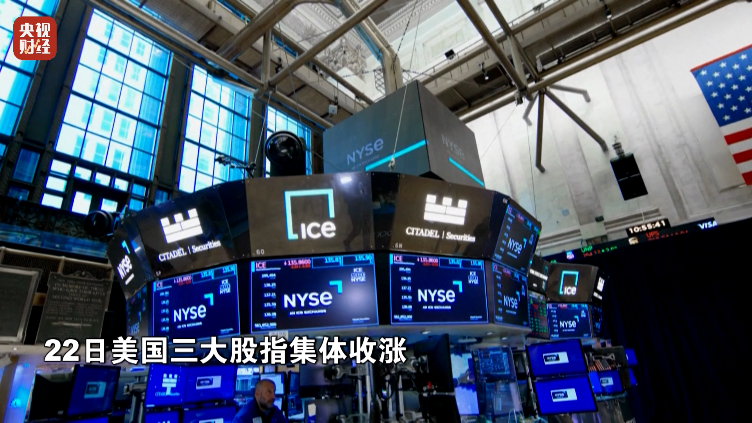
(来源:大众新闻-大众日报) 当地时间周一,市场对美联储明年多次降息的预期升温,叠加美国和委内瑞拉局势引发避险交易活跃,国 际金价显著上涨,突破每盎司4400美元整数关口,创盘中和收盘历史新高。与此同时,受美联储降息、供 应紧缺、投资需求和工业需求显著增加等因素综合影响,白银期价也延续强劲涨势,周一收盘再创历史新 高。 22日美国三大股指集体收涨 当地时间周一,随着年末的临近,美股受到季节性与技术性因素支撑,三大股指高开高走。随着美国11月 通胀数据意外回落、失业率反弹,市场更多押注美联储明年至少降息两次,同时也看好美国上市企业明年 的盈利增长前景。 受降息预期升温推动,金融、材料和工业等类别的周期股和小盘股领涨美股,同时,此前接连遭抛售的热 门AI概念股被部分投资者逢低买入,七大科技巨头与热门芯片股多数上涨,美国三大股指集体收涨。截至 收盘,道指涨0.47%,标普500指数涨0.64%,纳指涨0.52%。个股方面,特斯拉是美股周一成交额最高的个 股,收涨1.56%,股价创盘中新高;存储芯片股周一集体走高,美光科技预计整个行业供应紧缺的情况可 能持续数年,美光科技周一收涨4.01%。 22日欧洲三大股指集体收 ...
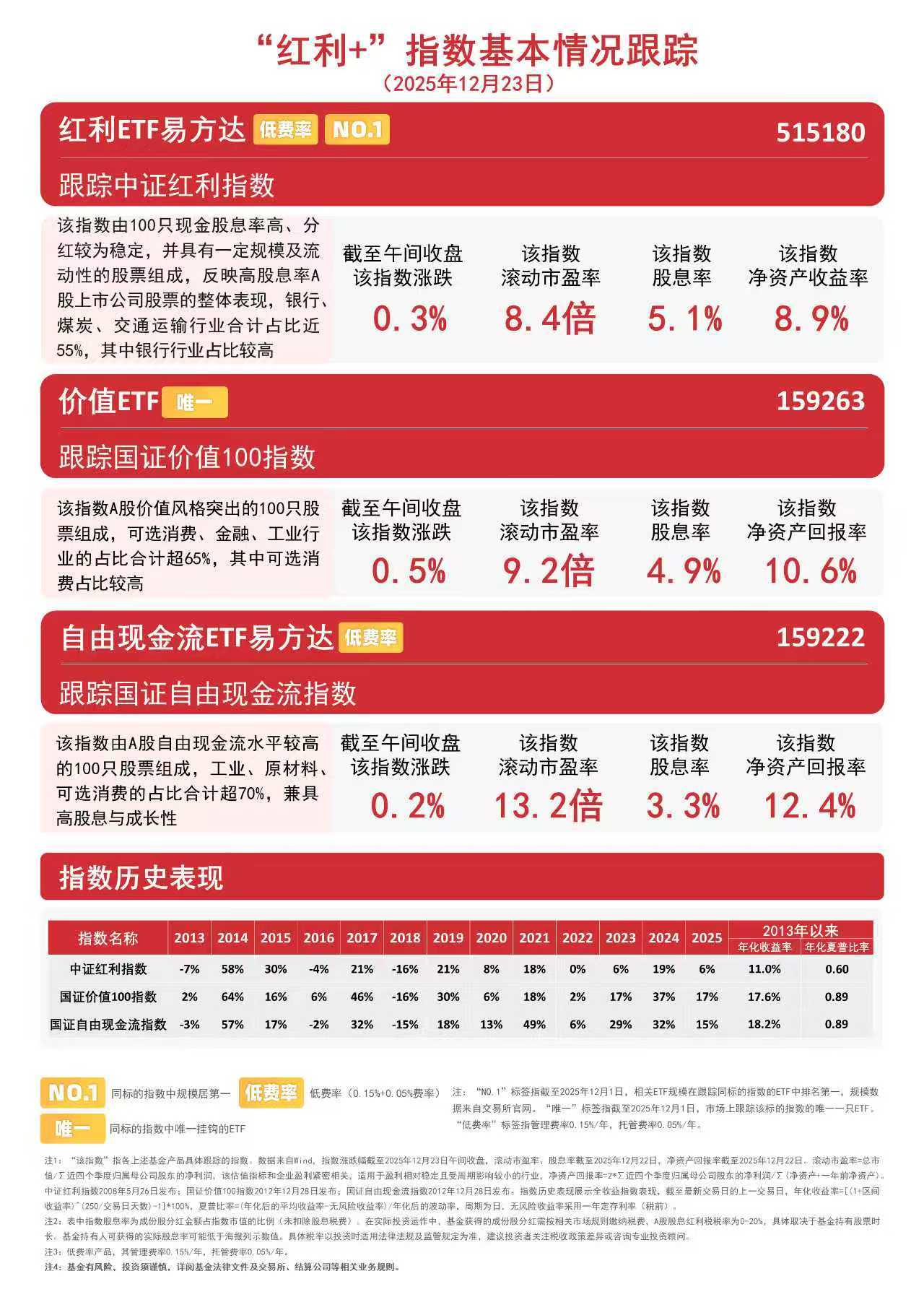
“红利+”指数震荡上行,关注价值ETF(159263)、自由现金流ETF易方达(159222)等投资机会
Sou Hu Cai Jing· 2025-12-23 04:48
Core Viewpoint - The "Dividend+" index is experiencing upward fluctuations, with notable increases in various indices and ETFs, indicating a positive trend in value and cash flow-focused investments [1]. Group 1: Index Performance - As of the midday close, the Guozheng Value 100 Index rose by 0.5%, the CSI Dividend Index increased by 0.3%, and the Guozheng Free Cash Flow Index saw a 0.2% rise [1]. - The CSI Dividend Index consists of 100 stocks with high cash dividend yields and stable dividends, with the banking, coal, and transportation sectors accounting for nearly 55% of the index [2]. - The Guozheng Value 100 Index is composed of 100 stocks with prominent value characteristics, with consumer discretionary, financial, and industrial sectors making up over 65% of the index [2]. Group 2: ETF Insights - The Value ETF (159263) has seen a net inflow of approximately 150 million yuan over the past six trading days, indicating strong investor interest [1]. - The Free Cash Flow ETF (159222) tracks the Guozheng Free Cash Flow Index, which includes 100 stocks with high free cash flow levels, primarily from the industrial, materials, and consumer discretionary sectors [2]. Group 3: Historical Performance - The annualized return for the CSI Dividend Index from 2013 to 2023 is 11.0%, with fluctuations in annual performance, including a peak of 58% in 2014 and a decline of 16% in 2018 [3]. - The Guozheng Value 100 Index has shown consistent performance with annual returns of 22% in 2013 and 17% in subsequent years [3]. - The Guozheng Free Cash Flow Index has experienced more volatility, with a significant decline of 57% in 2014, but an annualized return of 18.2% over the period [3].
佛山顺德打出“新政组合拳”!让企业不再为用地发愁
Nan Fang Du Shi Bao· 2025-12-23 02:33
"工业土地快到期了,还敢不敢投钱扩建?" 这是不少制造业企业长期的隐忧。长期以来,工业用地使用权到期后如何续期,缺乏明确政策指引,许 多企业不敢轻易投入资金进行扩建或改造升级。 12月19日,顺德区正式印发《顺德区关于推进土地要素市场化有效配置的实施意见(试行)》(下称 《实施意见》)。新政并非简单调整,而是瞄准企业真实需求,在土地管理与供应模式上进行了系统性 突破,通过制度性改革,力求让企业"安心扎根、轻装上阵、抱团发展"。 特别是针对国有工业用地续期路径不明、企业初始用地成本压力大、产业空间布局分散等问题,重点推 出工业用地续期、多元化弹性供应、产业用地联动出让、建设用地和农用地组合供应、优化经营性房地 产项目开竣工监管等政策,力求在土地要素配置上实现制度性突破,为实体经济营造更优发展环境。 工业用地可续期 破解企业"年限焦虑" 针对工业用地续期政策空白导致的增资扩产或拆除重建顾虑,《实施意见》建立"条件审核+年限封 顶"机制:剩余年限不足20年的工业及仓储用地,因增资扩产等需要申请土地使用权续期的,经产业准 入评估后可办理续期,总年限不超过法定最高出让年限。续期不是"自动续",而要经过产业准入评估, 确 ...

明年经济工作怎么干 四个关键词看着力点
He Nan Ri Bao· 2025-12-22 23:41
Core Viewpoint - The Henan Provincial Economic Work Conference emphasizes the importance of leveraging advantages to integrate and serve the national unified market, focusing on innovation-driven development, consumer demand stimulation, and improving people's livelihoods as key tasks for the upcoming economic year [4][5][9][10]. Group 1: Unified Market - The conference highlights the need to fully utilize advantages and deepen integration into the national unified market, with Zhengzhou as a pilot for market-oriented resource allocation reforms [5]. - Zhengzhou aims to eliminate barriers to the free flow and efficient allocation of resources, enhancing the quality of production factors and releasing market potential [5]. Group 2: Innovation-Driven Development - The meeting stresses the importance of promoting high-quality development in the manufacturing sector, focusing on enhancing original innovation capabilities and strengthening the role of enterprises in innovation [8]. - A series of forward-looking and targeted policy combinations will be introduced to support technological and industrial innovation [8]. Group 3: Consumer Demand Stimulation - The conference proposes to enhance consumer demand by developing new types of consumption service complexes and expanding digital, green, and health-related consumption [9]. - Measures will be implemented to improve the consumer environment, including a no-reason return policy for offline shopping and expanding the coverage of "reassured consumption insurance" [9]. Group 4: People's Livelihoods - The conference emphasizes prioritizing people's livelihoods, focusing on employment stability, public service enhancement, and addressing urgent issues faced by the population [10]. - Local governments are encouraged to improve services for key groups such as graduates, migrant workers, and veterans, while enhancing healthcare and social security systems [10].

Expect markets to do well going into 2026, especially growth trade: BMO's Schleif
Youtube· 2025-12-22 21:57
Market Overview - The market is experiencing gains and a broad-based rally, with positive movements across various sectors including AI, banks, retailers, and industrials [1] - There is optimism about the market's trajectory into 2026, with indications of underlying economic strength despite challenges faced by businesses [2] Earnings and Predictions - The market has shown resilience, with a 17% gain for the S&P this year, marking the third consecutive year of double-digit percentage gains [5] - Historical data suggests that average bull markets last about five years, indicating that the current market is still in its early stages [6] Economic Factors - Recent legislative measures and clarity around tariff policies are expected to positively impact the economy, alongside consumer support from back tax refunds and deregulation efforts [7] - The market's performance last year amidst uncertainties suggests that current clarity and fundamental support for earnings may sustain stock prices [8] Market Dynamics - There is ongoing confusion regarding market leadership, with fluctuations between major tech stocks and broader market indices [9] - The Federal Reserve's stance and continued earnings growth are critical factors for market stability moving forward [9] Historical Context - The market has only seen stocks rise in double-digit percentages four times consecutively in the last century, highlighting the uniqueness of the current situation [10]