
信息传输

Search documents
最新税收数据显示:我国经济向好态势不断稳固
Zhong Guo Jing Ji Wang· 2025-10-14 02:41
Core Insights - The implementation of a series of incremental and stock policies since September 26 last year has led to a steady recovery in both invoice sales and tax revenue, indicating a positive trend in China's economy [1][2][6] Group 1: Tax Revenue and Economic Indicators - The growth rate of value-added tax invoice sales and tax revenue has shown a steady recovery, reflecting an improving economic operation. From Q3 of last year to Q3 of this year, the quarterly sales revenue growth rates for enterprises were 0.4%, 2.6%, 2.1%, 3.1%, and 4.4% respectively [2] - Tax revenue has turned positive after seven months of negative growth, with a cumulative increase in tax revenue since February this year, showing month-on-month improvement [2] - In Q3, particularly in September, tax revenue growth was notably high, influenced by a narrowing decline in PPI and a low base from the previous year [2] Group 2: Capital Market Performance - Tax revenue related to the capital market has maintained a high growth rate, reflecting active stock market trading. In August, the total market value of A-share companies surpassed 100 trillion yuan, and the Shanghai Composite Index reached a ten-year high in September [3] - The tax revenue from capital market services increased by 56.8% year-on-year, with securities transaction stamp duty rising by 110.5% [3] - Personal income tax related to stock transfers and dividends also saw significant increases, contributing to a 9.3% year-on-year growth in personal income tax [3] Group 3: Industry and Sector Performance - Major industries and tax categories have shown stable growth, indicating improved business operations and profitability. The manufacturing sector's tax revenue grew by 5.4% year-on-year, accounting for 31% of total tax revenue [4] - High-end manufacturing sectors, such as railway and aerospace, experienced tax revenue growth of 31.5%, while emerging industries like information technology services saw tax revenue increases of 15.3% [4] - Domestic value-added tax grew by 3.2% year-on-year, and corporate income tax increased by 4.1%, reflecting improved profitability in certain sectors [4] Group 4: Real Estate Market Dynamics - The decline in tax revenue related to the real estate sector has narrowed, indicating the effectiveness of policies aimed at stabilizing the real estate market. The tax revenue from the real estate sector decreased by 9.8% year-on-year, but the decline was less than 5% when accounting for tax incentives [5] - The government has implemented tax reduction measures totaling nearly 80 billion yuan to lower housing transaction costs, contributing to market stabilization [5] Group 5: Consumer Activity and Equipment Upgrades - Nationwide enterprise equipment upgrades have accelerated, supported by policies promoting the replacement of old consumer goods. The procurement of machinery and equipment by enterprises increased by 9.7% year-on-year, with high-tech manufacturing seeing an 11.8% increase [5] - Retail sales of household appliances, such as refrigerators and televisions, experienced significant growth, with increases of 55.4% and 35.3% respectively [5]
经济增长动能澎湃 北京西城建设高品质现代化幸福之城
Zhong Guo Xin Wen Wang· 2025-10-13 14:03
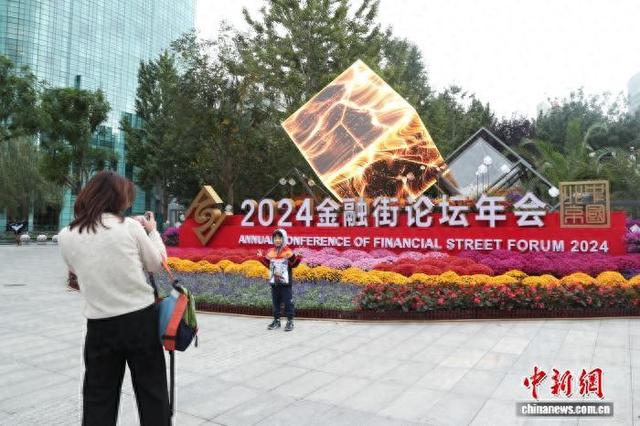
Core Insights - The economy of Xicheng District in Beijing is projected to surpass 600 billion yuan in GDP by 2024, reaching 603.8 billion yuan, with a high economic density of 119 billion yuan per square kilometer and a per capita GDP exceeding 550,000 yuan, ranking first in the city and among the top in the country [1] Economic Growth Dynamics - Xicheng is recognized as a core area for the capital's functions, with significant advancements in high-quality economic and social development, achieving the title of "China's Most Livable Urban Area" for two consecutive years [1] - The financial management center in Xicheng has seen continuous enhancement, with the Financial Street housing major financial institutions and regulatory bodies, contributing nearly 70% of the city's financial tax revenue [1] Asset Management and Financial Ecosystem - Xicheng has established itself as a hub for asset management, with over 260 institutions and an asset management scale exceeding 20 trillion yuan, supported by the Beijing Stock Exchange [3] - The Financial Street Forum has become a significant platform for national and international financial dialogue, with over 40% of attendees being foreign guests last year [3] Development of New Productive Forces - The district is accelerating the development of modern industries aligned with its core area positioning, particularly in financial technology, with significant investments in infrastructure and a surge in enterprise registrations [3][5] - The digital economy in Xicheng is expected to exceed 240 billion yuan in 2024, with the information transmission and software services sector generating over 110 billion yuan, marking a growth of over 40% compared to the end of the 13th Five-Year Plan [5] High-Level Reform and Opening Up - Xicheng has improved its business environment, with a service satisfaction rate of 99.9% and a significant increase in international schools and medical facilities [6] - The district has implemented 18 industrial support policies and established a government investment guidance fund of 20 billion yuan, focusing on high-end service industry transformation [6]

1—8月份泰安市经济延续回升向好态势
Qi Lu Wan Bao Wang· 2025-10-11 07:20
Economic Overview - The city has focused on high-quality development, leading to steady economic recovery and growth in the first eight months of the year [1] - Industrial production has shown stability, with a year-on-year increase of 7.7% in industrial added value [1] - The manufacturing sector has led the growth with an 8.5% increase, contributing 87.3% to the overall industrial growth [1] Industrial Performance - Among 37 industrial categories, 27 reported year-on-year growth, resulting in a growth rate of 73.0% [1] - Key sectors such as equipment manufacturing, high-tech manufacturing, and consumer goods manufacturing saw increases of 9.3%, 8.9%, and 8.8% respectively [1] Investment Trends - Fixed asset investment rose by 3.7% year-on-year, with the primary industry increasing by 5.3% and the secondary industry by 22.9% [1] - Industrial investment grew by 22.8%, with manufacturing investment specifically increasing by 20.0% [1] - New momentum investments, including "Four New" investments and high-tech industry investments, grew by 11.0% and 24.2% respectively [1] Consumer Market - The retail market has shown signs of recovery, with retail sales reaching 369.1 billion yuan, a 14.5% year-on-year increase [2] - Significant growth was observed in categories such as home appliances (48.7%), food (18.3%), and communication equipment (44.1%) [2] - The wholesale and retail sectors reported sales growth of 9.0% and 19.2% respectively [2] Service Sector - The scale of service industry enterprises saw an 11.6% increase in revenue year-on-year [2] - Among ten major industry categories, seven experienced revenue growth, indicating a positive trend [2] Financial Indicators - General public budget revenue reached 185.3 billion yuan, a 3.8% increase year-on-year [3] - By the end of August, the balance of deposits in financial institutions was 7386.5 billion yuan, growing by 11.0% [3] - The total electricity consumption was 206.5 billion kilowatt-hours, reflecting a 5.0% increase [3] Price Trends - The Consumer Price Index (CPI) was recorded at 99.6, showing a 0.4% year-on-year decrease [3] - Prices for clothing, housing, and healthcare saw increases, while food and transportation prices declined [3]
中威电子等成立科技新公司,含集成电路芯片业务
Qi Cha Cha· 2025-10-10 06:01
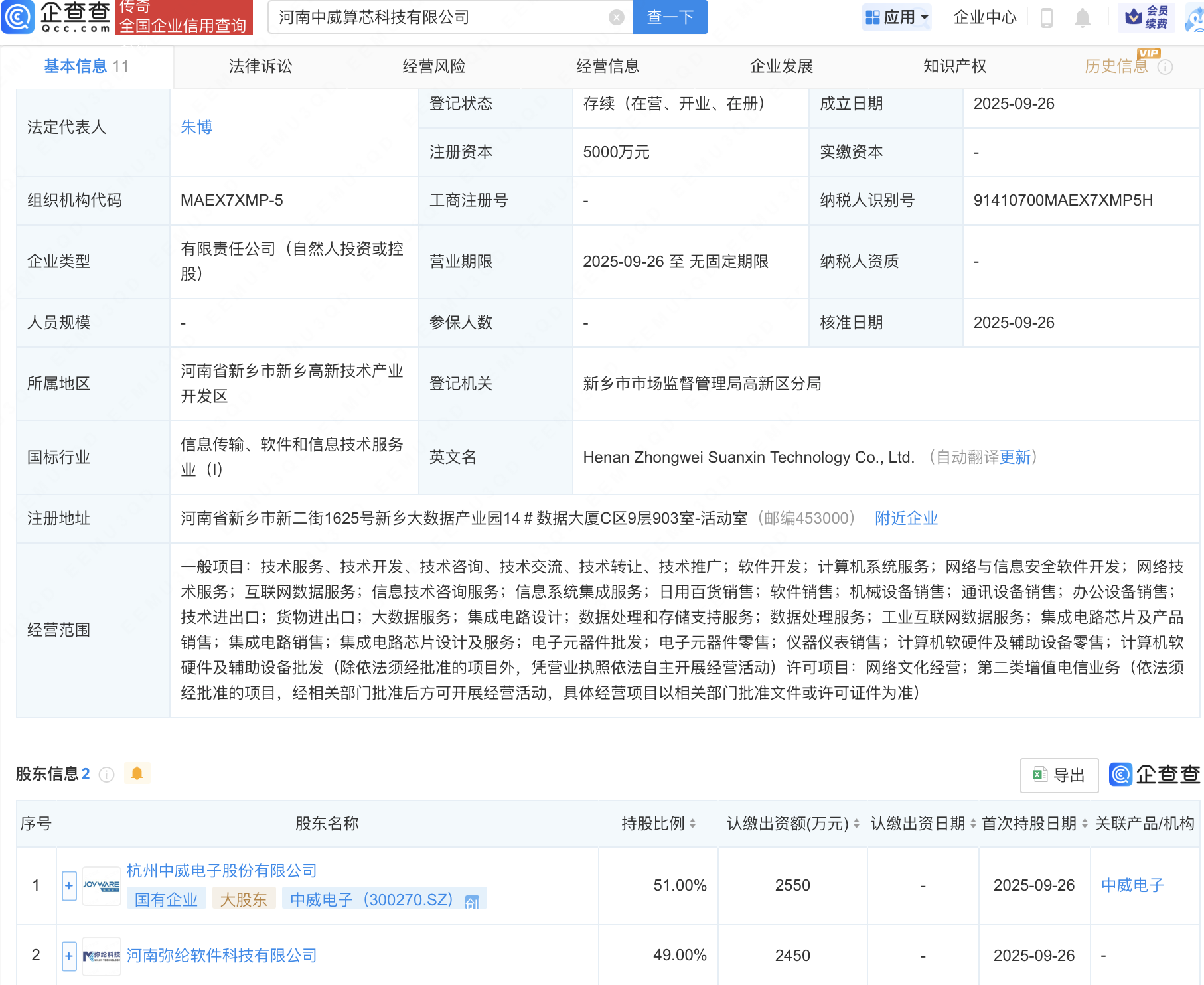
Core Insights - Henan Zhongwei Suanxin Technology Co., Ltd. has been established with a registered capital of 50 million yuan, focusing on industrial internet data services and integrated circuit chip sales and design [1][2]. Company Information - The company is located in Xinxiang High-tech Industrial Development Zone, Henan Province, and is registered as a limited liability company [2]. - The legal representative is Zhu Bo, and the company is currently in operation with a business term extending until September 26, 2025 [2]. Business Scope - The business scope includes technology services, internet data services, information technology consulting, integrated circuit design, and sales of electronic components [2]. - Specific services offered include technical development, consulting, and data processing and storage support [2]. Shareholding Structure - The major shareholder is Hangzhou Zhongwei Electronics Co., Ltd., holding a 51% stake, while Henan Milun Software Technology Co., Ltd. holds a 49% stake [3].

中国资产遭国际资本疯抢!5大推手曝光后,老百姓赚钱的机会来了
Sou Hu Cai Jing· 2025-10-06 16:59
Group 1 - The Federal Reserve's decision to lower the federal funds rate target range by 25 basis points to 4.00-4.25% in September 2025 marks the first rate cut since December 2024, triggering a key variable for international capital reallocation [1] - The depreciation of the US dollar has alleviated the pressure on the renminbi exchange rate, significantly reducing the exchange rate risk for renminbi assets, while the marginal improvement in the China-US interest rate differential has increased the relative attractiveness of Chinese bonds and stocks [3][5] - As of September 2025, the valuation of the CSI 300 index stands at a price-to-earnings ratio of 12.93, which is at the 46th percentile historically, compared to the S&P 500's 22.5 and the Nasdaq's over 40 [3] Group 2 - The Hong Kong stock market shows even more pronounced valuation advantages, with the Hang Seng Index at a price-to-earnings ratio of 10.48, significantly lower than its US counterparts and at historical lows [5] - The low interest rate environment is expected to benefit growth sectors and interest-sensitive industries, supported by a comprehensive macro policy framework that aims to stabilize market confidence and improve corporate profit expectations [5][8] - China's GDP growth rate for the first half of 2025 is reported at 5.3%, which stands out amid a global economic slowdown, with significant contributions from high-tech manufacturing and service sectors [10][12] Group 3 - The ongoing adjustment in the real estate market is counterbalanced by robust growth in infrastructure and manufacturing investments, indicating strengthening internal economic momentum [12] - The influx of international capital into Chinese assets is driven by fears of missing out on technological advancements, with significant net inflows into the Hang Seng Tech Index ETFs [12][15] - Institutional investors, both domestic and international, have been key contributors to the recent market rebound, with substantial increases in stock holdings reported [17] Group 4 - Nearly 60% of sovereign wealth funds prioritize China as an investment market, with Norway's sovereign fund increasing its allocation from 2.1% to 5.7% [19] - The global attractiveness of Chinese assets is expected to rise further due to ongoing economic development, policy optimization, and technological innovation [19]

1至8月份泰安市经济延续回升向好态势 新动能投资增长迅速,高新技术产业投资同比增长24.2%
Qi Lu Wan Bao Wang· 2025-09-28 08:47
Economic Overview - The city's economy has shown stable recovery and continuous improvement from January to August, with a more pronounced upward trend [1] - Industrial production remains steady, with the industrial added value of large-scale enterprises increasing by 7.7% year-on-year [1] Industrial Performance - The manufacturing sector leads the growth, with an added value increase of 8.5%, contributing 6.7 percentage points to the overall industrial growth [1] - Among 37 industrial categories, 27 reported year-on-year growth, resulting in a growth coverage of 73.0% [1] - Key sectors such as equipment manufacturing, high-tech manufacturing, and consumer goods manufacturing saw added value increases of 9.3%, 8.9%, and 8.8% respectively [1] Investment Trends - Fixed asset investment in the city grew by 3.7% year-on-year, with significant growth in the secondary industry at 22.9% [2] - Industrial investment increased by 22.8%, with manufacturing investment rising by 20.0% [2] - New momentum investments, including "Four New" investments and high-tech industry investments, grew by 11.0% and 24.2% respectively [2] Consumer Market - The retail market accelerated recovery, with retail sales of above-limit units reaching 36.91 billion yuan, a year-on-year increase of 14.5% [2] - Categories such as home appliances and audio-visual equipment, grain and oil products, and petroleum products saw significant retail sales growth of 48.7%, 18.3%, and 16.6% respectively [2] Service Sector - The revenue of large-scale service enterprises increased by 11.6% year-on-year, with 19 out of 29 industry categories showing growth [3] - Key sectors like scientific research, information technology services, and cultural and entertainment services experienced double-digit growth [3] Financial Indicators - The city's general public budget revenue reached 18.53 billion yuan, a year-on-year increase of 3.8% [3] - By the end of August, the balance of deposits in financial institutions was 738.65 billion yuan, up 11.0% year-on-year [3] Energy Consumption - Total electricity consumption reached 20.65 billion kilowatt-hours, a year-on-year increase of 5.0%, with industrial and tertiary sector electricity consumption growing by 3.0% and 8.8% respectively [3] Price Trends - The Consumer Price Index (CPI) was 99.6, reflecting a year-on-year decrease of 0.4%, with five categories of goods and services experiencing price increases [3]
前8个月杭州经济“成绩单”出炉
Mei Ri Shang Bao· 2025-09-24 06:52
Economic Overview - Hangzhou's economy shows stable operation with strong resilience and vitality, continuing to promote high-quality development [1][3] Industrial Sector - From January to August, the industrial economy in Hangzhou exhibited "steady growth and enhanced momentum," with the industrial added value reaching 299.7 billion yuan, a year-on-year increase of 6.3% [1] - Key industries such as automobile manufacturing and computer communication saw significant growth, with added values increasing by 30.2% and 15.4% respectively [1] - High-tech industries and strategic emerging industries outperformed the average industrial growth rate, with added value growth rates of 7.6%, 9.2%, and 9.4% [1] - Production of high-end manufacturing products like industrial robots surged, with output increasing by 82.4% and 103.0% respectively [1] - Industrial investment grew by 3.4%, with notable increases in automobile manufacturing (32.6%), general equipment manufacturing (24.6%), and electrical machinery (14.7%) [1] Trade and Export - The total import and export volume reached 595.4 billion yuan, a year-on-year increase of 7.0%, with mechanical and electrical products exports at 201.7 billion yuan, growing by 11.1% [2] - Private enterprises accounted for 76.6% of total exports, with a growth rate of 11.8% [2] - Exports to emerging markets, particularly countries involved in the Belt and Road Initiative, reached 209.6 billion yuan, growing by 18.9% [2] Consumer Market - Retail sales of consumer goods totaled 603.9 billion yuan, with a year-on-year growth of 5.2%, indicating a recovery in market sales driven by policy [2] - Significant growth was observed in household appliances (81.4%) and communication equipment (32.2%), reflecting a shift towards quality consumption [2] Service Sector - The service sector showed accelerated recovery, with revenue from major service industries reaching 1,277.4 billion yuan, a year-on-year increase of 8.9% [3] - Information transmission and software services grew by 13.5%, while emerging service industries like digital economy services saw revenue growth of 13.3% [3] Future Outlook - Despite the positive trends, challenges such as complex external environments and weak domestic demand remain [3] - Continued implementation of macro policies and development of new productive forces are essential for sustaining economic stability and health [3]
(活力中国调研行)海南外资企业突破万户 逾七成系近五年入驻
Zhong Guo Xin Wen Wang· 2025-09-24 01:11
Core Insights - Hainan has surpassed 10,000 foreign-funded enterprises, with 74% established after June 1, 2020 [1] - The number of foreign enterprises in Hainan is projected to reach 10,690 by August 2025, marking a year-on-year growth of 13.61%, maintaining the highest growth rate in the country for eight consecutive months [1] - The majority of foreign enterprises are concentrated in Haikou and Sanya, accounting for 58.34% and 17.82% respectively, with key industries being wholesale and retail, leasing and business services, and information technology services, which together represent 63.5% of the total [1] Industry Distribution - The foreign enterprises in Hainan are primarily involved in wholesale and retail, leasing and business services, and information transmission, software, and information technology services [1] - Notable international companies such as LVMH from France, Richemont from Switzerland, De Beers from the UK, and Dun & Bradstreet from the USA have established operations in Hainan, covering sectors like consumer goods, healthcare, finance, and digital economy [1] Regulatory Innovations - Hainan has implemented a series of innovative measures in the registration of foreign enterprises, including the direct registration system for foreign companies, allowing them to operate in service trade without establishing a Chinese entity [1] - Future upgrades to the market entity registration platform will include multilingual guidance services and AI response systems, enhancing online identity verification for foreigners and expanding electronic service coverage [2]
前8月浙江进出口规模创新高
Guo Ji Jin Rong Bao· 2025-09-23 06:20
Trade and Export - Zhejiang's total import and export value reached 3.68 trillion yuan from January to August, a year-on-year increase of 5.5% [1] - Exports amounted to 2.79 trillion yuan, growing by 7.7%, while imports were 0.89 trillion yuan, a decrease of 0.8% [1] - The province's import and export growth rates exceeded the national averages by 2.0, 0.8, and 0.4 percentage points respectively [1] - Mechanical and electrical products exports increased by 9.0% to 1.31 trillion yuan, accounting for 46.7% of total exports [1] - Private enterprises contributed over 90% to export growth, with their total import and export value at 3.02 trillion yuan, a 7.1% increase [1] Investment - Fixed asset investment decreased by 3.9% from January to August, but investment excluding real estate development grew by 6.7% [1] - Manufacturing investment rose by 9.5%, while infrastructure investment increased by 6.4% [1] - Investment in livelihood sectors such as ecological protection, transportation, energy, and water conservancy grew by 6.5% [1] - Equipment and tool purchases saw a significant increase of 10.3% due to large-scale equipment renewal policies [1] Consumer Market - The total retail sales of consumer goods in August reached 308.6 billion yuan, with a year-on-year growth of 4.9% [2] - Online retail sales surged by 15.9%, indicating strong growth in e-commerce [2] - Retail sales of quality-of-life products, including wearable devices and home appliances, saw substantial increases, with some categories growing by over 100% [2] - From January to August, total retail sales amounted to 2.51 trillion yuan, a growth of 5.1% [2] Industrial Growth - The industrial added value of Zhejiang's large-scale industries grew by 4.6% in August, with 22 out of 37 major industrial sectors reporting positive growth [2] - Key sectors such as automotive, instrumentation, and petroleum processing saw significant increases in added value, contributing to overall industrial growth [2] - The added value of high-tech manufacturing and strategic emerging industries also showed robust growth, with increases of 9.4% and 6.7% respectively [2] Service Sector - From January to July, the revenue of large-scale service enterprises reached 2.04 trillion yuan, a year-on-year increase of 8.4% [3] - The information transmission, software, and IT services sectors experienced a revenue growth of 12.8% [3] - Emerging service industries, including digital economy core services and high-tech services, reported revenue growth rates of 13.2% and 11.3% respectively [3]
江北:“双招双引”培育新质生产力
Sou Hu Cai Jing· 2025-09-22 11:35
Core Insights - Jiangbei District achieved a GDP of 99.74 billion yuan with a growth rate of 4.5% in the first half of 2025, ranking third in the city, driven by precise industrial chain attraction, government fund empowerment, and deep integration of industry and talent [1] Group 1: Industrial Chain Attraction - Jiangbei District implemented an "industrial chain leader responsibility system," with district leaders overseeing specific industrial chains, breaking down administrative barriers and reorganizing efficient investment attraction units [1] - The mechanism covers four pillar industries: modern finance, commerce and trade circulation, advanced manufacturing, and digital economy, allowing for targeted industrial and talent mapping [1] - In 2025, Jiangbei successfully attracted 83 projects with a signed investment amount of 61.483 billion yuan, setting a record for the speed of financial institutions' establishment in the region [1] Group 2: Fund Empowerment for Innovation - Jiangbei established a government guidance fund with a total scale of 4.9 billion yuan, focusing on early-stage and hard technology projects, leveraging social capital at a ratio of at least 1:1.5 [2] - The district is the first to set up a district-level state-owned fund management company in Chongqing, participating in 14 top-tier technology innovation sub-funds with a total scale of 51.651 billion yuan [2] Group 3: Deep Integration of Industry and Talent - Jiangbei focuses on digital economy development, optimizing policies and service environments through high-level carrier construction and high-quality market entity cultivation [3] - In 2024, the revenue of the information transmission, software, and IT service industry reached 21 billion yuan, with a year-on-year growth of 112.7%, leading the city [3] - The district's software enterprise count increased from over 2,000 in 2022 to over 4,000, achieving significant growth in the sector [3]