
ETF

Search documents
Is ALPS O'Shares U.S. Small-Cap Quality Dividend ETF (OUSM) a Strong ETF Right Now?
ZACKS· 2025-10-29 11:21
Core Insights - The ALPS O'Shares U.S. Small-Cap Quality Dividend ETF (OUSM) debuted on December 30, 2016, and offers broad exposure to the Style Box - Small Cap Blend category [1] - OUSM is designed to match the performance of the FTSE Russell US Qual / Vol / Yield Factor 3% Capped Index before fees and expenses [5] - The fund has accumulated over $940.53 million in assets, positioning it as an average-sized ETF in its category [5] Fund Characteristics - OUSM has an annual operating expense ratio of 0.48%, which is competitive within its peer group [7] - The ETF's 12-month trailing dividend yield stands at 1.30% [7] - The fund's top sector allocation is in Industrials, comprising about 22% of the portfolio, followed by Financials and Consumer Discretionary [8] Holdings and Performance - Td Synnex Corp. (SNX) is the largest holding at approximately 2.12% of total assets, with the top 10 holdings accounting for about 20.69% of total assets [9] - As of October 29, 2025, OUSM has returned roughly 2.36% and is up approximately 0.28% year-to-date [11] - The ETF has a beta of 0.96 and a standard deviation of 15.65% over the trailing three-year period, indicating effective diversification of company-specific risk with about 113 holdings [11] Alternatives - Other ETFs in the small-cap space include iShares Russell 2000 ETF (IWM) and iShares Core S&P Small-Cap ETF (IJR), which have significantly larger asset bases of $70.2 billion and $86.9 billion, respectively [13] - IWM has a lower expense ratio of 0.19%, while IJR has an even lower expense ratio of 0.06%, making them potentially more attractive options for cost-conscious investors [13]


多只光伏类ETF涨超8%;宽基ETF集体“吸金”丨ETF晚报
2 1 Shi Ji Jing Ji Bao Dao· 2025-10-29 09:54
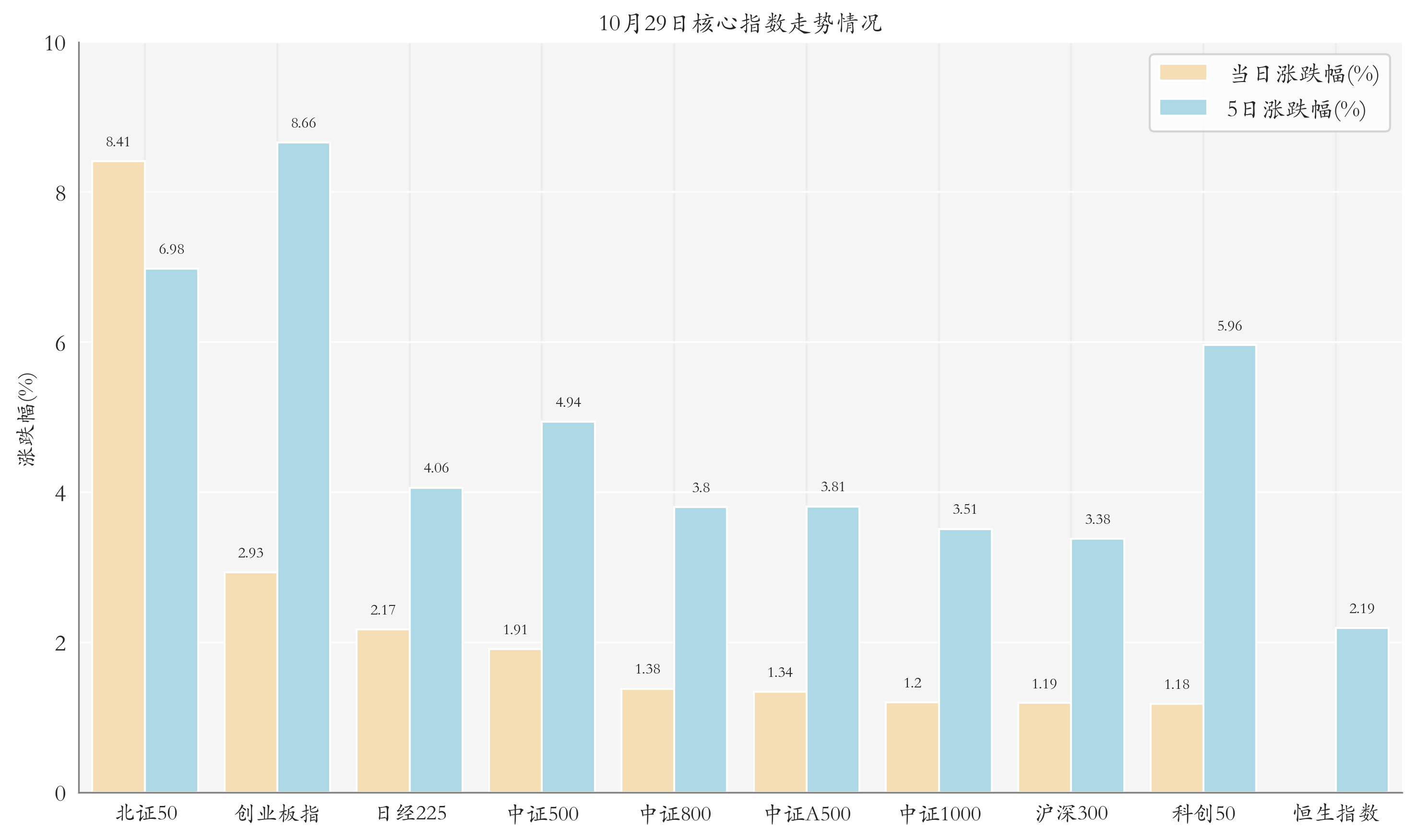
ETF Industry News - Multiple ETFs in the power equipment sector saw significant increases, with the leading photovoltaic ETFs rising by 8.81%, 8.75%, and 8.25% respectively [1][12][14] - The overall market saw a collective rise in major indices, with the Shanghai Composite Index increasing by 0.7% to close at 4016.33 points [3][6] Market Performance - The stock market experienced a net inflow of over 2 billion yuan in ETFs, with broad-based ETFs being the main contributors to the Shanghai Composite Index's push towards the 4000-point mark [2][9] - The power equipment sector led the performance among all industries, with a daily increase of 4.79%, while the food and beverage sector lagged behind with a decrease of 0.56% [6][9] ETF Categories Overview - The average performance of various ETF categories showed that thematic stock ETFs had the best average increase of 1.71%, while money market ETFs had no change [9][12] - The top-performing ETFs today were all in the photovoltaic sector, highlighting strong investor interest in this area [12][14] Trading Volume - The top three ETFs by trading volume were the A500 ETF, Securities ETF, and Sci-Tech 50 ETF, with trading volumes of 5.426 billion yuan, 5.175 billion yuan, and 4.807 billion yuan respectively [16][19]
Schwab U.S. Dividend Quality ETF (SCHD) Offers Higher Yield While Fidelity High Dividend ETF (FDVV) Leans Into Tech
The Motley Fool· 2025-10-29 02:46
Core Insights - The article compares Fidelity High Dividend ETF (FDVV) and Schwab U.S. Dividend Equity ETF (SCHD), focusing on their cost, performance, sector exposures, and structural details to determine which may better fit a dividend-focused strategy [1] Cost & Size - FDVV has an expense ratio of 0.16% while SCHD has a lower expense ratio of 0.06% - As of October 27, 2025, FDVV's one-year return is 10.9% compared to SCHD's -4.2% - FDVV offers a dividend yield of 3.0%, whereas SCHD provides a higher yield of 3.8% - FDVV has assets under management (AUM) of $7.1 billion, significantly less than SCHD's AUM of $70.2 billion [2] Performance & Risk Comparison - Over the past five years, FDVV experienced a maximum drawdown of 20.19%, while SCHD had a lower maximum drawdown of 16.86% - An investment of $1,000 in FDVV would have grown to $2,419 over five years, compared to $1,716 for SCHD [3] Holdings & Sector Exposure - SCHD tracks the Dow Jones U.S. Dividend 100 Index, holding 103 companies with significant exposure to Energy (20%), Consumer Defensive (19%), and Healthcare (16%) - Key holdings in SCHD include AbbVie, Cisco Systems, and Merck & Co. - FDVV has a higher allocation to Technology (25%), Financial Services (19%), and Consumer Defensive (13%), with top holdings including NVIDIA, Microsoft, and Apple [4][5] Long-term Performance - Over the last decade, FDVV generated total returns of 13% annually, while SCHD produced 11% growth, both trailing the S&P 500's 14% return during the same period [6] Investment Considerations - Both ETFs offer attractive dividend yields, low expense ratios, and below-market betas, issued by reputable financial firms - Investors with existing exposure to the S&P 500 may find FDVV less appealing due to its significant holdings in the "Magnificent Seven" tech stocks, which account for nearly 18% of its assets - SCHD's focus on essential sectors may provide a more defensive investment option for those lacking exposure in these areas [7][8]

Is First Trust Multi Cap Growth AlphaDEX ETF (FAD) a Strong ETF Right Now?
ZACKS· 2025-10-28 11:21
Core Insights - The First Trust Multi Cap Growth AlphaDEX ETF (FAD) aims to provide broad exposure to the Style Box - All Cap Growth category and utilizes a smart beta strategy [1][5] - FAD is managed by First Trust Advisors and has accumulated over $365.95 million in assets, positioning it as an average-sized ETF in its category [5] - The ETF seeks to match the performance of the Nasdaq AlphaDEX Multi Cap Growth Index, which employs a stock selection methodology based on fundamental characteristics [6] Fund Characteristics - FAD has an annual operating expense ratio of 0.62%, which is competitive within its peer group, and a 12-month trailing dividend yield of 0.27% [7] - The ETF's largest sector allocation is in Industrials at approximately 24.1%, followed by Information Technology and Consumer Discretionary [8] - The top three individual holdings include Rocket Lab Corporation (0.64% of total assets), Vertiv Holdings Co, and Advanced Micro Devices, Inc., with the top 10 holdings comprising about 5.04% of total assets [9] Performance Metrics - Year-to-date, FAD has increased by roughly 20.33% and is up about 23.59% over the last 12 months as of October 28, 2025 [10] - The ETF has a beta of 1.15 and a standard deviation of 18.57% over the trailing three-year period, indicating a medium risk profile [10] - FAD holds approximately 677 stocks, effectively diversifying company-specific risk [10] Alternatives - Other ETFs in the same space include iShares Morningstar Growth ETF (ILCG) with $3.14 billion in assets and iShares Core S&P U.S. Growth ETF (IUSG) with $26.1 billion, both having an expense ratio of 0.04% [12] - Investors may consider traditional market cap weighted ETFs for potentially lower-risk options that aim to match returns in the Style Box - All Cap Growth segment [12]

仅差0.93沪指4000点,帮我砍一刀!创业板ETF天弘(159977)涨超2%强势三连阳,创业板成长路径清晰,营收净利双高增可期
Sou Hu Cai Jing· 2025-10-28 01:25
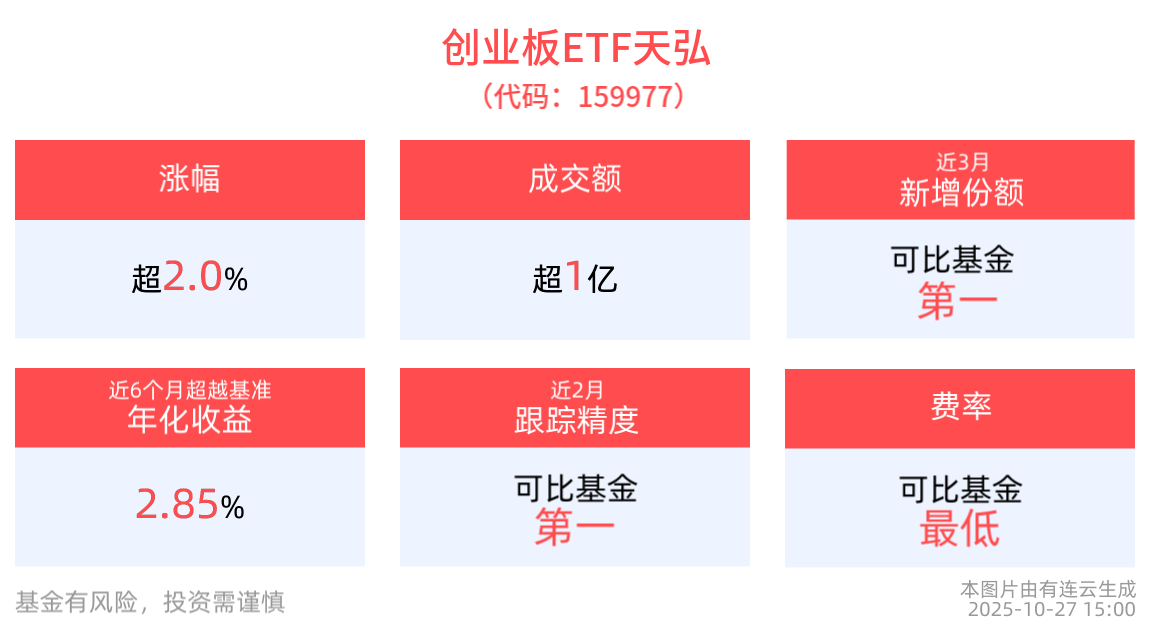
Core Insights - The A-share market is experiencing a strong upward trend, with the Shanghai Composite Index reaching a near ten-year high of 3999.07 points, just 0.93 points away from the 4000 mark [3] - The Tianhong ChiNext ETF (159977) has seen a significant increase in its share volume, with a growth of 21.85 million shares over the past three months, ranking first among comparable funds [3] - The high-tech manufacturing sector is showing robust growth, with profits increasing by 8.7% year-on-year from January to September, contributing to overall industrial profit growth [5] Product Highlights - The Tianhong ChiNext ETF (159977) tracks the ChiNext Index, which is currently at a historical midpoint, with attractive valuations compared to other broad indices like CSI 300 and CSI 500 [3] - The Tianhong CSI A500 ETF (159360) covers 35 secondary industries and serves as a balanced allocation tool to mitigate rotation risks [4] - The Tianhong Sci-Tech Index ETF (589860) covers 97% of the Sci-Tech board's market value, focusing on strategic emerging industries such as semiconductors and AI [4] Industry Trends - The innovation sector is becoming a key growth driver, with high-tech manufacturing profits showing a two-digit growth rate of 26.8% in September, significantly boosting overall industrial profits [5] - The Tianhong Fund highlights three promising sectors within the ChiNext: technology benefiting from AI advancements, pharmaceuticals driven by policy optimization, and renewable energy with improving supply-demand dynamics [6]

This Overlooked Market Segment Can Surprise Investors in 2026
Etftrends· 2025-10-27 17:42
Core Insights - 2025 presents various challenges for investors, including tariff uncertainty and potential stagflation, leading to a mixed performance across market segments [1] - A shift in investment strategy towards mid-cap stocks may be beneficial, as they combine strengths of both small-cap and large-cap firms while mitigating weaknesses [2][3] Mid-Cap Market Analysis - Mid-cap companies span various industries and can capitalize on market opportunities, potentially offering better revenue prospects than small-caps at more attractive valuations than large-caps [3] - The Fidelity Enhanced Mid Cap ETF (FMDE) is highlighted as a viable investment option, charging a fee of 23 basis points and utilizing quantitative analysis for active investment in U.S. mid-cap stocks [4] Performance Metrics - FMDE has achieved an 8.5% year-to-date return, outperforming both its ETF Database Category and FactSet Segment averages, and has attracted over a billion in net inflows in the past year [5] - The fund's strategy includes evaluating historical valuation, growth, and profitability, along with income generation through securities lending, positioning it well for uncertain market conditions in 2026 [5][6]

Weekly Economic Snapshot: Inflation Cools Yet Consumer Sentiment Stumbles
Etftrends· 2025-10-27 15:40
Economic Data Overview - The Consumer Price Index (CPI) rose to 3.0% in September, slightly up from 2.9% in August but below the expected 3.1% [2] - Monthly price growth was 0.3%, a deceleration from the 0.4% increase in August and below the projected 0.4% [2] - Core inflation, excluding food and energy, cooled to 3.0% in September, down from 3.1% in August and below the expected 3.1% [2] Inflation Drivers - The primary contributor to the CPI increase in September was higher gas prices, while food, shelter, airline fares, recreation, household furnishings, and apparel also saw price increases [3] - Conversely, prices for motor vehicle insurance, used cars, and communication costs declined [3] Consumer Sentiment - The University of Michigan Consumer Sentiment Index fell nearly 3% to 53.6 in October, below the forecast of 55.0, marking the lowest level since May [5] - The decline in sentiment was attributed to ongoing inflation concerns, with younger consumers showing improved sentiment but older demographics experiencing noticeable drops [6] Housing Market Insights - Existing home sales rose 1.5% in September, reaching a seasonally adjusted annual rate of 4.06 million units, aligning with expectations [8] - The median price for existing homes decreased by 1.7% from August, marking the lowest level in five months, although it was up 2.1% year-over-year [9] Market Reactions - The S&P 500 index briefly crossed above 6,800 for the first time, finishing the week with a 1.9% gain [11] - The CME FedWatch Tool indicates a 97% likelihood of a 25 basis point rate cut by the Federal Reserve in the upcoming meeting [12] Upcoming Economic Outlook - The economic outlook remains complex due to the ongoing government shutdown, with private and regional reports expected to provide insights into economic activity [13] - Attention will be focused on the Federal Reserve meeting, which will influence market expectations, alongside housing market reports and manufacturing sector data [14]

科创板改革“1+6”政策落地后 新增21只科创板ETF上市
Zheng Quan Ri Bao Wang· 2025-10-27 08:43
Core Viewpoint - The market enthusiasm for the Sci-Tech Innovation Board (STAR Market) ETFs has significantly increased since the release of the "1+6" policy, leading to a notable rise in investor demand [1] Group 1: Market Activity - In the past four months, 21 new STAR Market ETFs have been launched, covering a range of indices including the Sci-Tech 50, Sci-Tech 100, Sci-Tech 200, and the Sci-Tech Composite Index [1] - The current total number of STAR Market ETFs listed on the Shanghai Stock Exchange has reached 105, with a total scale of 300 billion yuan [1] Group 2: Investment Focus - The newly launched ETFs encompass broad-based indices as well as thematic sectors such as artificial intelligence, semiconductor materials and equipment, innovative pharmaceuticals, and new energy [1] - The investment trend is directing funds towards key development areas of new productive forces [1]
10.27犀牛财经早报:首批“翻倍基”普遍重仓AI产业链核心环节 宗馥莉已回娃哈哈上班
Xi Niu Cai Jing· 2025-10-27 01:37
Group 1 - The first batch of "doubling funds" has revealed heavy positions in core segments of the AI industry chain, with many actively managed equity funds achieving net value doubling this year due to early investments in AI-related sectors [1] - Traditional ETF products are facing stagnation, leading to a surge in differentiated products that provide more precise asset allocation tools, helping public funds break through growth bottlenecks in a crowded market [1] - The performance of companies listed on the Beijing Stock Exchange has shown steady growth, with many achieving both revenue and net profit increases, attracting more institutional investor attention [2] Group 2 - The domestic commercial insurance market for new energy vehicles has surpassed 100 billion yuan in premium income, growing by 36.6% year-on-year, significantly outpacing the overall car insurance market [3] - The eleventh batch of national drug procurement has begun, involving over 400 companies and 55 products, with new rules aimed at improving quality control and market competition [4] - Merge Labs, a brain-computer interface company co-founded by Sam Altman, is expected to adopt a non-invasive method combining gene therapy and ultrasound [4] Group 3 - 澜起科技 has successfully mass-produced the DDR5 fourth-generation RCD chip, which is a core component for high-performance server and data center memory systems [6] - 八一钢铁 plans to invest up to 35 million yuan in a new 3500mm pre-straightening machine project to enhance production quality [7] - 凯龙高科 intends to sell up to 122.33 million shares of repurchased stock to supplement its working capital [8] Group 4 - 北鼎股份 reported significant growth in its domestic self-owned brand categories, with Sam's Club becoming a key channel for sales [9] - 贵州百灵's net profit dropped by 35% in the first three quarters, with its controlling shareholder facing a significant lawsuit [10] - 德龙汇能 is planning a change in control, leading to a temporary suspension of its stock [11] - 中元股份 is also suspending trading due to the announcement of a significant matter [12] Group 5 - The three major U.S. stock indices rose last Friday, with the S&P 500 and Nasdaq reaching new highs, driven by a slowdown in core CPI growth and expectations of interest rate cuts [13] - Gold prices initially fell before rising 2.44% after the CPI data release, while oil prices experienced a slight decline [14]
Meet the Spectacular Vanguard ETF With Almost 40% of Its Portfolio Invested in Nvidia, Apple, Microsoft, and Amazon
Yahoo Finance· 2025-10-26 13:00
Core Insights - Growth stocks have been the market leaders, with the S&P 500 Growth index returning 60.6% over the five years ending October 20, compared to 56.7% for the S&P 500 [1] - The "Magnificent Seven," including Nvidia, Apple, Microsoft, and Amazon, have significantly contributed to the leadership of big growth stocks [1][2] - Investors holding these stocks have likely seen strong portfolio performance, although selecting the right stocks remains challenging [2] Vanguard Growth ETF Overview - The Vanguard Growth ETF (NYSEMKT: VUG) provides access to major growth stocks, with Nvidia, Microsoft, Apple, and Amazon making up approximately 39% of the fund [3] - VUG, with a total asset value of $195 billion, holds 160 stocks across 11 sectors, but has a heavy concentration in technology, allocating 62.1% of its portfolio to this sector [4] - The top three holdings in VUG—Nvidia, Microsoft, and Apple—account for one-third of the ETF's weight, with a combined market capitalization of $12.17 trillion [5] Sector Analysis - While VUG appears tech-heavy, it includes stocks like Meta Platforms and Alphabet as tech, which are technically classified as communication services [6] - Including Netflix, the technology exposure of VUG is closer to half its total weight when accounting for these classifications [6] - The Vanguard Growth ETF has shown strong performance compared to rivals and is considered a solid option for long-term investors due to its low fees [7]



