智能手机

Search documents
【光大研究每日速递】20260203
光大证券研究· 2026-02-02 23:08
Group 1: Copper Industry - The market believes that the probability of the Federal Reserve lowering interest rates in March 2026 is low; short-term declines in gold and silver may negatively impact overall commodity sentiment [5] - Cable companies' operating rates have rebounded week-on-week, but demand may weaken as the Spring Festival approaches; copper prices are expected to fluctuate in the short term [5] - The supply-demand tightness in 2026 remains unchanged, and there is continued optimism for copper price increases [5] Group 2: Commercial Aerospace - SpaceX plans to deploy one million computing power satellites, further expanding the commercial aerospace demand space [5] - The manufacturing and launch capabilities of reusable rockets are fundamental for large-scale constellation construction [5] - Laser communication networks are key to achieving large-scale inter-satellite communication [5] Group 3: Jiuri New Materials (688199.SH) - Jiuri New Materials expects to achieve a net profit attributable to shareholders of 21 to 31.5 million yuan in 2025, turning from loss to profit year-on-year [5] - The company anticipates a net profit of 14.4 to 21.6 million yuan after deducting non-recurring gains and losses, also turning from loss to profit year-on-year [5] - The recovery in the price of photoinitiators and the gradual production of new projects are solidifying the company's leading position in the industry [5] Group 4: Keda Manufacturing (600499.SH) - Keda Manufacturing is planning a major asset restructuring to acquire 51.55% of the shares of Tef International, aiming to hold 100% of the shares post-transaction [7] - The transaction is expected to significantly enhance the company's net profit attributable to shareholders [7] Group 5: Tesla (TSLA.O) - Tesla's total revenue for 2025 decreased by 2.9% year-on-year to $94.83 billion, while the Non-GAAP net profit fell by 26.4% to $5.86 billion [8] - In Q4 2025, Tesla's total revenue decreased by 3.1% year-on-year and 11.4% quarter-on-quarter to $24.9 billion, with a Non-GAAP net profit decline of 16.4% year-on-year to $1.76 billion [8] Group 6: Apple (AAPL.O) - Apple's FY1Q26 performance exceeded expectations, driven by strong demand for the iPhone 17 series and the continued penetration of AI features [8] - Despite rising storage costs, Apple managed to maintain and even increase its gross margin through product mix optimization and high-margin service business [8] Group 7: Ausnutria (1717.HK) - Ausnutria is expected to see a 1.1% year-on-year revenue growth in 2025, with a slowdown in growth primarily due to domestic milk powder business challenges [9] - The company's net profit attributable to shareholders is expected to remain flat year-on-year, with a decline in H2 2025 profits due to slower internal code adjustment progress and intensified industry competition [9]

电子:电子行业2026年度策略报告:AI与自主可控共振-20260202
Huafu Securities· 2026-02-02 14:55
Group 1: Mobile Industry - The global smartphone shipment is expected to reach 1.24 billion units in 2025, with a moderate growth rate of 1.5% CAGR from 2024 to 2029 [3][19] - Samsung maintained its position as the global leader in smartphone shipments with 60.6 million units and a 19% market share in Q3 2025, followed by Apple with 56.5 million units and a 4% year-on-year increase [3][19] - The demand for high-quality imaging is driving the need for CMOS image sensors (CIS), with the global CIS market projected to grow at a CAGR of 4.4% from $23.2 billion in 2024 to $30.1 billion by 2030 [32][39] Group 2: SoC Industry - The SoC industry is entering an "ALL IN AI" phase in 2026, with NPU becoming a core architecture that drives system operations, marking a shift from being auxiliary to a primary component [4][56] - Domestic SoC manufacturers are leveraging AI co-processor strategies to penetrate high-value edge computing markets, with companies like Rockchip achieving significant gross margin improvements [4][54] - The AIoT sector is expected to see rapid growth, particularly in AI glasses, which are becoming a general computing platform and terminal, supported by government subsidies [66][67] Group 3: Semiconductor Manufacturing - The semiconductor industry is focusing on both advanced and mature process technologies, with companies like SMIC and Hua Hong expected to increase their advanced manufacturing capacities [5][75] - There are significant investment opportunities in specialized manufacturing processes, with companies like Chipone and Silex Microelectronics leading in their respective fields [5][79] - The semiconductor equipment market is seeing growth through both organic expansion and mergers, with companies like North China Innovation and Zhongwei planning strategic acquisitions to enhance their product offerings [5][76] Group 4: Storage and AI - The global storage chip market is entering a super cycle, with prices expected to rise due to increased demand driven by AI applications, with Micron's CEO indicating this cycle may last until 2027 [6][6] - Companies involved in the HBM supply chain, such as Yake Technology and Huahai Chengke, are recommended for investment as the demand for high-performance memory continues to grow [6][6] Group 5: PCB Industry - The PCB industry is facing a tight supply-demand balance, particularly in high-end PCBs, with major manufacturers struggling to meet the growing demand from AI and high-frequency markets [10][10] - Investment opportunities are highlighted in leading PCB companies that are actively expanding their production capacities to meet the increasing demand [10][10]
全球智能手机产业链回暖!升级换机驱动2025年出货量创新高
Ge Long Hui· 2026-02-02 06:10
其中,2025年,苹果(AAPL.US)创下年度出货量新高,iPhone 出货量同比增长7% 至2.406亿部,使其连 续第三年保持全球最大智能手机厂商的地位。三星在经历连续三年的年度下滑后于 2025 年实现显著反 弹,同比增长 7%,出货略低于苹果。 在前五名之外,尽管市场环境充满挑战,仍有多家厂商保持正向增长。得益于在核心市场激烈竞争中快 速拓展地理版图带来的增长,荣耀和联想(00992)分别同比增长11% 和 6%,创下历史新高。 Omdia最新研究显示,2025年全球智能手机出货量增长 2%,达到12.5亿部,为2021年以来的最高水 平。除大中华区外,各地区出货量均同比增长,中国内地则因2025年国家补贴政策的激励效应不及预期 而略有下降。升级和换机的强劲需求支撑使市场保持增长,尽管商业环境充满不确定性,多家厂商仍然 打破了纪录。 受季节性利好因素和厂商强劲表现推动,2025年第四季度,全球智能手机出货量同比增长4%。 Omdia 研究经理 Le Xuan Chiew认为,市场波动时期,为能够快速应对挑战的厂商、供应商及合作伙伴 提供了竞争窗口。这种条件创造了一个战略机遇,可以抓住升级换机用户、开 ...

手机产业链全线走低 12月手机销量同比下滑20% 内存涨价或抑制手机出货量
Zhi Tong Cai Jing· 2026-02-02 04:06
Core Viewpoint - The smartphone supply chain is experiencing a significant downturn, with major companies seeing declines in stock prices and forecasts indicating a drop in smartphone sales in China by approximately 20% year-on-year by December 2025 [1] Group 1: Company Performance - QiuTai Technology (01478) shares fell by 5.91%, trading at HKD 8.75 [1] - BYD Electronics (00285) shares decreased by 4.13%, trading at HKD 32.02 [1] - GoerTek (01415) shares dropped by 3.76%, trading at HKD 29.14 [1] Group 2: Market Forecasts - China's smartphone sales are projected to reach approximately 21 million units by December 2025, reflecting a year-on-year decline of about 20% [1] - Goldman Sachs has revised its global smartphone shipment forecasts for 2026/27 down by 6% and 5% to 1.2 billion units for both years, indicating a year-on-year change of -6% and +2% respectively [1] Group 3: Market Share - The top five smartphone brands in China by market share are Huawei (20%), OPPO (17%), Honor (14%), Vivo (14%), and Apple (13%) [1]

港股异动 | 手机产业链全线走低 12月手机销量同比下滑20% 内存涨价或抑制手机出货量
智通财经网· 2026-02-02 04:04
Group 1 - The smartphone industry is experiencing a decline, with major companies like Q Technology, BYD Electronics, and GoerTek seeing significant stock price drops of 5.91%, 4.13%, and 3.76% respectively [1] - By December 2025, China's smartphone sales are projected to reach approximately 21 million units, representing a year-on-year decrease of about 20% [1] - The top five smartphone brands in China by market share are Huawei (20%), OPPO (17%), Honor (14%), vivo (14%), and Apple (13%) [1] Group 2 - Goldman Sachs has revised its global smartphone shipment forecasts for 2026/27 down by 6% and 5% to 1.2 billion units for both years, indicating a year-on-year change of -6% and +2% respectively [1] - The decline in smartphone shipments is attributed to rising memory prices impacting the overall market [1]
苹果大中华区表现靓丽,上海市“火箭星城”方案发布
Ping An Securities· 2026-02-02 02:00
Investment Rating - Industry investment rating: Outperform the market (expected to outperform the market by more than 5% in the next 6 months) [36] Core Insights - Apple reported Q1 2026 financial results with revenue of $143.76 billion, a 16% year-over-year increase, and net profit of $42.10 billion, also up 16% year-over-year. iPhone revenue reached $85.27 billion, growing 23% year-over-year, accounting for 59.3% of total revenue. The Greater China region showed strong performance with revenue of $25.53 billion, a 38% increase year-over-year [3][6] - The semiconductor industry index fell by 0.9% this week, underperforming the CSI 300 index by 0.98 percentage points. However, since the beginning of 2026, the semiconductor industry index has risen by 18.04%, outperforming the CSI 300 index by 16.39 percentage points [27][30] - Global smartphone shipments are expected to decline by 2.1% in 2026 due to rising storage costs. It is recommended to focus on brands with scale advantages, comprehensive product lines, and vertical integration capabilities. Emerging products like foldable phones, AI smartphones, and AI glasses are expected to create new opportunities for the supply chain [3][12] - The Shanghai "Rocket Star City" plan was officially released, aiming to build a national aerospace industry hub with a target industry scale of around 100 billion yuan by 2027. The plan includes a complete layout for reusable rockets and satellite production capabilities [18][19] Summary by Sections Apple Financial Performance - Q1 2026 revenue: $143.76 billion, up 16% year-over-year - Net profit: $42.10 billion, up 16% year-over-year - iPhone revenue: $85.27 billion, up 23% year-over-year, 59.3% of total revenue - Greater China revenue: $25.53 billion, up 38% year-over-year [3][6] Semiconductor Industry Performance - Semiconductor industry index down 0.9% this week, underperforming CSI 300 index - Year-to-date increase of 18.04%, outperforming CSI 300 index by 16.39% [27][30] Global Smartphone Market Outlook - Expected decline in global smartphone shipments by 2.1% in 2026 - Focus on brands with scale advantages and emerging product opportunities [3][12] Shanghai Aerospace Initiative - "Rocket Star City" plan aims for a 100 billion yuan industry scale by 2027 - Goals include production capabilities for reusable rockets and satellites [18][19]
闻泰科技跌停,博时基金旗下1只基金重仓,持有5.75万股浮亏损失22.65万元
Xin Lang Cai Jing· 2026-02-02 01:50
2月2日,闻泰科技跌停,截至发稿,报35.46元/股,成交1.61亿元,换手率0.36%,总市值441.35亿元。 博时湖北新旧动能转换ETF(159743)基金经理为尹浩。 资料显示,闻泰科技股份有限公司位于广东省深圳市罗湖区黄贝街道新秀社区罗沙路5097号银丰大厦B 座一层,成立日期1993年1月11日,上市日期1996年8月28日,公司主营业务涉及房地产开发与经营;以 智能手机为主的移动互联网设备产品的研发与制造;上游半导体。主营业务收入构成为:智能终端 69.00%,半导体产品30.88%,其他0.12%。 截至发稿,尹浩累计任职时间6年117天,现任基金资产总规模96.69亿元,任职期间最佳基金回报 158.37%, 任职期间最差基金回报-32.87%。 从基金十大重仓股角度 声明:市场有风险,投资需谨慎。 本文基于第三方数据库自动发布,不代表新浪财经观点,任何在本 文出现的信息均只作为参考,不构成个人投资建议。如有出入请以实际公告为准。如有疑问,请联系 biz@staff.sina.com.cn。 数据显示,博时基金旗下1只基金重仓闻泰科技。博时湖北新旧动能转换ETF(159743)四季度减持60 ...

财信证券晨会纪要-20260202
Caixin Securities· 2026-02-01 23:30
Market Strategy - The market shows resilience, with opportunities in consumer and real estate sectors [5][10] - The overall A-share market index has been fluctuating, indicating a correction in upward trends, while maintaining strong trading volumes [8][10] Economic Insights - The national public budget revenue for 2025 is projected at 21.6 trillion yuan, reflecting a 1.7% decrease from 2024 [19][20] - The manufacturing Purchasing Managers' Index (PMI) for January 2026 is reported at 49.3%, indicating a slight contraction in market demand [23][24] Industry Dynamics - Revenue for large-scale cultural enterprises in 2025 is expected to grow by 7.4%, reaching 1521.35 billion yuan [29][30] - The energy sector is focusing on a "four modernization" initiative to enhance renewable energy development [32][33] - Real estate development investment in Shenzhen is projected to decline by 31% in 2025 [35][36] - The Chinese smart glasses market is anticipated to see a significant increase in shipments, with a 211% year-on-year growth expected in 2025 [41][43] Company Tracking - Denghai Seed Industry (002041.SZ) forecasts a net profit growth of 62.29% to 79.99% for 2025, driven by reduced seed costs and increased sales of transgenic corn [46][47] - Longping High-Tech (000998.SZ) expects a net profit increase of 14.17% to 66.86% in 2025, supported by stable domestic operations and improved capital structure [48][49] - Century Huatong (002602.SZ) anticipates a staggering net profit growth of 357% to 475% for 2025, attributed to continuous revenue growth in its gaming business [50][52] - Tongkun Co., Ltd. (601233.SH) projects a net profit increase of 60.55% to 81.96% for 2025, benefiting from policy support and optimized production capacity [53][54] - Enjie Co., Ltd. (002812.SZ) expects to turn a profit in 2025, with net profits projected between 109 million to 164 million yuan, recovering from a previous loss of 556 million yuan [56][57]
深圳公布GDP,中国经济的“含深量”还在上升
Xin Lang Cai Jing· 2026-02-01 12:38
Core Viewpoint - Shenzhen is emerging as a significant economic powerhouse in China, with its GDP projected to reach 38,731.8 billion yuan in 2025, making it the third-largest economy in the country and likely to surpass 40 trillion yuan by 2026 [2][30]. Group 1: Economic Growth - Shenzhen's GDP is expected to grow by 5.5% year-on-year, ranking first among major cities in China [3][31]. - The city contributed 1,929 billion yuan to the provincial GDP growth, accounting for 45.8% of the total increase, solidifying its role as the strongest economic engine in the province [3][31]. Group 2: Industrial Leadership - Shenzhen has become the first city in China to achieve an industrial output value exceeding 50 trillion yuan, with a projected industrial output of 54 trillion yuan in 2024 [6][35]. - The city continues to lead in industrial value-added growth at 5.4% in 2025, maintaining its status as the top industrial city in the country [6][35]. Group 3: Foreign Trade Dominance - In 2025, Shenzhen's total import and export volume is expected to reach 45,500 billion yuan, marking a 1.4% increase and maintaining its position as the leading city for foreign trade in mainland China [9][38]. - Shenzhen's export volume has achieved 33 consecutive months of growth, contributing 10% to the national total and 48% to Guangdong's total foreign trade [10][38]. Group 4: Entrepreneurial Environment - The total number of business entities in Shenzhen has surpassed 4.65 million, making it the city with the most entrepreneurs in China [13][41]. - In 2025, Shenzhen is projected to add 14,000 new foreign-funded enterprises, reflecting a growth of over 40% [13][41]. Group 5: Research and Development - Shenzhen's total R&D expenditure is expected to reach 245.31 billion yuan in 2024, with a growth rate of 9.7%, leading the country in R&D intensity at 6.67% [14][42]. - The city ranks first in the number of high-value patents, with 241,900 patent grants and 24,950 trademark registrations in 2024 [14][42]. Group 6: Cross-Border E-commerce - Shenzhen is recognized as the leading city for cross-border e-commerce, with import and export volumes reaching 372 billion yuan in 2024 [16][44]. - By 2025, the gross merchandise volume (GMV) of cross-border e-commerce in Shenzhen is expected to exceed 1 trillion yuan, representing a significant portion of the national market [18][45]. Group 7: Shenzhen's Success Factors - The success of Shenzhen is attributed to a combination of external factors (such as reform and opening-up) and internal characteristics (such as a market-driven economy and a culture of innovation) [22][52]. - The city embodies a spirit of entrepreneurship and innovation, emphasizing the importance of efficiency and a proactive approach to economic development [26][54].



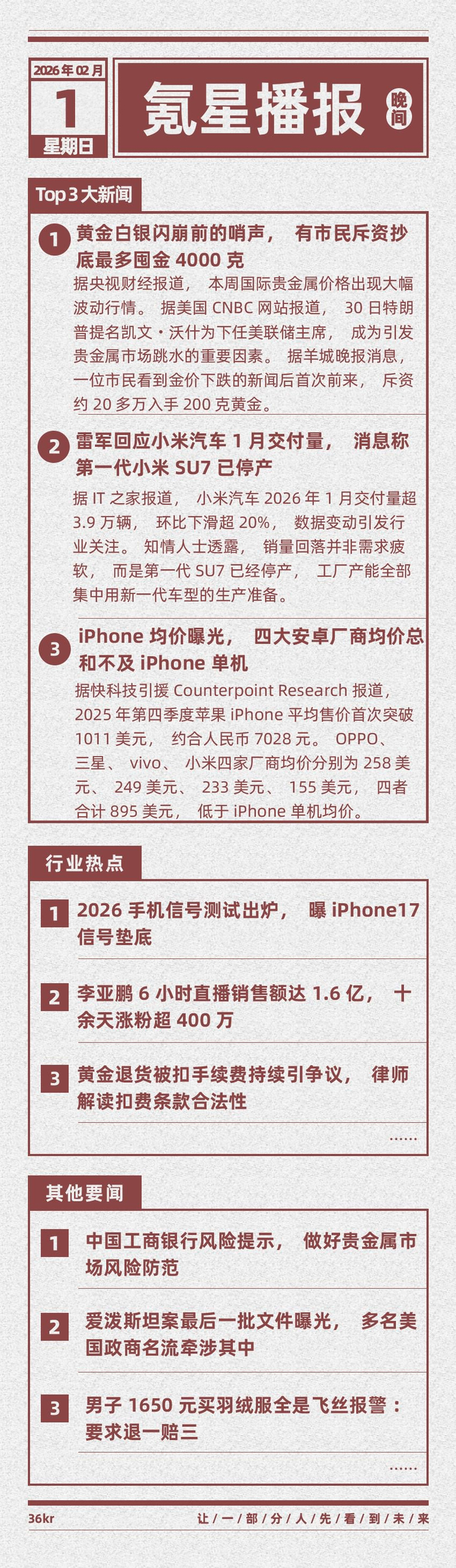
黄金白银闪崩市民抄底囤金4000克,小米SU7停产iPhone均价引关注
3 6 Ke· 2026-02-01 12:38
Group 1 - Significant fluctuations in international gold prices were reported, influenced by the nomination of Kevin Walsh as the next Federal Reserve Chairman, which triggered a drop in the precious metals market [6] - A citizen invested approximately 200 grams of gold, spending around 200,000 yuan, following news of declining gold prices [6] Group 2 - Xiaomi's January 2026 delivery volume exceeded 39,000 vehicles, reflecting a more than 20% month-over-month decline, attributed to the discontinuation of the first-generation SU7 model and a shift in production focus to new models [7] - The average selling price of the iPhone surpassed $1,011 in Q4 2025, while the combined average prices of four major Android manufacturers (OPPO, Samsung, vivo, Xiaomi) totaled $895, indicating a significant price gap [8]